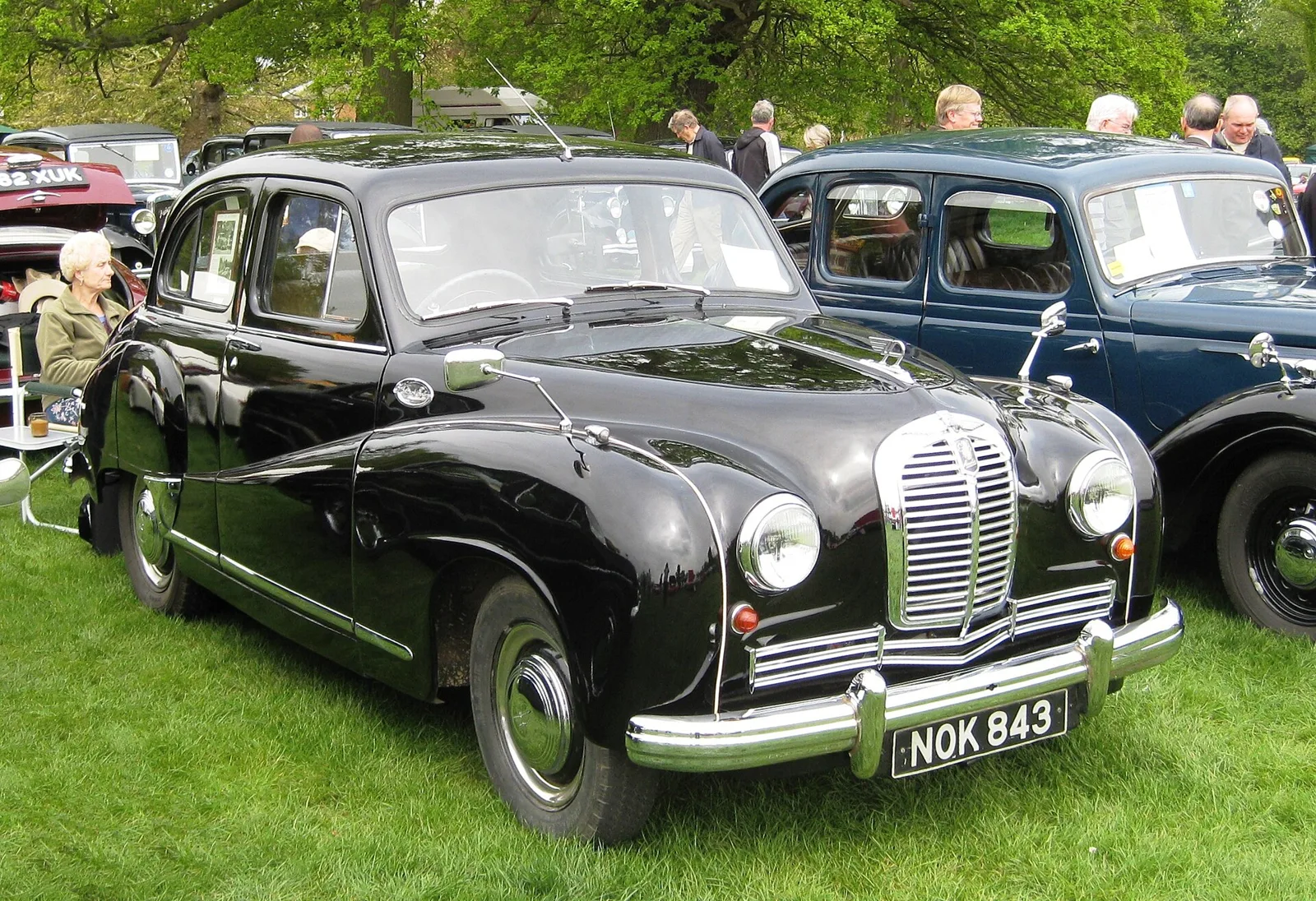
Launched in 1951 with the Austin A30 and built until 2000, the A-series grew from 803 cc to 1,275 cc, gained a turbo and still powers classic and racing cars.
Launched by Austin in 1951, the A-series was built until 2000 and grew from 803 cc to 1275 cc. Its turbocharged 1275 cc version carried the Metro into motorsport, and the engine lived on in the Mini.
The Austin Motor Company A-series was a British small straight-four engine. It was launched in 1951 in the Austin A30, and production ran until 2000 in the Mini. Over that span it grew from 803 cc to 1,275 cc, gained a diesel and a turbocharged form, and became one of the most widely used small engines in British motoring.
Where did the A-series come from?
The A-series was described at the time as a clean-sheet design, but it owed much to established Austin practice. In general layout and appearance it resembled a smaller relative of the larger overhead-valve unit that debuted in the Austin A40 Devon, and that earlier design became the foundation for the later B-series.
The overhead-valve cylinder head was designed by Harry Weslake, a specialist famed for his work on SS, later Jaguar, engines and several Formula One title winners.
The engine was never a single fixed design. Its basic architecture stayed in place for half a century, while bore, stroke and head changed from car to car.
A small British four that began in the Austin A30, ended in the Mini and grew from 803 cc to 1,275 cc.
How was the A-series built?
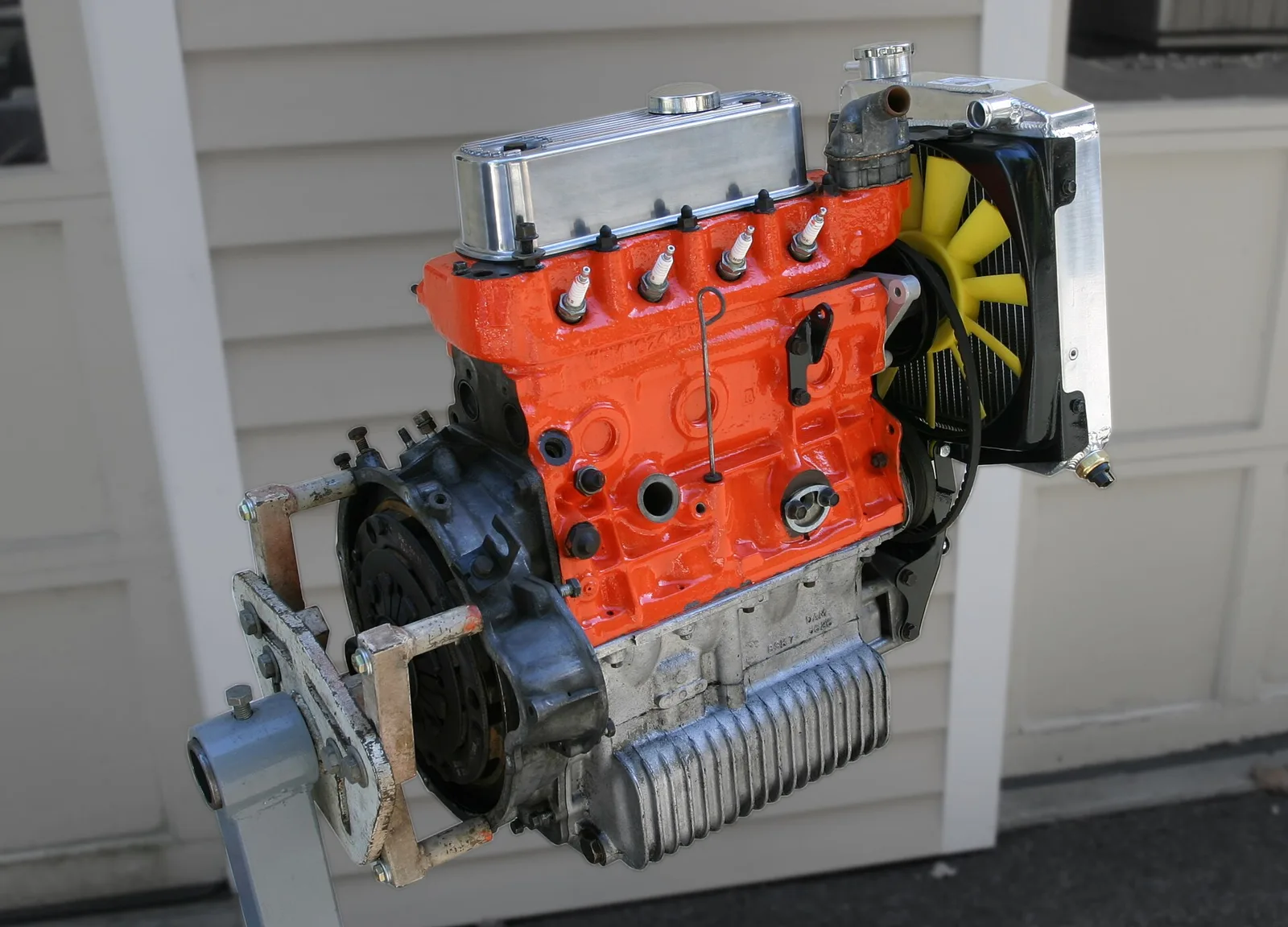
The block and cylinder head were cast iron, and the steel crankshaft ran on three main bearings. The camshaft sat in the cylinder block, and a single-row chain drove it in most applications, with tappets that slid in the block. Access came through pressed steel side covers. Finish mattered too: units painted black were factory and dealer warranty replacements, mostly for faults in the early Mini's wet-crank primary gear arrangement. Standard engines wore Middle Bronze Green until mid-1970, though that rule did not cover overseas models such as Australian-built units.
Valves were operated through rockers in the overhead-valve versions, with two valves per cylinder. Every engine in the family used a sidedraft SU carburettor.
Blocks were not interchangeable between the conventional end-on gearbox versions and the in-sump transaxle used on the British Motor Corporation and British Leyland front-drive models, including the Mini.
How did the capacity grow from 803 cc?
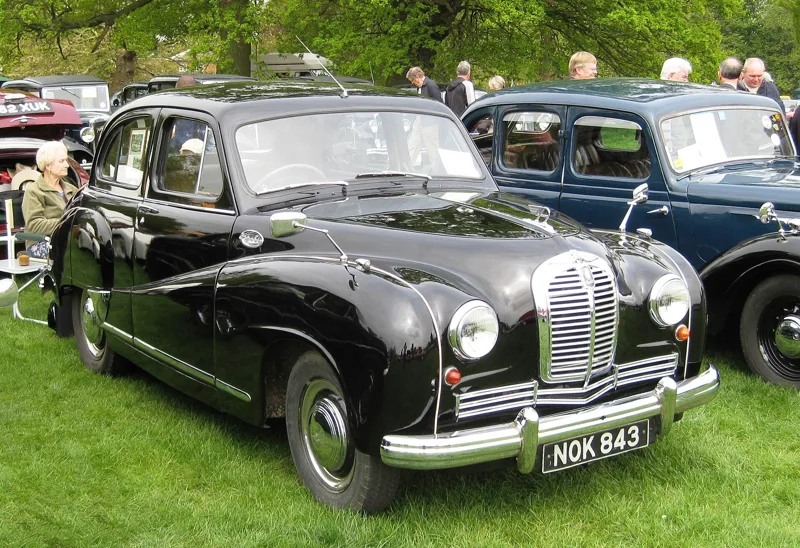
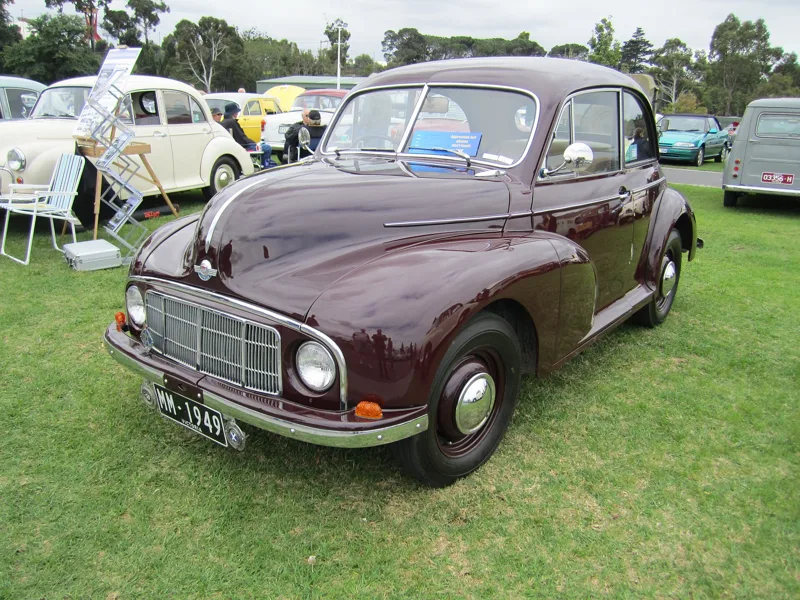
The first engine was an 803 cc unit used in the A30 and the Morris Minor, produced from 1952 to 1956. Its bore and stroke were 57.92 mm and 76.2 mm, an undersquare layout, with the stroke longer than the bore.
In 1956 the bore grew to 62.9 mm while the stroke stayed at 76.2 mm, producing a 948 cc engine that ran until 1964. A shorter stroke of 68.26 mm then gave the Mini its 848 cc version in the late 1950s, which kept production until 1980 before the 998 A-Plus replaced it. The 1098 cc version, a stroked 998, was fitted to MG Midget, Austin A35 Van, Morris Minor and BMC saloons from 1962, and it went transversely into the Mini.
| Version | Years | Displacement | Bore and stroke | Output |
|---|---|---|---|---|
| 803 | 1952-1956 | 803 cc | 57.92 mm x 76.2 mm | 28 hp (21 kW) at 4400 rpm, Austin A30 |
| 948 | 1956-1964 | 948 cc | 62.9 mm x 76.2 mm | - |
| 848 | Late 1950s-1980 | 848 cc | 62.9 mm x 68.26 mm | - |
| 997 | 1961-1964 | 997 cc | 62.43 mm x 81.4 mm | 55 hp (41 kW) at 6000 rpm, Mini Cooper |
| 998 | 1962-1992 | 998 cc | 64.58 mm x 76.2 mm | - |
| 1098 | 1962-1980 | 1,098 cc | Stroke 83.8 mm | - |
| 1070 | 1963-1964 | 1,070 cc | 70.6 mm x 68.26 mm | 70 hp (52 kW) at 6000 rpm, Mini Cooper S |
| 970 | 1964-1965 | 970 cc | 70.6 mm x 61.95 mm | 65 hp (48 kW) at 6,500 rpm, Mini Cooper S |
| 1275 | 1964-1980 | 1,275 cc | 70.6 mm x 81.4 mm | - |
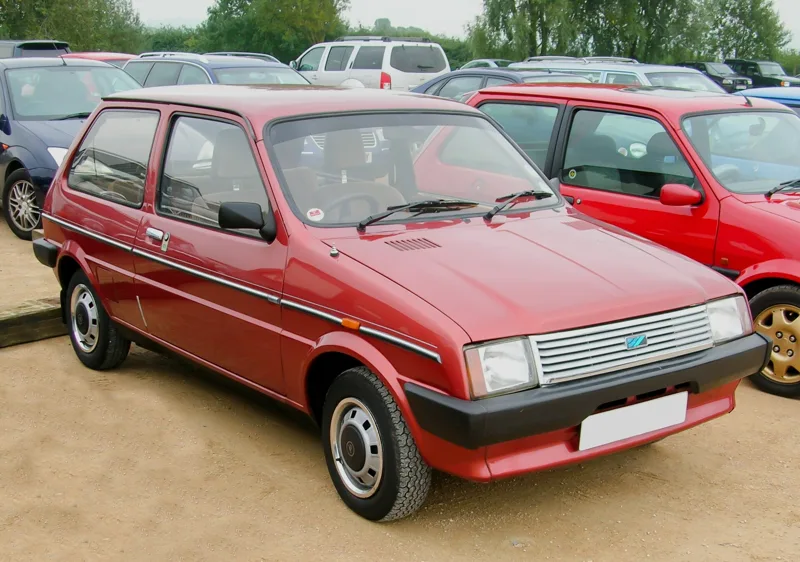
| 1275 Turbo | 1983-1990 | 1,275 cc | - | 94 hp (70 kW) at 6130 rpm, MG Metro Turbo |
| 1275 MPi | 1997-2000 | 1,275 cc | - | 63 hp (47 kW) at 5500 rpm, Rover Mini MPi |
Across the table, the largest capacity sits at 1,275 cc, while the smallest is the original 803 cc.
What were the Mini Cooper engines?
The 997 cc one-off built for the Mini Cooper had a 62.43 mm bore, narrower than the 70.6 mm of the 1275, with a longer 81.4 mm stroke. It was produced from 1961 to 1964 and delivered 55 hp (41 kW) at 6000 rpm.
The Mini Cooper S moved to a 1,070 cc engine with a 70.6 mm bore and the 68.26 mm stroke of the 848. It was made only in 1963 and 1964, and it gave 70 hp (52 kW) at 6000 rpm. Paired with the rarer 970 cc unit, it created an oversquare A-series, the only engine of that type in the family.
The 970 cc Cooper S ran from 1964 to 1965 with the same 70.6 mm bore and a shorter 61.95 mm stroke. Its output of 65 hp (48 kW) came at 6,500 rpm.
What did the A-Plus upgrade change?
British Leyland wanted to update the A-series during the 1970s, but its attempts at a replacement failed. An early-1970s K engine, unrelated to the later Rover K series, was abandoned, and an overhead-cam version of the A-series also never reached production.
Engineers testing the A-series against newer rivals found that it still offered competitive fuel economy and torque for its size. With no funds for an all-new unit, the company chose to upgrade the existing engine at a cost of 30 million pounds. The resulting A-Plus series came in 998 cc and 1,275 cc sizes.
A-Plus engines had stronger blocks and cranks, lighter pistons, improved piston rings and spring-loaded tensioners for the timing chain. The service interval rose from 6,000 to 12,000 miles (9,700 to 19,300 km), and more modern SU carburettors with revised manifolds gave small power gains without losing torque or economy.
The upgrade also brought the higher metallurgy standards previously limited to the most highly tuned engines. Between major rebuilds the standard unit typically reached 80,000 to 100,000 miles (130,000 to 160,000 km) of normal running, and the A-Plus engines generally went further.
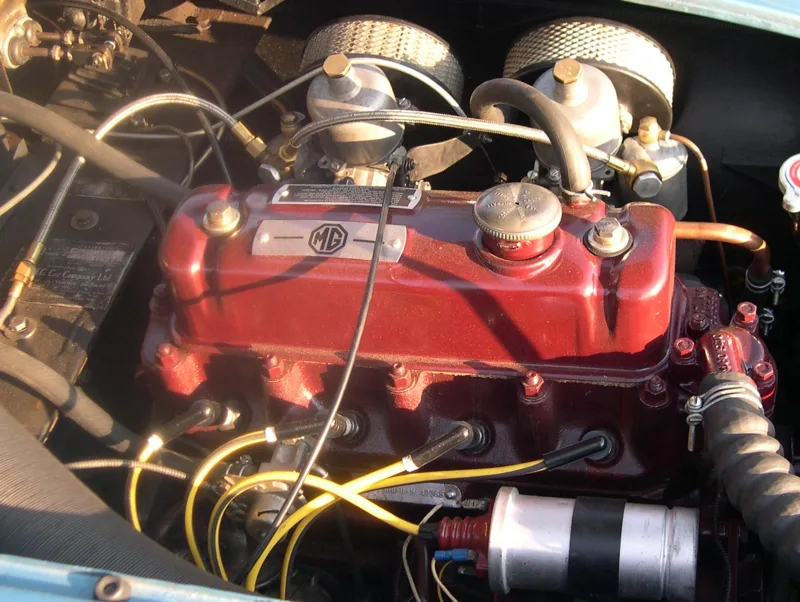
Studies looked at five main bearings, but the three-bearing crank had proved reliable even at high speeds and in high states of tune, so the extra cost was not justified. The new engines carried A+ rocker cover badges, with yellow blocks and heads for 998 cc units and red for 1,275 cc.
How did the 1275 Turbo work?
To help the MG Metro compete with larger hot hatchbacks, the 1,275 cc A-Plus was turned into a turbocharged engine, developed with help from Lotus Engineering. It used a Garrett T3 turbocharger, a special SU carburettor and a fuel system that regulates pressure automatically.
Boost was controlled by a two-stage system that allowed full boost only above 4000 rpm. That protected the sump-mounted four-speed gearbox, a design from the early 1950s that struggled with the turbo's low-speed torque.
Changes reached the block, head, pistons, crank and valves alike, all departing from the standard A-Plus parts. The quoted output was 94 bhp (70 kW), although the figure varied from car to car. The engine had no intercooler, so power also changed noticeably with the weather.
The MG Metro Turbo raced in the British Touring Car Championship during 1983 and 1984, and the tuned racing engines produced more than 200 bhp (150 kW). Turbo versions were built from 1983 to 1990, and the Mini ERA Turbo used the same engine in 1989 and 1990.
What was the 1275 MPi?
A twin-port injection version of the 1,275 cc engine came from Rover engineer Mike Theaker. Built from 1997 to 2000, it was the final A-series variant. Its changes were made to meet the Euro 2 standard, and later Euro 3, with a three-way catalytic converter and twin-point injection.
The ignition moved to a wasted-spark system, which dispensed with the distributor. In Japan the single-point injection setup carried on, and the radiator stayed on the side to clear the air conditioning hardware.
The Rover Mini MPi 1.3i, badged TPi, produced 63 hp (47 kW) at 5500 rpm and 70 lb-ft (95 N-m) at 3000 rpm. Separately, John Cooper Garages also sold factory-approved Cooper S and Cooper Si packs during the 1990s, with outputs from 77 bhp to 90 bhp.
Did the A-series run as a diesel?
The diesel version arrived in 1962 for the BMC Mini tractor. Ricardo Consulting Engineers helped develop it as a redesign of the 948 cc engine, with a new cylinder head and Lucas CAV fuel injection.
The diesel's block was almost identical to the petrol unit, but it had dry liners, and its oil pump was driven from the distributor drive position. Its Ricardo-patented Comet V combustion chambers gave a compression ratio of 23.6:1, producing 15 hp.
A petrol version of the same modified engine was reverse-engineered for the Mini tractor, keeping parts common with the diesel. Marine versions of the diesel were sold as BMC units, sitting beside the diesel B-series, and production ceased in 1969.
What other A-series versions were tried?
At the end of 1965 BMC South Africa began a programme to use more locally made components. It produced two versions, of 1.1 and 1.3 litres, which shared a redesigned cylinder block with new oil circulation and bigger main bearings. Production ran from 1971 to 1980.
Leyland also developed an OHC version for the new Mini Clubman and the current ADO16. It had a single overhead camshaft, a redesigned block and an aluminium head with twin SU carburettors. Eleven prototypes were built in 970, 1070 and 1275 cc, all sharing one bore size, but the plan was abandoned in 1975.
An earlier experiment, code ADO11, produced a twin-cylinder engine based on the 948 unit, intended for the Mini with an in-sump gearbox. It was tested in an Austin A35 in May 1957.
How is the A-series used today?
The A-series remains in use in classic cars and racing, and it has wide support from manufacturers. Almost every component is still made, including pistons, camshafts, crankshafts and cylinder heads, in original or improved specification.
Heads come as eight-valve or sixteen-valve designs, cast from aluminium with five, seven or eight ports. Owners have often pushed past 1275 cc, and the most common enlargement is a bored-out version that keeps its reliability when serviced regularly.
The David Brown Mini Remastered uses a fully rebuilt A-series with new internals. The engine is based on the 1,275 cc MPi, with larger capacity options including a Monte Carlo version and two Oselli Editions.