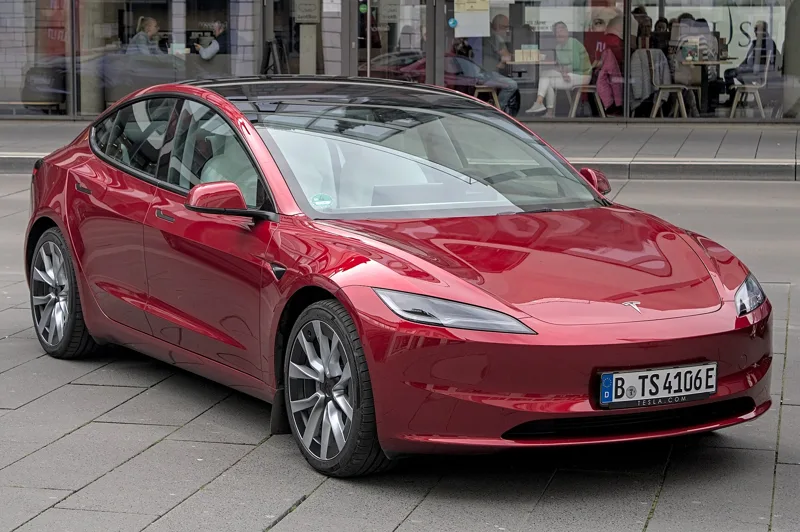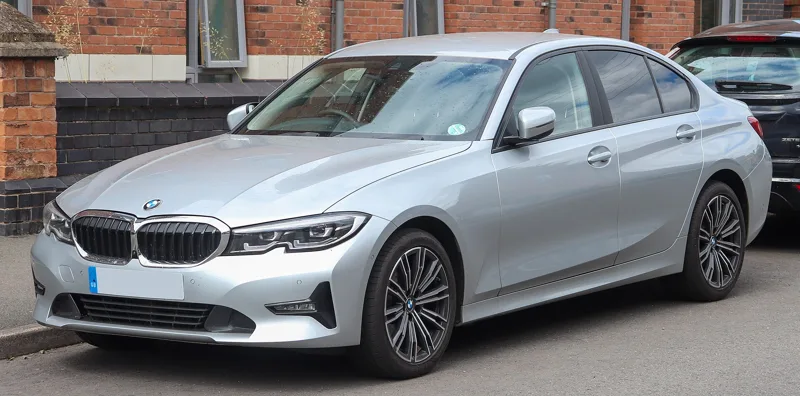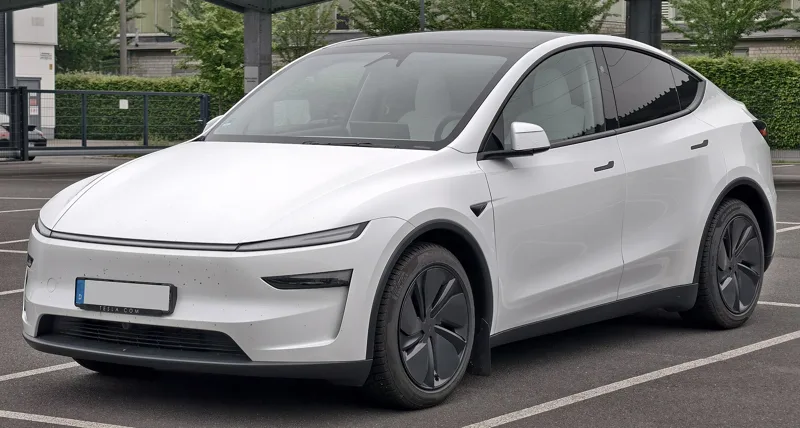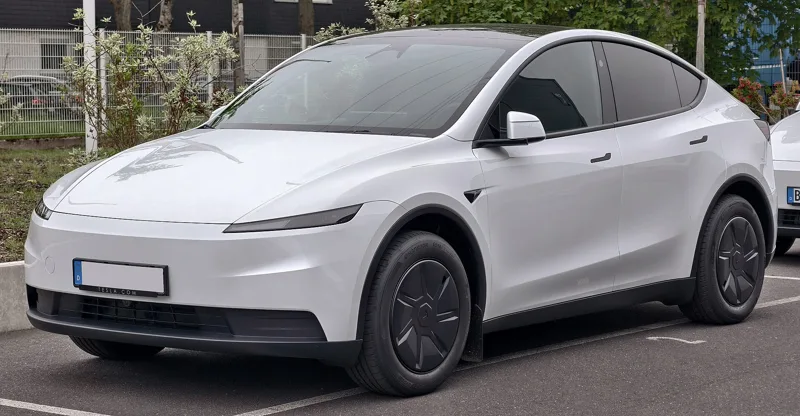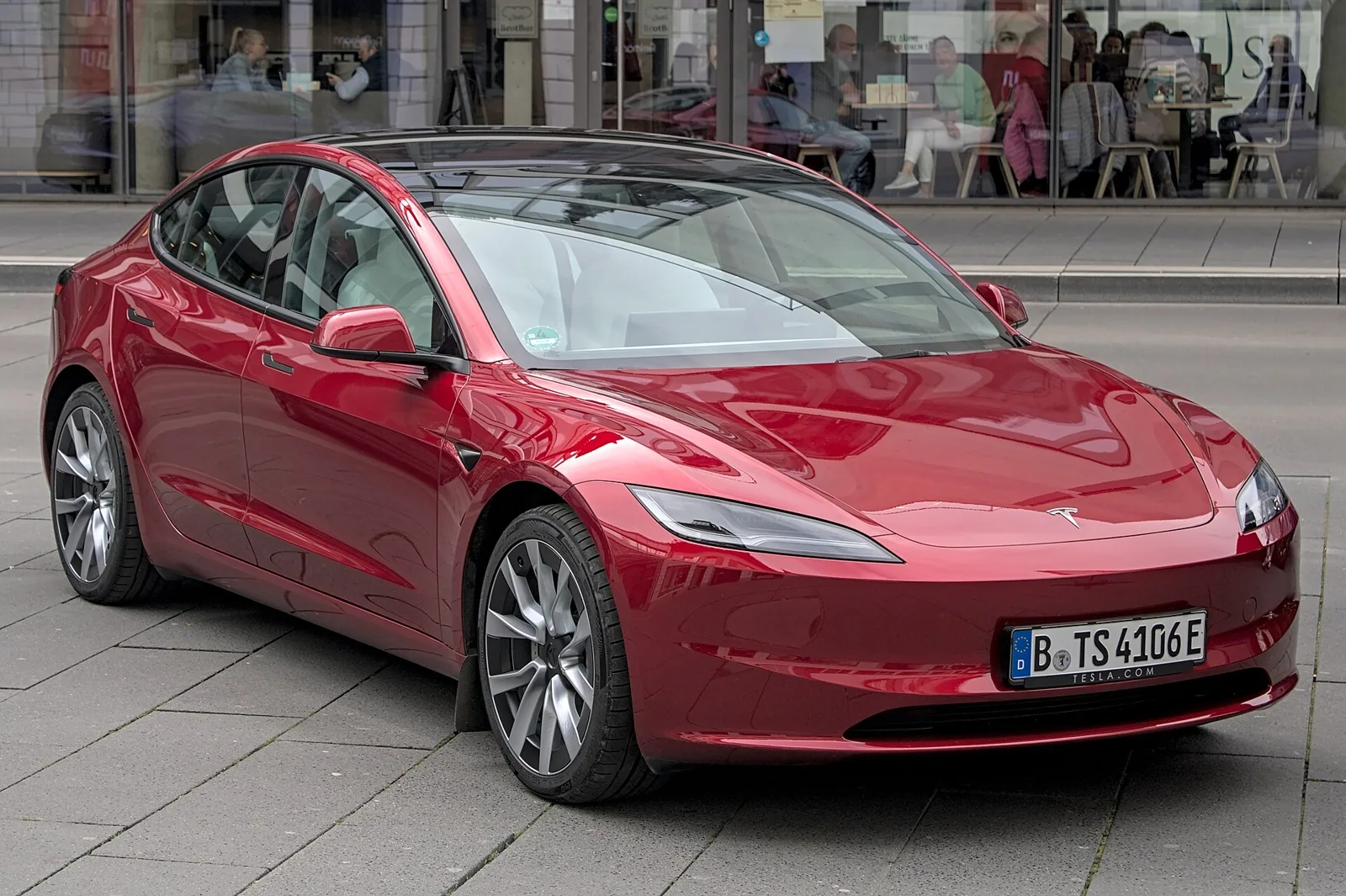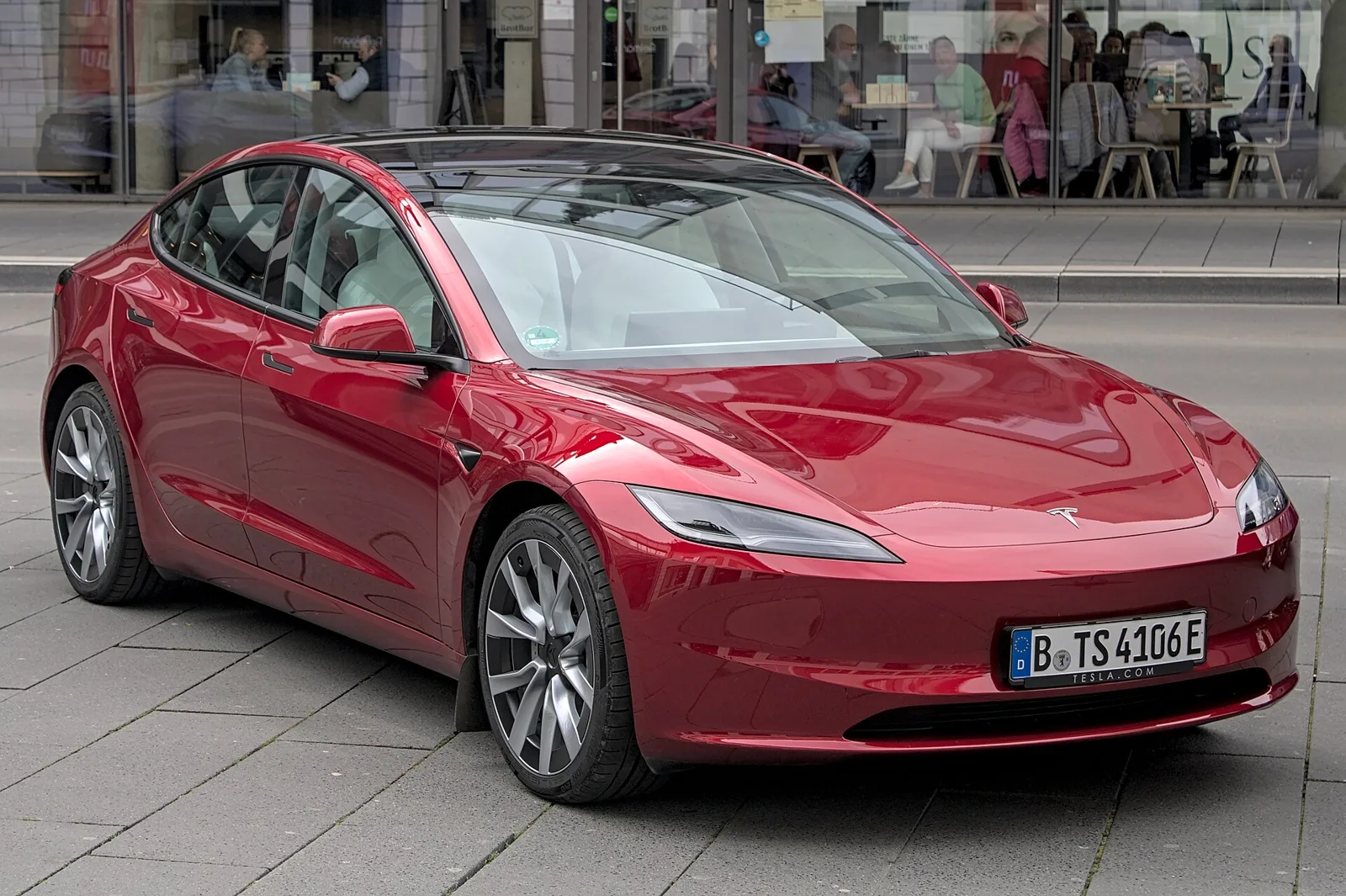
A battery electric fastback that set the plug-in sales pace against a seventh-generation 3 Series with petrol, diesel and plug-in hybrid choices.
The Tesla Model 3 is a battery electric fastback sedan introduced in 2017 that passed 1 million global sales in June 2021. The BMW 3 Series G20 went on sale in March 2019, and the 2019 3 Series scored five stars in Euro NCAP testing.
The Tesla Model 3 and the BMW 3 Series G20 were set against each other from the start, when Tesla's design chief named the 3 Series alongside the Audi A4 and Mercedes-Benz C-Class. The Model 3 arrived as a battery electric fastback in 2017 and became the world's top-selling plug-in car from 2018 to 2020. The G20 followed in 2018 and 2019 with petrol, diesel and plug-in hybrid choices, and its safety and awards record is the main thing to weigh against Tesla's sales.
Why were these two sedans compared?
Tesla's design chief described the Model 3 in 2013 as a car of the same kind as the Audi A4, BMW 3 Series and Mercedes-Benz C-Class, aimed at the mass market. The brief was to offer range, affordability and performance in one package. Tesla pitched it as a more affordable option than its own Model S and Model X.
The two cars began from different positions. Tesla built a new design that reused technology first developed for the Model S, while BMW replaced the F30 with a seventh-generation car on the Cluster Architecture platform. That gave the 3 Series a long run of engine choices, whereas the Model 3 was battery electric from the start.
An electric sedan that set the plug-in sales pace, against a premium 3 Series that answered with choice, safety results and awards.
How did the designs differ?
The Model 3 dropped the front grille altogether, because electric cars need less cooling than combustion ones. Every trim has an expansive glass roof made by the Tesla Glass group, and most of the controls sit in one 15.4 in centre touchscreen.
Critics praised the screen's interface, but they pointed out that drivers must dig through menus for jobs a button or knob could handle. Tesla is also one of the few carmakers that offers no Apple CarPlay or Android Auto.
The G20 is a conventional sedan by comparison. It was 55 kg (121 lb) lighter than the F30 it replaced, 85 mm (3.3 in) longer and 16 mm (0.6 in) wider, and it kept a 50:50 weight distribution while raising body rigidity by 50%.
The Model 3 was first announced with a drag coefficient of Cd=0.225, below the Model S figure of Cd=0.24 that stood as the lowest among production cars in 2014. The 2023 refresh brought it to 0.219 through a lower, more aerodynamic nose, a better rear diffuser and more aerodynamic wheels.
The G20 family improved its own figures too. The 320d's drag coefficient fell from 0.26 Cd to 0.23 Cd through a flat, covered underbody, and the boot stayed at 480 litres (17 cu ft), identical to the F30.
How far can each car go on electricity?
Tesla's first promise for the Standard Range Model 3 was an estimated EPA range of 215 miles (346 km), along with five seats and front and rear trunks. The 2023 refresh then improved range by around 10%, largely through the revised nose, diffuser and wheels.
BMW's electric answer was the i3 sedan, a battery electric version of the long-wheelbase 3 Series. It is built at a BMW Brilliance works in Shenyang with China as its main market, and it uses a 70.3 kWh battery, giving up to 526 km on the CLTC cycle.
The i3 eDrive35L uses a single rear motor producing 210 kW (282 hp) and 400 N-m (295 lb-ft), and it reaches 100 km/h in 6.2 seconds. The eDrive40L steps up to 250 kW (335 hp), reaching 100 km/h in 5.6 seconds with a range of 592 km (368 mi) on CLTC.
Charging on DC fast chargers tops out at 95 kW for the i3 sedan, and the car takes 11 kW on AC. Its boot holds 410 litres (14 cu ft), 70 L (2.5 cu ft) less than a conventional 3 Series.
What about the plug-in hybrid?
The 330e pairs a 50 kW (67 hp) electric motor with the 320i's engine and a 12 kWh battery, with 9.6 kWh usable. Its maximum electric range is 60 km (37 mi), and a feature called XtraBoost can add up to 30 kW (40 hp) temporarily.
Independent testing raised doubts about the hybrid's emissions. The Graz University of Technology found that the plug-in version, along with several others, emitted 112 g/km on its own road test, against an official figure of 36 g/km.
What engines did the G20 offer?
The G20 range covered petrol, diesel and plug-in hybrid engines, with the 320d, 320i, 330d, 330i and M340i offered in rear-wheel drive or xDrive all-wheel drive. The Model 3 has no engine to choose, only trims, because it is battery electric throughout.
The 320d gained a mild hybrid drivetrain as standard in 2020, and later models followed. Only the 318d and selected 320d were offered with a six-speed manual, and the ZF 8-speed automatic became standard when the car was facelifted.
China's long-wheelbase 325Li used a 2.0-litre turbo making 184 hp and 300 N-m, while the cheaper 320Li used a 154 hp, 250 N-m version of the same engine family. The 330Li, which came later, made 258 hp from its 2.0-litre turbo.
The 3 Series family also includes the M3, which arrived in 2021 with a 3.0-litre BMW S58 straight-six. Optional xDrive made it the first M3 that was not rear-wheel drive only, though it is a separate car from the G20 sedan.
Specifications side by side
| Specification | Tesla Model 3 | BMW 3 Series (G20) |
|---|---|---|
| Introduced | 2017 | Unveiled 2 October 2018; on sale March 2019 |
| Body | Battery electric mid-size fastback sedan | Seventh-generation sedan (G20) and Touring wagon (G21) |
| Drag coefficient | Cd=0.225 at announcement; Cd=0.219 after the 2023 refresh | 0.23 Cd (320d) |
| Electric range | 215 miles (346 km) EPA estimate, Standard Range | 526 km CLTC (i3 eDrive35L); 592 km (368 mi) CLTC (i3 eDrive40L) |
| Battery | Not given | 70.3 kWh (i3 eDrive35L); 12 kWh (330e) |
| Output | Not given | 210 kW (282 hp) i3 eDrive35L; 250 kW (335 hp) i3 eDrive40L; 50 kW (67 hp) motor in 330e |
| 0-100 km/h | Not given | 6.2 seconds (i3 eDrive35L); 5.6 seconds (i3 eDrive40L) |
| Boot | Not given | 480 litres (17 cu ft) for the G20; 410 litres (14 cu ft) for the i3 sedan |
| Main screen | 15.4 in centre touchscreen | 14.9-inch infotainment and 12.3-inch instrument displays from 2022 |
| Safety results | Not given | Five stars in Euro NCAP (2019 3 Series); IIHS Top Safety Pick for the 2022 top trim |
| Sales milestone | 1 million global sales in June 2021 | Not given |
Interior and technology
The Model 3's first big revision came in November 2020, with exterior and interior styling changes, many borrowed from the Model Y crossover built on its chassis. Chrome door handles, mirror trim, window trim and camera covers turned black. A heat pump with an octovalve improved climate control, a power trunk arrived, and the centre console gained Qi wireless charging pads and quieter double-pane glass.
Some hardware was also taken out over time. The adaptive cruise control radar went in April 2021, the front passenger lumbar support in May 2021, and the park assist ultrasonic sensors in October 2022, which were replaced by Tesla Vision.
Tesla's 2023 refresh added an 8-inch touchscreen for rear passengers, ventilated front seats and a speaker system with up to 17 speakers, up from 14. The new steering wheel dropped the turn signal stalk, which Edmunds called unsafe in June 2024.
Tesla has since reversed course. Turn signal stalks return to new Model 3 cars in China, a paid retrofit is available for existing cars without one, and the stalk came back to US and global models for the 2026 model year.
BMW's facelifted G20 from 2022 carries a curved display combining a 14.9-inch infotainment screen and a 12.3-inch instrument display, running iDrive 8. The 2025 model year moved the car to BMW Operating System 8.5.
BMW also introduced a yearly charge for Apple CarPlay, a feature built into the car, before backtracking. The fee was reported as dropped by December 2019, and Tesla's position is the opposite: its cars run without Apple CarPlay or Android Auto.
Safety, awards and recognition
Standard kit on the G20 includes full LED headlights and tail-lights, automatic climate control, rain-sensing wipers and collision warning with braking intervention. The 2019 3 Series scored five stars in its Euro NCAP test. The IIHS gave the top trim of the 2022 3 Series its Top Safety Pick award, which is a clear external benchmark for the G20.
The G20 also gathered awards in 2018 and 2019, including Auto Bild Allrad's all-wheel-drive Car of the Year up to 40,000 euros, Auto Zeitung's World's Best Car in the midsize category and What Car?'s Best Executive Car. Car Sales named it Car of the Year in 2019.
On the Tesla side the Model 3 took the Chevrolet Volt's title as the all-time best-selling plug-in electric car in the US in February 2019. Early in 2020 its sales ran past the Leaf, which made it the best-selling plug-in car of all time worldwide.
How did reservations and sales compare?
Tesla's Model 3 drew 325,000 reservations within a week of its 2016 unveiling, and it reached 455,000 net reservations by August 2017. Reservations required a refundable US$1000 deposit, and owners and employees were given priority before the public.
Demand was only the first hurdle. In May 2016 Tesla brought forward its plan for 500,000 units across the Model S, Model X and Model 3 to 2018. Industry experts were dubious, and the ramp produced the production bottlenecks and 'production hell' that many had predicted.
The company's targets were ambitious. On 18 April 2018 it raised its goal to 6,000 vehicles per week by the end of June 2018, and on 1 July 2018 Elon Musk said Tesla had met its 5,000-cars-a-week goal for the week.
Global sales of the Model 3 crossed one million in June 2021, a first for any electric car. By then the car had already spent three years at the top of the plug-in charts before the Model Y took that place.
Where are the two cars built?
Gigafactory Shanghai has built the Model 3 since December 2019 for China and for export beyond the United States. The refreshed car went on sale in North America from 10 January 2024, built at the Fremont Factory.
Mexico now builds the G20 sedan for several markets, the United States among them. That move took over from the Rosslyn works in South Africa, which had built the X3 instead. The G21 Touring wagon is assembled only at Munich.
For the 2026 model year in the United States, the 330i and M340i were built in Munich, alongside the M340i xDrive 50 Jahre Edition.
Which car suits which buyer?
On the figures, the Model 3 suits a buyer who wants a fully electric sedan with a large touchscreen, a glass roof and a manufacturer with a strong record in plug-in volume. The 3 Series suits a buyer who wants a choice of petrol, diesel, mild hybrid, plug-in hybrid or the i3 electric version, with published Euro NCAP and IIHS results.
A buyer who needs the highest electric range should weigh the Model 3's 215 miles (346 km) EPA estimate against the i3 eDrive40L's 592 km (368 mi) on CLTC. Those figures come from different test cycles, so they are not directly comparable.
Neither car is the clear winner on every measure. The Model 3 has the stronger electric sales story and the more radical design, while the G20 has the wider engine choice and the published safety results to point to.