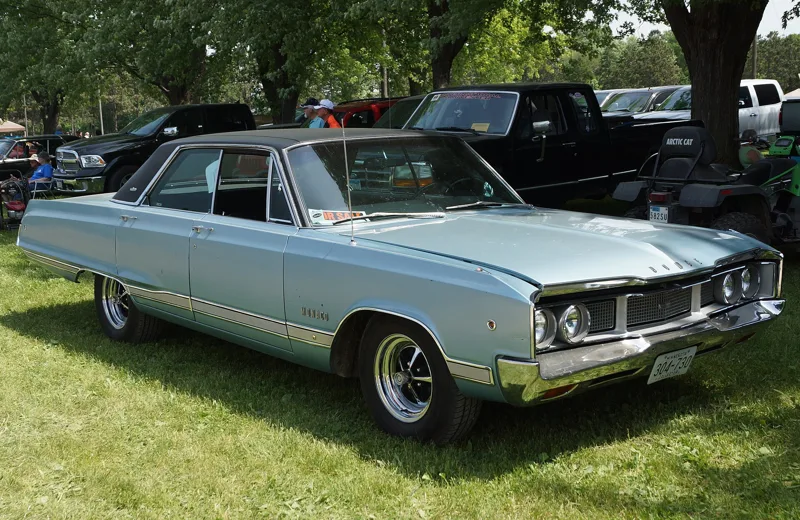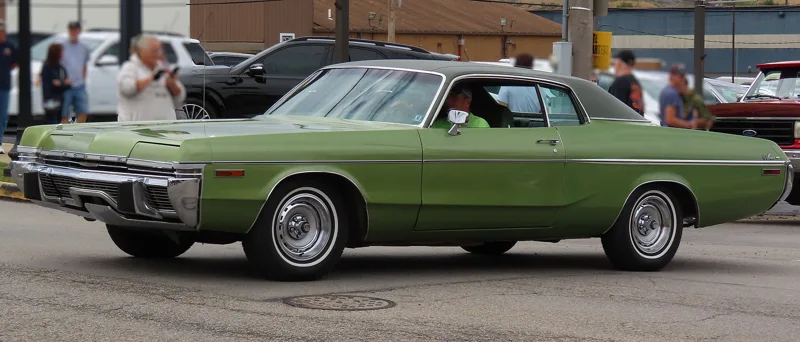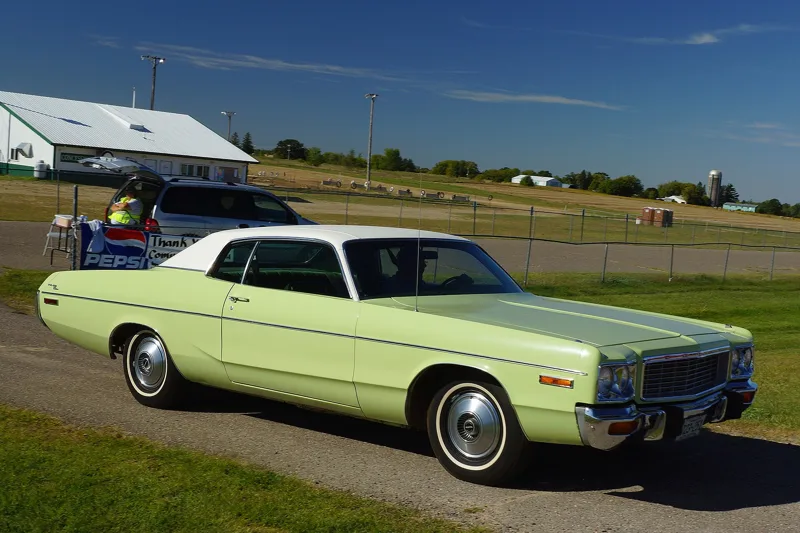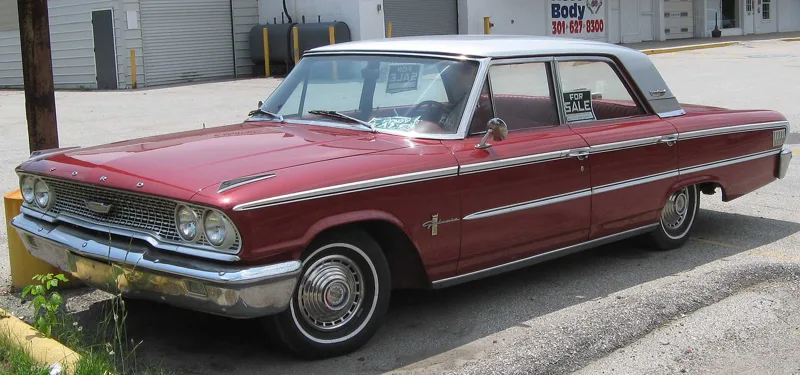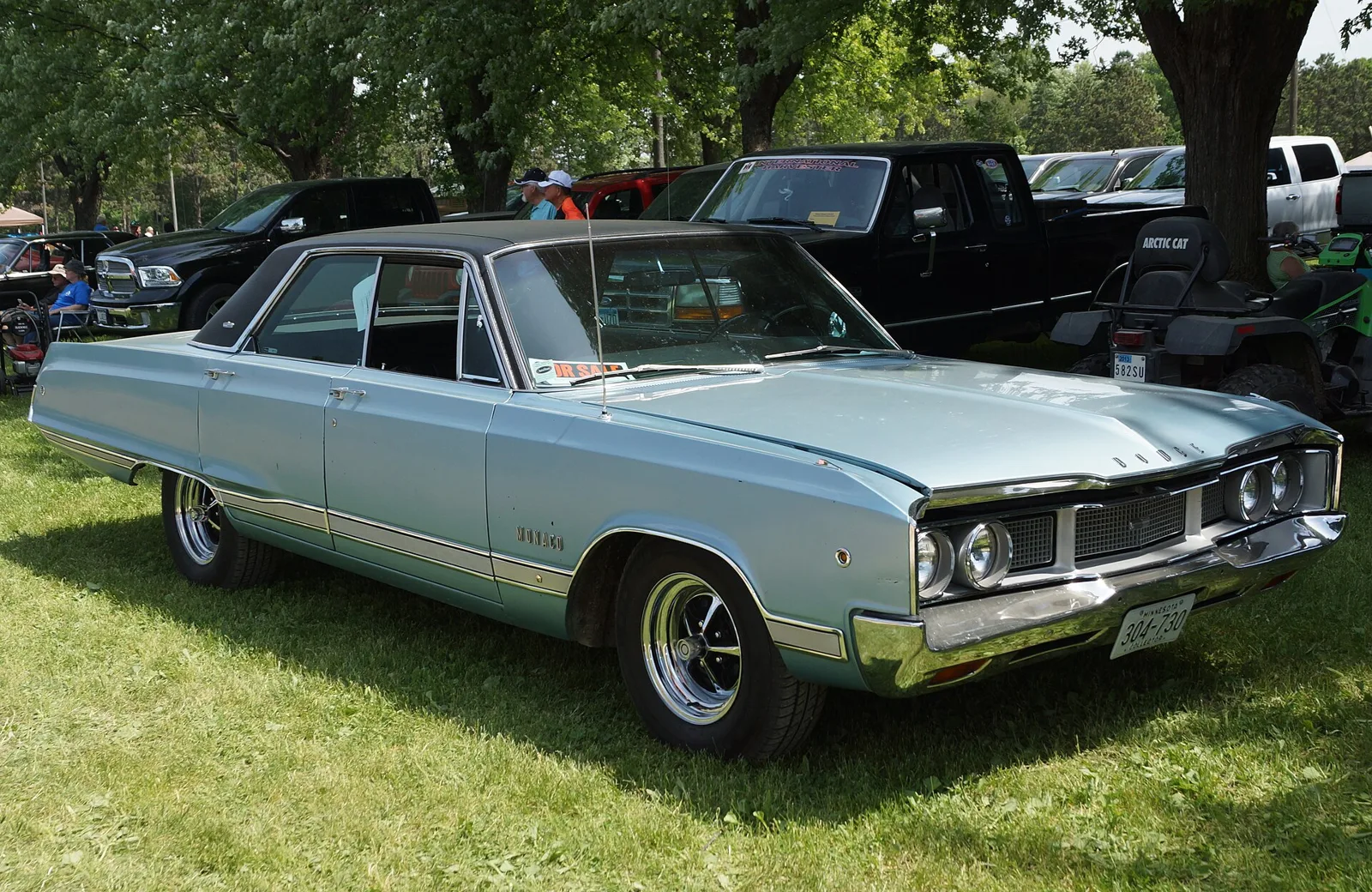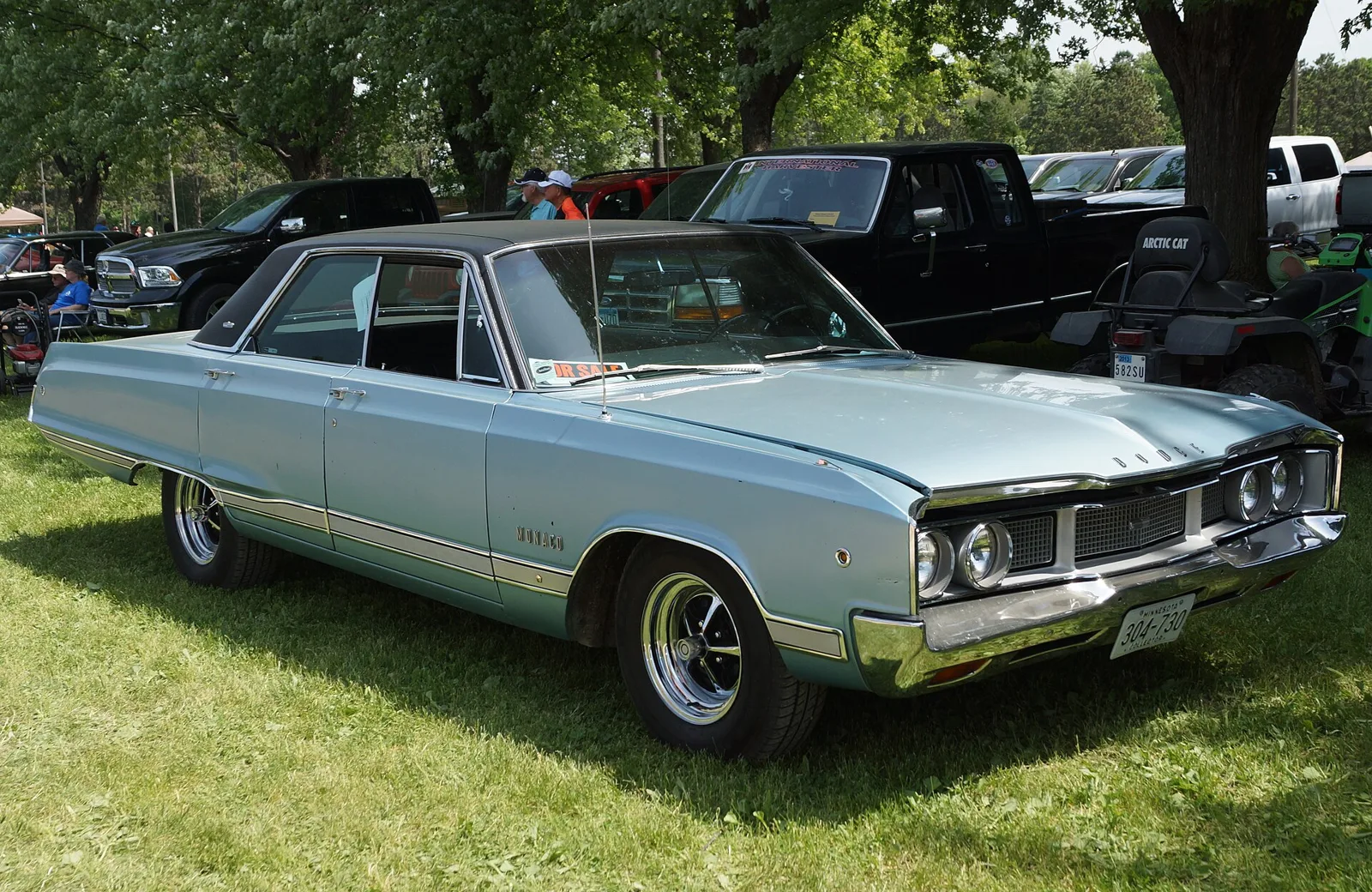
Dodge's Monaco was built to chase personal luxury buyers, while Ford's Galaxie carried a Space Race name through four generations.
The Dodge Monaco was Dodge's flagship full-size car from the 1965 model year, built to chase personal luxury buyers. The Ford Galaxie ran from 1959 to 1974 as a full-size Ford and competed with the Chevrolet Impala and Plymouth Fury throughout.
Dodge's Monaco and Ford's Galaxie were both large, V8-powered sedans and hardtops that competed for the same full-size buyers. The Monaco arrived as a sporty flagship for the 1965 model year, while the Galaxie had already been on sale since 1959. Looking at them side by side shows how each maker tried to balance luxury, performance and value.
When did the Monaco and Galaxie first go on sale?
The Monaco was introduced on 25 September 1964 for the 1965 model year, based on the Custom 880 two-door hardtop body. The Galaxie came first, appearing in 1959 as a trim level in Ford's range and gaining its own identity over the following years.
The Monaco was aimed at the personal luxury market and was meant to compete with the Pontiac Grand Prix. Its standard equipment included a full-length centre console, bucket seats front and rear, and a 383 cu in V8 rated at 325 hp (330 PS; 242 kW).
Ford's Galaxie owed its name to the Space Race, which was the excitement of the period. In 1959 it took the top position in the range from the Fairlane 500, and it carried both Fairlane 500 and Galaxie badges during that first year.
Both cars were sold as sedans and hardtops, and both were assembled in several American plants. The Monaco stayed in the Chrysler full-size family for most of its life, while the Galaxie sat within Ford's range until the 1974 model year.
Two full-size rivals from the 1960s, one a Chrysler flagship with a sporty streak and one a Ford with a space-age name and a racing past.
How did the Monaco's engines change through the 1960s?
The 1965 Monaco came with the 325 hp (330 PS; 242 kW) 383 as standard. By 1969 the standard 383 had fallen to 245 hp, while the four-barrel 383 and the 440 Magnum offered 330 hp and 375 hp respectively.
The 1970 Monaco adopted loop-type bumpers at both ends, and the 440 Magnum was dropped from the option list. The 350 hp 440 that had been wagon-only in 1969 became the top engine for every Monaco.
The 1971 model year brought lower compression ratios across the range. The two-barrel 383 kept its 245 hp rating, but the four-barrel fell to 290 hp and the 440 to 320 hp.
By 1972 the standard V8 was a 360 cu in unit rated 210 hp (net), and the 440 produced 275 hp (net). Sales of 37,013 that year nearly matched the 1969 level, which showed that the redesigned car was holding its buyers.
How did the Galaxie's performance editions take shape?
The 1961 Galaxie offered a 390 cu in FE V8 with three two-barrel carburettors, rated at 401 hp (gross) in its higher-performance form. The 352 was downgraded to a two-barrel unit in the same year.
The 1962 Galaxie 500/XL added bucket seats and a console, and Ford's Experimental Garage built 11 lightweight Galaxies using fibreglass panels and aluminium brackets. The lightened cars came in under 3,400 lb (1,542 kg).
The 1963 half-year fastback was the industry's first official half-year model, and a 427 cu in engine rated 425 hp (gross) appeared in limited numbers. A batch of 212 lightweight R-code cars was built for drag racing, with a fibreglass hood and no options.
Those drag-racing Galaxies had a list price of about US$4,200, compared with US$2,324 for a base Ford 300 and US$3,268 for an XL Fastback. The price gap showed how far the special cars sat above the regular range.
How did the two full-size cars compare over their runs?
Both cars sat in the same full-size segment, but the Monaco's run was shorter and its platform path more complicated. The Galaxie lasted from 1959 to 1974, while the Monaco ran from 1965 through 1977 on the full-size C platform. The table sets the key facts side by side.
| Feature | Dodge Monaco | Ford Galaxie |
|---|---|---|
| Launch | 1965 model year | 1959 model year |
| End of original run | 1977, then the Dodge St. Regis for 1979 | 1974 |
| Platform | Chrysler C platform; B platform for 1977 and 1978 | Four generations of the model line |
| Standard V8 at launch | 383 cu in, 325 hp at launch | 352 V8, 300 hp (carried from 1958) |
| Top engine, 1970s | 440 at 350 hp (1970); 360 cu in at 210 hp (net) in 1972 | Not given |
| Performance note | Not given | 427 cu in, 425 hp (gross), limited 1963 run |
| Output figure | 38,566 of 127,252 full-size Dodges (1969) | Not given |
| Successor | Dodge St. Regis (1979); Monaco revived in 1990 | Ford LTD from 1966 |
What did the Monaco look like in its early years?
The 1965 Monaco carried a distinctive rear end, front fender-mounted turn indicators and wheel covers with simulated knock-off centres. Its bodysides had only a slim full-length moulding and a ribbed rocker panel trim, which kept the look clean.
Inside, the car received standard bucket seats front and rear, a rear package tray contoured to the tops of the seat backs, and rattan wicker accents on the door and quarter panels. A three-spoke steering wheel finished the cabin, and it set the Monaco apart from the plainer full-size Dodges.
The 1966 model year brought the Monaco 500 as a two-door hardtop, while the basic Monaco took hardtop coupe, pillarless hardtop sedan, pillared sedan and station wagon forms. In 1967 the hardtop coupes adopted a semi-fastback roofline with reverse-slanted rear quarter windows, and the body was given all-new exterior sheet metal.
The 1969 Monaco adopted the fuselage styling, with a nearly straight-across bumper and a five-segment egg-crate grille. A mid-beam auxiliary lamp called the Super-Lite was offered at US$50, mounted in the driver's side of the grille and produced in a joint venture with Sylvania.
How did the Galaxie's body and trim change in the 1960s?
The 1960 Galaxie introduced a new design with less ornamentation, and its Starliner had a pillarless hardtop body with a curving rear observation window. Three star emblems marked the thin rear roof pillar, and that badge served the Galaxie through the 1960 to 1962 models.
For 1961 the tailfins were almost gone, and the small blade-like fins capped smaller versions of the pie-plate taillamps. The Starliner was dropped at the end of that year, as a square-roof hardtop coupe called the Galaxie Club Victoria took most of the sales.
In 1962 the Galaxie name was applied to all of Ford's full-size models, and the Galaxie 500 and 500XL became the top trims. The 500XL carried bucket seats and a console, and Ford said XL stood for Xtra Lively, a phrase that the marketing built around.
The 1963 model was largely unchanged save for trim, and a lower, fastback roofline was added mid-year. That sports hardtop outsold the square-roof models, and by 1965 the Galaxie 500 LTD had been introduced as a flagship.
For 1966 the Galaxie 500 LTD became the Ford LTD, while the Galaxie moved to the mid-level position in the full-size line. The XL was slotted above the standard Galaxie from 1967 and was discontinued after 1970.
What were the Monaco's sales and production figures?
The 1969 Monaco line accounted for 38,566 of the 127,252 full-size cars made by Dodge that year, and Polara and Monaco sales together were down by nearly 20,000 cars from 1968. The Monaco's share was the largest single slice of that output.
Sales then fell further. Dodge built 24,692 Monacos for the 1970 model year, despite a series of styling and mechanical changes that cost Chrysler a considerable sum. The 1971 model year saw a small rise, with about 25,544 built, although the exact figure is not known.
The 1972 model year brought all-new sheet metal and a rebound to 37,013 built, which nearly matched the 1969 level. The 1973 model year was the Monaco's last as Dodge's top full-size car, and sales dropped again to 29,396.
How did the Galaxie's final years unfold?
The Galaxie stayed in the mid-range full-size Ford through the 1970s, positioned between the Custom and the LTD. Its mid-range role meant it competed directly with the Chevrolet Impala and the Plymouth Fury for the same family buyers.
After the 1974 model year Ford dropped both the Galaxie and the Custom, consolidating its full-size sedan line into the LTD. The Custom 500 survived for a time as a fleet model, which kept a small link to the older range.
The Galaxie's end marked the close of a 1959 run that had begun with a trim level in a Fairlane-based range. It was the Ford name that outlasted the Dodge in this comparison, since the Monaco's shape gave way to the Dodge St. Regis in 1979. Both original runs ended within a few years of each other, although the two makers handled their successors very differently.
The 1963 full-size range also offered several V8 choices, including the 352 and the 390, which created a large number of driveline combinations for buyers to weigh.
Which buyer suits each car?
On the facts given, the Monaco suits a buyer who wanted a Chrysler flagship with a sporty hardtop body and a range of V8 engines. The Galaxie suits a buyer who wanted a Ford with a long run, a racing heritage and a choice of trims.
The Monaco's most distinctive years were 1965 to 1970, when its personal luxury styling and standard V8 gave it a clear identity. Buyers who wanted that look had a Ford alternative in the Galaxie 500/XL hardtop.
The Galaxie's strongest claim is its range of trims and bodies across four generations, from the 1959 Skyliner retractable hardtop to the 1963 sports hardtop. Its performance story is also richer, with the lightweight R-code cars standing out in the record books of drag racing.
Neither car is shown to be better overall, and the figures for the Galaxie's later sales are not given. A buyer who prefers a longer history in the full-size segment will find the Galaxie's run more substantial, while a buyer who values a Chrysler flagship will look to the Monaco.