The Rambler came first and the Falcon followed, and the two budget compacts were judged on price, economy, engines and the V8 options that split them late in their lives.
The AMC Rambler American and Ford Falcon were budget compacts that competed for buyers in the early 1960s. The Rambler ran from 1958 to 1969 in three generations, while the Falcon was sold in North America from 1960 to 1970 with a six-cylinder engine and later a V8 option.
The AMC Rambler American and the Ford Falcon were both budget compacts, and they competed for the same buyers in the early 1960s. The Rambler came first, in 1958, and it ran until 1969. The Falcon launched for 1960 as the first compact marketed by one of the Big Three, and it was sold in North America until 1970.
Were the Rambler American and the Falcon rivals?
Yes. AMC's 1960 four-door Rambler American was meant to battle the newly introduced compacts from the Big Three, and the Ford Falcon was among them. The Falcon was positioned against the same cheap, economical buyer, even though the Rambler had reached the market first.
The rivalry was one of timing as much as design. The Rambler had a head start, while the Falcon arrived with the full weight of Ford behind it. Their paths crossed most directly in the early 1960s, when both cars were in their first generations.
The Rambler arrived first and the Falcon followed with Ford's weight behind it, two budget compacts that split on V8s and on the Mustang's shadow.
Which compact came first?
The Rambler American came first. It was reintroduced for 1958 from a modified 1955 Nash Rambler design, with a 100 in (2,540 mm) wheelbase, and it was launched during a recession that favoured a low-priced small car. The Falcon followed for 1960 and was the first compact marketed by a Big Three manufacturer.
The Falcon's own history acknowledges the Rambler's earlier arrival. It was preceded by the Rambler American, although the Falcon was the first of the Big Three's compacts, and it was introduced just as the other domestic makers were building cars of their own in the same class.
How did the Falcon's design come about?
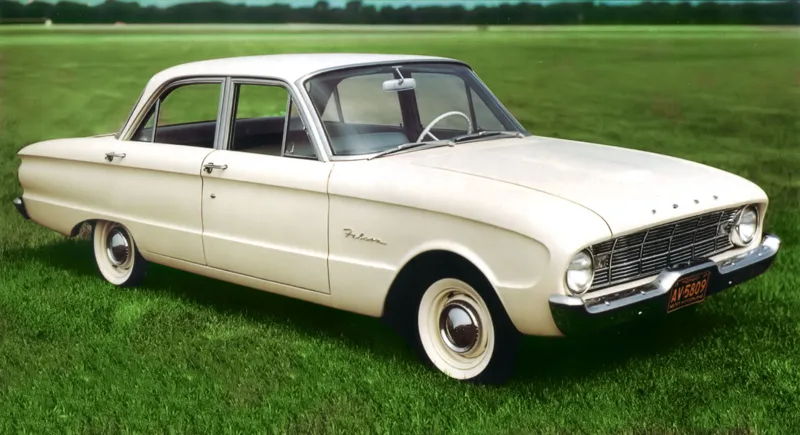
The Falcon was started and sponsored by Ford general manager Robert McNamara, who pushed for a car that kept costs and weight as low as possible. It was developed as a scaled-down version of the full-size Ford Galaxie, and it offered room for six passengers in reasonable comfort.
Engineer Harley Copp used a unibody structure on a standard suspension and sourced parts from Ford's existing stock to keep the price down. The car's sales success, alongside slow sales of GM's rear-engined Corvair, led General Motors to introduce its own compact, the Chevy II, based on the Falcon's principles.
How did the Rambler American's design evolve?
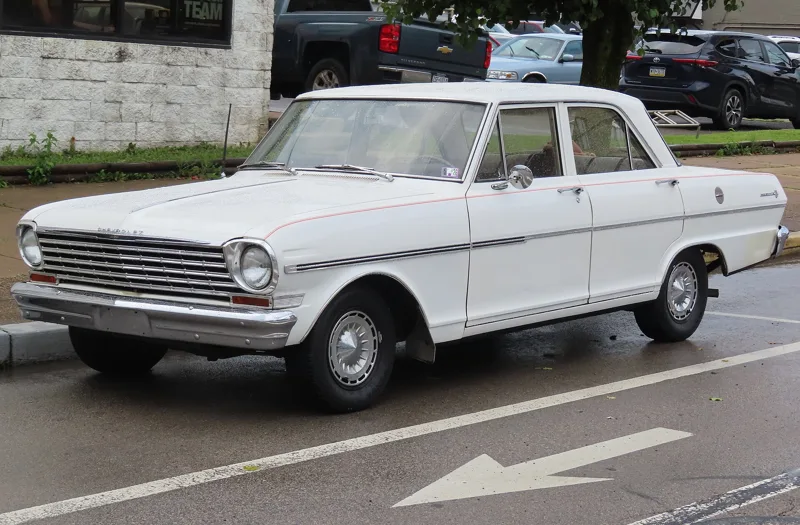
The Rambler American kept its basic structure from the Nash platform for its first generation. The 1958 car had a new grille and more open rear fender wells, and it was sold as a two-door sedan only. A station wagon arrived in 1959, and a four-door sedan and Custom trim came for 1960.
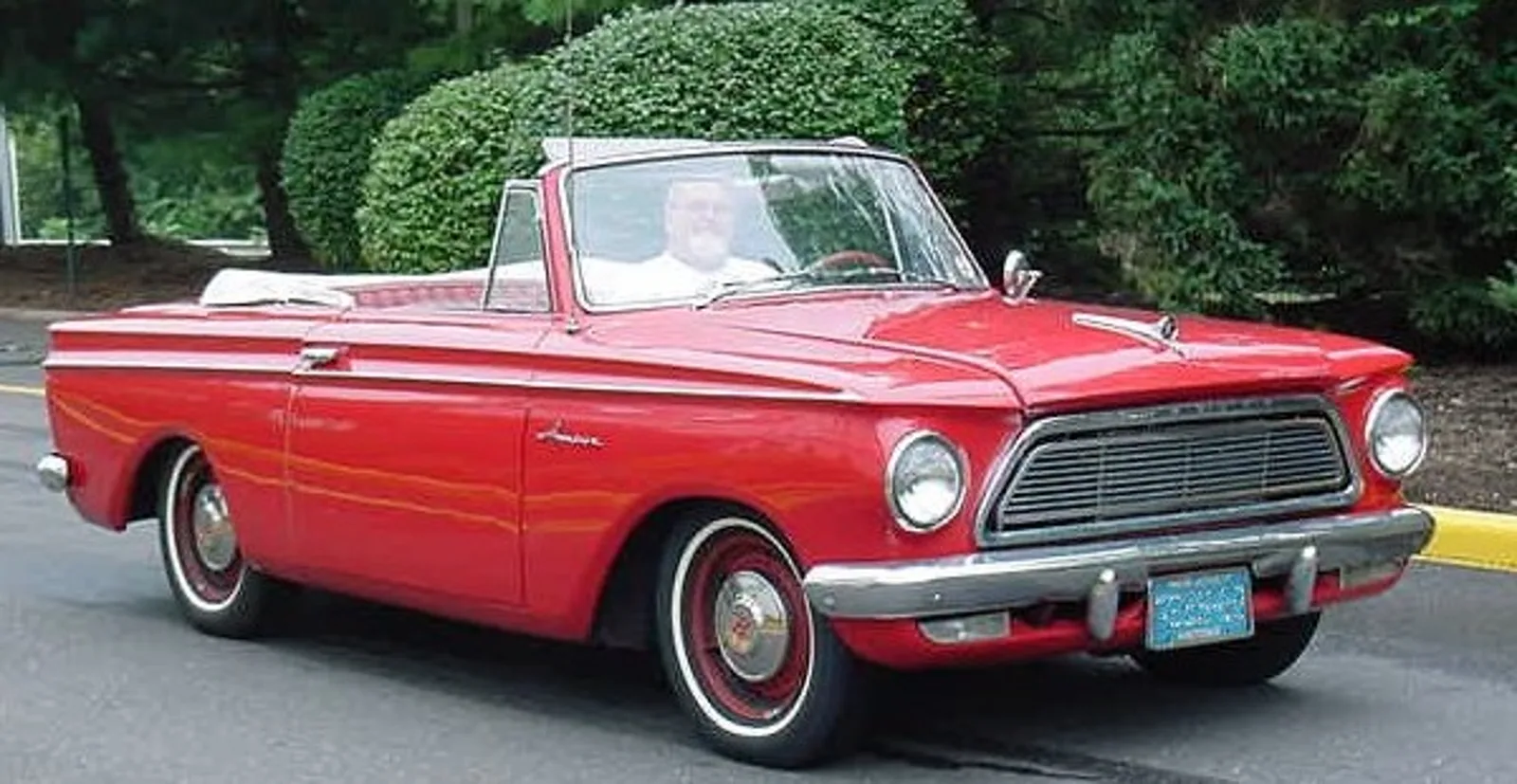
The 1961 restyle was the biggest change of the Rambler's first decade. The body became squarer, so the car ended up three inches (76 mm) narrower and shorter at 173.1 in (4,397 mm) overall. A four-door wagon and a two-door convertible joined the line, and passenger room grew from five to six.
The 1961 car kept the same mechanical layout while its skin changed. All outside sheet metal was new, but the side window frames carried over, and only the rear glass changed to suit the new roofline. A new firewall and dashboard moved the clutch and brake pedals from under the floor to the firewall.
How did the Falcon's styling and trim develop?
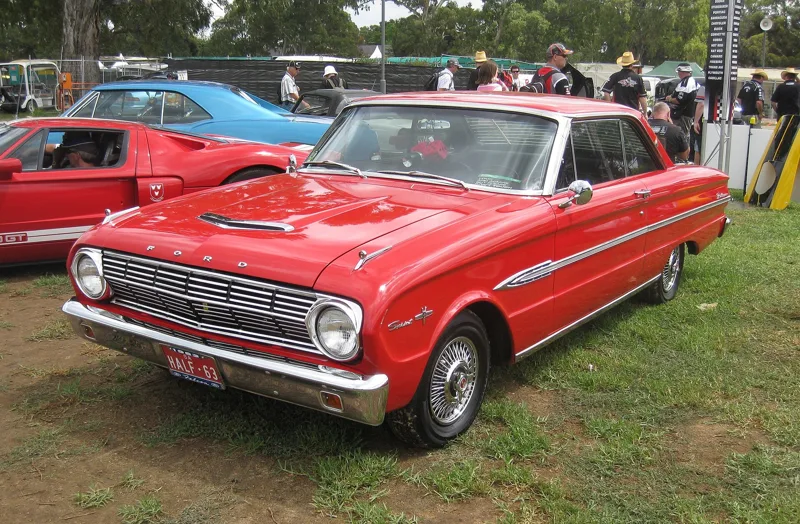
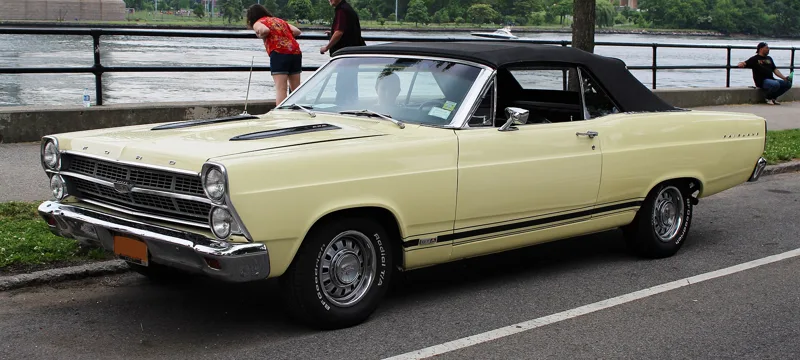
The Falcon changed its face and trim through its first generation, with a facelift in 1962 and a wider range in 1963. The 1964 car moved to a more squared-off shape, and the 1966 third generation followed on a shortened Fairlane platform.
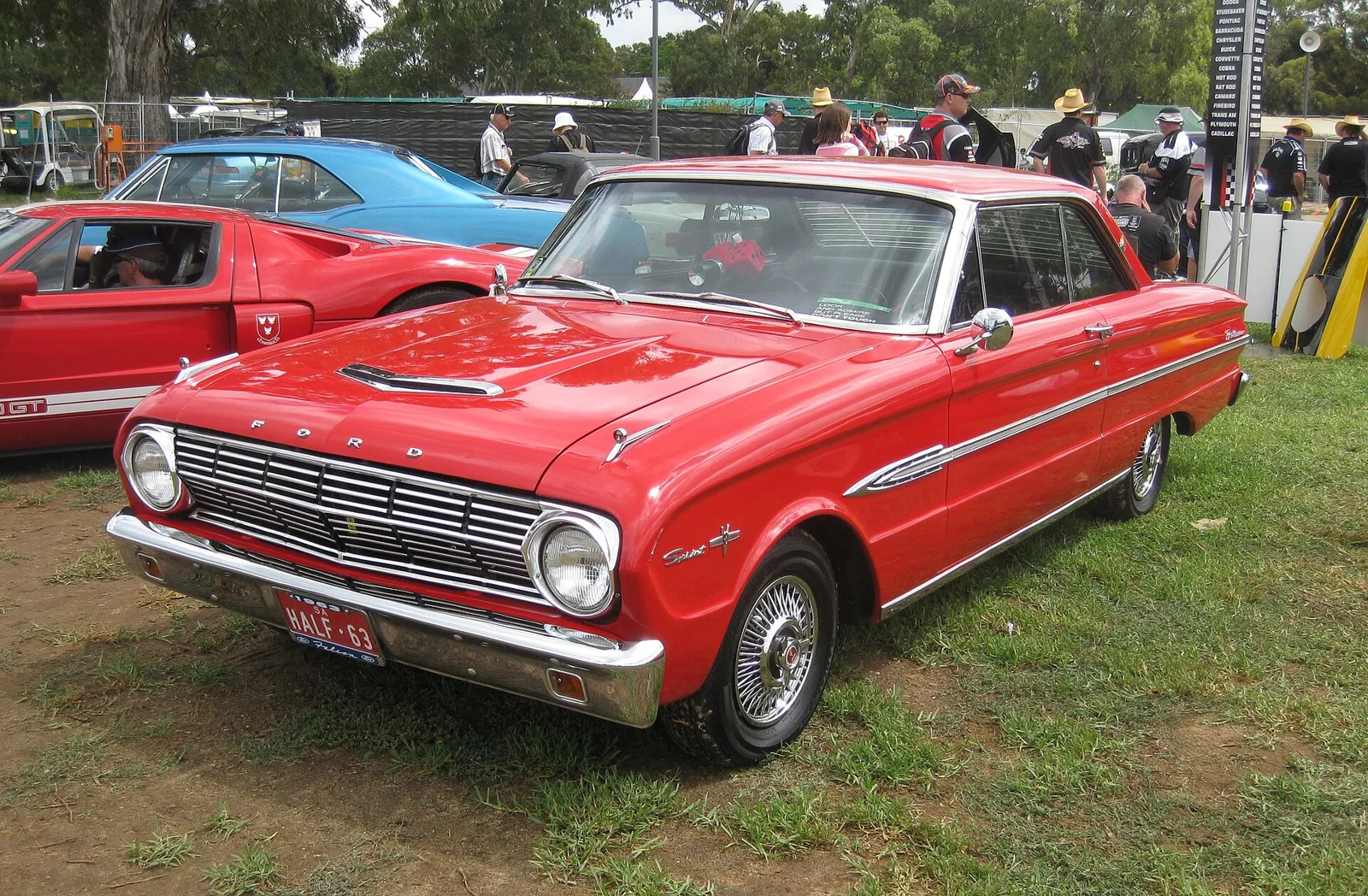
For 1962 the Falcon received a moderate facelift, with a new grille, front bumper and tail lights that gave it a slightly more angular look. The hood gained a chrome trim piece that implied a scoop, and midway through the year the back window roofline was reworked along Thunderbird lines.
The 1963 line added a four-door Futura and a deluxe wagon, along with convertibles and the Sprint. In 1966 the Futura Sports Coupe carried chrome side window frames that gave the two-door sedan the look of a hardtop, and its Sports Coupe script on the C-pillar was borrowed from the Fairlane.
How did the body ranges compare?
Both makers offered several body styles, but the Falcon's range was wider from the start. Its 1960 line included two- and four-door sedans, wagons and the Ranchero pickup, while the Rambler's first year was a two-door sedan only.
The Rambler added a wagon in 1959, a four-door sedan in 1960, and a four-door wagon and two-door convertible in 1961. The Falcon, by contrast, offered a full range from launch, with the Ranchero built on its platform after being transferred from the Fairlane for 1960.
In 1962 Ford introduced the Falcon Club Wagon, an eight-passenger van built on Econoline underpinnings with the cab over the engine. American Motors, meanwhile, built a new plant at Brampton, Ontario for the American and the larger Classic, while Ford made the Falcon in several North American plants.
How do the specifications compare?
| Feature | AMC Rambler American | Ford Falcon |
|---|---|---|
| Production | 1958 to 1969, three generations | 1960 to 1970 model years in North America |
| Body styles | Two-door sedan (1958); wagon (1959); four-door sedan (1960); four-door wagon and convertible (1961) | Two- and four-door sedans, wagons, Ranchero pickup (1960); convertibles and hardtops later |
| Base engine | 195.6 cu in (3.2 L) flathead six, 90 hp (67 kW; 91 PS) in 1958 | 144 CID (2.4 L) Mileage Maker six, 95 hp (71 kW) in 1960 |
| Upgraded engine | 125 hp (93 kW; 127 PS) overhead-valve six in the 1960 Custom | 170 CID (2.8 L) six, 101 hp (75 kW) in 1961 |
| Largest early V8 | 390 cu in (6.4 L), SC/Rambler, from late 1966 | 260 CID (4.3 L) Challenger, 164 hp (122 kW), mid-1963 |
| Transmissions | Advertised automatic in 1958; E-stick option in 1962 at $59.50 | Three-speed manual standard; two-speed Ford-O-Matic optional in 1960 |
| Brakes | Twin-circuit Double-Safety brakes from 1962 | Drum brakes front and rear in 1960; dual-circuit system in 1967 |
| Fuel economy | Mobil Economy Run wins; figures not reported | Claimed 30 mpg-US (7.8 L/100 km; 36 mpg-imp); 32.5 mpg-US (7.2 L/100 km; 39.0 mpg-imp) on a Mobilgas run in 1962 |
| Sales | 120,603 units in 1960 | Over half a million in the first year; over a million by the end of the second |
| Motorsport | Not reported | Used in the Trans-Am series in 1966 |
| Final model year | 1969 | 1970 in North America |
How did the Falcon grow into a V8 car?
The Falcon was a six-cylinder car for most of its first generation. The first V8 option came in mid-1963 with a 260 CID Challenger V8 rated at 164 hp (122 kW), but only in very limited numbers. The Sprint package then gave the car the 260 V8, a stiffer suspension and a louder exhaust for 1964.
The Sprint was never a volume seller. The mid-1963 Sprint hardtop was built in 10,479 examples and the convertible in 4,602. Ford's new Mustang, which had the same options for a little more money, overshadowed it, and the 289 V8 added in late 1964 did little to change that. The Sprint was dropped after 1965.
The Falcon's V8 story is tied to the Mustang. The first-generation Sprint cars became the basis for the 1964 and a half Mustangs, which were nearly identical mechanically while looking different. The Mustang dealt a blow to Falcon sales in North America that the car never fully recovered from.
How did braking and safety compare?
The Rambler set the pace on brakes. American Motors introduced twin-circuit Double-Safety braking in all 1962 Ramblers, a feature offered at the time by only a few cars. The United States later required twin-circuit systems on all cars from the 1967 model year.
The Falcon launched with drum brakes at both ends and a three-speed manual as standard, and it added a dual-circuit brake system alongside other federal safety equipment in 1967. That year's changes included an energy-absorbing steering wheel and mountings for front shoulder belts, which were available as an option.
What was the E-stick, and did it succeed?
The E-stick was a manual three-speed gearbox with an automatic clutch, offered by American Motors in 1962 as a cheaper alternative to a full automatic. It cost $59.50 and did not sell well, despite its economy and driver control.
The system removed the clutch pedal but kept stick-shift control. Engine oil pressure and intake manifold vacuum engaged and disengaged the clutch when the driver changed gear, and an overdrive unit could be added to the package.
The system was complex, and that complexity is one reason the option had little commercial success. Buyers who wanted a stick shift without a clutch pedal had to accept that trade-off.
Which buyer suits which car?
The facts do not settle which car was better, so the choice depends on the buyer. The Rambler suits a buyer who values the early twin-circuit brakes, the squarer 1961 body and the wide choice of bodies in a small footprint. The Falcon suits a buyer who wanted a Ford-badged compact with a six, a Ford-O-Matic option and, from 1963, a V8 that could be ordered on a sporty model.
Sales point in the same direction. The Falcon's first year was enormous by any measure, with over half a million cars sold, while the Rambler's 1960 total of 120,603 units was strong for an independent maker. The two figures reflect different market positions rather than a winner and a loser.