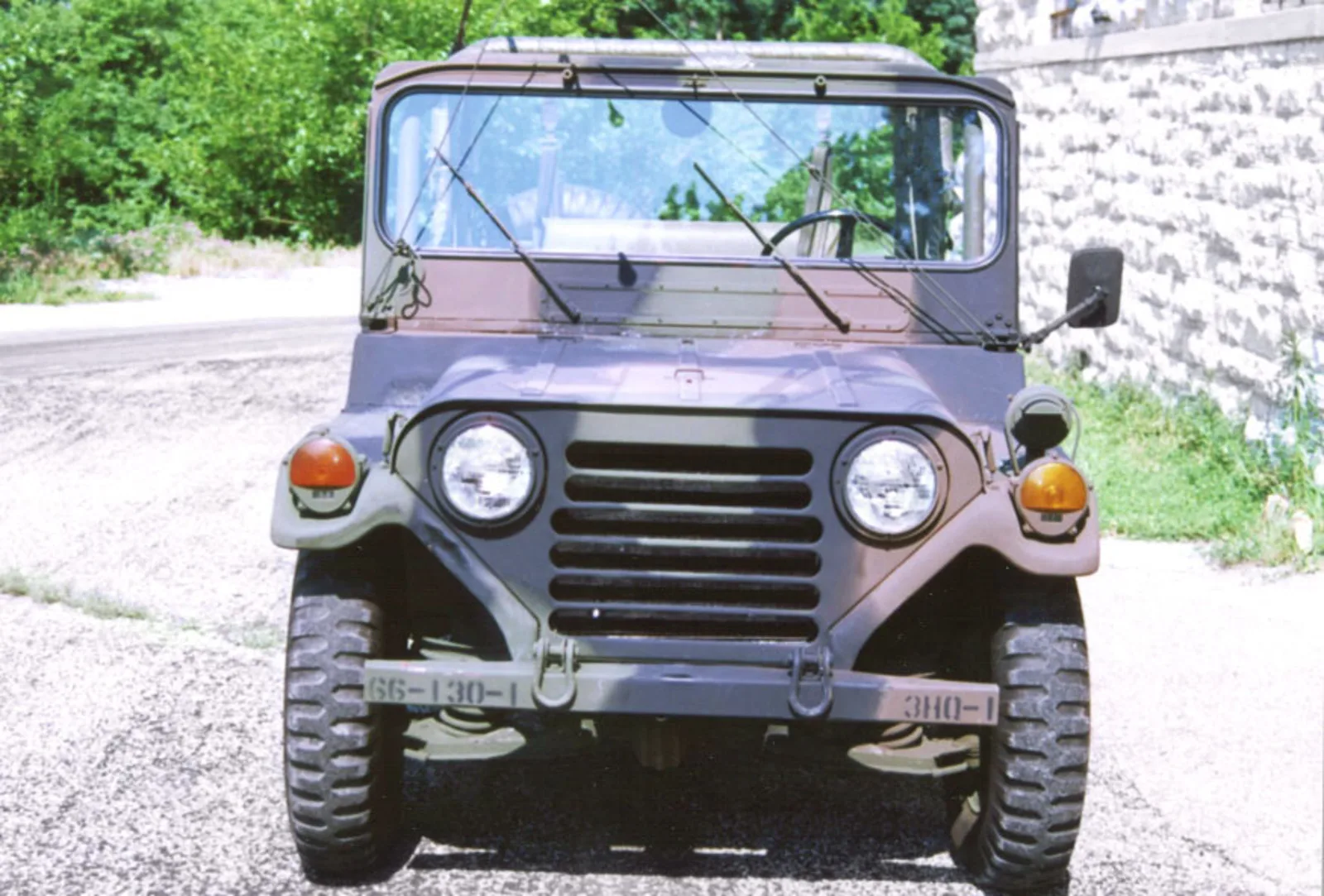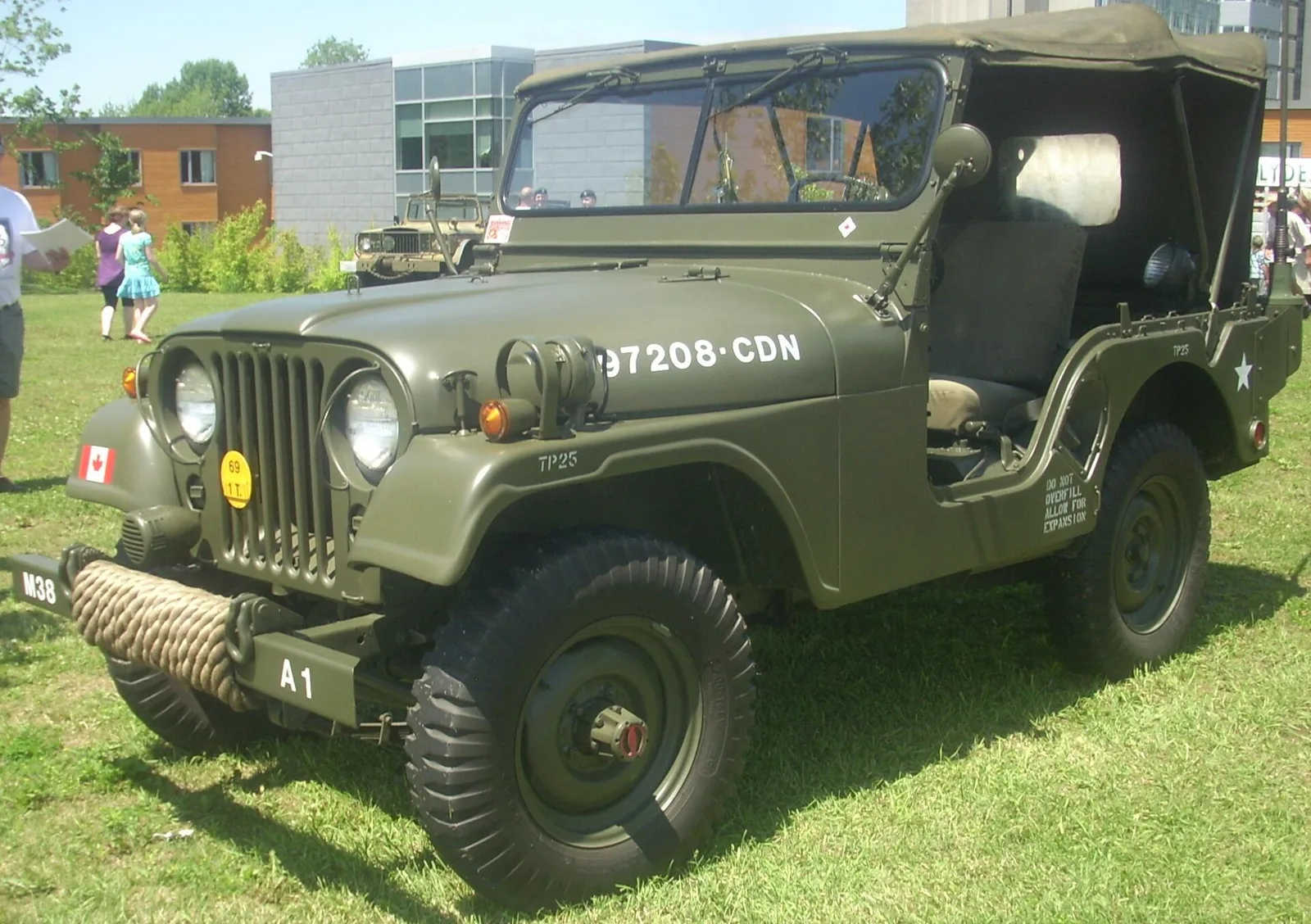
A 1/4-ton four-wheel drive utility built from 1952 to 1971, with 101,488 examples, a Marine variant and a long export life.
The Willys M38A1 was a 1/4-ton four-wheel drive military utility vehicle built from 1952 to 1971 by Willys and Kaiser Jeep. Its restyled rounded body led to the civilian CJ-5, and it served in the Korean War, the Vietnam War and many other conflicts.
The Willys MD, formally the M38A1 1/4-ton 4x4 utility, was the first Willys jeep with the rounded hood and fenders that later defined the civilian CJ-5. Built by Willys Motors and Kaiser Jeep from 1952 to 1971, it served the US military and many foreign armies, and 101,488 examples were made.
Where did the M38A1 come from?
Following the earlier M38 and MC prototypes that used the F engine, the M38A1 was the next post-war step in the Willys MB family. The US military procured it widely from 1952 until 1957, after which American purchases narrowed to the Marine Corps. The vehicle is also called the MD, and its US Army catalogue designation was G-758.
Production was shared between Willys Motors and Kaiser Jeep, and the Marine version differed slightly from the units used by other services. Replacement came in 1960, when the US Army adopted the Ford M151. Low-volume exports to friendly governments continued until 1971.
A round-fendered Willys that became a global workhorse and the template for the civilian CJ-5.
What made the MD body different?
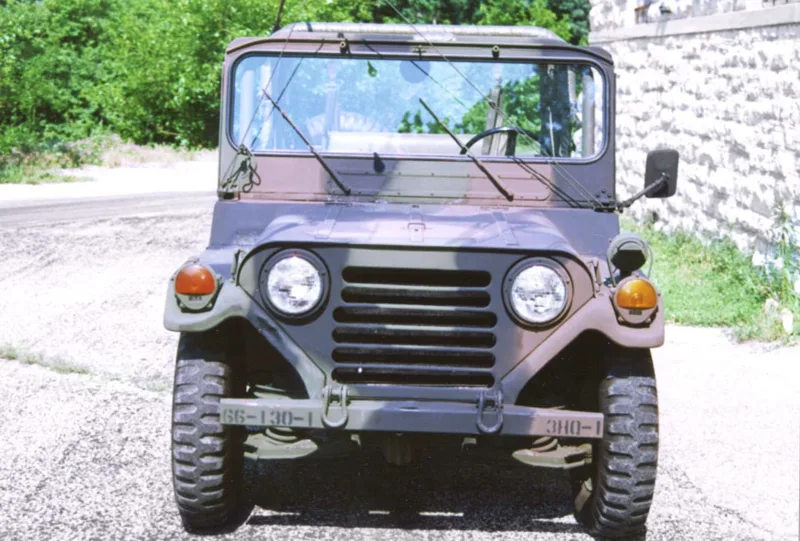
The MD introduced a heavily reworked body and was Willys' first jeep of that kind, instantly recognisable by its rounded hood and fenders. Its wheelbase was stretched by one inch (2.5cm), and the overall length rose by about 6 in (15 cm). The rounded shape later defined the civilian CJ-5.
The rounded look came from the taller Hurricane engine, which needed more room under the bonnet than the wartime Go-Devil unit. Hard doors were still not available, so buyers relied on a soft top with soft side panels and small hinged doors. Those doors were built from a light steel frame, filled with cloth and plastic panes.
What engine and drivetrain did the M38A1 use?
This model was the first Army jeep fitted with the inline-four Hurricane F-Head 134 from Willys, which stood taller than the earlier Go-Devil unit. Otherwise it kept a T-90 3-speed gearbox, a Dana 18 transfer case, a Dana 25 or Dana 27 front axle and a Dana 44 rear axle. The 1/4-ton rating placed it in the light utility class.
Which M38A1 variants were built?
The basic M38A1, or MD, was a utility vehicle that regularly carried an M2 .50 calibre machine gun and radio equipment. Variants included the M38A1C recoilless rifle carrier, the M38A1 'D' nuclear delivery vehicle, the M170 ambulance and Canadian and Dutch builds.
The M38A1C carried an M40A1 106 mm recoilless rifle, which was aimed using an M8C .50 calibre semi-automatic spotting rifle. The spotter cartridge was shorter than the standard .50 round, so the first shot could be checked for accuracy, and a slot in the windshield frame held the 106 mm barrel while travelling.
Several dozen M38A1s were converted to carry the Davy Crockett tactical nuclear weapon system. Each vehicle carried two M388 projectiles fitted with the Mk-54 nuclear warhead, fired from an M28 120 mm or M29 155 mm smoothbore recoilless gun. The M28 reached roughly 1.25 miles (2 km), while the M29 extended that to 2.5 miles (4 km), and the system was allocated to airborne units.
Only a single welding unit is believed to have been produced. It used a Harger and Valentine arc-welding rig driven by the power take-off.
What was the M170 ambulance?
The M170 Frontline Ambulance stretched the wheelbase by 20 in (51 cm), and its fuel tank held 20 US gal (76 L). It carried six seated patients or three on litters, and its spare tyre moved into a special wheel well. Kaiser Jeep built 4,155 in Toledo, Ohio, between the mid-1950s and the early 1960s.
The ambulance also formed the basis for the later civilian CJ-6, which carried the same general body approach into a longer production run.
How did the US Marines' jeeps differ?
USMC jeeps had reinforced bumpers with lift rings for helicopter airlift, and most had both front and rear rings. Roughly two thirds received extra undercoating, and the vehicles wore 34052 forest green paint with yellow numbers on the hood. There was no uniform official specification for them, so the details varied.
The Marine Corps also began ordering limited-slip differentials, mostly for the rear axle, as the Army moved on to the Ford M151.
How were the Canadian and Dutch versions built?
Canada produced the M38A1CDN and M38A1CDN2, while the M38A1CDN3 was built in the United States for Canada. Ford of Canada built more than 1,000 M38A1 CDN jeeps in 1952 and 1953. In the Netherlands, American kits were assembled as NEKAF jeeps from 1955 onward.
Kaiser Jeep of Canada began assembling Jeeps in Windsor in the former Willys factory, which had been established there in 1934. A 1967 Canadian government contract called for 800 M38A1 CDN2 jeeps at $2,789,000 CDN, and CDN3 units were made in America during 1970 and 1971.
Dutch NEKAF production and service
The Royal Netherlands Army wanted a successor after using surplus US jeeps. A DAF prototype was considered, but it lost out, and American jeeps were instead assembled from knock-down kits at the Netherlands Kaiser-Frazer (NEKAF) factory. About 24 % of the parts were eventually supplied by Dutch firms.
Production under Kaiser-Frazer ran from 1955 to 1958 and produced some 5,650 units. A Dutch company later took over and delivered 2,237 more vehicles through 1963, keeping the NEKAF label. The overall total was just under 8,000.
After 1959, 355 Nekafs were converted to M38A1C standard with 106 mm M40 recoilless rifle carriers. Between 1983 and 1989, forty of the M38A1C type were fitted to fire cable-guided TOW missiles.
Why did the M38A1 stay in service so long?
The Royal Dutch military kept the M38A1 in service for some four decades, from 1952 until 1996. Budget limits and the sheer longevity of the vehicles kept them on the strength, even after the DKW Mungas had been bought to replace them.
The DAF vehicles that followed in the 1970s were a different story. Some 1,200 arrived, but they had little off-road capability and were retired in the early 1990s.
How did the M38A1 serve in conflicts?
The M38A1 saw extensive service in the Korean War and the Vietnam War, as well as several other conflicts. The Cuban Army used it during the Cuban Revolution, and the Croatian National Guard relied on it in the Croatian War of Independence from 1991 to 1995. It also served in the Laotian Civil War from 1954 to 1975.
Other users included the Katangese Gendarmerie and the Congolese army during the Congo Crisis, and Portuguese forces in the Portuguese Colonial War. Captured Iranian-built versions were reused by Spetsnaz teams during the Soviet-Afghan War.
South Vietnamese forces used the MD in the Vietnam War, and Israel later replaced its M38A1s with the AIL Storm. Non-state forces also acquired the jeep: the Sandinista National Liberation Front captured M38A1 MD and CJ-5 vehicles from Nicaragua's National Guard.
Who operated the M38A1 and its copies?
Operators included the Royal Danish Army, the Hellenic Army, the Spanish Armed Forces, the Turkish Army and the Pakistan Army, among many others. South Korea built its own Keohwa and Kia versions, and Iran produced Simurg copies that were later used by Afghan fighters.
South Korea produced Keohwa KH-5GA1/A2 and Kia KM410 variants. Those entered service in 1978 and found export customers in Iran, Lebanon, Chad, Bangladesh, Malaysia and Sri Lanka.
In Iran, Sherkat-Sahami produced the Simurg, also spelled Simoorgh, as a copy of the truck. Afghan Mujahideen fighters used Simurg variants during the Soviet-Afghan War, which shows how far the design travelled beyond its original armies.
What are the Willys M38A1 specifications?
| Specification | Detail |
|---|---|
| Type | 1/4-ton 4x4 military light utility vehicle, catalogue G-758 |
| Built | 1952 to 1971 by Willys Motors and Kaiser Jeep |
| Total production | 101,488, of which 80,290 were domestic and 21,198 foreign |
| Engine | Willys Hurricane F-Head 134 inline-four |
| Gearbox | T-90 3-speed with Dana 18 transfer case |
| Axles | Dana 25 or Dana 27 front; Dana 44 rear |
| Wheelbase change | Stretched by one inch (2.5cm) over the M38 |
| Overall length change | Some 6 in (15 cm) longer |
| US Army successor | Ford M151 from 1960 |
| M170 ambulance | 20 in (51 cm) stretched wheelbase; 4,155 built |
| Dutch NEKAF | Just under 8,000 units, built 1955 to 1963 |
For readers comparing the MD with the CJ-5 that followed, the key difference is the military role. The MD carried weapons, ambulances and radio equipment, while the CJ-5 was a civilian vehicle. Both shared the same basic body style, so buyers could recognise the family resemblance at a glance.
Which regions used the M38A1 most widely?
Export customers spread across Europe, the Middle East, Asia, Africa and Latin America. European users included Denmark, Greece, Spain, Switzerland, Portugal and Turkey, while Israel, Iran, Jordan, Kuwait and Lebanon operated the type in the Middle East. Pakistan and Bangladesh also fielded it in South Asia.
In Asia, Myanmar, the Republic of China and Malaysia used the jeep, and Malaysia also took the South Korean Kia KM410 version. In Africa, Rhodesia's security forces, the Republic of the Congo's army and Chad operated the type, with Chad using a Keohwa-built version.
In Latin America, Brazil, Cuba, El Salvador, Guatemala and Nicaragua fielded the family, with CJ-5 and CJ-7 models also in service. Anecdotal evidence also points to a Canadian Navy unit built in 1964, although the details remain unclear.
What is the M38A1's legacy?
The M38A1 gave Willys its round-fendered look, which the civilian CJ-5 kept for decades. Jeep models built from 1954 to 1983 carried that shape, and the M38A1 is remembered in both military and civilian markets as the start of that round-fendered family.
Its service record is equally long. The type fought in Korea and Vietnam, and it stayed in Dutch service until 1996. Its civilian descendant, the CJ-5, was built for three decades, and its shape was carried through that long run of production.