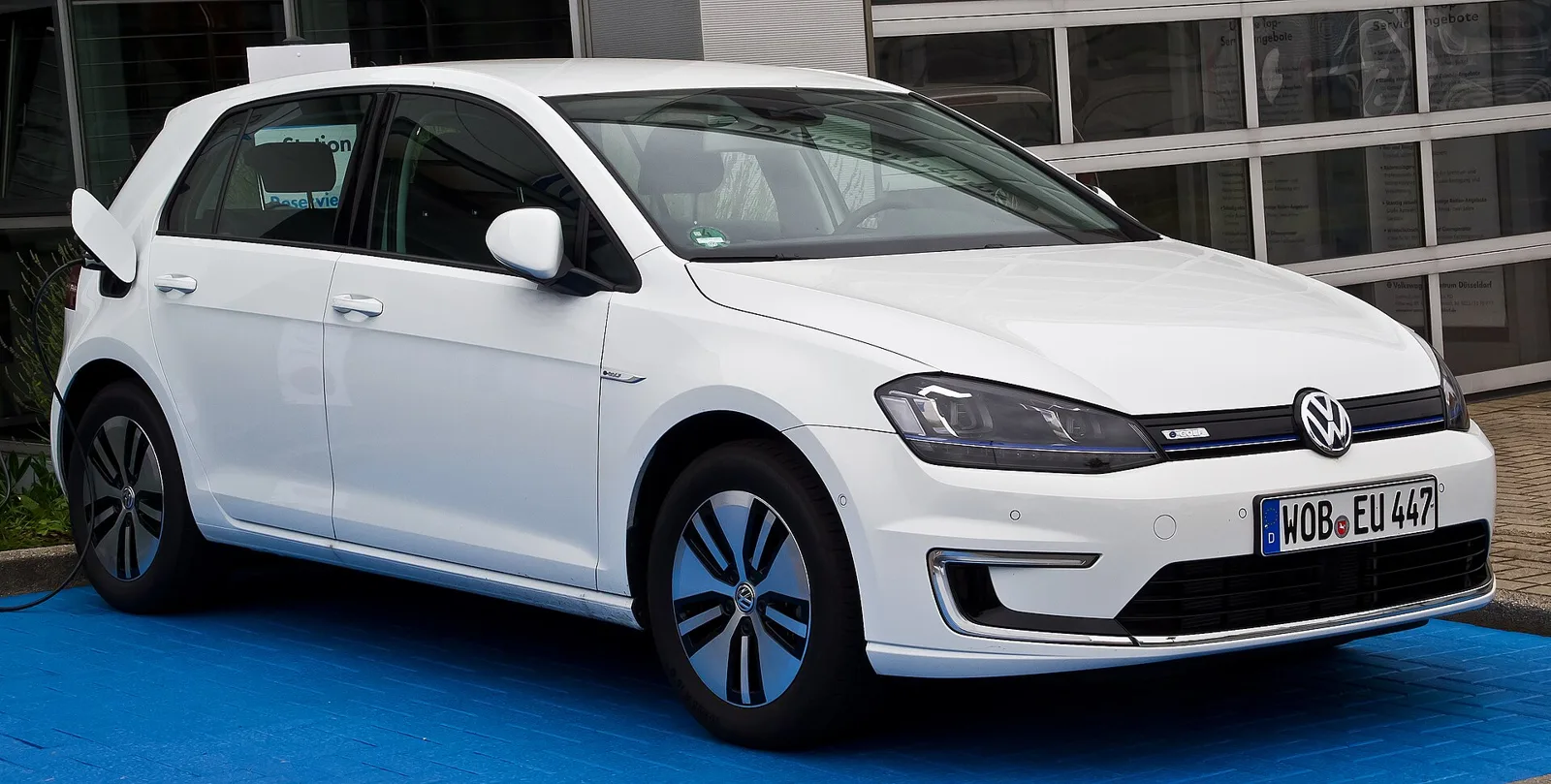
Volkswagen's fully electric Golf from 2014 to 2020, with a 24.2 kWh battery at launch, a 35.8 kWh upgrade in 2017 and the last Golf hatchback built in Europe.
An electric Golf from 2014, the e-Golf used a 24.2 kWh battery at first, moved to 35.8 kWh in 2017 and ended production in late December 2020 as the last Golf hatchback built in Europe.
The Volkswagen e-Golf was the fully electric version of the Golf Mk7, sold from 2014 until production ended in late December 2020. It started with a 24.2 kWh battery and an 85 kW (114 hp) motor, and it gained a 35.8 kWh pack and 100 kW (130 hp) in 2017. It was also the last Golf hatchback built in Europe before the ID.3 took over its factory line.
What was the Volkswagen e-Golf?
The e-Golf was the all-electric version of the seventh-generation Volkswagen Golf, the Mk7, which was introduced in Berlin on 4 September 2012. Its production version was unveiled at the 2013 Frankfurt Motor Show, and it went on sale in Germany on 14 February 2014.
Retail production started in March 2014. Volkswagen opened orders in Norway and the UK in the same spring, with the first UK deliveries arriving at the end of June 2014. The car was sold alongside the petrol and diesel Golfs that shared its body.
An electric Golf that changed batteries once, changed factories twice and ended as the last Golf hatchback built in Europe.
Where did the e-Golf fit in the Golf Mk7 range?
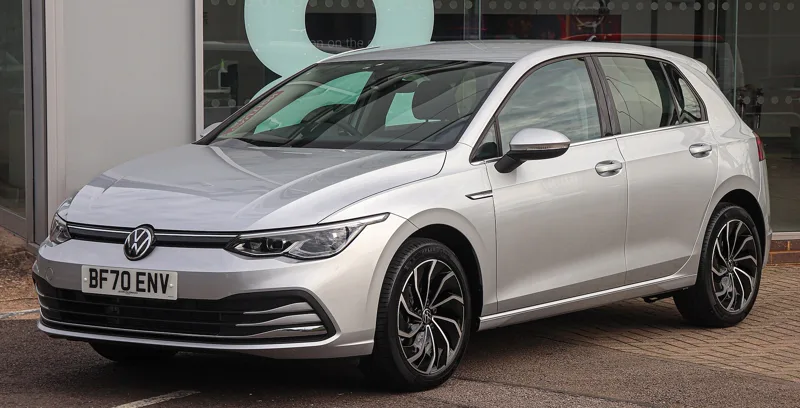
The Golf Mk7 was a C-segment hatchback, estate and van built on the MQB platform shared with the Audi A3, SEAT Leon and Skoda Octavia. The e-Golf used that body but replaced the petrol and diesel engines with an electric motor, and it was distinguished from the regular Golf mainly by full LED headlamps and no exhaust outlet.
The Mk7 was roomier than the car it replaced. It was 20 mm (0.8 in) wider than the Mk6, had a 59 mm (2.3 in) longer wheelbase, more shoulder and rear legroom, and a larger boot. Volkswagen sold the Golf in three-door and five-door hatchback form, plus an estate, and a van sold only in Ireland.
The Golf GTE plug-in hybrid was a separate model, not an e-Golf variant, and it launched in the fourth quarter of 2014.
The petrol and diesel Golfs at launch used 1.2 and 1.4-litre turbocharged petrol engines and 1.6 and 2.0-litre diesels, so the e-Golf was the electric alternative within the same line-up. Volkswagen gave the Mk7 a facelift in November 2016, and the Golf Mk8 replaced it in December 2019.
How far could the e-Golf go on a charge?
Volkswagen's own practical figure was 130 to 190 km (81 to 118 mi), and the NEDC test gave 190 km (118 mi). In the US EPA cycle the 2015 car managed 83 mi (134 km), and real-world range varied between 58 and 110 mi (93 and 177 km).
Winter cut the practical figure to 80 to 120 km (50 to 75 mi). Real-world tests recorded an average of 3.7 mi/kWh over 2,700 mi (4,300 km), mostly in the city. Buyers could also specify a heat pump, which cut the heater's power draw in cold weather.
The EPA combined rating for the 2015 car was 116 mpg-e (29 kWh/100 mi), where mpg-e means miles per gallon petrol equivalent. Its city and highway figures were combined into that one number.
What was inside the original e-Golf battery and motor?
The original e-Golf carried a 24.2 kWh traction battery made up of 264 cells, with a nominal voltage of 323 V. Its 85 kW (114 hp) electric motor drove the car through a single-speed gearbox, and the vehicle weighed 1,510 kg (3,330 lb) including the driver.
The battery was arranged in 27 modules of 6 or 12 cells each. Of the car's total weight, 318 kg (701 lb) was the battery, which made it a large share of the vehicle's mass.
The traction motor was designed as the EEM 85 and the gearbox as the EQ 270. In Normal mode it produced 85 kW (114 hp) and 270 Nm (200 lbf ft). Eco mode reduced that to 70 kW (94 hp) and 220 Nm (162 lb ft), while Eco+ dropped to 54 kW (73 hp) and 175 Nm (129 lb ft) and also switched off the climate system. Four levels of regenerative braking could be selected.
Top speed was electronically limited to 140 km/h (87 mph).
Did the e-Golf battery need active cooling?
Volkswagen announced a liquid-cooled battery for the e-Golf in November 2013, but the description was removed from later press releases in early 2014. Internal testing with Mk6 e-Golf prototypes showed that high ambient temperatures did not affect battery performance, so active thermal management was dropped.
The smaller battery in the GTE hybrid does use active thermal management. That model was positioned as a hybrid version of the sporty GTI, rather than as the electric counterpart of the regular Golf Mk7 that the e-Golf represented.
How did charging work on the e-Golf?
The standard on-board AC charger had a maximum input of 3.6 kW. DC fast charging through a Combined Charging System (CCS) connector was optional and accepted up to 40 kW, and choosing it also upgraded the on-board AC charger to 7.2 kW.
Owners who wanted quicker top-ups therefore had to pay for the DC option, which also raised the rate at which the car could take power from a home or workplace AC supply. Without it, the charger was limited to 3.6 kW.
What changed with the 2017 upgrade?
The 2017 version, the Mk7.5, had a 35.8 kWh battery, a 300 km (190 mi) NEDC range and a 125 mile (201 km) EPA rating. Traction motor output rose to 100 kW (130 hp), which cut the 0 to 100 km/h (62 mph) time to 9.6 seconds.
Real-world testing gave a full-charge range of 110-120 mi (180-190 km). For the 2020 model year a change in EPA test procedure gave a rating of 123 mi (198 km), while combined efficiency fell from 119 to 113 mpg-e (28 to 30 kWh/100 mi).
The upgrade also made AC charging up to 7.2 kW standard. DC fast charging was optional on the SE trim and standard on the SEL Premium and Limited Edition models.
What were the e-Golf's specifications at a glance?
| Feature | 2014 to 2016 e-Golf | 2017 Mk7.5 e-Golf |
|---|---|---|
| Battery | 24.2 kWh, 264 cells | 35.8 kWh |
| Motor output | 85 kW (114 hp), 270 Nm (200 lbf ft) | 100 kW (130 hp), 290 Nm (210 lbf ft) |
| NEDC range | 190 km (118 mi) | 300 km (190 mi) |
| EPA range | 83 mi (134 km), 2015 car | 125 miles (201 km) |
| 0 to 100 km/h | Not listed | 9.6 seconds |
| AC charging | 3.6 kW standard | 7.2 kW standard |
| DC fast charging | Optional, up to 40 kW | Optional on SE, standard on SEL Premium and Limited Edition |
| Top speed | 140 km/h (87 mph), electronically limited | Not listed |
How did the e-Golf go on sale?
Volkswagen opened German sales on 14 February 2014, and Norwegian pre-orders followed on 25 February 2014 for June delivery. UK ordering opened on 11 March 2014, with deliveries from the end of June.
US sales opened in November 2014 in a handful of states, offering only the SEL Premium for the 2015 model year. The GTE plug-in hybrid launched in the same fourth quarter, so the electric and plug-in models reached buyers at much the same time. The sales rollout was staggered: Germany first, Norway and the UK next, and the United States last of the major launches.
Volkswagen later stopped selling the e-Golf in the UK in 2021, by which point the car had been on sale there for seven years.
Where was the e-Golf built, and when did production end?
The e-Golf was the last hatchback version of the Golf Mk7 built in Europe, with production continuing until late December 2020 because demand remained high. Its successor, the ID.3, launched in 2019 and took over the Transparent Factory line in Dresden from late January 2021.
In China, FAW-Volkswagen began domestic e-Golf production in 2019, replacing vehicles imported from Wolfsburg. The move helped VW meet a Chinese rule that makes manufacturers selling more than 30,000 vehicles a year make 10% of them electric from 2019.
Production at the FAW-VW Foshan plant continued into 2021 with two models, the Golf Pure Electric Motor and the Golf Pure Electric Motor Pro. Foshan had built MQB vehicles since it opened in 2014, and it was retooled to add an MEB line, where the first ID.4 CROZZ vehicles began production in late November 2020.
In the United States, the 2020 model year allotment of e-Golfs was diverted to Canada.
Could Canadian buyers choose a custom paint colour?
Canadian e-Golfs from the 2017 to 2020 model years could be ordered in one of 40 custom paint shades under Volkswagen's Spektrum programme, for roughly $3,000 CAD extra. The programme drew orders for 104 e-Golfs in total.
The programme was first introduced only for Canadian e-Golfs and was later extended to the Golf R.
What awards did the Golf Mk7 family win?
The Golf Mk7 won the Car of the Year Japan award in 2013, the first time that award had gone to a European product. It also took the 2013 European Car of the Year and 2013 World Car of the Year titles.
The family was also named 2015 North American Car of the Year and 2015 Motor Trend Car of the Year, and it appeared on the Car and Driver 10Best list in 2019. The awards were given to the Golf Mk7 range as a whole, not to the e-Golf alone.
How did the e-Golf differ from the Golf GTE?
The e-Golf was fully electric, while the Golf GTE was a plug-in hybrid. The GTE combined a 1.4-litre TSI petrol engine with a 75 kW (101 hp) electric motor, and together they produced 150 kW (204 PS; 201 hp) and 350 Nm (258 lb ft) of torque.
The GTE's battery stored 8.8 kWh and gave an official EV range of 50 km (31 mi), with a theoretical total range of 827 km (514 mi). It could reach 130 km/h (81 mph) on electric power alone, and in 2015 it ranked second among European plug-in hybrids, with 17,282 sales.