A full-size Toyota pickup built in the United States since May 1999, from its first V8 to a hybrid third generation.
Toyota's Tundra is a full-size truck that has been made in America since 1999. It has run through three generations, beginning with a 3.4-litre V6 and a 4.7-litre V8, and the newest uses a twin-turbocharged V6 with an optional hybrid.
Toyota's full-size Tundra has been built in America since May 1999, and it has moved from a T150 prototype to a hybrid-capable third generation. Each generation has been shaped by engines, cab layouts and a long list of special editions.
What is the Toyota Tundra?
Toyota's Tundra sits in the full-size class and has been assembled in America since May 1999. The T100 was a Japanese full-size pickup before it, but the Tundra was the first such truck built on the continent. Its line runs through three generations, with the latest arriving in 2021.
The truck started life under the name T150 for its prototypes and show vehicles. Ford and automotive journalists said that name looked too much like the F-150, the market leader, and a Ford lawsuit forced the production model to be called Tundra instead.
The Tundra also reached the shortlist of the North American Truck of the Year contest. Motor Trend magazine named it Truck of the Year in 2000 and again in 2008.
A full-size Toyota pickup that started as the T150, reached 300,000 units of annual capacity and once towed a space shuttle.
Where was the Tundra built?
The Tundra was first assembled in a new Toyota plant at Princeton, Indiana. From 2008 production was consolidated at the San Antonio, Texas factory, where third-generation trucks began rolling off the line on 3 December 2021. Every engine and transmission for the Tundra was built in the United States.
Second-generation capacity was set at 300,000 units a year, with 100,000 from the Indiana plant and 200,000 from Texas. Toyota arranged for 21 key suppliers to set up factories on the Texas site, which helped with logistics. That closeness also left the suppliers more exposed when the market fell.
Toyota also funded a $9 million health care facility that served workers and their dependants. The second-generation truck carried 75% North American parts content, and in the second quarter of 2008 all Tundra production moved to Texas.
Production at San Antonio then stopped for three months as sales fell during 2008.
How did the first-generation Tundra start?
The first-generation Tundra, launched in May 1999 as a 2000 model, shared its 3.4-litre V6 with the Toyota T100 and the Tacoma. It added a 4.7-litre V8, the first V8 Toyota had offered in a pickup. Its name began as T150 but changed after a Ford objection.
The model codes separated the layouts: XK30 denoted rear-wheel drive and XK40 four-wheel drive. Compared with the T100 the Tundra was a little bigger, and sales ran at double the T100's rate, giving Toyota its highest initial vehicle sales in company history.
The Double Cab added four rear-opening doors to a crew cab layout and went on sale late in 2003 as a 2004 model. Its bed was nearly 127 mm (5 in) longer than the bed on rival Nissan Titan and Ford F-150 trucks. Measured against the Regular and Access Cab bodies, it was 330 mm (13 in) longer, 76 mm (3 in) taller and 102 mm (4 in) wider, and its wheelbase ran 305 mm (12 in) further.
Early reviews questioned the power. The first-generation Tundra was reported to lack enough muscle to compete with the heavier-duty offerings from General Motors, Chrysler and Ford.
What engines did the Tundra offer?
Early Tundras used a 3.4-litre V6 with 24 valves and a 4.7-litre V8 with 32 valves. Output rose over the years, reaching 284 kW (381 hp) in the 5.7-litre V8 of the second generation. The third generation dropped V8 engines altogether in favour of a twin-turbocharged V6.
The V6 was the base engine, and the 4.7-litre V8 produced 427 Nm (315 lb-ft) of torque alongside 183 kW (245 hp). Only the V6 was sold with a manual gearbox at first, while the V8 was never offered with a factory manual.
The 4.0-litre V6 arrived in 2005 with an aluminium block, and the V8 gained Toyota's VVT-i variable valve timing that year. The 2006 V8 was rerated lower, but the engine itself stayed the same, so the change came from new industry rating standards rather than new hardware.
Toyota Tundra specifications
| Engine and years | Output |
|---|---|
| 3.4L V6 (first generation, to 2004) | 142 kW (190 hp); 300 Nm (220 lb-ft) |
| 4.7L V8 2UZ-FE (first generation) | 183 kW (245 hp); 427 Nm (315 lb-ft) |
| 4.0L V6 1GR-FE (2005) | 176 kW (236 hp); 361 Nm (266 lb-ft) |
| 4.7L V8 with VVT-i (2005) | 210 kW (282 hp); 441 Nm (325 lb-ft) |
| 5.7L V8 3UR-FE (2007) | 284 kW (381 hp); 544 Nm (401 lb-ft) |
| 4.6L V8 (2010) | 231 kW (310 hp); 443 Nm (327 lb-ft) |
| 4.0L V6 (2011-2013) | 201 kW (270 hp); 377 Nm (278 lb-ft) |
| TRD supercharged 5.7L V8 | 376 kW (504 hp); 746 Nm (550 lb-ft) |
| Third-generation twin-turbo V6 | 260-290 kW (348-389 hp); 549-650 Nm (405-479 lb-ft) |
| i-Force Max hybrid | 326 kW (437 hp); 790 Nm (583 lb-ft) |
How did the second generation change the truck?
A larger Tundra was shown at the February 2006 Chicago Auto Show and went on sale in January 2007. It took styling cues from the Tacoma and from the FTX concept truck, and its new 5.7-litre 3UR-FE V8 was paired with a new 6-speed automatic.
When it launched, the truck came in 31 configurations, built from three bed lengths, three cab styles, three wheelbases and two transmissions. The extended cab gained conventional rear doors and took the Double Cab name, while the crew cab became the CrewMax, offered only with a short 1.7 m (5.5-foot) bed.
The 6-speed automatic could lock its torque converter in fifth and sixth gears. The 5.7-litre model reached 0-60 mph (0-97 km/h) in 6.3 seconds and covered the quarter mile in 14.7 seconds.
Toyota aimed the design at tradespeople, with extra-large door handles, a deck rail system, an integrated tow hitch and head restraints that fit a worker in a hard hat. Standard equipment included an electronic limited-slip differential, stability control and anti-lock brakes.
Which special editions did Toyota sell?
Toyota sold the T3 Special Edition in 2003 to coincide with the release of Terminator 3: Rise of the Machines. It had a TRD performance package and T3 badging, and 650 were sold in the US as 4x2 trucks and 200 in Canada as 4x4 trucks.
The Darrell Waltrip Edition followed in 2006, honouring the NASCAR driver. Just 2,000 Double Cabs with the V8 left the line, with special badging and 18-inch wheels. In June 2008 the Ivan Ironman Stewart Signature Series arrived, and Stewart's record includes seventeen Baja 500 wins in Toyota vehicles.
The TRD Rock Warrior package arrived for 2009 with 17-inch TRD forged aluminium wheels, Bilstein shocks and a sliding rear window on Double Cabs. A Platinum package followed for 2010, with 20-inch aluminium wheels and a JBL sound system, before becoming a trim level in 2013.
What did the third generation bring?
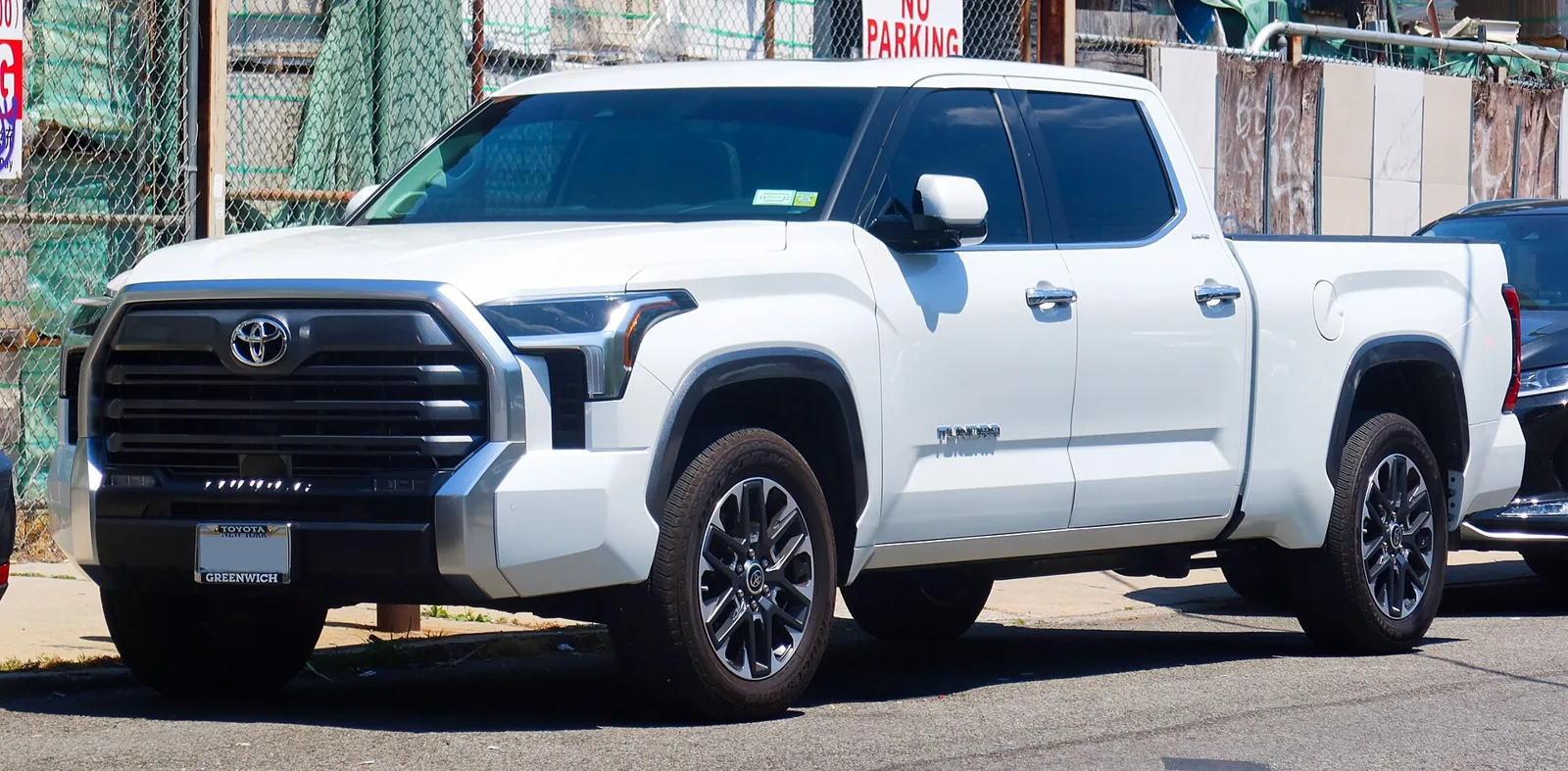
The first look at the third generation came with an official photo on 18 June 2021, and the truck was unveiled that September. The truck sat on a body-on-frame GA-F design. Its frame was fully boxed, and the rear suspension used coil or air springs.
The engine line-up was simplified. A 3.4-litre V6 with two turbochargers delivered 260-290 kW (348-389 hp), and the i-Force Max hybrid produced 326 kW (437 hp) with an electric motor inside the transmission. Both were paired with an Aisin-sourced 10-speed automatic, and no V8 option was offered.
The maximum towing capacity rose to 12,000 lb (5,400 kg), and the maximum payload to 1,940 lb (880 kg). Seven trim levels were offered, including the new luxury-oriented Capstone, and four-wheel drive was standard on the TRD Pro and Capstone.
Later years brought steady change. The SX package arrived for the 2023 model year, a Terra colour for the 2024 TRD Pro, the TRD Rally package for 2025, and a facelift for 2027 with the Trailhunter package on the SR5.
Is the Tundra sold in Australia?
Australian buyers have been able to purchase the Tundra since November 2024. Toyota builds it in left-hand drive in the United States, and then the Walkinshaw Automotive Group remanufactures it to right-hand drive in a second-stage process in Clayton South, Victoria.
A first run of 300 right-hand-drive trucks was offered for lease from November 2023 as part of a 12-month real-world test, and the lessees gave feedback to Toyota Australia. The Australian range started as a single Limited variant with the i-Force Max hybrid, and a Premium variant followed in April 2025.
Elsewhere, the Tundra went on sale in New Caledonia as of May 2024, which the company described as the only place in the French Republic where it could be bought officially. Toyota announced a Japanese launch in December 2025 with a single 1794 Edition, unveiled on 2 April 2026.
How safe is the Tundra?
The truck became the first full-size pickup to win the IIHS Top Safety Pick, and it earned a Good score in the frontal offset test. Ford and Dodge rivals scored Poor, while GM's entry was rated Marginal in the same test.
The airbag package covered the front seats with dual bags and torso bags, plus side curtain bags for both rows. From 2010 the driver and front passenger also received knee airbags as standard equipment, and NHTSA frontal crash scores improved to five stars that year.
Stability control caused debate. Consumer Reports questioned the Top Safety Pick award because the system was disabled when 4x4 was engaged. Toyota said the Tundra had no centre differential to become a weak point, and from 2010 stability control worked in 4x4 High, with only 4x4 Low disengaging it.
A 2022 model later passed IIHS testing and was rated Top Safety Pick+.
What recalls affected the Tundra?
The biggest recall involved rust in a rear crossmember. Toyota recalled 110,000 vehicles from the 2000-2003 model years in late 2009, initially covering only 20 cold-weather states. Issues had already shown up elsewhere, so the recall was widened nationwide in March 2010.
In January 2012 Toyota called back 533,000 trucks and SUVs over ball joints that could wear out, making steering and suspension hard to control. The defect was linked to 11 accidents and six injuries, and it covered 2004-2006 Tundra pickups in the US.
Other campaigns included 20 camshaft failures in the 5.7-litre engine reported in May 2007, a December 2007 recall of 15,600 4x4 model-year 2007 trucks over a rear propeller shaft joint, and a 2022-2023 recall over machining debris in the engine.
How well did the Tundra sell?
After more than a decade on sale, the Tundra's share of the full-size half-ton segment stood at roughly 17%. Toyota sold 107,798 Tundras in 2000, against roughly 50,000 T100 pickups, and reached 126,529 units by 2005. Those early totals placed it well ahead of the older T100.
Toyota expected around 200,000 sales for 2007, once the San Antonio plant was running, and it fell just short with just under 200,000 vehicles. Chevrolet Silverado sales that year were more than 422,000 above the Tundra, and the Ford F-150 led the segment with 756,980 units.
Around 70-80% of Tundra sales were the 5.7-litre versions, and 46% were CrewMax models. The standard cab versions sold more slowly than expected.
Did the Tundra race and set records?
The Tundra entered NASCAR's Craftsman Truck Series in 2004 and won its first race at Michigan International Speedway on 31 July that year. In the 2006 season it won 12 of the 25 races and gave Toyota its first manufacturer title.
Todd Bodine and Germain Racing also took the driver and owner championships that season. The truck won in every year from 2006 to 2018.
On 12 October 2012 an unmodified Tundra CrewMax towed the Space Shuttle Endeavour over the Manchester Boulevard span above Interstate 405. The orbiter's 12-mile (19 km) trip to the California Science Center was largely handled by four robotic transporters, and Toyota made an advert shown at the 2013 Super Bowl.
Edmunds tested a supercharged Tundra over the quarter mile in 13.3 seconds, reaching 103.8 mph (167.0 km/h). Motor Trend recorded 13.0 seconds and 106.3 mph (171.1 km/h), while Edmunds had earlier clocked a naturally aspirated 5.7-litre truck at 14.8 seconds.