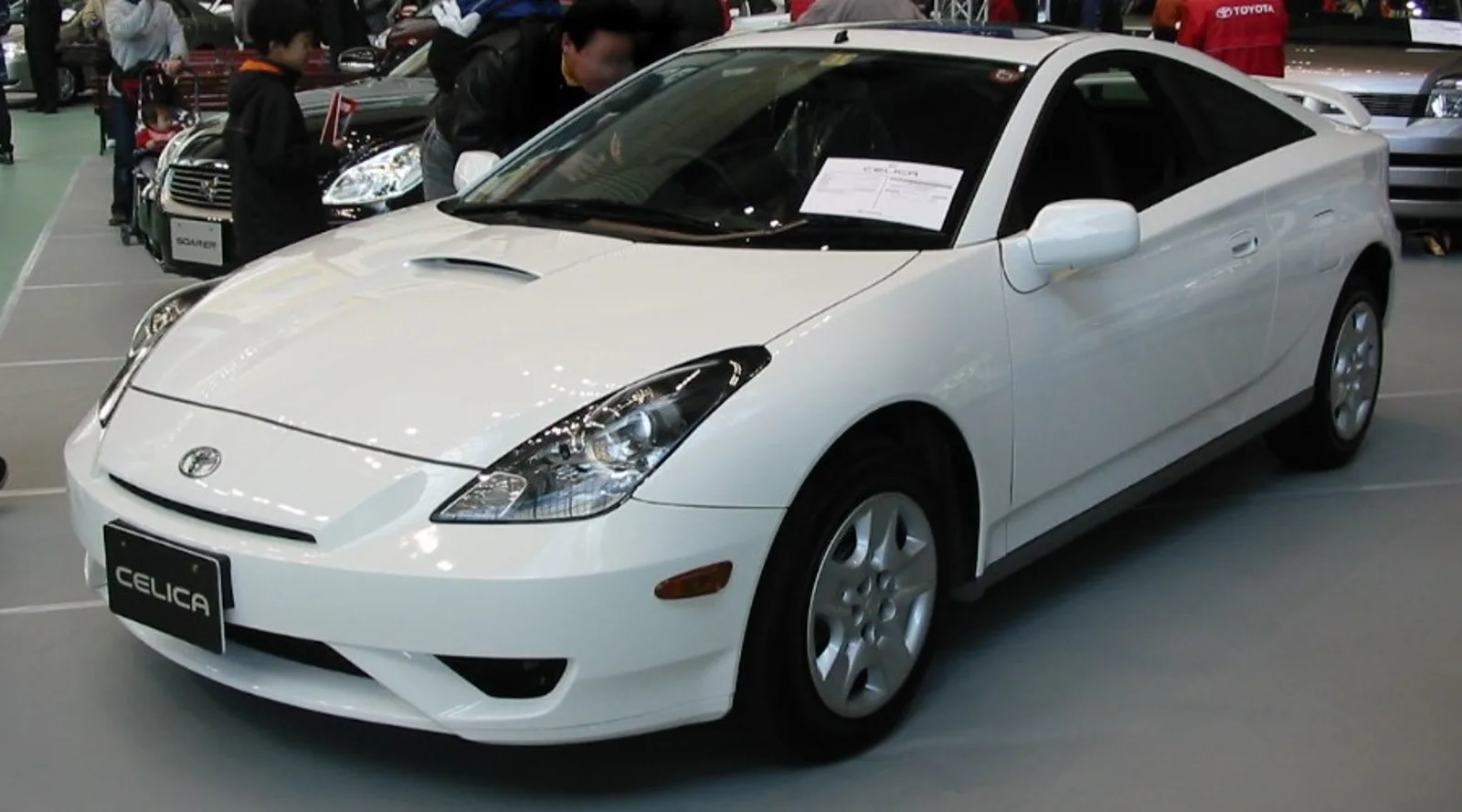
The 1999 Celica dropped the coupe, kept a 1.8 litre twin-cam option and ended a 36-year run in April 2006.
The Toyota Celica T230 was a liftback built from July 1999 to April 2006, the last generation of the Celica nameplate. It offered 1.8 litre engines in 140 and 192 hp forms, and its sales fell sharply in the US before production ended.
The seventh-generation Toyota Celica, code T230, was a liftback sports car built from July 1999 until April 2006. It dropped the coupe body, kept a choice of two 1.8 litre four-cylinder engines and closed out a 36-year run that began in 1970. Its story is closely tied to a shrinking US market for sports coupes.
What was the seventh-generation Celica?
The T230 was the final generation of the Celica nameplate that Toyota had built since 1970 and sold through its Corolla Store dealer network in Japan. It was offered only as a liftback, and it replaced the notchback coupe that had been part of the range since the original car.
Production began in July 1999 and sales started later that year. The car closely resembled the XYR concept that Toyota had shown in early 1999, with changes mainly to the front bumper and rear spoiler.
A 1.8 litre liftback that ended the Celica's 36-year run, with a twin-cam engine and a US sales slide.
Where did the T230 come from?
The seventh generation was part of Toyota Project Genesis, a programme meant to attract younger buyers to the brand in the United States. The effort did not succeed, and the car's later sales show how hard that goal proved to reach.
Engineers aimed to keep the car light and inexpensive to build. Power window and door lock controls were placed in the centre console, so one set served both doors. Initial sunroofs were made of polymer plastic rather than glass, a change that helped trim weight.
What engines did the T230 use?
The two engines were both 1.8 litre four-cylinder units. The ZZT230 used the 1ZZ-FE, rated at 140 hp (142 PS; 104 kW) and chosen for economy, while the ZZT231 used the higher-performance 2ZZ-GE, rated at 192 hp (195 PS; 143 kW) in Europe and Japan.
The 2ZZ-GE was co-developed with Yamaha and featured a two-step variable valve lift control working alongside variable valve timing. The 1ZZ-FE used Toyota's VVT-i system, which adjusts the intake cam phase to improve torque and power across the rev range.
How did the North American GT and GT-S differ?
In the US and Canada there were two models, the base GT and the higher-performance GT-S, and both were liftbacks only. The GT used the 1ZZ-FE rated at 140 bhp (104 kW; 142 PS) at 6,400 rpm, with 125 lb-ft (169 Nm) of torque at 4,200 rpm. It came with a 5-speed manual or a 4-speed automatic.
The GT-S drew on the 2ZZ-GE, whose output was 180 bhp (134 kW; 182 PS) at 7,600 rpm, with peak torque of 133 lb-ft (180 Nm) reached at 6,800 rpm. Buyers could choose a four-speed automatic with steering-wheel shift buttons or a six-speed manual, and every GT-S had four-wheel disc brakes and metal pedals.
| Specification | Detail |
|---|---|
| Code | T230 (ZZT230 and ZZT231) |
| Production | July 1999 to 21 April 2006 |
| Body | Liftback only |
| Base engine | 1.8 L 1ZZ-FE, 140 hp (142 PS; 104 kW) |
| Twin-cam engine | 1.8 L 2ZZ-GE, 192 hp (195 PS; 143 kW), Europe and Japan |
| GT (North America) | 140 bhp (104 kW; 142 PS) at 6,400 rpm; 125 lb-ft (169 Nm) at 4,200 rpm |
| GT-S (North America) | 180 bhp (134 kW; 182 PS) at 7,600 rpm; 133 lb-ft (180 Nm) at 6,800 rpm |
| Transmissions | 5-speed manual or 4-speed automatic (GT); 4-speed automatic or 6-speed manual (GT-S) |
| Tyres | 195/60/15 (GT); 205/55/15 or 205/50/16 (GT-S) |
| Drive | Front-wheel drive; no all-wheel drive option |
| US sales, 2000 | 52,406 units |
| US sales, 2005 | 3,113 units |
How was the T230 sold in Japan?
In Japan the early cars were badged SS-I and SS-II. The SS-I used the 1ZZ-FE, while the SS-II used the 2ZZ-GE, and the SS-II could be ordered with a Super Strut Package that added a rear strut bar, 16-inch alloys, metal pedals and coloured rocker panels.
Buyers could also choose the Elegant Sports version with a front lip spoiler and smoked fuel lid, or the Mechanical Sports version with a full body kit. The Mechanical Sports car had a sportier front bumper, a bigger grille, hood and rear spoilers, and higher trunk spoiler.
Toyota also built a limited-production TRD Sports M based on the SS-II. Rated at 200 PS (147 kW; 197 hp), it had a reinforced unibody, a special instrument cluster and TRD body kits, and it was sold only in Japan. In August 2002 the Japanese car received minor changes to its front bumper and rear lamps.
How quick was the 2ZZ-GE Celica?
In Japan the SS-II with the 2ZZ-GE could reach 100 km/h from rest in roughly 6.5 to 7.0 seconds, depending on transmission, condition and test method. The VVTL-i lift cam engaged at about 6,200 to 6,400 rpm, and the engine's rev limit sat at around 8,200 to 8,500 rpm.
What did the 2002 and 2003 changes bring?
For the 2002 model year Toyota introduced the Action Package, with an aggressively styled front bumper, a wider grille, rocker panels, a rear bumper diffuser and a higher rear spoiler. The package could be fitted to earlier seventh-generation cars, and it changed the look of the car from the front.
The Celica received a facelift for the 2003 model year, with a restyled front bumper and rear combination lamps, a power antenna and a new option for High Intensity Discharge headlamps. For 2004 all models were fitted with a cabin air filter, and the Action Package was restyled again with a different front bumper and spoilers.
Why did US sales fall so sharply?
US sales of the Celica reached 52,406 units in 2000, then dropped sharply to 14,856 in 2003. They fell further to 8,710 in 2004 and 3,113 in 2005, which left the car with a very small share of a shrinking market.
In July 2004 Toyota announced it would end US sales of the Celica and the MR2 after the 2005 model year. The wider decline in sports coupes had several causes, including the 1997 Asian financial crisis, the collapse of the Japanese asset price bubble and a rising yen that pushed up overseas prices.
When did production finally end?
Exports to North America and Australia ceased in July 2005. The last Celica rolled off the production line on 21 April 2006, after 36 years and seven generations, and in its final year the car was sold only in Japan and Europe.
The 2005 model year was the last for the car in the US.
How did the T230 sell in the UK and Australia?
In Europe the car was sold as the 1.8 VVT-i and 1.8 VVTL-i T-Sport, which corresponded to the GT and GT-S. Every European model had a six-speed manual and disc brakes at all four corners, and the T-Sport got 17-inch alloys and climate control with a digital display.
The UK Celica GT appeared in 2005 and used the more powerful 2ZZ-GE, which made it the T-Sport with a more aggressive body kit, 17-inch alloys, a 30 mm lowered suspension and part-leather, part-Alcantara trim.
In Australia and New Zealand only the 2ZZ-GE was offered, in two trims. The SX had 15-inch alloys, a CD player and electric windows, while the ZR added ABS, a moonroof, side and front airbags, fog lights and 16-inch alloys. Australia also offered TRD Sportivo body kits.
How safe was the seventh-generation Celica?
The US 2005 model received 4 stars for the driver front and 4 stars for the passenger front, with 3 stars for the front side. Across the Celica's US history, driver's side airbags were standard from 1990, and dual airbags from 1994.
Seat-mounted side airbags were optional in the US from 2000. The T230 also came with dual front airbags as standard in North America, along with daytime running lights and auto-on headlights.
Did the Celica race in the seventh generation?
The seventh-generation Celica had a racing life beyond the showroom. Toyota Team Racing Project Bandoh ran a rear-wheel drive version with a 3S-GTE engine in the GT300 class of the Japanese Grand Touring Championship, and kept the car in that class until 2008.
In the United States the seventh generation raced in NHRA Sport Compact drag racing in the early 2000s. Goody's Dash Series cars also used 6th or 7th generation bodies on a steel tube-frame chassis, and Robert Huffman's 2003 Dash Series title helped lead Toyota into NASCAR.
How was the T230 equipped in North America?
North American cars came with dual front airbags, daytime running lights with auto-on headlights and four cup holders, two at the front and two at the rear. The rear seats were contoured for two passengers and split 50/50 to extend the cargo space, and the front wipers offered two speeds with a variable intermittent setting.
Options included ABS, a rear spoiler, side-impact airbags, floor mats, a 6-disc CD changer, leather seat surfaces, a cargo net and a cold area package with a heavy-duty battery and starter motor. A vehicle intrusion protection alarm with door lock and unlock was available, along with a liftback cargo cover.
What were the 2ZZ-GE's other uses?
The 2ZZ-GE was not limited to the Celica. Variants of the engine powered the Matrix XRS and Corolla XRS, and the Lotus Elise ran a version with a Lotus engine control unit that added 10 bhp. The 1ZZ-FE, meanwhile, shared its tuning with the Matrix, Corolla and MR2 Spyder.
In the GT-S, the four-speed automatic used shift buttons on the steering wheel, and manual shifters and steering wheels were upgraded to leather-wrapped trim. Four-wheel disc brakes and metal pedals completed the sporty package.
How did the Japanese range change over time?
The Japanese range was shaped by tax rules. Engine displacement was reduced, which reflected a drop in sales caused by the annual road tax that had applied to earlier, larger-engined generations. The 2ZZ-GE remained the performance choice for buyers who wanted the sportier car.
Japanese SS-II buyers could pick the Elegant or Mechanical Sports options, and the TRD Sports M gave enthusiasts a more serious alternative. The August 2002 update restyled the front bumper and rear lamps on the Japanese cars.
Where else was the Celica sold?
Although not sold through official Toyota dealers, the Japanese-spec Celica was imported through parallel-import dealers in several Asian markets, including Indonesia, Malaysia and Singapore. In Indonesia the pre-facelift cars were offered in the Australian-spec SX and ZR trims alongside the Japanese SS-I and SS-II.
After the facelift most of the Indonesian imports were the Japanese SS-II. Thailand and Hong Kong offered a single trim level similar to the Australian ZR, with the 2ZZ-GE engine.
How did the Celica perform in racing before the T230?
Earlier Celicas built a strong competition record. The first-generation liftback was used in the German DRM series in 1977 and 1978, and Dan Gurney's All American Racers ran Celicas in the IMSA GTU and GTO classes from 1983 to 1988, winning the GTO championship in 1987.
A Toyota Motor Sales and Rod Millen Motorsports Celica silhouette race car won the Pikes Peak International Hill Climb three times between 1994 and 1997 with a modified 3S-GTE engine. Its record time stood for more than 10 years, and modified stock Celicas were the spec cars in the Toyota Pro/Celebrity Race until 2005.
Is a new Celica coming?
In May 2023 Toyota President Koji Sato said he wanted to bring the Celica brand back. In November 2024 Toyota confirmed that a new Celica was being developed, with a market introduction expected in 2026 or 2027.
That revival would follow a long gap since the seventh-generation car.
How did the Celica's wider history shape the T230?
The Celica was launched in 1970 as a coupe built on a sedan's mechanicals, a formula that followed the Ford Mustang. Toyota coined the term liftback for its fastback Celica in 1973, and the car later won Motor Trend's Import Car of the Year awards in 1976 and 1978.
The earlier cars also built the rally reputation that the seventh generation inherited. The Group B TA64 won six WRC events in Africa between 1983 and 1986, and the GT-Four ST165 went on to win the WRC drivers' title with Carlos Sainz in 1990.