Subaru's kei car ran from 1972 to 1992, moving from a two-stroke rear-engined design to a front-drive hatch with optional four-wheel drive.
The Subaru Rex was a kei car built by Subaru from 1972 to 1992, first as a rear-engined two-stroke and later as a front-drive hatchback. It replaced the R-2, and it was sold in Japan and several export markets under names such as Sherpa and Mini Jumbo.
The Subaru Rex was a kei car that Subaru built from 1972 to 1992, mostly for the Japanese market. It replaced the R-2 and went through three generations, from a rear-engined two-stroke design to a front-drive hatchback with optional four-wheel drive. Export versions carried a range of other names, including Sherpa, Mini Jumbo and Ace.
How did the Rex replace the Subaru 360?
The Rex (K21) arrived on 15 July 1972 as the successor to the R-2, which had itself replaced the long-lived Subaru 360. The R-2 was an interim model, a rebodied 360, so it lasted less than three years, while the rear-engined Rex stayed on sale for nine.
The 360 itself was marketed for 11 years. The Rex was a fresh design that shared little of its look with its predecessor, but it kept the rear-engine layout and the rear swing axle. Its styling echoed Subaru's new compact car, the Leone.
A rear-engined kei car that became a front-drive hatch, a supercharged four-cylinder and a cult drift machine.
What did the first Rex look like?
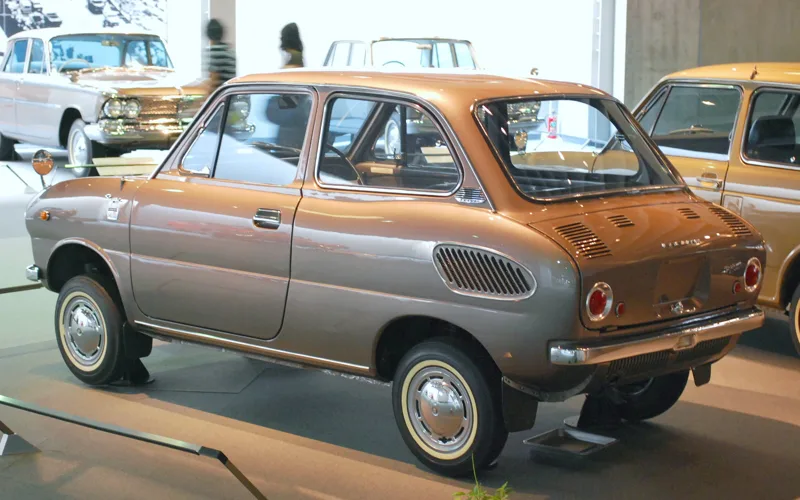
The first Rex was a two-door sedan at launch, with a four-door added in February 1973. The Van could be registered as a commercial vehicle, which brought considerable savings on tax and fees, and a three-door two-seater Van followed in February 1974.
The Wagon arrived in September 1974 with four permanent seats. It could no longer be registered as a commercial vehicle, and its load capacity was lower. In April 1975 the Van gained a raised roof and seated four, because Japanese commercial rules required a completely flat floor when the rear seat was folded.
The rear engine left the cargo floor high, so more headroom was needed before a seat could be fitted. The Wagon kept selling until the SEEC-T version arrived in December 1975, but the four-seater Van took most of its market.
Why did Subaru change the engine?
Subaru moved from a 356 cc water-cooled two-stroke to a 358 cc four-stroke in October 1973. The new EK21 was a rear-mounted two-cylinder that carried Subaru Exhaust Emissions Control (SEEC). It produced 31 PS (23 kW) at 8000 rpm, and the four-stroke car could reach 110 km/h (68 mph).
The EK21 also produced 3.0 kg-m (29 N-m; 22 lb-ft), peaking at 6500 rpm. Front disc brakes were offered as an option from the same month.
The two-stroke models had offered 32, 35 or 37 PS (24, 26 or 27 kW), depending on trim. The sporty GSR used a double carburettor for 37 PS (27 kW), while the TS produced 35 PS (26 kW). SEEC-T arrived in December 1975 and set every version at 28 PS for the 1976 model year.
What was the Rex 550?
The Rex 550 was a May 1977 model with a 544 cc four-stroke twin, the EK23, designed to meet the 1978 emissions rules. It made 31 PS (23 kW) at 6200 rpm and 4.2 kg-m (41 N-m; 30 lb-ft) of torque at 3500 rpm. It followed the Rex 5, a 490 cc car that lasted only a year.
Export markets mostly knew the 550 as the Subaru 600. The marketing focused on the Multi-Use Lever, which grouped the headlight, indicator and washer controls into one stalk. The lowest-spec Type B and Standard versions did not get it.
In March 1978 the Swingback arrived as a two-door sedan with a larger opening rear window, which also gave access to the luggage compartment from outside. In October 1979 the Family Rex, a decontented Van, was priced at 480,000 yen, under US$2,000, to compete with the Suzuki Alto. An automatic clutch option followed in March 1980.
What changed with the second generation?
The second-generation Rex, launched in August 1981, switched to front-wheel drive with independent suspension all round and new hatchback bodies. Power stayed at 31 PS (23 kW), and on-demand four-wheel drive, a first for the class, arrived in October 1983.
Subaru said the rear-engined predecessor had left only two connecting rods and an ashtray in the new car. The Dinos trim of 1982 was sold only by mail order.
The 4WD system was engaged electrically by a switch on top of the gear lever, and a turbo option arrived in December 1983 to offset the extra weight. Europe first got the car as the Subaru 600 or Mini Jumbo. From September 1982 the European car was badged Subaru 700, with a 665 cc engine making 37 PS (27 kW) and a top speed of 125 km/h (78 mph).
The bodyshell was lengthened and widened to form the original Subaru Justy, which used a larger 1-litre engine and stayed in production until 1994.
What were the key Rex specifications?
| Specification | First generation | Second generation | Third generation |
|---|---|---|---|
| Launch | 15 July 1972 | August 1981 | November 1986 |
| Layout | Rear-engined, rear swing axle | Front-wheel drive, on-demand 4WD from October 1983 | Front-wheel drive, part-time and full-time 4WD options |
| Engine at launch | 356 cc water-cooled two-stroke EK34 | Twin-barrel carburettor, 31 PS (23 kW; 31 bhp) | SOHC two-valve, 30 PS (22 kW; 30 bhp) |
| Three-valve option | Not offered | Not offered | 36 PS (26 kW; 36 bhp) |
| Top speed | 110 km/h (68 mph), four-stroke car | 125 km/h (78 mph), Euro Subaru 700 | 125 km/h (78 mph) four-speed, 130 km/h five-speed |
| Notable addition | SEEC-T from December 1975 | Turbo on 4WD from December 1983 | Supercharged version from March 1988 |
How did the third generation change the Rex?
The third generation was presented in November 1986 with a 30 PS SOHC two-valve engine and a 36 PS three-valve option. A continuously variable transmission, called ECVT, arrived in June 1987. A supercharged version with an intercooler and fuel injection followed in March 1988, with 55 PS (40 kW; 54 bhp).
Twin Viscous full-time four-wheel drive, with a limited-slip rear differential, came in February 1987. From then on every four-wheel-drive car used the three-valve engine, and the supercharger gave less lag than a turbo did.
June 1989 brought a gentle facelift and a new four-cylinder, the EN05 Clover 4, rated at 38 PS (28 kW; 37 bhp) in the standard car and 61 PS (45 kW) with supercharging. The Mazda Carol had been the previous four-cylinder kei car.
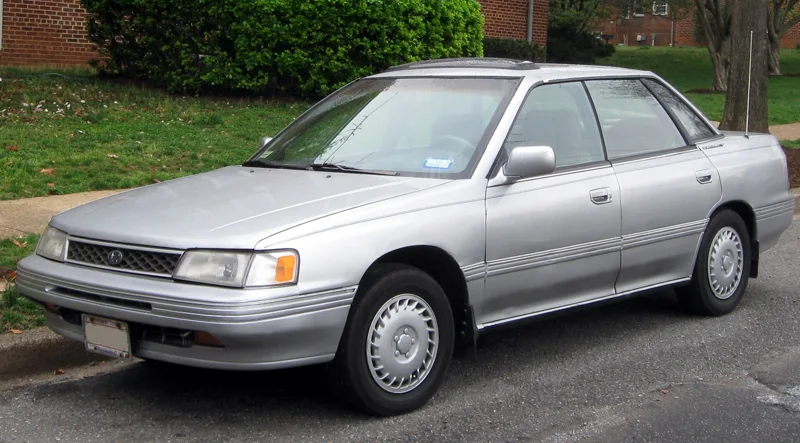
Naturally aspirated cars received cat's-eye headlamps and a reshaped bonnet, while supercharged models kept the rectangular lamps behind a new four-hole grille. The export M70 in Europe became the M80, and the Sherpa in Australia was replaced by the Fiori.
The 660 cc EN07 arrived in March 1990 with an extended, more rounded nose to meet new kei regulations. The final Rex used chassis codes KH3 and KH4 for sedans, and KP3 and KP4 for commercial vans.
The Fiori had a 758 cc carburetted four-cylinder EN08 making 42 PS (31 kW) at 6,000 rpm. Subaru offered a two-year, 50,000 km warranty when the car was new.
Why is the Rex still talked about?
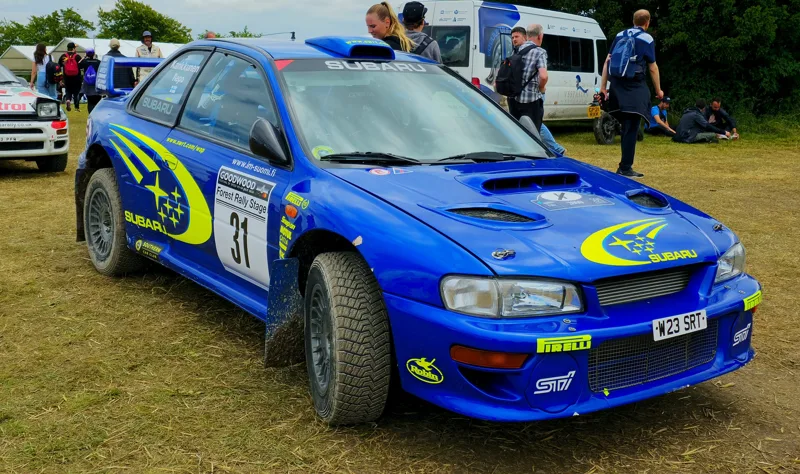
The Rex has become something of a cult car in Japan, where it is popular in front-wheel-drive drift events. Its nickname is also used for the Impreza WRX, especially in Australia, where the car was sold as the Sherpa and then the Fiori.
In Southeast Asia the car was marketed as the Viki, and the Rex ViKi was a special edition for the Japanese market. Export copies also took other names, including Mini Jumbo in Europe and Ace in New Zealand.
The Vivio replaced the Rex in March 1992, and a total of 1,902,811 Subaru Rexes had been built across its lifetime.