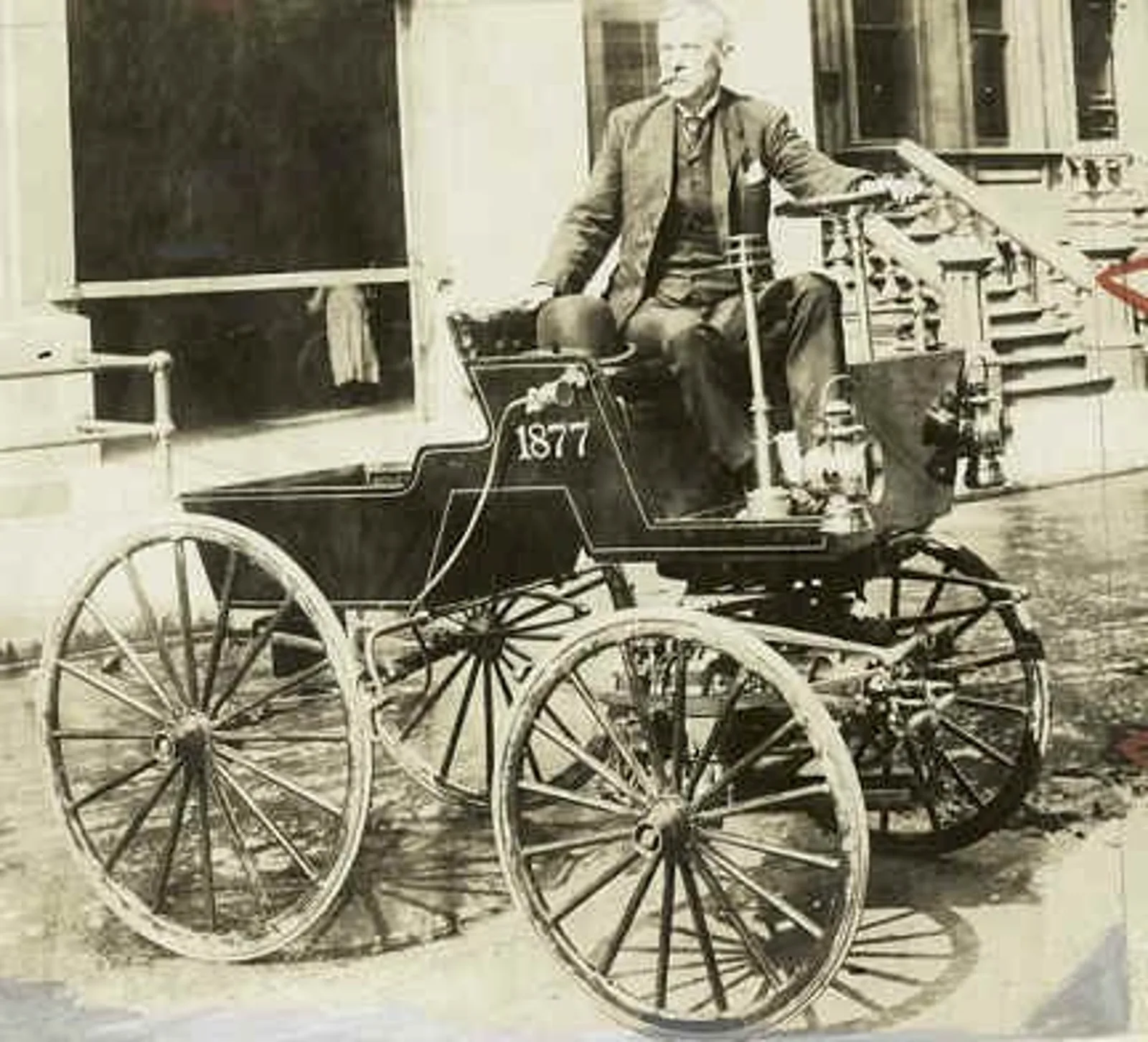
A partly built prototype, a patent that reached far beyond it and two replicas tested in court.
The Selden Road engine was a US car prototype built by Rochester patent attorney George Baldwin Selden. Its drawings formed the basis of the 1895 Selden patent, which was used against the early automobile industry, and two replicas were later built to serve as evidence in court.
The Selden Road engine was a prototype car built by George Baldwin Selden, who worked as a patent attorney in Rochester, New York. It was only partly built when Selden applied for a patent in 1879, yet its drawings became the basis of a document that had far-reaching consequences for the US car industry for years.
Who was George Baldwin Selden?
Living in Rochester, New York, George Baldwin Selden (1846-1922) worked as a patent attorney and inventor. He had studied technical courses at the Sheffield Scientific School, which was linked to Yale University, and the patent at the centre of a long legal dispute bears his name.
Earlier he had devised a typewriter and a device for making barrel hoops. He showed both at the 1876 World Exhibition in Philadelphia, where he also came across the gas engine of George Brayton. Selden remained convinced for the rest of his life that he was the real inventor of the automobile.
His business career was mixed. He founded the Selden Motor Vehicle Company to make cars, then set up the Selden Truck Sales Corporation, which built commercial vehicles. His company produced until 1930 and merged into the Bethlehem Motor Truck Company. Detractors argued he did little himself once the idea existed, and that legal manoeuvres kept the patent back until it could bite hardest.
A partly built prototype whose patent drawings shaped a legal fight over the early automobile.
What was the engine like before the Road engine?
Combustion engines were new and rare around 1870. The best known were gas engines, such as the Lenoir engine, which suited small workshops but depended on a gas supply and so suited only fixed installations, and the two-stroke engine of George Brayton, which needed no spark plug.
Etienne Lenoir (1822-1900) patented his engine in early 1860. Lacking pressurised gas containers, Lenoir reworked the engine for petroleum or turpentine fuel and devised an early carburettor and an ignition system. One of the vehicles it powered was a three-wheeled road machine called the Hippomobile, which covered 18 km in 1863.
In the Lenoir design, drive went straight to the crankshaft, and the unit was a two-stroke with no compression stage. Nikolaus Otto and Eugen Langen had shown a free-piston engine at the 1867 Paris World Exhibition, and the Otto engine presented in 1876 was inspired by Lenoir's design.
George Brayton's engine, patented in 1872 and improved in 1874, was an atmospheric design influenced by the steam engine. It burned liquid hydrocarbon and is seen as a predecessor of the diesel. Constant pressurised air made the mixture burn steadily instead of exploding, and the patented version reached 800 lbs (362.9 kg) per horsepower at best.
France was further ahead on chassis engineering. Amedee Bollee (1844-1917) gave his 1873 steam omnibus, L'Obeissante, a swing axle with parallel springing and independent front suspension, and each rear wheel had its own steam engine. His La Mancelle, an open six-seater, placed engine, transmission and axle one behind another. Bollee patented steering knuckle steering again in 1876, unaware that the idea had been invented before. A German Reich patent on the same steering principle, held by Carl Benz, dates from 1891.
Brayton's own test vehicle, built in 1878-1879, was far more modern than Selden's design. Chain drive to the rear wheels, a countershaft, spiral-toothed gears and a friction clutch made up its layout. It failed because Brayton had chosen a much too heavy omnibus, and the engine, though it worked, was too weak to move the vehicle.
How did Selden improve the Brayton engine?
Selden's version was much lighter and simpler than the original: three cylinders, each with a compressed-air pump at both ends. A closed crankshaft design, smaller pistons and a short stroke completed the layout. Its speed of 500 rpm was double that of any other combustion engine of the day.
In December 1877 Selden took his plans to Frank Clements's workshop in Rochester, where an engine block was cast. Selden laid it out so that it could first run on a single cylinder, and only that cylinder was bored out and made to work. The engine first ran in May 1878, though not satisfactorily. At 380 lbs (172.4 kg) it made 2 bhp (1.4 kW), which brought its weight per horsepower below 200 lbs (90.7 kg), a clear improvement.
The engine seems to have run hot, and the problem apparently persisted in Selden's own replica. Even so, Selden now had a drive that was light enough, in principle, for a road vehicle.
How did the Road engine drive and steer?
The Road engine used front-wheel drive. The engine sat on a turntable front axle and turned with it, so one chain to the drive shaft was enough. Each front wheel had its own clutch, and a reverse gear was fitted. Shifting was done with hand wheels on a column in front of the driver, not a gear lever.
The steering was unusual. A steering wheel on a column almost vertical above the turntable acted through a gear wheel on a vertical shaft, which replaced the kingpin usual on horse-drawn vehicles. Because the whole engine turned with the steering, the car needed great physical effort to steer, and it was unsuited to higher speeds.
The chassis began with a carriage, possibly a Duc, whose front axle was replaced by Selden's own turntable design. Every axle had a pair of leaf-spring packs, each made of two half-elliptical springs facing one another. Wooden spokes gave diameters of 32 inches in front and 38 at the rear. Brake blocks pressed on the rear wheels through shoes, and a lever, ratchet and chains operated them.
Road engine specifications at a glance
| Specification | Detail |
|---|---|
| Type | US prototype, front-wheel drive |
| Engine | Three-cylinder design based on the Brayton engine |
| Output | 2 bhp (1.4 kW) |
| Engine speed | 500 rpm |
| Engine weight | 380 lbs (172.4 kg) |
| Power-to-weight | Under 200 lbs (90.7 kg) per horsepower |
| Transmission | Two-speed gearbox, reverse gear, clutch, hand-wheel shifting |
| Wheels | Wooden spokes, 32 in front, 38 in rear |
| Patent | US 549,160, granted 5 November 1895 |
| 1907 replica length | 1,473 mm (58 in) |
| 1907 replica width | 1,473 mm (58 in) |
| 1907 replica height | 1,651 mm (65 in) |
| 1907 replica weight | 320 to 430 kg (705 to 948 lb) |
How did the patent become a legal weapon?
The patent was granted on 5 November 1895 as US patent No. 549,160. Selden had delayed it with later changes, timing its term to fall during the years when such vehicles were being sold. Once the Electric Vehicle Company held it, speculators and parts of the motor trade used it as a blanket claim on combustion-engined cars.
The case against Henry Ford showed how contested the patent was. In 1909 the first court to hear it upheld it in full. On appeal in 1911 its reach was cut back to vehicles with Brayton engines, which left it commercially uninteresting a year before its regular expiry.
Were there really two working replicas?
Yes, two replicas were built to the patent drawings, though they differed from one another. The Electric Vehicle Company built one in Hartford, dated by its present owner to between 1902 and 1906, while Selden and his sons built the other in 1907 using the original 1877 engine. Both survive today.
The E.V.C. replica was built in secret in the company's Hartford workshops, and its date is disputed. The Connecticut State Library gives 1902 to 1906, while another account says the company commissioned it only in 1905. Hiram Percy Maxim, the chief engineer, oversaw the work despite having condemned the Road engine before the purchase. Herman F. Cuntz led the team that did the physical work, and he was the engineer who had first spotted the patent while studying car production at Pope.
Hartford's engineers could not make the drawings work, so they took liberties. The Hartford builders added water cooling, two gears, electric ignition and pneumatic tyres, and starting also needed an external air compressor. The Seldens, by contrast, stuck as closely to the plans as they could.
How did the replicas perform in the Ford trial?
Henry Ford's defenders wanted a public demonstration to prove that Selden's invention was impractical, and therefore that the patent could not hold. A road drive in New York could not be approved, so the two replicas were run on a racetrack in Guttenberg, New Jersey.
Selden called the replicas 'China copies', a term then used for an exceptionally exact copy. Even so, the two results differed a good deal. The Seldens had stuck closely to the plans and used the original engine. That engine had been designed with three cylinders, but Selden had bored out only one for cost reasons, so the other two were now made to work.
The tests lasted two frustrating days, and breakdowns plagued the vehicles. The Hartford road wagon, thanks to its added refinements, did somewhat better, and at one point it covered two and a quarter miles in 15 minutes. Frederic R. Coudert, counsel for the French co-defendant Panhard and Levassor, judged the heavy machine as 'much Hartford and little Selden'.
Where are the Road engine replicas today?
The E.V.C. replica now stands at 450 Capitol Avenue, Hartford, in a Connecticut State Library building that also houses the Office of Policy and Management. Selden's replica belongs to the Henry Ford Museum, which does not show it at present. The iron model submitted with the patent is kept at the Smithsonian.
After the trial the E.V.C. replica went to New Jersey and Long Island, where it was shown for a time. It came back to Connecticut only in 1968 and was restored there. Its present home lies very close to where it was constructed more than 110 years ago.
The Henry Ford Museum received Selden's replica as a donation from the Stevens Institute of Technology. For many years it stood, rather pointedly, beside Henry Ford's Quadricycle of 1896.
What did the Road engine leave behind?
The Road engine became part of American popular culture. Versions of its image, more or less accurate, were printed on plates, jugs, ashtrays and collectors' cards for decades after the patent dispute ended. They often sat beside other early motor vehicles or important inventions.
Selden promoted his company with the Road engine, and one long-running slogan was 'The Father of them All'.
Why does the Road engine still matter?
The Road engine matters for its place in combustion-engine history and for the patent drawn from it. Although the vehicle was hardly usable, the patent had far-reaching consequences for the industry. Serious questions persist over whether it ran reliably over long journeys without overheating.
Selden did improve the Brayton gas engine, and his solutions were quite innovative. The patent was challenged in court repeatedly, and the dispute over it was fought bitterly for years. His filing predated the combustion-car patents of Carl Benz and Gottlieb Daimler by eight years.
Its validity was never wholly challenged and never wholly struck down. Without it there would have been no Selden lawsuits, and without the two demonstration vehicles the Association of Licensed Automobile Manufacturers would hardly have succeeded.