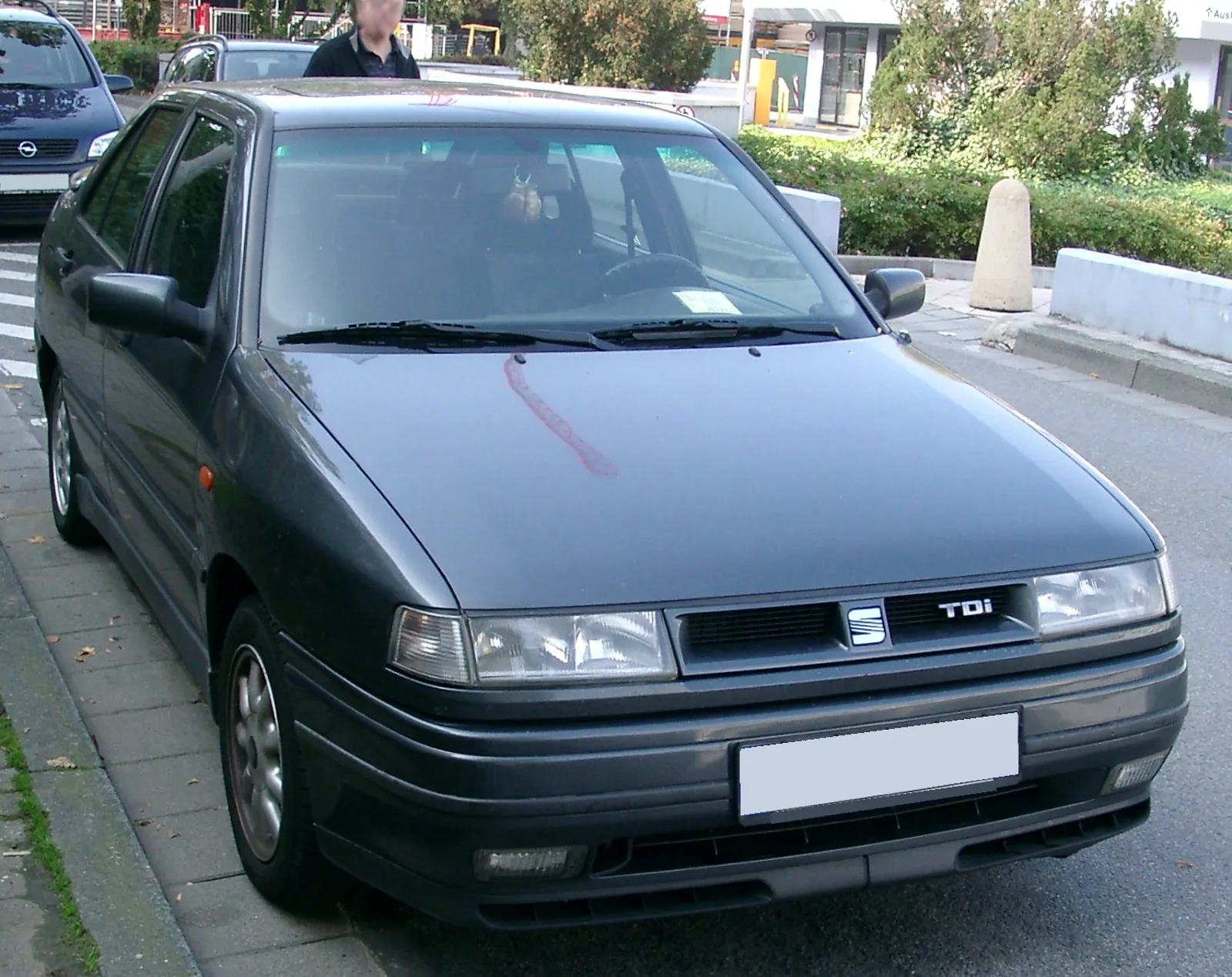
SEAT's first Volkswagen-era car gave a saloon look a hatchback tailgate and became the official car of the 1992 Barcelona Olympics.
The first-generation SEAT Toledo was a segment C car built by SEAT from 1991 to 1998. It was the first SEAT engineered with Volkswagen and offered a saloon look with a hatchback tailgate. Its petrol engines ranged from 1.6 litre (97.6 cu in) to a 150 PS (148 hp) 2.0-16v, and the car was named car of the year.
The first-generation SEAT Toledo arrived in 1991 as the Spanish maker's new flagship, and it was the first SEAT engineered alongside Volkswagen. Sold as a segment C car with segment D ambitions, it was refined through trims, engines and several updates, including a major restyle in 1995. Production ran from 1991 to 1998.
Why was the first Toledo a landmark for SEAT?
The Toledo was the first SEAT developed in cooperation with the Volkswagen Group, under the internal name Project S3. Volkswagen had bought 51% of the Spanish brand in 1986, and the Toledo was the first car to carry that influence from the start. It also opened a new segment in Spain: cars that looked like saloons but came with a hatchback tailgate.
The model was shown at the Barcelona Motor Show in May 1991. A book, Ole Toledo!, written and signed on the spot by Edourd Seidler, who had followed the project closely, was presented at the same show. King Juan Carlos I opened the official launch at a national parador in the city of Toledo.
A saloon look with a hatchback tailgate, built on a Volkswagen Golf platform.
How was the Toledo designed?
Sketches began in 1986, and the aim was a large saloon with a big jump in quality and an attractive, functional design. The first plan used the Volkswagen Passat B3 platform, but production costs ruled it out. Engineers settled on the A2 (PQ32) platform of the second-generation Golf, which also underpinned the Jetta and Corrado.
The Toledo was then fitted to the largest body the platform would allow. The result was a five-door liftback whose large tailgate gave access to a 550-litre boot, extendable to 1,360 litres with the rear seats folded. The car created a new kind of vehicle, with saloon styling and a practical tailgate that outdid many estate models.
Small modifications and improvements were added to the platform to suit that body. The car also picked up more modern components shared with the third-generation Golf and other Volkswagen Group models of the period, even where the underlying platform differed.
Who styled the Toledo?
Giorgetto Giugiaro designed the Toledo, working with Aldo Mantovani in the design company, and his firm also oversaw merchandise under the Boutique Toledo name. The Proto T and Proto TL prototypes of 1989 and 1990, developed at Italdesign, gave an early preview of the production shape.
After several nearly definitive mock-ups, the final design drew on those Italdesign prototypes. Two Concepto T versions, a coupe and a convertible dating from 1992 and 1993, were meant as sporty variants but were abandoned. A planned estate for 1994 was also dropped, so the range kept the liftback body alone.
The Toledo carried distinctive graphics. Airbrushed Toledo lettering appeared on the rear light clusters, and a small plate on each front wing carried the trim name in place of the side indicator. Turbo diesels showed TD on that plate, the GT versions showed 2.0i, and the GT-16 showed 16V, since those two trims carried a GT badge on their sporty sill covers.
How did the Toledo sell in its early years?
SEAT began selling the Toledo in October 1991 under the slogan For a demanding world. It sat above the somewhat outdated SEAT Malaga and was meant to give the brand a modern, generously sized flagship. Its main rivals were the Fiat Tempra and the basic versions of the Ford Sierra, Opel Vectra and Renault 21, against which it offered more equipment.
Production started at the old factory in the Barcelona Free Zone. When the Martorell plant opened in 1993, manufacturing began to move to SEAT's new facilities. The 100,000th Toledo came off the line on 24 February 1992. It was a burgundy GLX with a sunroof and the 1.9 TD engine of 75 PS (74 hp).
In March 1992 the first special edition appeared, sold as the Sport or Sport 2000, and its side mouldings were soon added to the GL and GLX versions. The Toledo was named car of the year and led its segment in sales.
How did the Olympics help the Toledo?
SEAT was the main sponsor of the 1992 Olympics, and the Toledo became the official car of the Barcelona Games. The company supplied more than 2,000 vehicles to the COOB 92 organising committee. Most were Toledos, though there were also Ibiza and Marbella models and other group cars, all decorated for the occasion and registered with special plates for the event.
Among the other group cars were the Audi 100, Volkswagen Passat and Transporter. SEAT also accompanied the Olympic torch with an electric Toledo prototype, and it gave the Spanish gold medallists a special model called Podium.
SEAT had hoped to launch the car in the United States that same year under the name Barcelona. That plan did not happen, because the company wanted to make use of the marketing the Games brought.
What equipment could buyers choose?
The Toledo offered good standard equipment across its trims, from the basic CL to the sporty GT. Each trim had specific upholstery or styling that identified it, and some extras that were optional at first were later fitted as standard, partly because of regulations and partly to make the car more complete. Twelve paint colours were offered at launch.
Light grey bumpers and sill covers could be specified on the GT and GT-16v. One example shown at the 1991 Barcelona show had the same two-tone finish as the SEAT Ibiza SXi New Style, which was also presented at that show. A winter pack came as standard in cold countries, and it added heated seats, mirrors, washer jets and headlamp washers, the last hidden behind covers.
Audio was at first only pre-wired for a radio cassette, with several optional Grundig models. Early cars had four speakers from 1991 to early 1992, then six, once small covers that doubled as storage trays were replaced in the front doors. From late 1992 a Grundig radio branded SEAT Sound System became standard, first with the 3842 code and later the 3905. A six-CD changer in the right side of the boot was also offered from the accessories catalogue.
Which engines did the Toledo use?
The Toledo dropped SEAT's System Porsche engines in favour of Volkswagen units, which SEAT called Econosport. The petrol range ran from a 1.6 litre (97.6 cu in) to a 2.0-16v of 150 PS (148 hp), while the diesels covered naturally aspirated and turbocharged 1.9 litre (116.0 cu in) units, followed by the direct-injection 1.9 TDI.
The four-cylinder petrol engines were a 1.6 litre (97.6 cu in) at 75 PS (74 hp), a 1.8 litre (109.8 cu in) at 90 PS (89 hp), a 2.0 litre (122.0 cu in) Digifant at 115 PS (113 hp), which could be had with an automatic gearbox, and a 1.8 litre (109.8 cu in) 16V at 136 PS (134 hp). A catalysed version of the 1.8 16V gave 128 PS (126 hp) and was tied only to the GT trim. The 2.0-16v arrived later as the range's top model, replacing the 1.8i 16v.
By the end of its life the petrol range was reduced to a 1.6 litre at 100 PS (99 hp) and a 2.0 16V at 150 PS (148 hp). The naturally aspirated 1.9 litre diesel produced 68 PS (67 hp), later reduced to 64 PS (63 hp) to meet anti-pollution rules, while the turbocharged version made 75 PS (74 hp). The 1.9 TDI, shared with other Volkswagen Group models, arrived with 90 PS (89 hp) and later 110 PS (108 hp).
Several details told the engines apart. Turbo diesels had a rev counter, while the plain diesels had an analogue clock. Turbo diesels bore a red logo on the grille, first reading Turbo D and from 1995 reading TD. The 90 PS TDI had chrome letters in its badge, while the 110 PS version had a red final letter. Early cars were sold with both catalysed and non-catalysed engines.
Toledo I engines at a glance
| Engine | Displacement | Output | Notes |
|---|---|---|---|
| Petrol | 1.6 litre (97.6 cu in) | 75 PS (74 hp) | 100 PS (99 hp) at the end of production |
| Petrol | 1.8 litre (109.8 cu in) | 90 PS (89 hp) | Four-cylinder petrol |
| Petrol, Digifant | 2.0 litre (122.0 cu in) | 115 PS (113 hp) | Automatic available |
| Petrol, 16V | 1.8 litre (109.8 cu in) | 136 PS (134 hp) | Catalysed version 128 PS (126 hp), GT trim only |
| 2.0-16v | 2.0 litre (122.0 cu in) | 150 PS (148 hp) | Range top, replacing the 1.8i 16v |
| Diesel | 1.9 litre (116.0 cu in) | 68 PS (67 hp); later 64 PS (63 hp) | Naturally aspirated |
| Turbo diesel | 1.9 litre (116.0 cu in) | 75 PS (74 hp) | Turbocharged |
| 1.9 TDI | 1.9 litre (116.0 cu in) | 90 PS (89 hp); later 110 PS (108 hp) | Direct fuel injection |
How did the 1995 restyle change the Toledo?
The restyle was presented at the Frankfurt Motor Show in 1995 and reached showrooms that September or October. It changed the engine range and mainly the exterior, with new bumpers, headlamps and grille. Inside, the car gained dual airbags, an immobiliser and a third brake light as standard, and the engine line-up changed too.
The new bumpers were rounder and better finished, and the headlamps were lightly redesigned. The grille became a single piece with the moulding and carried a larger SEAT badge. Beneath it sat an insert painted dark grey at first, later in a lighter tone. The side mouldings were thinner and matched the new bumpers.
Inside, the car received new upholstery, courtesy lights with a timer and gradual switch-off, and belt pretensioners. The third brake light, which had been optional and could be fitted into the rear spoiler, now sat at the top of the rear window as standard.
Small equipment changes included pre-wiring for cruise control and for a one-touch indicator, the Komfortblinker, both on TDI models. The one-touch function was rarely known to buyers, since dealers fitted it, and it could be switched on through a diagnostic setting once the left-hand lever had been changed.
What changed in the Toledo's final years?
The 1997 update brought modest changes. A new 5201 radio arrived, and the aerial moved from the left front wing to the rear of the roof, where it gained an anti-theft system matching the sporty trims. Door handles were now body-coloured, the amber side indicators became smoked transparent units, and the rear spoiler grew taller.
The taller spoiler came only on the sporty versions. On the Magnus it was an option, while the TDI 110 PS (108 hp) fitted it as standard. The wheel and wheel-trim designs were renewed, and interior details included door seals trimmed to match the roof and chrome interior door handles.
Production of the first generation stopped at the end of 1998, but the car continued to sell until March 1999, alongside the second generation, known as the 1M, which had appeared at the end of 1998. The last units received minor changes, including five-spoke wheels shared with the Ibiza and Cordoba, and a Grundig 5300 radio in part of the European market.