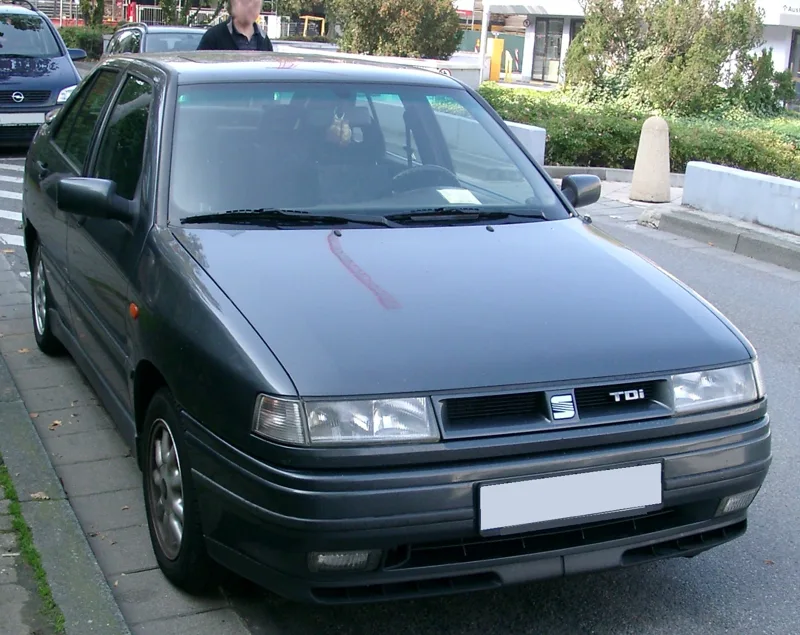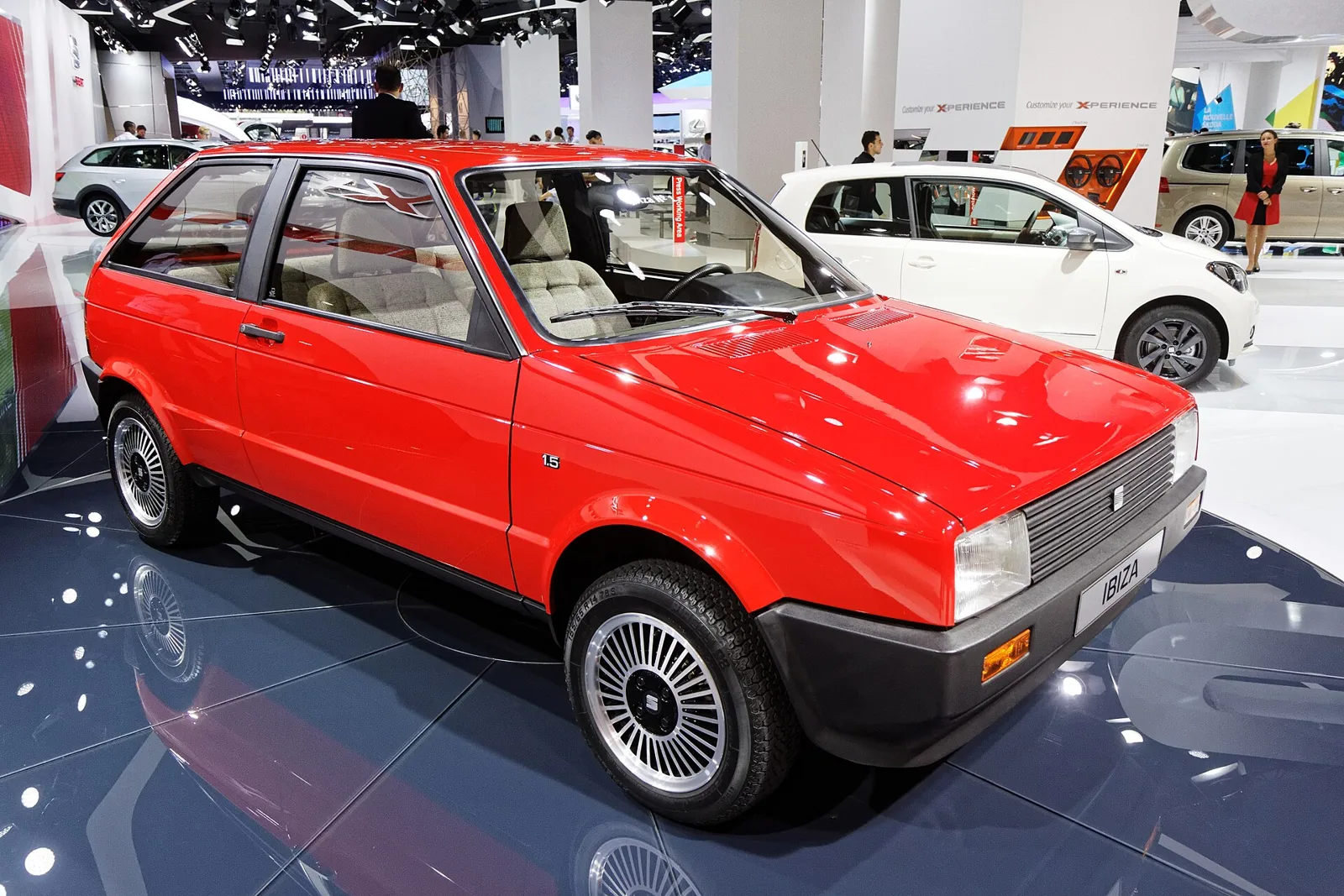
Giugiaro's three-door body, engines developed with Porsche and a sporting SXI that arrived in 1987.
The SEAT Ibiza 021a was the first Ibiza, launched in 1984 with a Giugiaro-styled body and engines developed by Porsche. The sporting SXI arrived in 1987. Spanish production ended in 1993, and Chinese assembly continued until 2008.
The first SEAT Ibiza, coded 021a, was a small hatchback that gave the nameplate its start in 1984. Giorgetto Giugiaro styled the body, and Porsche developed the engines. The sporting SXI followed in 1987, and the car had a long afterlife in China.
Where did the first Ibiza come from?
The first Ibiza went into production at the Zona France plant near Barcelona at the end of April 1984, with its official premiere in July. Giugiaro, who ran the Italdesign studio in Turin, styled the launch body: a three-door hatchback 3.65 metres (12.0 ft) long, whose luggage area could be varied. The new engines were designed for it together with the Seat Malaga saloon.
The engines were new. They were mounted transversely ahead of the front axle and drove the front wheels. Their development, the production of the cylinder head and several other components of the liquid-cooled overhead-cam units of 1.2 l, 1.5 l and 1.7 l were handled by Porsche, the renowned Stuttgart maker of sports cars.
That is why the valve covers carried the words System Porsche beside the SEAT logo. SEAT paid a fee for each car sold for that decorative badge, so the feature had a cost as well as a meaning.
The first cars were delivered to customers in Spain in June 1984.
SEAT paid a share on every car sold with the System Porsche badge, so the engines carried a cost as well as a name.
Which engines did the first Ibiza use?
The first version, built from 1984 to 1989, used a 1,193 cc (72.8 cu in) engine that delivered 46 kW (62 hp) at 5,800 rpm. The larger 1,461 cc (89.2 cu in) unit produced 63 kW (84 hp) at 5,600 rpm, and both were fitted with a five-speed gearbox. Top speeds were 155 km/h (96 mph) for the smaller engine and 175 km/h (109 mph) for the larger one.
Fuel was metered by a Weber carburettor. A Fiat 1.7D diesel of 1,714 cc (104.6 cu in) joined the range in 1985, rated at 41 kW (55 hp) at 4,500 rpm, with a stated top speed of 150 km/h (93 mph) and a quoted use of 5.2 l/100 km at 90 km/h.
The cheapest model, the 900 Junior, arrived in January 1985 with a 903 cc (55.1 cu in) engine producing 32 kW (43 hp) at 5,800 rpm, and it used a four-speed gearbox. A five-door body followed, dated to the autumn of 1985 in one account and to October 1986 in another.
The petrol units of 1.2, 1.5 and 1.7 litres shared the vast majority of their parts, and only the bore or the stroke was changed to alter the capacity. On the 1.2 and 1.5, the differences between capacities and output versions came from piston shape, which moved the compression ratio from 11:1 to 10.2:1, and from a different control unit and catalytic converter.
Engine range at a glance
| Engine | Displacement | Output |
|---|---|---|
| 1.2 petrol, 1984-1989 | 1,193 cc (72.8 cu in) | 46 kW (62 hp) at 5,800 rpm |
| 1.5 petrol, SXI | 1,461 cc (89.2 cu in) | 74 kW (99 hp) at 5,900 rpm |
| 1.7 Diesel, from 1985 | 1,714 cc (104.6 cu in) | 41 kW (55 hp) at 4,500 rpm |
| 900 Junior | 903 cc (55.1 cu in) | 32 kW (43 hp) at 5,800 rpm |
| 1.7 petrol, Sportline | 1,675 cc (102.2 cu in) | 72 kW (97 hp), 74 kW (99 hp) or 79 kW (106 hp), by market; peak at 5,700 rpm |
How did the SXI change the Ibiza?
The SXI first appeared in spring 1987, and its four-point fuel injection lifted the 1.5-litre engine to 74 kW (99 hp) at 5,900 rpm. Its claimed top speed was 184 km/h (114 mph). Customers had to wait until April 1988 for the production version. By July that year more than 500,000 Ibizas had been built in total.
The SXI was better equipped than the base cars. It came with sports seats, electric front windows, adjustable instrument lighting, central locking, opening rear windows, a central tunnel between the front seats and an oil pressure gauge. Early examples had a rear spoiler, while the rear axle stayed rigid on leaf springs, which showed in the car's handling.
A turbocharged version called the TURBO used the 1.5 engine with a Garrett turbocharger and an intercooler. Peak boost was 0.4 bar and the compression ratio was 9.1:1. It made 80 kW at 5,500 rpm and 150 Nm (111 lb ft) at 4,000 rpm, but it was sold only in some markets, including Switzerland and Germany.
When the catalytic converter arrived, the SXI's 1.5 output was cut from 74 kW to 66 kW (90 hp), the same as the standard 1.5. The Sportline replaced it as the top sporting version with the 1991 facelift, although the SXI stayed on offer. The Sportline used a 1.7 engine with 72 kW (97 hp), 74 kW (99 hp) or 79 kW (106 hp) depending on the market.
What did the 1988 update and 1991 facelift change?
The December 1988 update brought a more modern interior and a grille painted in body colour. A luxury Businessline model added leather upholstery and a mobile phone as standard. On the 1.2 engine the switch from a carburettor to Bosch Jetronic multipoint injection raised output to 52 kW (70 hp) at 6,000 rpm, and the 1.5 rose to 66 kW (89 hp) at 6,000 rpm.
The first generation received its last restyle in March 1991. The front was changed radically, the rear less so, and the trim gained the New Style name. By the spring of 1991 a total of 1,000,000 vehicles had been built.
At the 1988 update the 900 Junior had been replaced by the 900 Special, which added only an uncontrolled catalytic converter while keeping its output. Sportline models of 1992 and 1993 completed the car's run in Spain, and the final Spanish cars left the line in May 1993. That month also saw the arrival of a new generation built on a Volkswagen platform, which took over from the Ibiza.
What happened to the Ibiza in China?
After production ended in Spain, the production lines were sold in 1997 to Nanjing Automobile in China. Vehicles began to roll out of those lines six years after the last Spanish 021a, and several body changes were made for the Chinese market.
Nanjing's licence to build the Ibiza expired in 2003, so the model was modernised and altered. Earlier, in 1999, the first Chinese cars had been named the Nanjing Yuejin NJ6400, and the February 2003 facelift brought the 7150 Encore name and a utility version called the Soyat Unique NJ1020.
The Soyat Unique used a rear end based on the more modern SEAT Inca, and the 1.2 engines were replaced by Toyota 1.3-litre units during production. The last facelift came in 2007, and production ended in 2008.
Which special editions were sold?
The standard trims ran from the basic L and LD through CL, GL, SX and GLX to the top sporting SXI. Special editions were mostly promotional models tied to a significant sporting or other event.
The Paco Rabanne edition of 1985 was shown at the Barcelona show and had only 50 limited units. The RVN of 1989 had 100 units, all three-door cars with the 1.2 engine only, and the Businessline of 1989-1990 had 100 units based on the SXI with leather seats, a car phone and a tilting sunroof.
Some editions were sold in one country only. A very limited Bolero Interstate appeared in the Netherlands in 1984, a three-door with a sporting bodykit and alloy wheels, and it was later used for a saloon prototype. The Star of 1985 for France was the only edition with four headlamps taken from the Volkswagen Golf. The Bonito of 1986 in the United Kingdom was a three-door with 1.2 engines, while the Ace of 1988 in England was white, with painted wheel covers, red lines and an ace symbol on its flank.
The Crono of 1988 was the second-best edition after the SXI, offered in five colours, and it was available only with the 1.2 and 1.5 engines. Artist Cesar Manrique worked with BMW on its Art Collection and painted ten Ibizas in 1987, one of which he gave to SEAT. SEAT repeated the idea in 2015 with 100 units of the new Ibiza. The G. Sabatini edition of 1990 and 1991 was inspired by the tennis player Gabriela Sabatini and carried tennis-racket and ball motifs.
Which prototypes did SEAT build?
SEAT built several prototypes that never reached SEAT production, among them a Cabriolet developed in several versions, the Raider 2+2 by Francisco Podadera, a Marathon rally project and a saloon. The Raider was later built in 83 units under the name Anibal Podadera.
The Cabriolet existed in several forms. The first was created by the Proto Design studio, with Elias Bacoulas as its author, and was shown in Greece in 1986, in black only. An ASC prototype followed at the Barcelona show in 1987, a third was built by Italdesign in 1989, and a fourth was based on the facelifted car in 1991.
The Raider had 2+2 seats and its luggage sat outside the crew compartment, with retractable lamps. Volkswagen turned the design down, so Podadera completed the project under his own brand before production stopped in 1992 for economic reasons. Two variants were offered: the F90 with the 1.5i engine at 63 kW (84 hp) and the F100 with 78 kW (105 hp).
The Olympic Concept was used to promote Barcelona at the 1992 Olympic Games. The Marathon was a racing project that was never really realised. It was planned for the Paris-Dakar event with a V8 from Audi, and it served only as a study for the Toledo Marathon. The Sedan, a saloon version of the Ibiza, was cancelled as redundant, since SEAT already sold a saloon called the Malaga, and only one prototype was built.
Did the Ibiza compete in motorsport?
The Group S project produced the Ibiza Bimotor, a rally car with two engines, one driving each axle, because SEAT could not afford its own four-wheel-drive gearboxes at the time. Each engine was a 1,461 cc unit, for a total of 2,922 cc (178.3 cu in), and the car weighed 1,001 kg (2,207 lb).
The two engines first gave 95 kW (127 hp) each, a theoretical 190 kW (250 hp). Later they were tuned to 111 kW (149 hp) each, or 223 kW (299 hp) in theory. Synchronising the two power units and linking the two gearboxes caused early problems. Cooling the rear engine was handled by a special radiator placed in front of it, with air admitted through openings in the rear windows.
Groups B and S were cancelled when the project was nearly complete, and the Bimotor was tested only a few times, with fairly good success, in smaller Spanish events. The project was suspended in 1988 after the definitive decision to cancel Group S. After a few more domestic outings the car went into storage, and it only reappeared in 2011 at the Goodwood Festival of Speed. SEAT Sport then turned to the Dakar, with a concept built around an Audi V8 and four-wheel drive, which served as a study for the Toledo Marathon.