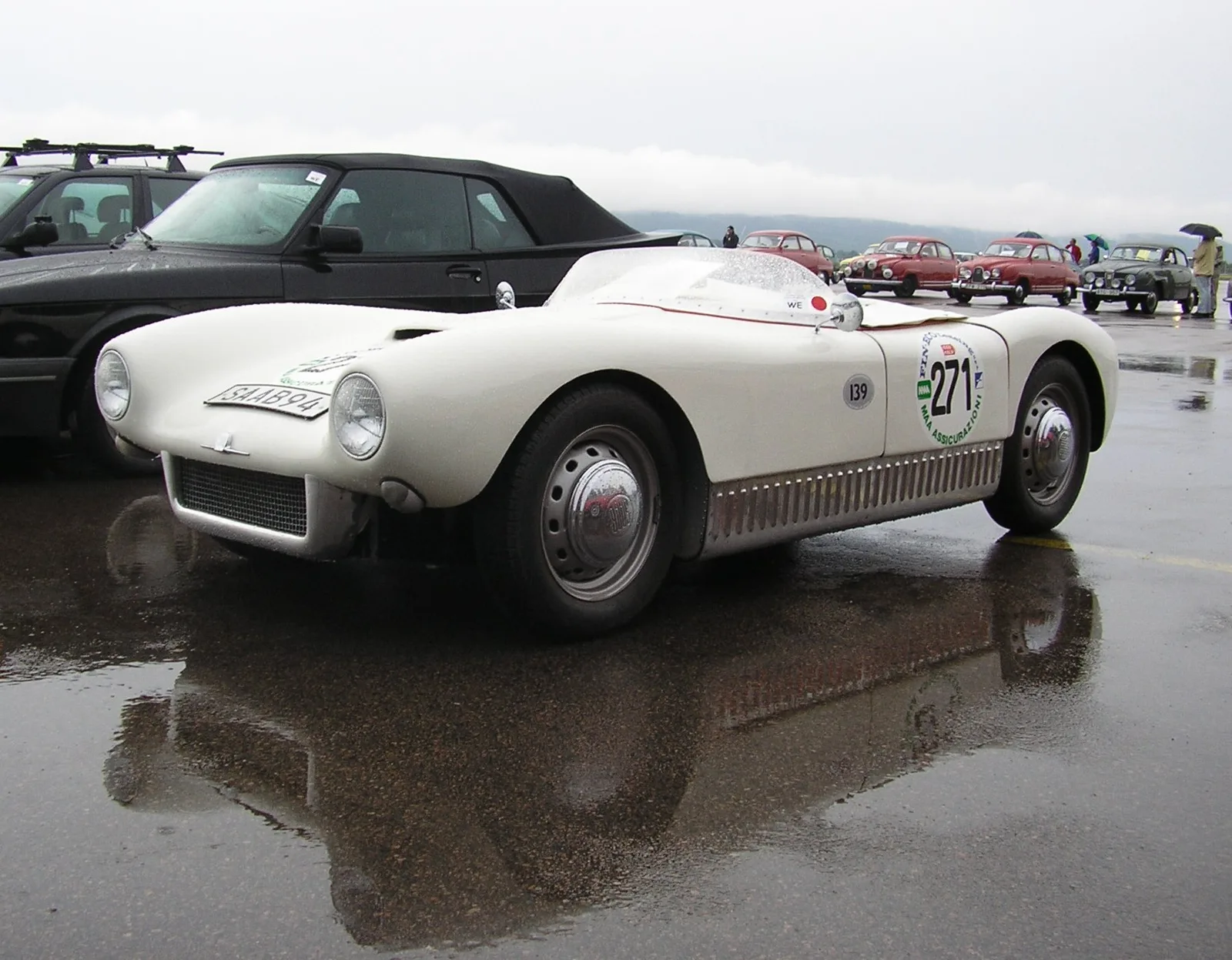
A lightweight Swedish two-seater that started as a 1956 racing prototype and returned as a fiberglass roadster for the American market.
The Sonett was a Swedish two-seater from Saab, built from 1955 to 1957 and again from 1966 to 1974. It started life as a lightweight racer, later became a fiberglass roadster, and most cars were sold in the United States.
The Saab Sonett was a small two-seat sports car from the Swedish maker Saab, built in two spells: from 1955 to 1957, and again from 1966 to 1974. It began as a lightweight racing prototype with a two-stroke engine, then became a fiberglass roadster sold mainly in the United States. Its name came from a Swedish phrase, and it was revived for the production models.
Where did the Sonett idea begin?
Saab engine developer Rolf Mellde and a small team designed the first two-seat roadster prototype in a barn near Trollhattan, on a budget of 75,000 Swedish kronor. The project first went by the Saab 94 name, and the car received the Sonett name in October 1955.
The name came from a Swedish phrase meaning how neat it is. Designer Sixten Sason proposed it, and management first rejected it before accepting it when the prototype was finished.
The Sonett borrowed its front suspension, engine and gearbox from the 93 Saloon. Mounting the unit behind the front axle meant turning the engine and gearbox around by 180 degrees, which was easy because the engine was a two-stroke.
A Swedish two-seater that began as a racing prototype and found its market in America.
What made the Sonett I so light?
The Sonett I used a stressed-skin aluminium chassis weighing under 70 kg (154 lb), with the metal sections riveted together as in aircraft building. Its glass-reinforced plastic body was made by Soab, a Gothenburg plastics firm, and the complete car weighed 600 kg (1,323 lb).
Mellde chose this approach over the tubular frames used by other low-volume sports cars. The mechanical parts were mounted directly onto the chassis, and glass-reinforced plastic was then becoming popular for car bodies.
The Sonett I was introduced on 16 March 1956 at Stockholm's motor show. Its three-cylinder 748 cc two-stroke engine produced 57.5 PS (42 kW), and the projected top speed was 190 km/h (120 mph).
Why did the Sonett I never reach production?
Saab planned a run of 2,000 cars for 1957, but changing race rules let modified production cars compete in the classes the Sonett was built for. That weakened the economics and marketing case, and just six examples were completed between 1955 and early 1957.
All six were right-hand drive. The first prototype, known as No. 1, had a hand-built GRP body and served as the reference for the other five. In early 1958 Saab abandoned that plan and built a performance 93 instead, the GT 750.
Survival is rare, and only two cars are known to exist in the United States. Chassis number 2 sat in the GM Heritage Center collection, went to Saab Cars North America after the 2009 GM bankruptcy, and was later sold on to a museum in South Dakota after Saab went bankrupt in 2012.
In September 1996 rally driver Erik Carlsson took a Swedish speed record in the sub-750 cc class, reaching 159.4 km/h (99.0 mph) in the restored No. 1 prototype.
Why did Saab build the Sonett II?
American dealers persuaded Saab that a sports car would sell in the US, where MG and Triumph roadsters were doing well. They asked for a targa top, wind-up windows, a standard heater and good handling. Saab handed the work to outside studios, chose the MFI13 design, and launched it as the Sonett II in 1966.
The MFI13 was developed by Bjorn Karlstrom, an aircraft and automotive illustrator, together with Walter Kern, an engineer at the Massachusetts Institute of Technology. Sixten Sason had produced a rival concept, the Saab Catherina. Engineers then reworked it, notably with a sheet metal box-frame chassis, before the MFI13 went on show in New York and Geneva in 1966.
Production started in 1966 at ASJ in Arlov, with 28 cars that year, and Saab's internal model number was 97. A further 230 units were built in 1967. The two-stroke design was becoming uncompetitive under US emissions rules, which set the stage for the engine change.
The Sonett II's three-cylinder two-stroke engine produced 60 PS (44 kW; 59 hp). Its 0 to 100 km/h sprint took 12.5 seconds, and the top speed was 150 km/h (93 mph). Every Sonett II was left-hand drive, and the hood hinged forward for access to the engine, transmission and front suspension.
Transmissions had a freewheel that could be engaged while moving, using a pull handle near the throttle pedal. Oil-injected racing engines and the later V4 did not need it. The Sonett II competed against the Austin-Healey Sprite and Triumph Spitfire in SCCA races, although its low volume led to disqualification from some events.
What changed with the Sonett V4?
The V4 replaced the two-stroke engine with a 1.5 L (1,498 cc) Ford Taunus V4 making 65 hp (48 kW). It arrived in the middle of the 1967 model year, starting at serial number 259, and it needed a new bulge hood to clear the taller engine.
The bulge was offset slightly to the right to keep the driver's view clear. Designer Gunnar A. Sjogren drew it, and the asymmetric shape drew criticism from the press and inside Saab itself. That criticism was one motive for the 1970 redesign.
Performance was 0 to 100 km/h (0 to 62 mph) in 12.5 seconds, and the top speed reached 160 km/h (99 mph). The dashboard was wrinkle-finished black rather than the wooden panel of the Sonett II, and the 1969 cars gained taller seat backs and a glovebox lid.
Saab built 70 V4s in 1967, 900 in 1968 and 640 in 1969, for a total of 1,610 cars. The heater was made somewhat more efficient, and nearly all production went to the United States.
US prices ran from US$3,200 to US$3,800, which works out to roughly US$28,094 to US$33,362 in current money. Standard equipment included a roll bar, three-point belts and bucket seats with tall backs. The car also had front-wheel drive and a column-mounted shifter, which set it apart from American rivals.
Marketing was weak and the design quirky, yet the V4 found a niche in the US, helped by the Sonett II's SCCA results. Competitors were mainly British roadsters from MG, Triumph, TVR and Austin-Healey, among them the MGB and the Sprite Mark IV.
How did the Sonett III differ?
The 1970 Sonett III was a redesign aimed at the criticised V4 styling and at US emissions rules after the Clean Air Act of 1970. Saab's own designer, Gunnar A. Sjogren, fitted the new body to the existing Sonett II chassis, replacing the bulge hood with a small popup panel.
The redesign was first given to Italian designer Sergio Coggiola to make the car look more appealing. Saab then handed the job to its own designer, because the changes had to fit the existing chassis without costly production-line changes.
The hatch became a hinged rear window, and the bulge-less hood led to a small popup panel with more limited engine access. Heavy engine work still meant lifting off the complete front hood.
For US tastes the Sonett III had a floor-mounted shifter in place of the column unit, and dealers could fit air conditioning. Its hidden headlamps were raised by a manual lever. Impact-proof bumpers required after 1972 changed its Italian look, and every Sonett III was left-hand drive.
The 1500 cc Ford V4 stayed available for 1970 and 1971, but from 1972 to 1974 the car used the 1700 cc unit, with net power held at 65 hp (48 kW). A 42-tooth ring gear and 9-tooth pinion, against the 39:8 ratio of the 95 and 96, pushed top speed to 165 km/h (103 mph). The drag coefficient was 0.31 cd.
Sales were disappointing, particularly during the 1973 oil crisis. Production ended in late 1974 after 8,368 Sonett IIIs had been made between 1970 and 1974. Across all three generations the total reached 10,236 cars.
What were the main Saab Sonett specifications?
| Specification | Sonett I | Sonett II | Sonett V4 | Sonett III |
|---|---|---|---|---|
| Years | 1955-1957 prototype, shown 1956 | 1966-1967 | 1967-1969 | 1970-1974 |
| Engine | 748 cc three-cylinder two-stroke | 841 cc three-cylinder two-stroke | 1.5 L (1,498 cc) Ford V4 | 1700 cc Ford V4 from 1972 |
| Power | 57.5 PS (42 kW) | 60 PS (44 kW; 59 hp) | 65 hp (48 kW) | 65 hp (48 kW) net |
| 0-100 km/h (0-62 mph) | Not given | 12.5 seconds | 12.5 seconds | 13 seconds |
| Top speed | 190 km/h (120 mph), projected | 150 km/h (93 mph) | 160 km/h (99 mph) | 165 km/h (103 mph) |
| Weight | 600 kg (1,323 lb) | Not given | Not given | Not given |
| Units | Six built | 28 in 1966, then 230 in 1967 | 1,610 cars | 8,368 cars |
What happened to the Sonett after 1974?
Saab USA president Jonas Kjellberg proposed a new Sonett with Reliant, styled by Tom Karen of Ogle Design, but the Saab board rejected the plan. A later PhoeniX concept by Jason Castriota was also cancelled when Saab was dissolved in 2012.
Under the Reliant proposal, Reliant would have designed, engineered and assembled the car for the US market. The board turned it down when Kjellberg presented Reliant's business plan.
Some Sonett III bodies were used for steam test builds with a Rankine cycle engine, and one survivor sold at auction in Stockholm in July 2019.
The PhoeniX was planned as the production basis for a new Sonett. Designed as an affordable halo car, it would have been a 2+2 producing up to 400 hp in its highest form, built on the Phoenix platform meant to underpin the next 9-3 and 9-1.