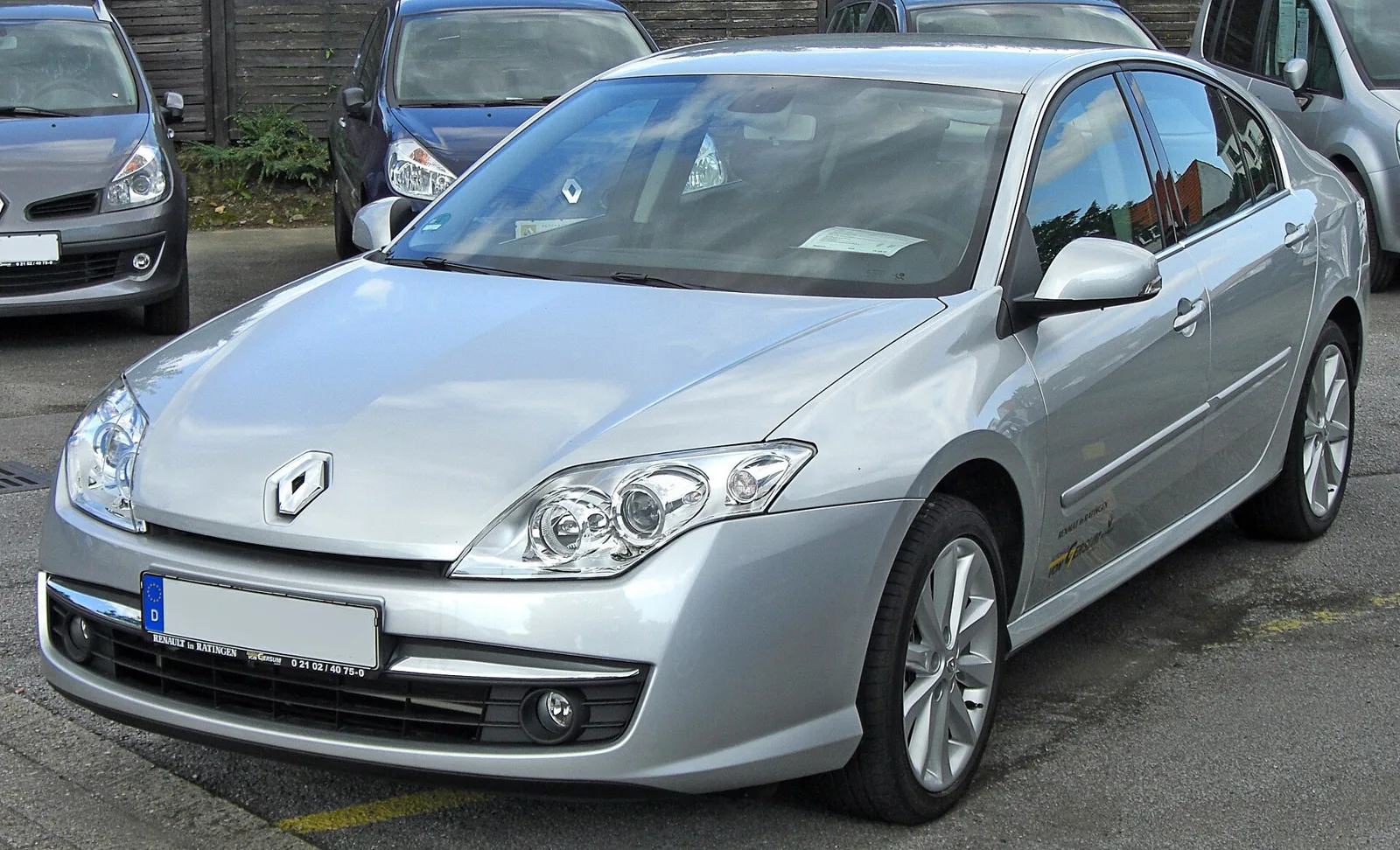
A Renault-Nissan platform, rear steering on the GT and a range that ended almost entirely in diesel.
Built from 2007 to 2015 on a platform shared with Nissan, this final Laguna offered rear steering on the GT trim and an estate boot of 1,593 litres. Sales fell short of expectations, and by 2013 nearly every engine on offer was a diesel.
The Renault Laguna III was the third and last generation of Renault's upper-middle-class car, built from 2007 until 2015 and then replaced by the Talisman. It was developed alongside Nissan on a shared platform, but it did not enjoy the success Renault had hoped for, and by 2013 almost the whole range was diesel.
Where did the Laguna III come from?
The Laguna III grew out of project X91, a new French D-segment car started in the early years of the twenty-first century. Its platform was also meant to underpin later models from Nissan, so the car carried the Renault-Nissan partnership from the start. Renderings had reached the specialist press by 2006.
Louis Schweitzer was still running the group when the project began. From 1 May 2005 Carlos Ghosn took over, having been the chief executive of Nissan alone and the main architect of the merger. He gave the French company an extra push, which helped revive sales of the Laguna II, whose reputation for reliability had been damaged by technical faults until 2003.
Renault spent heavily to hit its quality targets. Project X91 cost one billion euros, and the prototypes were put through hard use. Test mules ran along rough tracks in Argentina, and one was photographed fording a stream. Tests reached altitudes of 4,000 metres, and 120 units covered 6 million kilometres in all, including runs on the internal track at Sandouville, where the car would be assembled.
A Renault-Nissan platform, rear steering on the GT and a range that ended almost entirely in diesel.
How did the Laguna III look?
The Laguna III kept a two-and-a-half-volume body with a hatchback, drew part of its look from the Altica and Fluence concepts, and used a full grille without a mask at the front. The saloon reached a drag coefficient of 0.293, which rose to 0.316 on the estate after careful work on the airflow.
The front bumper had a large central mouth that enclosed the foglamps, with two extra slots on either side. At the rear, a short, truncated tail carried horizontal light clusters on its upper edge. The designers also reworked the areas around the front pillars and the rear flanks to cut turbulence, and the side view showed a higher belt line than the two earlier series.
Inside, the car made clear progress in perceived quality and equipment. Finer materials and more even panel gaps were the aim, and a longer wheelbase with a reshaped rear bench gave rear passengers 20 cm more legroom.
Laguna III launch engines
| Engine | Displacement | Power |
|---|---|---|
| 1.6 16v | 1,598 cc (97.5 cu in) | 110 PS (81 kW; 108 hp) |
| 2.0 16v | 1,997 cc (121.9 cu in) | 140 PS (103 kW; 138 hp) |
| 2.0 Turbo 16v | 1,997 cc (121.9 cu in), turbocharged | 170 PS (125 kW; 168 hp) |
| 1.5 dCi | 1,461 cc (89.2 cu in), turbodiesel with common rail | 110 PS (81 kW; 108 hp) |
| 2.0 dCi | 1,995 cc (121.7 cu in), common rail turbodiesel | 130 and 150 PS (96 kW; 128 hp and 110 kW; 148 hp) |
| Gearbox | Six-speed manual or six-speed automatic | Not applicable |
How did the rear steering work?
Active Drive, also called 4Control, was an electrically actuated rear-steering system. Below 60 km/h the rear wheels turned against the fronts to tighten the turning circle, and above that speed they turned with them to stop the rear axle sliding.
The system was fitted to the GT trim, and the coupe also used the GT floor pan, which carried the 4Control hardware, except in the version with the 170 PS petrol engine. The Laguna GT was easy to spot, with a specific front bumper and front light clusters with black rather than chrome bases.
It was the biggest technological innovation the Laguna III brought. It was not simply a revival of the rear steering that some Japanese cars used until the early nineties, such as the Honda Prelude. Instead it was an electrically actuated system that used sensors to manage the rear axle according to the car's speed.
What changed in the 2010 restyling?
The facelift shown at the 2010 Paris motor show was modest. It changed the headlamps, split the bumper mouth into three with chrome inserts on the sides, added smoked rear light clusters and a new navigation system, and left the range almost entirely to diesel.
The engine line-up varied by market. In Germany the naturally aspirated 2-litre of 140 PS still ran on ethanol, and a 2-litre turbo of 205 PS remained, while France kept only the 2-litre petrol and ethanol engine. Italy's range was diesel only, with a 1.5 dCi and 2-litre engines of 150, 175 and 180 PS.
Why did the Laguna III sell so poorly?
The blame was put on the design, which was judged too anonymous and without appeal. A severe car market recession at the end of the decade also took its toll, and in 2009 the range began to be thinned out in several markets.
The reputation of the Laguna was undermined by teething faults that had affected the second series. Those faults carried over to the new version, even though the new car was no longer affected by them. Renault itself was sceptical about the future of the Laguna and kept quiet about any follow-up in the D-segment.
Which body styles were sold?
The Laguna III came as a saloon, an estate and a coupe. The estate was called GrandTour in Germany and Spain, Estate in France and the United Kingdom, and SporTour in Italy, while the coupe arrived in November 2008 as a new body style for the Laguna.
Renault's top management wanted a sportier line, even at the cost of load capacity. With the rear seat folded the estate offered 1,593 litres, measured to the parcel shelf 1,377 litres, which placed it closer to a premium estate such as the Mercedes-Benz C-Class than to a mainstream family estate. An Opel Vectra C had 500 litres more.
The coupe took its look from the Fluence concept, with a sweeping tail and thin horizontal rear light clusters. Its front was redrawn so it could be told apart from the other two versions, and its wheelbase was cut by 6 cm for more agility on the road.
How did the coupe sell?
The coupe sold even less than the saloon. Its launch engines included a 3-litre common-rail V6 turbodiesel of 235 PS, a 3.5-litre V6 of Nissan origin derived from the one in the 350Z sports car, and smaller engines such as a 2-litre turbo petrol of 205 PS.
Gearboxes followed the engines. The V6 versions had a six-speed automatic, and the four-cylinder versions a six-speed manual. The 170 PS petrol version was the exception to the 4Control floor pan, since it used the conventional two-wheel-steering layout.
In 2010 a 2-litre dCi with reduced power of 150 PS was added to tempt buyers, and petrol engines vanished from much of the European price lists. A 1.5 dCi of 110 PS arrived in 2012 in another attempt to revive sales. In 2013 the 2-litre dCi of 180 PS went, leaving the 3-litre V6 diesel to carry the 4Control technology.
In 2011 a 2-litre dCi of 173 PS joined the 180 PS unit without replacing it. All of the smaller engines were paired with the conventional two-wheel-steering system, while the 3-litre V6 kept the 4Control technology.
The coupe disappeared from its last price lists in summer 2015, and no replacement was planned. Photos of the Talisman Sporter, heir to the SporTour, followed on 26 August 2015, which marked the end of SporTour production.
How did sales begin, and when did the estate arrive?
Sales started straight after the Frankfurt show, first for the saloon alone. The estate reached the price lists in December under the SporTour name, even though its sales had been pencilled in for the following January. As with the two previous generations, the estate carried a different name in each market.
The estate debuted with the same engines planned for the saloon, including the market-by-market differences. The GT trim with 4Control four-wheel steering was offered on the estate too, and its rear window opened separately, a practical feature inherited from the previous version.
What did 2008 add to the range?
In 2008 Renault added the coupe body style, a 2-litre turbo petrol of 205 PS and a 2-litre diesel in 175 and 180 PS versions. The 205 PS turbo petrol and the 180 PS diesel were offered in the GT trim, which carried the Active Drive system.
A new 3-litre V6 diesel of 235 PS arrived as well. In Italy it was reserved for the coupe alone, although other markets extended it to the other two body styles.
How did the range shrink after 2009?
In 2009 the range was cut back in several markets. Germany lost its 2-litre engines of 130 and 175 PS, the 175 PS unit also left the Italian price list, and all the petrol engines went apart from the naturally aspirated 2-litre of 140 PS.
For the French market alone, and for only about a year, the saloon and estate were also offered with the coupe's top engine, a 3.5-litre V6 of Nissan origin rated at 240 PS (177 kW; 237 hp). In the United Kingdom the estate was cancelled in 2012, having had a year and a half on sale before the mid-life restyling.
What did the 2013 update change?
The 2013 update brought LED position lights and changes to the interior trim, in the countries where the Laguna stayed on sale. The saloon disappeared from the Italian price list that year, with the SporTour estate staying on.
The MY'13 engine line-up was the 1.5 dCi of 110 PS, the 2.0 dCi in 130 PS (not for Italy), 150 PS and 175 PS, and a 3-litre dCi V6 of 240 PS for the coupe alone. Some countries also received a 2.0 TCe of 180 PS and the EDC twin-clutch gearbox, and apart from those cases the range was entirely diesel.
What was under the skin?
The floor pan evolved from the Laguna II, and the body shell was stiffer, which cut weight by between 15 and 65 kg depending on the version. Springs were 20% stiffer at the front and 50% stiffer at the rear, but high-elasticity components kept the ride comfortable.
The suspension layout was unchanged from the Laguna II, with a MacPherson front axle and a rear axle with interconnected wheels. Pressurised shock absorbers were paired with the front springs and twin-tube units with the rear. The four discs were ventilated at the front, and the steering was rack-and-pinion with hydraulic assistance.
What replaced the Laguna III?
The Renault Talisman replaced the Laguna III. Renault revealed its first photos in mid-2015, and it was an updated version of a model on sale since 2012 for Asian and North American markets. Production of the Laguna III ceased at the same time.
A crossover that had been rumoured in 2014 to replace the Laguna and rival models such as the Citroen DS5 stayed a rumour, and it was definitively denied when the Talisman arrived.