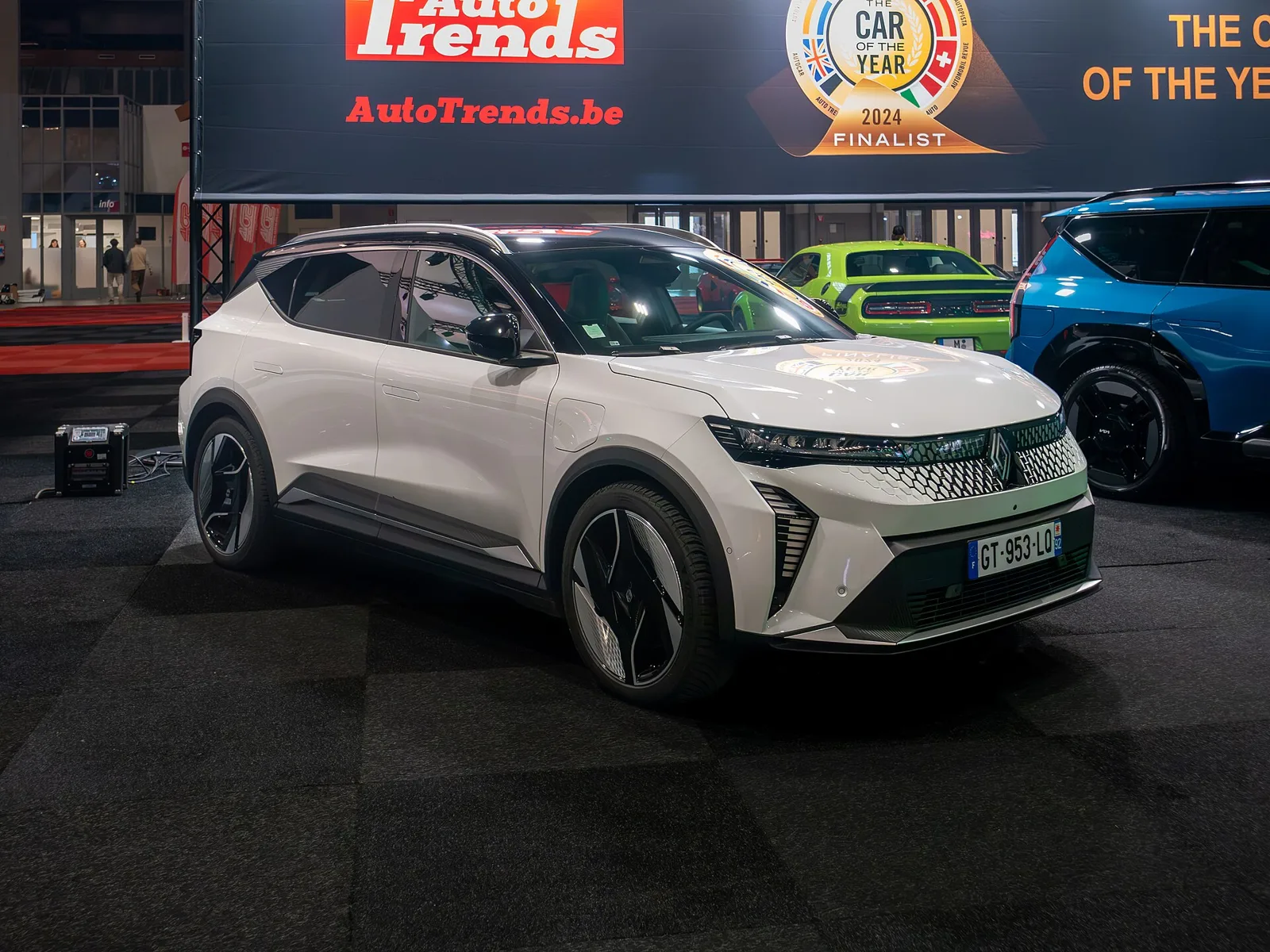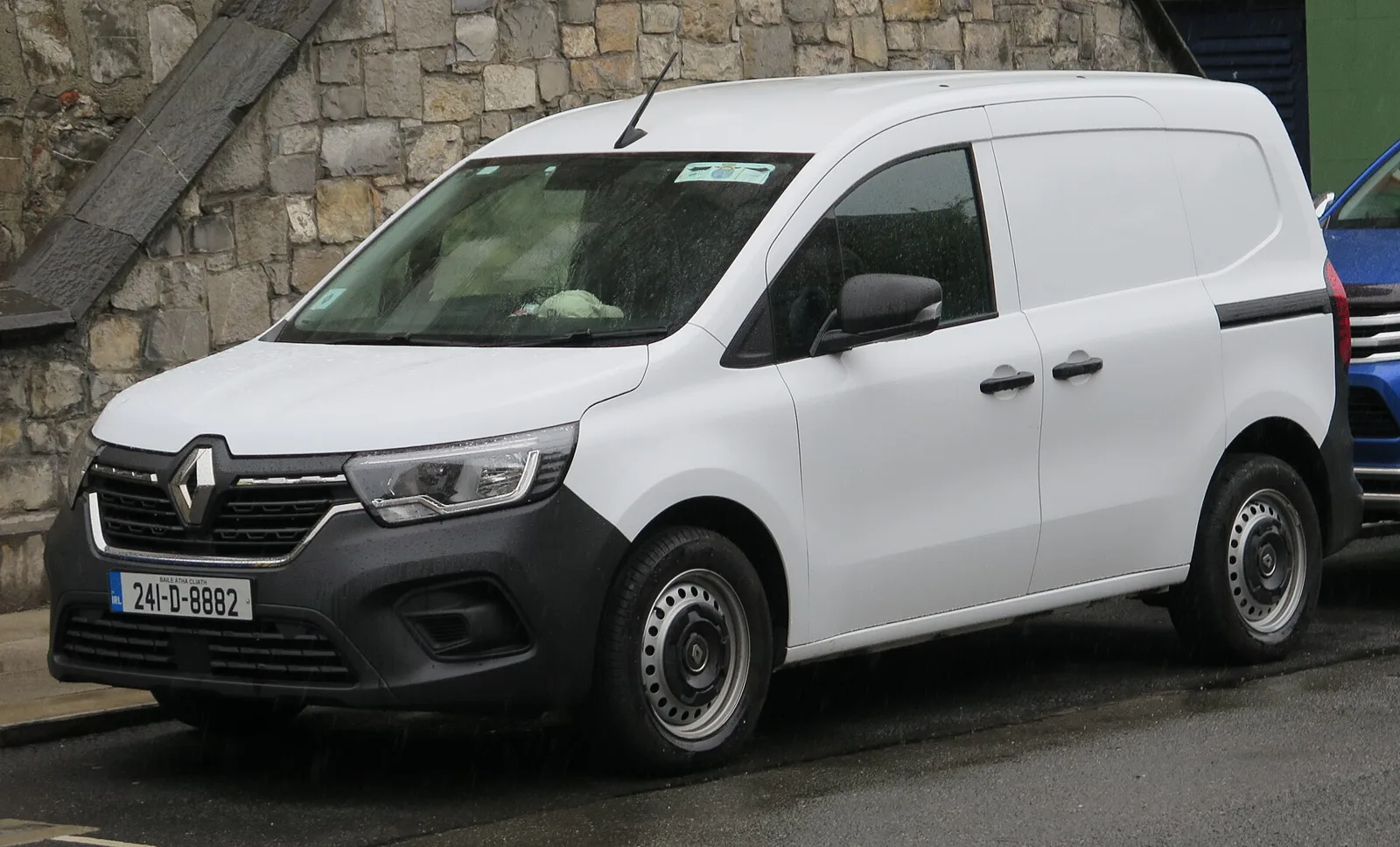
A minivan family built since 1997 for passengers and trades, which went electric in 2011 and became Europe's best-selling all-electric light commercial.
Renault's Kangoo has been sold as both a passenger vehicle and a light commercial since 1997, across three generations. Its Z.E. and E-Tech electric versions turned it into a leading electric van, and rebadged versions reached Nissan and Mercedes-Benz showrooms.
The Renault Kangoo is a family of minivans that Renault has built since 1997 across three generations. It is sold both as a passenger vehicle and as a light commercial, and it has become Europe's top-selling all-electric light commercial vehicle, with more than 100,000 units produced by June 2023.
Where is the Kangoo built and sold?
The European-market van comes from the MCA plant in Maubeuge, France. The same basic van has also been sold through other brands, which gave it reach well beyond Renault's own showrooms.
Nissan rebadged the Kangoo as the Kubistar in many European markets from 2003 to 2009, then as the NV250 and later the Townstar. Mercedes-Benz began marketing a rebadged second-generation car as the Citan in September 2012, and the current generation is sold as the EQT and T-Class.
A minivan that began as a family-sized panel van and became Europe's electric workhorse.
What was the first-generation Kangoo?
The first generation, codenamed X76, was introduced in October 1997. A facelift in March 2003 brought new front-end styling, including the Renault diamond mounted on a body-coloured panel in the grille and teardrop headlamps.
The rear windows and seats could be removed to make the panel van Kangoo Express. The car was also a long-running favourite with mobility-impaired people and wheelchair users, because of its height and the way it could be adapted.
Adaptations included a cut-out at the rear for a ramp, retractable front belts that lock a wheelchair in place and rear clamping buckles that stop it moving forward. Wallace and Gromit fronted the UK advertising from July 2003.
How did the Kangoo Trekka handle off-road?
The four-wheel drive version arrived in 2002 under the name Trekka. Its all-wheel drive system used a Nissan-sourced automatic torque coupling, which engaged the rear wheels only when the fronts began to lose traction.
Electronic traction control could brake the front wheels to arrest slip. The front struts were longer, and the rear suspension was rebuilt as a fully independent coil-sprung system with wishbones on a subframe that raised ground clearance.
Those changes gave a fording depth of 400 mm (15.7 in) and a hill-climbing angle of 28 degrees. In the UK the Trekka was offered with a 1.6-litre petrol and a 1.9 dCi diesel, both with a five-speed manual.
In 2005 the Trekka cost GBP 12,600 with petrol and GBP 13,600 with diesel. The petrol version reached 100 km/h in 14.3 seconds and returned 9 L/100 km (31 mpg-imp; 26 mpg-US) on the combined cycle.
The diesel produced 180 N-m (133 lb-ft) of peak torque and managed over 7 L/100 km (40 mpg-imp; 34 mpg-US). The interior was spartan, but the rear bench folded to create a 2.5 m3 (88 ft3) load area.
What was the Kangoo Break'Up concept?
The Kangoo Break'Up was a four-wheel drive concept announced in August 2002. It previewed the facelift design due in 2003, complete with a pickup-style rear, and it used a 1.6-litre engine producing 82 kW (110 hp).
Its layout pointed towards the later Trekka, although the concept never reached production in that form.
How did the Kangoo sell in Argentina?
The first generation was produced in Argentina from 1998 to 2018. Panel van production began in 1998 and the passenger model followed in 2001, with a first facelift in 2008.
A second facelift, internally codenamed VLL, arrived in 2013 for the Argentine market alone. The line was discontinued in 2018 to make way for a replacement based on the Dokker, after 374 591 units had been built for Argentina and several other Latin American countries, including Brazil, Uruguay, Paraguay, Colombia, Chile, Mexico and Cuba.
What did the second generation bring?
The second-generation car, codenamed X61, went on sale in May 2007. It was based on the Scenic and built at Maubeuge, and a seven-seat version, 40 cm longer, became available from July 2012.
The short-wheelbase Kangoo Compact carried 500 kg (1,102 lb) of payload, while the Express and Express Maxi offered between 650 and 825 kg (1,433 and 1,819 lb). The Express Maxi had up to 2.90 m (9.5 ft) of usable floor length.
The Be Bop was a three-door, four-seat version with a sliding glass roof at the rear and a two-tone body. Renault showed it at the 2008 Paris Motor Show, but it was judged expensive and impractical, and only 1,400 units were built between 2009 and 2011.
How did the Kangoo Z.E. electric van take off?
The Kangoo Z.E. was prototyped at the September 2010 International Commercial Vehicles Show in Hanover and released for retail sale in October 2011. It was voted International Van of the Year for 2012 and was named Electric Vehicle of the Year in 2012 and 2013 by GreenFleet.
In France, 3,652 units were registered through December 2012, and 2,869 were delivered in 2012 alone. That made it the top-selling plug-in electric vehicle there. Across Europe the van sold 6,658 units through December 2012, and worldwide sales reached 6,665.
Worldwide cumulative sales passed 10,000 by September 2013, roughly 10% of the Kangoo's total van sales. By June 2014, 9,125 Z.E. vans were registered in France, and global sales totalled 48,821 through December 2019.
The Z.E. uses a synchronous electric motor with a 44 kW (59 hp) peak output at 10,500 rpm. Its 226 N-m (167 lbf-ft) of torque is paired with a 22 kWh lithium-ion battery, and the top speed was capped electronically at 130 km/h (81 mph).
The original Z.E. was limited to 3.7 kW of AC charging, and the 33 version doubled charging power to 7 kW.
The 2017 Z.E. 33, sometimes called Power+, added a 33 kWh battery with a range of 270 km (170 mi) on the NEDC cycle. It also got a new charger that doubled charging power to 7 kW, a heat pump and a Renault R60 motor developed from the Zoe's R90.
What is the third-generation Kangoo?
The third-generation Kangoo was revealed on 12 November 2020, alongside a lower-spec model called the Express. It is based on the CMF-CD platform developed by Renault and Nissan, production started in late 2020 and sales began in early 2021.
The Z.E. reached Mexico on 15 October 2020, and a 2024 update brought Renault's latest logo to the range.
Nissan's Townstar, revealed in September 2021, replaced the NV200 and NV250 in various markets. In Europe the electric Nissan e-NV200 was replaced by a Townstar EV based on the Kangoo E-Tech Electric, which earned four stars from Euro NCAP in 2021.
The Kangoo E-Tech Electric was previewed by the Kangoo Z.E. concept in April 2019 and officially introduced in November 2021. Production of the 100% electric panel van began in June 2022, and the passenger version followed at the Paris Motor Show in October 2022.
Buyers could specify an optional charger accepting up to 80 kW DC or 22 kW AC, while the standard onboard charger is limited to 11 kW AC.
The E-Tech has a 90 kW (120 hp) traction motor with 245 N-m (181 lbf-ft) of torque, drawing from a 45 kWh battery for a WLTP range of 285 to 300 km (177 to 186 mi). It reaches 100 km/h in 11.6 seconds and tops out at 135 km/h (84 mph), with an Eco mode that cuts output to 56 kW (75 hp).
Specifications across the generations
| Generation | Code | Launch | Notable figures |
|---|---|---|---|
| First | X76 | October 1997 | Kangoo Express panel van, Argentine production 1998 to 2018 |
| Second | X61 | May 2007 | Be Bop 3,870 mm (152 in), Grand Kangoo seven seats |
| Z.E. electric | X61 based | October 2011 | 44 kW (59 hp), 22 kWh battery, 170 km (110 mi) NEDC |
| Third | XFK | 12 November 2020 | CMF-CD platform, E-Tech Electric 90 kW (120 hp) |
Why did the Kangoo Z.E. matter?
In its early years the Z.E. led the small electric van segment, and it was France's most registered electric vehicle. It also showed that a commercial van could work as a battery electric product at scale.
Today Renault sells the Kangoo E-Tech alongside its petrol and diesel siblings, and the Z.E. name remains a reminder of where that electric story began.
Renault also tested hybrid ideas with the Cleanova II drivetrain, which was fitted to a Kangoo-based vehicle in both full electric and plug-in hybrid form.