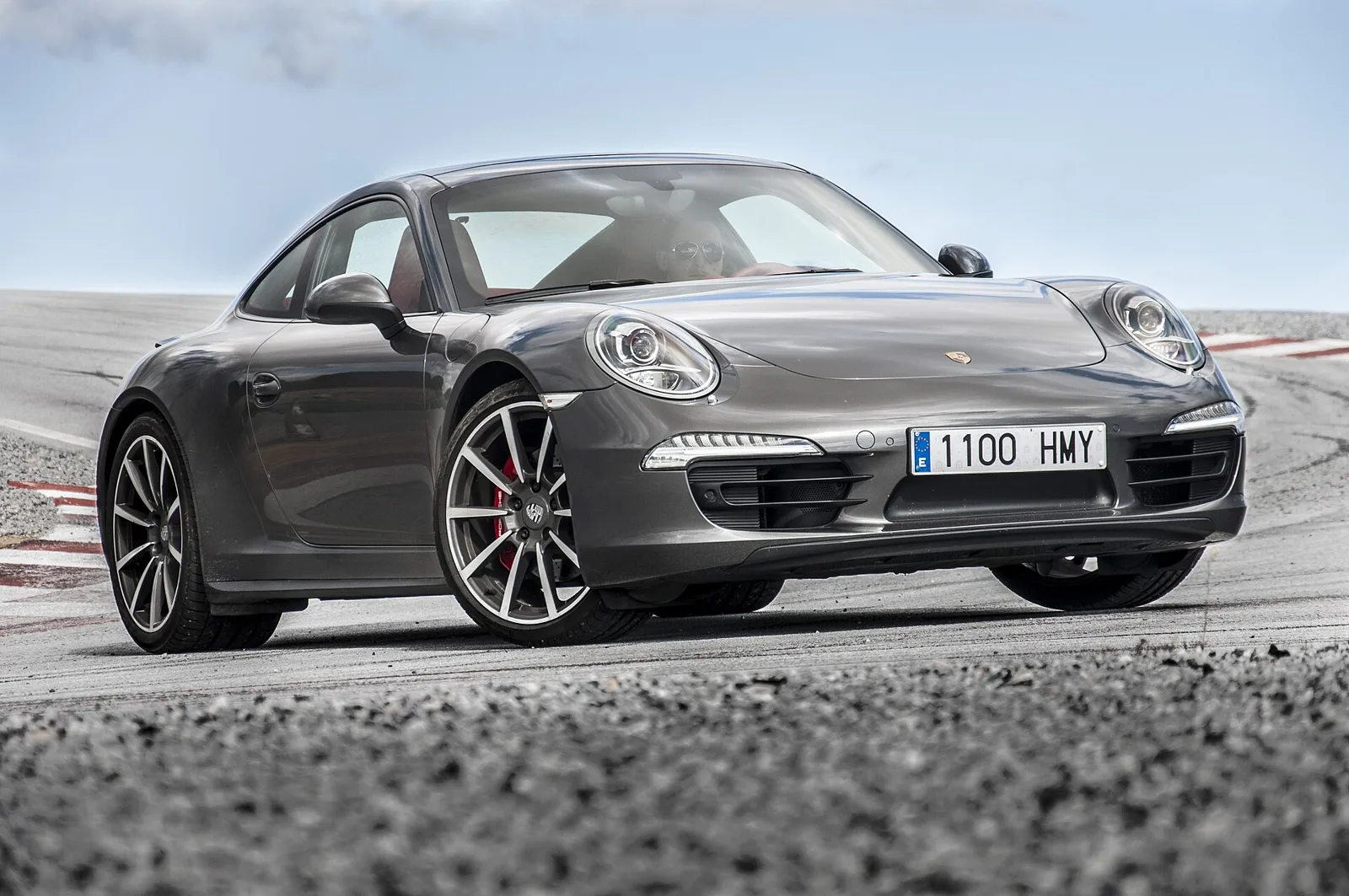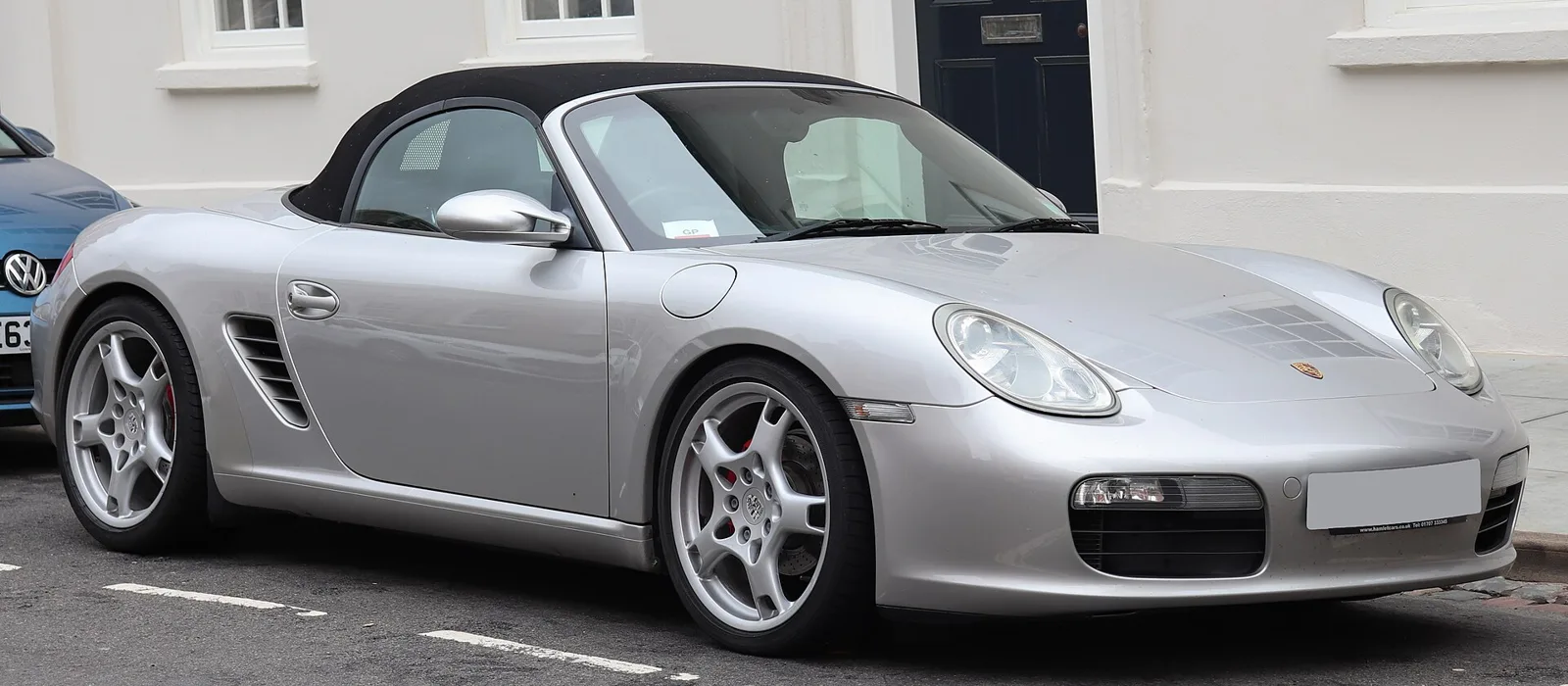
The second-generation Boxster and its Cayman sibling, from the 2004 debut through Spyder, Boxster E and Cayman R variants to the 2012 handover to the 981.
The Porsche 987 is the second generation Boxster, launched in 2005 and sharing its mid-engine platform with the Cayman coupe. Porsche replaced it with the Porsche 981 in 2012, and the 987 family spawned the RS60 Spyder, Boxster Spyder, Boxster E and Cayman R.
The Porsche 987 is the project name given to the Boxster's second generation. Launched at the 2004 Paris Motor Show beside the 911 (997), it reached showrooms in 2005 and gave way to the Porsche 981 in 2012. The fastback Cayman arrived in 2005 on the same mid-engine platform, so the 987 generation covered both an open roadster and a closed coupe.
How much did the 987 Boxster change from the 986?
The 987 Boxster kept the basic shape of its predecessor, but Porsche says it shares only 20% of its components with the earlier car. The most visible change is the headlight profile, which now follows a shape close to that of the Carrera GT, the mid-engine flagship Porsche was building at the time.
The side intake vents grew larger, with more pronounced horizontal slats, and they were finished in metallic silver whatever the body colour. The wheel arches were widened to accept wheels up to 19 inches in diameter, the first time the Boxster range had offered that size.
Most of the significant updates were inside the car. The instrument cluster and cooling vents adopted a more prominent circular theme, giving the cabin a different character from the 986 series it followed.
A shared mid-engine platform that let the Boxster and Cayman match each other on power from 2007.
What engines did the 987 Boxster use at launch?
The base Boxster used a 2.7-litre flat-6 rated at 176 kW (236 hp), while the Boxster S ran a 3.2-litre engine producing 206 kW (276 hp). Both were boxer engines mounted behind the seats, and those figures set the baseline for the first 987 cars before later updates added power.
The 2007 model year brought a revised base engine with VarioCam Plus, adding 3.7 kW (5.0 hp) to reach 183 kW (245 hp). That matched the Cayman. The Boxster S grew from 3.2-litre to 3.4-litre, and its output rose by 11 kW (15 hp) to 220 kW (295 hp), again matching the Cayman S.
Those upgrades left the Boxster and Cayman ranges level on power, so buyers could compare the two bodies on equal footing.
What changed with the 987.2 Boxster in 2008?
Porsche revealed the revised 987.2 Boxster and Boxster S at the Los Angeles International Auto Show in November 2008. Both used entirely new engines, the MA1.20 and MA1.21 units, and a new 7-speed PDK dual-clutch gearbox was offered alongside a standard 6-speed manual.
Capacity in the base flat-six went up from 2.7 to 2.9 litres, which took it from 245 hp (183 kW) to 255 hp (190 kW). Direct injection on the Boxster S lifted its 3.4-litre unit to 310 hp (231 kW), up from 295 hp (220 kW).
For 2009 the styling was refreshed at both ends: the lights were redesigned, the front intakes grew and gained daytime running lights, and the lower tail was reshaped with twin diffusers. An optional Porsche Communication Management System arrived with a touchscreen, which reduced the number of buttons on the dashboard.
How many RS60 Spyders were built?
Announced in November 2007, the RS60 Spyder marked Porsche's 1960 victory at Sebring in the 12 Hours. Porsche built 1,960 worldwide, with roughly 800 earmarked for the US, and each car carried a numbered badge on the dash.
The RS60 came only in GT Silver Metallic. Carrera Red leather was the standard interior, with dark grey leather available as an option. It rode on 19-inch SportDesign alloys with PASM, and a sports exhaust took output to 303 PS (299 hp; 223 kW).
The Boxster S Porsche Design Edition 2 followed in October 2008 as a 2009 model. A free-flowing exhaust lifted its output from 217 kW (291 hp) to 223 kW (299 hp). Only 500 were made for the worldwide market, with 32 coming to the US and 18 to Canada.
The Design Edition 2 was finished in Carrera White, with white 19-inch wheels, black and grey upholstery, white dials, red rear lamps and light grey side stripes.
For 2008, Porsche also unveiled a limited edition Boxster and Boxster S at a private gathering tied to the 2007 New York Auto Show. Drawing on the 2007 911 GT3 RS, Porsche built 250 of each model in brilliant orange, with Alcantara trim and orange detailing inside.
What was the Boxster Spyder?
Porsche announced the Boxster Spyder on 5 November 2009 and unveiled it at the 2009 Los Angeles Motor Show. Sitting above the Boxster S, it was the lightest Porsche on sale then, at 1,275 kg (2,811 lb).
The Spyder weighed 80 kg (176 lb) less than a Boxster S. Porsche dropped the soft top's operating gear, the radio, the door handles, the air conditioning and the cup holders, plus the big LED modules up front. Some of those items could be re-added as options.
Further weight came out through aluminium doors, an aluminium rear deck and the lightest 19-inch wheels in the Porsche range. The car also sat almost one inch lower than the other Boxsters, with a firmer suspension setup designed for sharper handling.
The roof was a manual canvas item, the seats were carbon fibre sports buckets, and two signature humps ran along the rear deck. Under that deck the six-cylinder boxer made 320 PS (316 hp; 235 kW) with 273 lb-ft (370 N-m) of torque, which sits 7.5 kW (10 hp) above the Boxster S and the Cayman S.
How light was the Boxster Spyder's mechanical package?
The Spyder was 80 kg (176 lb) lighter than the Boxster S, and the savings came from stripping equipment rather than changing the engine's basic layout. Its six-cylinder boxer kept the same architecture, while the body and interior were reworked to shed mass.
The rear deck and doors were aluminium, and the wheels were the lightest 19-inch items Porsche offered. The lower stance and firmer suspension were there to help the car handle. The lower stance and firmer suspension were there to help the car handle.
The Spyder came with a 6-speed manual transmission as standard, and Porsche's 7-speed PDK dual-clutch gearbox was available as an option. The car went on release worldwide in February 2010 as a 2011 model.
What was the Boxster E?
The Boxster E was an electric prototype built on the 987 chassis. Three battery-electric prototypes were produced in 2011 as part of the Model Region Electro-Mobility Stuttgart trial, and they were unveiled at the Michelin Challenge Bibendum in May 2011.
One prototype had electric motors on both the front and rear axles, while the other two had motors on the rear axle only. Each motor produced 90 kW (120 hp) and 270 N-m (200 lbf ft) through a single-speed transmission, with a maximum speed of 12,000 rpm. Paired together, the two-motor car made 180 kW (240 hp) and 540 N-m (400 lbf ft).
The two-motor Boxster E was claimed to reach 0-100 km/h (62 mph) in 5.5 seconds, with a top speed of 200 km/h (120 mph). The rear-motor cars took 9.8 seconds to the same benchmark and reached 150 km/h (93 mph).
On the NEDC cycle the car was rated at 170 km (110 mi). Its LiFePO4 pack offered 29 kW-hr gross and 26 kW-hr usable, and the whole vehicle tipped the scales at 1,600 kg (3,500 lb), 341 kg (752 lb) of which was battery.
When did the Cayman arrive?
The Cayman fastback coupe was developed for two years before its first model, the Cayman S, was released. Photographs and technical details appeared in May 2005, and the public unveiling came at the September Frankfurt Motor Show. The base Cayman followed on sale in July 2006.
The S suffix stood for Sport or Special and marked the Cayman S as the higher performance version of a base model that had not yet been released.
Both cars sat on one mid-engine platform and used many shared parts, from the front wings and boot lid to the doors, lamps and the front half of the cabin. The body drew styling cues from classic Porsches, among them the 356/1, the 550 Coupe and the 904 Coupe.
Unlike the Boxster, the Cayman has a hatchback that opens to the luggage area above and behind the engine cover. Everything behind the side doors is built from stainless steel, and the suspension is fundamentally the same as the Boxster's, with revised settings to suit the stiffer fixed-roof body.
What engines and gearboxes did the first Cayman use?
The first-generation Cayman S used a 3.4-litre flat-6, the M97.21, derived from the 3.2-litre unit in the Boxster S. It had cylinder heads from the 997 S 3.8-litre engine. The base Cayman used the 2.7-litre M97.20, and both engines were exclusive to the Cayman until the 2007 model year.
The Cayman S engine carried VarioCam Plus inlet valve timing and lift, a system later fitted to the Boxster. Porsche ended the Cayman-only engine arrangement in 2007 when it upgraded both Boxster models.
On gearboxes, the Cayman came with a 5-speed manual as standard, while the S used a 6-speed Getrag 466 manual as standard. A 6-speed manual was an option on the base car, and an electronically controlled 5-speed Tiptronic automatic was available on both. From 2009 the seven-speed PDK dual-clutch replaced the Tiptronic.
Other options included PASM active shock absorbers, ceramic disc brakes branded PCCB, Bi-Xenon headlights and the Sport Chrono package with its electronically controlled sport mode. The first-generation Cayman ceased production in November 2011.
How fast was the Cayman S around the Nurburgring?
Rally driver Walter Rohrl set 8 minutes 11 seconds around the Nurburgring Nordschleife in a Cayman S. That car had optional 19-inch wheels, PCCB and PASM. Porsche's published figure for a standard Cayman S was 8 minutes 20 seconds.
Rohrl recorded 8 minutes 15 seconds in a 911 Carrera on the same circuit, so the optioned Cayman S was quicker than the 911 on that run.
Run by a private team of Juergen and Uwe Alzen, one Cayman took fourth place out of 220 entrants at the 2007 Nurburgring 24 Hour. The result put it ahead of two flagship 997 GT3 RSRs, a 997 GT3 Cup and a 996 GT3 Cup. CSR and MSpeed entered two more privateer Caymans, which finished 22nd and 117th. Porsche gave no backing to the Cayman teams but supported some or all of the 997 squads.
What changed with the Cayman in 2009?
The revised Cayman 987.2 arrived on 21 February 2009 with a new engine family, the MA1.20 and MA1.21. The base car's displacement rose from 2.7 to 2.9 litres, and the Cayman S gained direct injection. PDK, the seven-speed dual-clutch unit, took over from the Tiptronic S.
The base engine gained 15 kW (20 hp) to reach 198 kW (266 hp), while the Cayman S gained 19 kW (25 hp) to reach 239 kW (321 hp). The Intermediate Shaft was gone from the new engines, having been a weak point in pre-2009 units.
A 7 kW (9 hp) advantage over the roadster was kept by both the Cayman and the Cayman S. Each model also got its own front bumper design, and the signal lamps differ too: the Cayman's LEDs are arranged like the face of dice, while the Boxster uses a horizontal row of 4 LEDs.
Porsche's limited-slip differential also became a factory option. The Cayman R, from 2011, sat at the top of the 987.2 family, shedding weight and gaining power, aero and handling tweaks.
Which special editions did the Cayman get?
The Cayman had several special editions. The Porsche Design Edition 1 had 777 cars built as 2008 models, the Cayman S Sport had 700 built, and the Black Edition was the rarest limited Cayman S with 500 made.
The Porsche Design Edition 1 was a Cayman S designed by Porsche Design to mark its 35th anniversary. Trim was black leather across the seats, dashboard and doors, with Alcantara on the wheel and headliner. The 19-inch wheels came from the 997 911 Turbo, sized 235/35 ZR 19 at the front and 265/35 ZR 19 at the rear. Its body sat 10 mm (0.4 in) lower with PASM.
The Design Edition 1 went on sale in November 2007 in Germany, with US sales following from January 2008. A briefcase came as standard, holding a chronograph, a pocket knife, sunglasses, a pen and a key ring, all in black.
The Cayman S Sport arrived in October 2008 as a 2009 model, with Porsche Sports Exhaust, PASM and Sport Chrono. Its colour range included Bright Orange and Signal Green taken from the 911 GT3 RS. 700 were built, with 100 of them destined for the US.
The Black Edition went on sale from July 2011, and 500 were built, which makes it the rarest limited Cayman S in the series.
What made the Cayman R the pinnacle of the 987?
The Cayman R, introduced in 2011, was based on the 2009 987.2 Cayman S. It weighed 54.8 kg (121 lb) less, carried a 3,436 cc flat-six producing 330 PS, 243 kW (326 hp), and sat lower than a PASM Cayman S.
Lighter parts did most of the work: 19-inch wheels shared with the Boxster Spyder, doors from the 997 GT3, bucket seats derived from the 997 GT2, and no radio, storage bins, air conditioning, door handles or rear wiper. Porsche's ceramic composite brakes were an additional option.
The R treatment extended to decals on the doors, an instrument cover delete, gloss black mirrors, black R badges on the boot, dashboard and sills, and black painted wheels. Aerodynamic changes were minor, with a carbon rear spoiler and more aggressive front spoilers, using a Porsche aero kit that had been offered as an option since 2007.
Performance figures were 5 seconds for 0-100 km/h (62 mph) with the manual gearbox, 4.9 seconds with the PDK, and 4.7 seconds with the Sport Chrono package and its launch control. Top speed was 282 km/h (175 mph) with the manual and 280 km/h (174 mph) with the PDK.
The R made its debut at the 2010 Los Angeles Auto Show, on 17 November 2010, and 1,621 were built worldwide. Of those, 220 went to the UK, and the split was roughly 100 manuals to 120 PDK automatics. The R name echoed the 1967 911 R, a racing car of which only 19 were made.
How long did the 987 generation run?
The 987 generation ran from its 2004 debut at the Paris Motor Show until its replacement by the Porsche 981 in 2012. The first-generation Cayman stopped production in November 2011, a year before the handover.
What are the Porsche 987 specifications?
| Specification | Detail |
|---|---|
| Type | Mid-engine sports car: Boxster roadster and Cayman fastback coupe |
| Launch | Debut at the 2004 Paris Motor Show; on sale in 2005 |
| Replaced by | Porsche 981 in 2012 |
| Boxster base (2005) | 2.7-litre flat-6, 176 kW (236 hp) |
| Boxster S (2005) | 3.2-litre flat-6, 206 kW (276 hp) |
| Boxster (2008) | 2.9-litre, 255 hp (190 kW); Boxster S 3.4-litre with direct injection, 310 hp (231 kW) |
| Boxster Spyder | 1,275 kg (2,811 lb); 320 PS (316 hp; 235 kW); 273 lb-ft (370 N-m) |
| Cayman S (2009) | 3.4-litre, 229 kW (307 hp); 2.9-litre base 198 kW (266 hp) |
| Cayman R | 3,436 cc, 330 PS, 243 kW (326 hp), 370 N-m (273 lb-ft) |
| Cayman R weight saving | 54.8 kg (121 lb) against the Cayman S |
| Cayman R sprint | 5 seconds manual, 4.9 seconds PDK, 4.7 seconds with Sport Chrono |
| Boxster E | Two-motor output 180 kW (240 hp); NEDC range 170 km (110 mi) |