Fastback styling, the shared EMP2 platform, a 2023 facelift and the 360 PS 508 PSE: the story of Peugeot's second-generation 508.
The Peugeot 508 II was the second generation of Peugeot's 508 family saloon, built from September 2018 to May 2025. It came as a five-door fastback in Europe and a longer four-door 508L in China, with petrol, diesel and plug-in hybrid engines, before the 360 PS 508 PSE arrived.
Peugeot's second-generation 508 arrived in 2018 as a sleeker alternative to the saloon it replaced. It was aimed squarely at the five-door coupe segment, and it stayed in production until May 2025, with a facelift in 2023 and a high-performance PSE model along the way.
What did the 508 II set out to do?
The 508 II replaced the first-generation 508 in the family saloon segment, with a hatch and a more dynamic silhouette than its predecessor. Peugeot's stated aim was to compete with the Audi A5 Sportback and the Volkswagen Arteon in the five-door coupe segment.
The launch was staggered. Peugeot presented the European model on 22 February 2018, and it was shown to the public at the Geneva International Motor Show that March. The Chinese version followed at the Beijing motor show in April, and sales started in September of the same year.
The estate, the SW, waited for the 2018 Paris Motor Show and went on sale in early 2019. Before the saloon reached showrooms, two 508s acted as support cars for 504s entered in the Tour Auto Optic 2000 in April 2018, a way of promoting the model in France.
Shorter than its predecessor, sharing its platform with three sister cars, and offered in a 360 PS form that Peugeot called its most powerful saloon.
How did the 508 II look, and what changed in 2023?
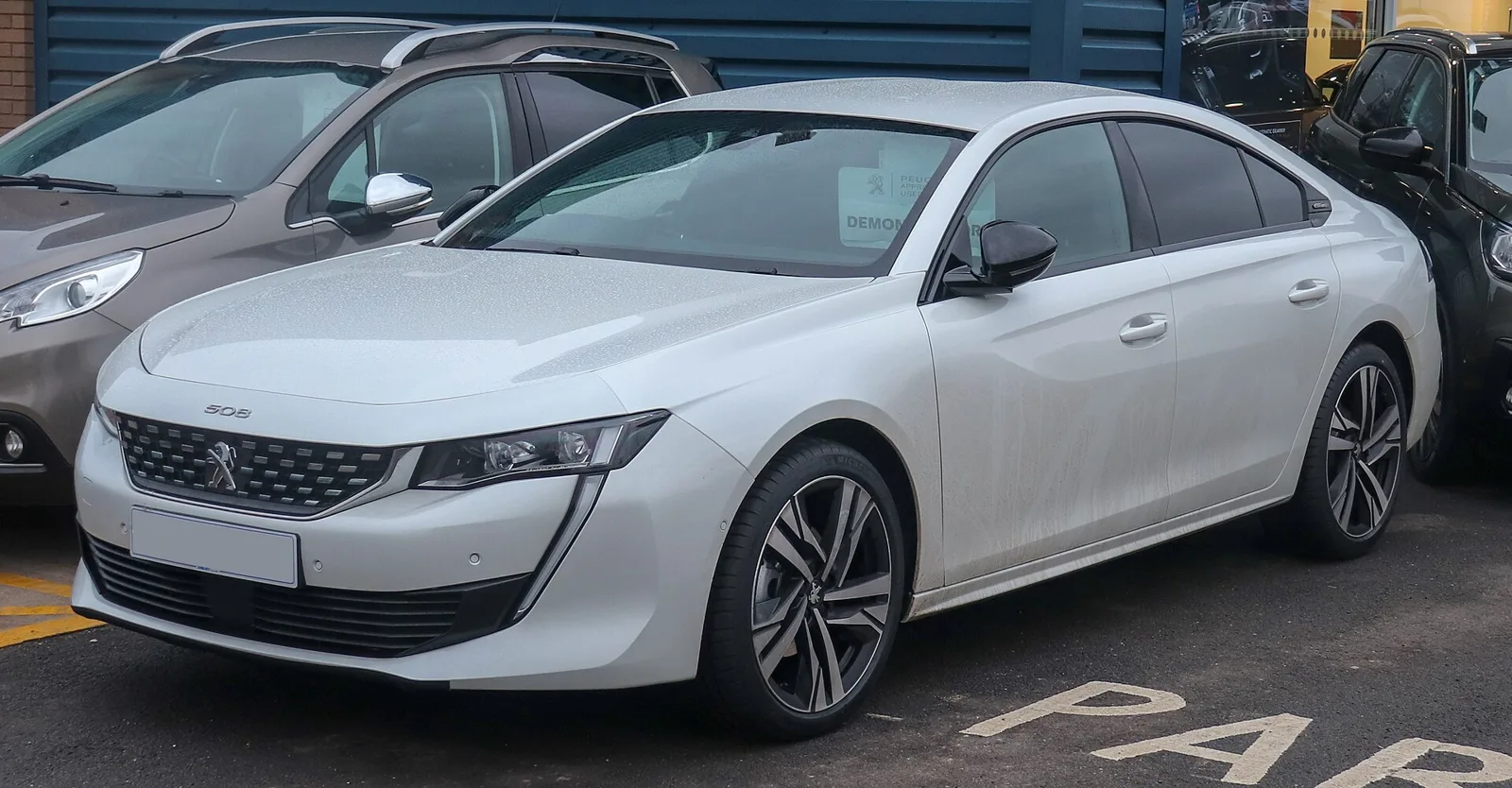
The car had a hatch, a sharper profile than the saloon it replaced, and doors without window frames, which matched its rivals. Giovanni Rizzo signed the exterior design, while Sylvain Henry drew the estate, which has a steeply inclined rear window. The design reference was the Peugeot Exalt, a four-door coupe shown at the 2014 Beijing motor show.
The facelift, presented on 24 February 2023, gave the saloon a new front end. Three-claw daytime running lights replaced the single-claw units, and slimmer headlights used an LED matrix. The grille was redesigned in body colour where the old one had been chrome, and the PSE version received a single, uniform black finish.
At the rear the lights were modified slightly, with the direction of the claws reversed, and the PEUGEOT lettering took the place of the old logo. The new brand logo appeared on the car too, but it was not offered on the wings of the top trim, as was the case on the 308 and 408.
Key specifications
| Specification | Figure |
|---|---|
| Platform | EMP2, PSA Group |
| Length | About 4.75 m (15.6 ft) |
| Wheelbase | 2.79 m (9.2 ft) |
| Rear suspension | Multi-link |
| Launch engines | Five |
| Hybrid system | 1.6 PureTech 180 PS (178 hp) and 80 kW (110 PS; 108 hp) electric motor, 200 PS (197 hp) combined |
| 508 PSE output | 360 PS (355 hp) |
| 508 PSE torque | 520 Nm (384 lb ft) |
| 508 PSE 0-100 km/h | 5.2 s |
| 508 PSE top speed | 250 km/h (155 mph) |
| Hybrid CO2 emissions | Below 49 g/km |
What platform did the 508 II use?
The 508 II sat on the new EMP2 platform of the PSA Group, the same architecture used by the Citroen C5 Aircross, DS 7 Crossback and Opel Grandland X. It was shorter than its predecessor, at about 4.75 m (15.6 ft) against 4.83 m (15.8 ft), with a wheelbase of 2.79 m (9.2 ft).
The shorter body was deliberate. It kept the 508 from coming too close to its sister model, the DS 9, which was launched in 2020 and measures 4.93 m (16.2 ft) in length.
Like the first-generation 407 and 508, the 508 II used a multi-link rear suspension, and it kept the hatch of the earlier car. Technology followed the second-generation 308 and 3008: the i-Cockpit arrived, along with a variable-damping suspension called Active Suspension Control, standard on the petrol versions.
The instruments were digital, with a 31 cm screen offering six display modes. On the dashboard sat a 20 cm touchscreen at entry level, growing to 25 cm from the Allure trim up. A night vision system became optional in 2021, using an infrared camera to spot people and animals after dark and alert the driver.
Which engines did the 508 II offer?
At launch in 2018 the 508 offered five engines. The petrol range used the 1.6 THP four-cylinder in 180 PS (178 hp) and 225 PS (222 hp) outputs, while diesel buyers got a new 1.5 BlueHDi 130 PS (128 hp) and the 2.0 BlueHDi in 160 PS (158 hp) and 180 PS (178 hp) versions.
Stop and Start came fitted to every version. The range then changed quickly. The Euro 6D-Full standard, steadily rising CO2 bonus-malus charges and European quotas on average emissions pushed the most powerful purely combustion engines out of the catalogue.
In December 2020 the 1.5 BlueHDi 130 BVM6 and the two 2.0 BlueHDi engines disappeared, leaving the 1.5 BlueHDi 130 EAT8 as the only diesel. Petrol followed in June 2021, when the 1.6 PureTech engines rated 181 PS (179 hp) and 225 PS (222 hp) were removed.
Only the three-cylinder 1.2 PureTech of 130 PS (128 hp) remained in petrol form. The most powerful versions became plug-in hybrid only, a shift the WLTP test protocols favoured. Peugeot ended diesel engines on the 508 in September 2024.
How far could the plug-in hybrid go on electricity?
The plug-in hybrid relied on the second generation of the PSA Hybrid system, the first time that system was built around a petrol engine. The 1.6 PureTech 180 PS (178 hp) was paired with an 80 kW (110 PS; 108 hp) electric motor at the front, for a combined 200 PS (197 hp) and an 11.8 kWh lithium-ion battery.
Peugeot presented the hybrid at the 2018 Paris Motor Show. Its fully electric range was more than 40 km at a maximum of 135 km/h (84 mph), with CO2 emissions below 49 g/km. The car stayed front-wheel drive, and the hybrid versions were expected for autumn 2019 in the Allure, Allure Business, GT Line and GT trims.
A full recharge took 8 hours from a standard 230 V, 16 A socket, or under two hours with a 6.6 kW 32 A wallbox. The hybrids left the range in February 2023 while the model waited for its facelift.
What did the 508 PSE add?
The 508 PSE, unveiled in February 2020 and officially presented that September, was the most powerful saloon in Peugeot's history. Peugeot Sport Engineered gave it 360 PS (355 hp) from a 1.6 THP petrol engine of 200 PS (197 hp) plus two electric motors, and it was offered as a saloon and an estate.
One electric motor sat at the front, with 81.2 kW (110 PS; 108 hp), and a second at the rear, with 83 kW (114 PS; 112 hp). Depending on conditions the system drove the front wheels, the rear wheels or all four. An eight-speed automatic gearbox was paired with it, delivering 520 Nm (384 lb ft) of torque.
Its front and rear tracks were widened by 24 mm and 12 mm respectively. The PSE reached 250 km/h (155 mph), with 135 km/h (84 mph) on electric power alone, and it covered 0 to 100 km/h in 5.2 s.
Commercial success was modest. By April 2022 Peugeot had built only 2,000 units, although the target of 5 to 6% of total 508 sales was reached. The first-phase PSE went out of sale in February 2023, and the model was carried over as phase 2 the following year despite weak sales.
What was the 2019 Sport Engineered concept?
Geneva 2019 introduced the Sport Engineered concept, a preview of the production car. Under its skin sat a 1.6-litre Puretech petrol unit making 200 PS (197 hp) and 500 Nm (369 lb ft), joined by electric motors rated 110 PS (108 hp) up front and 113 PS (111 hp) at the back, all in a plug-in hybrid saloon of 360 PS.
The concept ran 0 to 100 km/h in 4.3 seconds, with a top speed of 250 km/h (155 mph). Its 11.8 kWh battery gave about 50 km in all-electric mode, and CO2 emissions were limited to 49 g/km on the WLTP cycle. Aerodynamic work and kryptonite green accents gave it a sportier look.
Which trims could buyers choose?
The 508 II came in four trims, Active, Allure, GT Line and GT, plus a launch series. The range paired five engines with two gearboxes, and the GT trim remained on sale until September 2024. Each trim built on the one below: Allure added to Active, GT Line added to Allure, and GT added to GT Line.
Active and Allure
- Active: fabric upholstery with a leather wheel, a speed limiter, 16-inch alloy wheels, an 8-inch touchscreen radio, carbon-effect trim, automatic air conditioning, hands-free start and an electric parking brake with hill-start assist.
- Allure: 17-inch wheels, hands-free access, City pack 1, Safety Plus pack, lumbar-adjustable front seats, controlled suspension on the 180 PS petrol, a 10-inch touchscreen with GPS, darkened rear glass and fabric and synthetic leather upholstery.
GT Line and GT
- GT Line: 18-inch Hirone diamond-cut wheels, i-Cockpit Amplify, 3D full LED rear lights, a chrome checkerboard grille, blue ambient lighting, aluminium pedals, a stitched dashboard, full LED headlights with cornering lights and a leather wheel with a GT Line badge.
- GT: a focal audio system, a digital radio, electric heated and massaging seats, 18-inch Sperone diamond-cut wheels, the Drive Assist Plus pack, Alcantara upholstery, a hands-free tailgate, wood interior trim and a leather wheel with a GT badge.
The First Edition launch series, limited to 508 examples, was on sale until June 2018. It added 19-inch wheels, Night Vision, wireless smartphone charging and a panoramic sunroof to the GT specification.
How was the 508L built for China?
The 508L was a four-door, three-box version developed for China and unveiled at the 2018 Guangzhou show. It was designed in partnership with the local carmaker Dongfeng and went on sale in spring 2019. Its wheelbase was longer, at 2.85 m (9.4 ft), and it stood 6 cm taller than the European car.
The car was 12 cm longer than the European 508, bringing its length to 4.86 m (15.9 ft). The extra height allowed conventional doors to ease access, and the 508L had no translucent rear lights, with a conventional boot lid giving it four-door saloon status.
Three petrol engines were offered: 350THP, a 1.6 turbo of 167 PS (165 hp); 360THP, a 1.6 turbo of 170 PS (168 hp); and 400THP, a 1.8 turbo of 210 PS (207 hp). A 508L PHEV plug-in hybrid was presented at the Shanghai motor show in April 2019, and the facelifted version followed a few weeks after the European model.
Where was the 508 II built and how was it recognised?
The 508 II was built at the Mulhouse plant, and its engines were made at Tremery and Douvrin. From its launch the car carried the Origine France Garantie label, which appeared alongside those build sites. In January 2019 the car took the Most Beautiful Car of the Year 2018 title, presented at the 34th International Automobile Festival.
The award came a few months after sales began, while the car was still in its first phase.