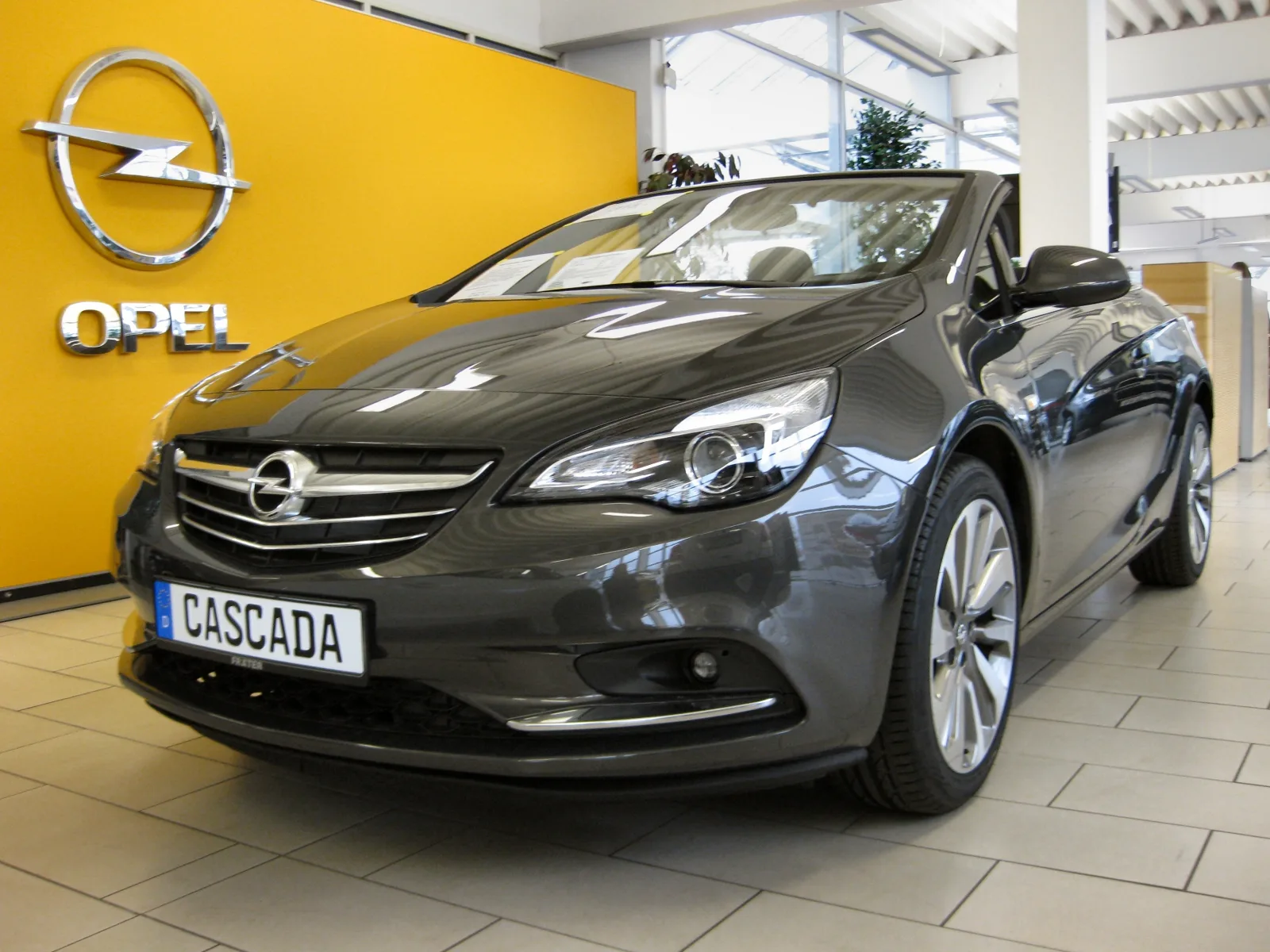
A 2013 to 2019 convertible sold as Opel, Vauxhall, Holden and Buick, with a Polish-built body and a fabric roof that rises in 19 seconds.
The Opel Cascada was a four-seat fabric-roof convertible that Opel built from 2013 to 2019 and sold under four brand names. It was assembled in Gliwice, Poland, and 48,500 were produced before the final car left the line in June 2019.
Opel's answer to the open-top market was a car built for year-round touring rather than sportiness. Its engineering and styling came from Germany, and the same car was sold under the Vauxhall, Holden and Buick names in markets where those brands operated.
Where was the Cascada engineered and built?
The Cascada was engineered at Opel's technical centre in Germany and styled under Mark Adams, head of Opel design. Exterior work came from Andrew Dyson and interior work from Elizabeth Wetzel. It was built in Gliwice, Poland, after a debut at the 2012 Geneva Auto Show.
Vauxhall launched first in the UK in March 2013. Opel followed on 20 April 2013 with two four-cylinder petrol engines and a 2.0-litre diesel, and both brands offered six-speed manual or automatic gearboxes.
Vauxhall's UK range began with 140PS 1.4-litre and 170PS 1.6-litre turbo petrols and a 2.0-litre CDTI diesel. A 200PS 1.6-litre SIDI arrived in October 2013.
A fabric-roof four-seater that GM sold under four badges, engineered for comfort and built in Poland until its 2019 end.
What engines did the Cascada use?
Most Cascadas used a turbocharged 1.6-litre four-cylinder with spark ignition direct injection, which reduces fuel consumption. In the Cascada it reached 0 to 60 mph in the 8 to 9 second range. The other options were two 1.4-litre petrol engines and a 2.0-litre CDTI diesel.
The Buick used only the 200 PS (147 kW; 197 hp) version of the 1.6-litre engine, and the Holden had only the 170 PS (125 kW; 168 hp) unit. Both were paired with a six-speed automatic.
The 1.4-litre Family 0 petrol engines produced 120 PS (88 kW) and 140 PS (103 kW), with 200 Nm of torque, rising to 220 Nm with overboost. The 2.0-litre CDTI diesel made 165 PS (121 kW) and 380 N.m (280 lb ft).
How was the Cascada's body built?
The Cascada was built on GM's Delta II platform, which it shared with the Opel Astra J and other compact front-wheel drive cars. Its structure used high-strength steel, with diagonal struts in the doors and a torsion box behind the rear seats. Opel claimed the body was 43% stiffer than the Astra H TwinTop.
The front seats carry AGR-certified designs with six-way movement and a long fore and aft travel of 280 mm (11.0 in). A seat cushion extender adds 60 mm (2.4 in) for longer thighs.
Easy Entry tilts the front seat forward to reach the 2+2 rear seats, and the seat stops when it senses a rear passenger's knees. Automatic shoulder-belt presenters extend the outboard belt toward the occupant when the door closes and the ignition is on.
How much luggage space did the Cascada have?
The Cascada offered 380 litres (13.4 cu ft) of cargo space with the top raised and 280 litres (9.9 cu ft) with it stowed. Flexfold lets each rear seat back be lowered separately, operated while standing at the open boot.
Because the taillights sit on the boot lid, a second set of lights inside the boot stays visible when the lid is raised. That arrangement met European safety rules for the car.
How does the Cascada's roof work?
The soft top is electro-hydraulic and can be raised or lowered at up to 50 km/h (31 mph). Magna Car Top Systems made the top module, and an articulating tonneau cover conceals the fabric when it is down.
Lowering takes 17 seconds and raising takes 19 seconds, and each roof was tested through 15,000 cycles. The key must be in accessory or on, and the driver holds the switch until a chime signals completion.
Every car goes through a water test booth at the end of the line, where 124 nozzles spray 1.9 gallons per minute for ten minutes. That is the equivalent of 1.23 inches of rain per minute.
What roof colours did the Cascada offer?
The fabric top came in black, tan, brown and burgundy, marketed as Ebony, Sahara, Sweet Mocha and Malbec. Availability varied by model year and trim, and a triple-layer premium top added heavier layers and a fleece layer for insulation. The top also came with heated rear glass.
The double-layered standard top gave thermal and acoustic insulation, and the premium version was designed for quieter running with the roof up.
How did the Cascada handle and ride?
The Cascada used HiPer Strut front suspension, which reduces the kingpin inclination and shortens the kingpin offset to limit torque steer. At the rear it used a semi-independent twist beam with a Watt's linkage, a layout that keeps the axle centred in corners.
HiPer Strut helps prevent torque steer and increases front axle grip in cornering, and it allows the car to run 20-inch tyres. The Watt's linkage gives lateral stiffness while letting the suspension travel vertically on straight roads.
The Cascada shares its suspension approach with the Cadillac ELR and the Opel Astra GTC, both of which use the Delta II platform.
What standard equipment did the Cascada have?
Standard equipment across the badges included an electric park brake, sport seats, French stitching on the dashboard, DAB radio, automatic headlights and wipers, cruise control and a seven-inch Intellilink infotainment system. Trim and equipment levels differed between the Opel, Buick, Vauxhall and Holden versions.
Those differences came from badge engineering rather than the body, which was the same in every market. The core structure and roof were common to all four brands.
How did the Cascada protect occupants in a rollover?
Spring-loaded rollover bars sit behind the rear seats and rise to windshield height when an imminent rollover is detected. They are pyrotechnically activated and connected to the airbag system, so they fire together with the airbags. The bulkhead behind the rear seats is reinforced to carry them.
Which safety fittings were standard?
ISOFIX child-seat points were standard on Opel, Vauxhall and Holden models, and Holden added top tether mounts. Excluding Holden, GM's OnStar system was included on Buick and Opel cars from 2016, and on Vauxhall Elite trim from the same year.
What was the Buick Cascada?
The Buick Cascada debuted at the January 2015 North American International Auto Show and went on sale in the US in January 2016. It was the brand's first factory convertible since the 1991 Buick Reatta, and its first two-door since the 1999 Buick Riviera.
More than 600 changes were needed to meet US safety and comfort requirements. The Buick came in Base (1SV), Premium and Sport Touring trims, all with the 200 PS (147 kW; 197 hp) 1.6-litre engine and a six-speed automatic.
GM sold the Buick only in the US and China, and it was not marketed in Canada or Mexico.
Why was the Holden Cascada different?
The Holden Cascada went on sale in Australia and New Zealand in April 2015 as the successor to the Astra TwinTop. At launch it had only the 1.6-litre petrol engine and a six-speed automatic, and Holden ended sales on 1 May 2017.
The Launch trim brought larger 20-inch alloy wheels, leather sport seats with ventilation, bi-xenon headlights that adapt to the road, and LED running lights. Holden's range had two trims, a base car and the Launch edition.
What happened to the Cascada in the end?
The Cascada was built during a difficult period for General Motors, which had filed for Chapter 11 bankruptcy and was restructuring. Opel was sold to Groupe PSA in 2017, and GM confirmed in February 2019 that it would end marketing the car.
Low sales, especially in the United States, and a sharp decline in the convertible segment globally had reduced demand. Groupe PSA then confirmed it would not continue future production. Buick production ended on 28 June 2019, and the combined total produced was 48,500.