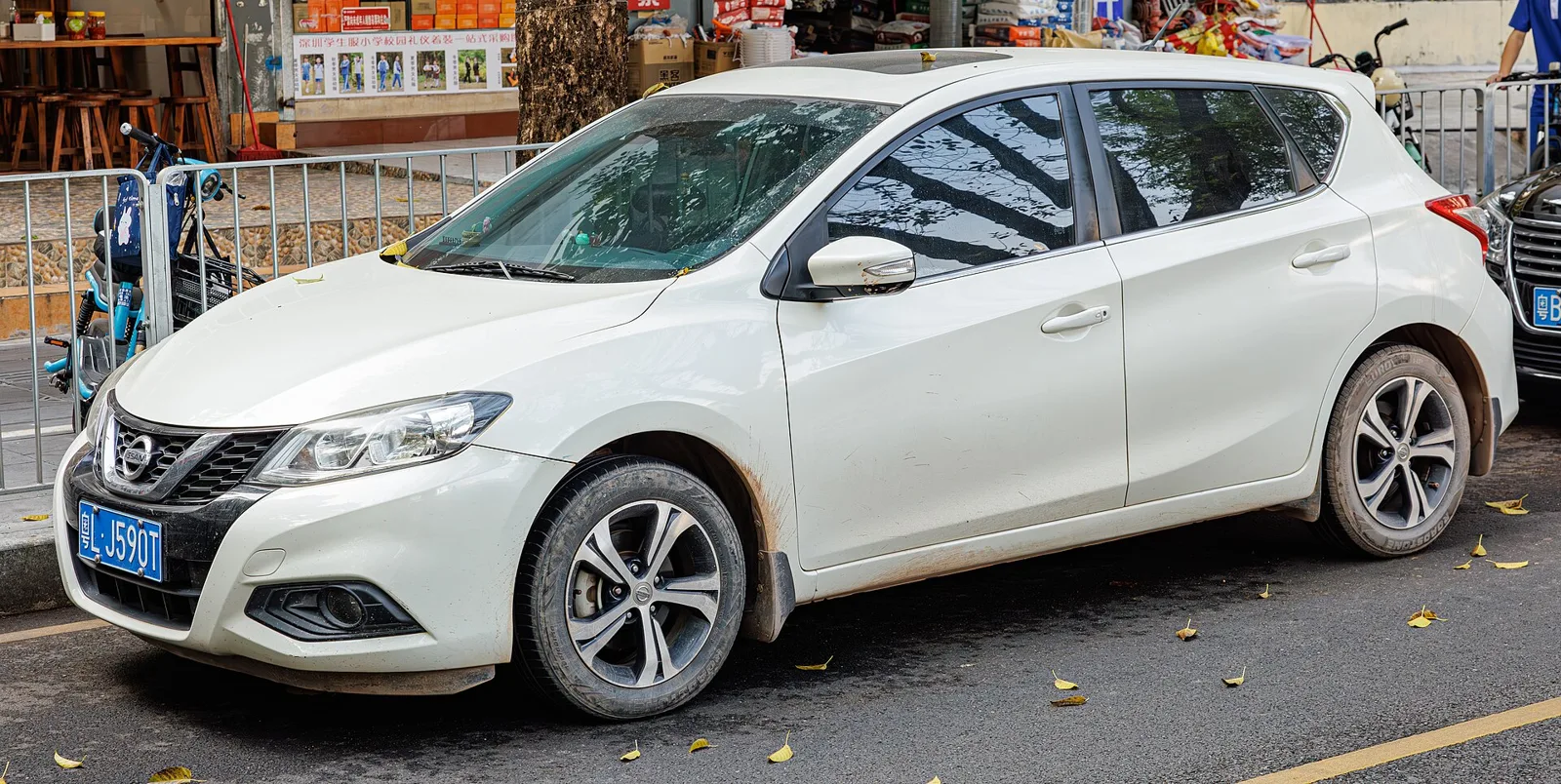
Three generations of Nissan's compact, from the 2004 hatchback and sedan to the 2011 C12 and the 2015 Pulsar-based C13.
The Nissan Tiida is a compact car that Nissan built from 2004 to 2023 in three generations. It was sold as the Versa in North America and the Latio in Southeast Asia, and its name was Okinawan for sun.
Across nearly two decades, Nissan's Tiida went by several names in different markets. It sat on the B platform at first and the V platform later, and in some places it carried the Pulsar badge instead.
Its name is Okinawan for sun, a nod to the Sunny that Nissan had sold since 1966. The first generation was a hatchback and sedan, the second was a hatchback only, and in several markets the car wore the Pulsar name instead of Tiida.
Where did the Tiida's name come from?
Tiida is the Okinawan word for sun, and it continued a naming tradition that Nissan had started in 1966 with the Sunny. The first-generation car, codenamed C11, was previewed by the C-Note concept, which was shown at the 2003 Tokyo Motor Show.
The C-Note was a concept hatchback that previewed the C11's styling, and it used a platform shared with the Renault Megane. Naming was not uniform across markets, which made the car's identity more complicated than its single name suggests.
Nissan initially wanted the Tiida name everywhere, but Australia insisted on the better-known Pulsar and the United States chose a new name, Versa. Australia later reused the Pulsar name for the second generation.
One name, three generations and several disguises: the Tiida was a compact that kept changing its identity to suit each market.
How did the first-generation C11 go on sale?
The C11 Tiida went on sale in Japan as a hatchback and a Latio sedan in 2004, and it reached some European countries in 2007. It sat between the Micra and March and the larger Sylphy and Sentra, and in Japan it replaced the Sunny as the smallest sedan.
Engines were 1.5, 1.6 or 1.8-litre four-cylinders, and the larger engine could pair with a six-speed manual. Two dealer packages, the Nismo S-tune Aero Package and the Nismo Performance Package, added sporty touches for buyers who wanted more.
In January 2008 both body styles received a facelift with a new grille, bumpers, headlights, tail lights and wheel covers. The interior gained a more modern look, a new instrument cluster and metallic-finish dash panels, along with retuned power steering.
How did the Versa differ in North America?
The Versa arrived in the United States and Canada in July 2006 as a 2007 model, and it was assembled at Nissan's Aguascalientes plant in Mexico. Nissan said the name was short for versatile space, a reference to the car's interior and configurable cargo area.
The Versa 1.8 used a DOHC 1.8-litre four-cylinder with 122 hp (91 kW) and 127 lb ft (170 N.m). Buyers could choose a four-speed automatic, a continuously variable transmission or a six-speed manual, and the SL trim added air conditioning, power accessories and ABS.
A 1.6-litre sedan joined the range for the 2009 model year, with the HR16DE engine rated at 107 hp (80 kW) and 111 lb ft (150 N.m). It came with a five-speed manual as standard and a four-speed automatic as an option.
When the Versa launched in fall 2008, its base price of US$9,990 made it the cheapest new car in the United States. A Hyundai Accent price cut soon took that title by $20, and the Versa 1.6 was priced at C$12,498 in Canada.
Nissan replaced the sedan in North America for the 2012 model year, while the hatchback continued one more year. Production for that market stopped in mid-2011.
How did the second-generation C12 differ?
The second-generation C12 was unveiled in April 2011 at the Shanghai Auto Show and went on sale in China that June. It was a five-door hatchback only, and it was not sold in Japan, where the sedan role passed to other Nissan models.
The C12 widened the car to fill the compact class and was marketed as a C-segment vehicle worldwide. It shares the Nissan V platform and much of its mechanicals with the Sylphy B17, and Thai-built versions even use the Sylphy's interior.
The Chinese and Taiwanese cars had a distinctive design of their own. In Thailand the hatchback was sold as the Nissan Pulsar from February 2013, using a 1.8-litre MRA8DE engine that it shared with the Sylphy.
Why did Australia call it the Pulsar?
In Australia the Tiida name was dropped in favour of the Nissan Pulsar, a nameplate that had been popular in earlier years. The warm hatch arrived in late 2013 as the SSS, with a 140 kW turbocharged 1.6-litre engine.
The SSS used the MR16DDT engine that also powered the Pulsar ST-S, and it was aimed at the warm hatch market, a category placed between standard and hot hatches. Its equipment included push start ignition, keyless entry and dusk-sensing headlights.
How did the Tiida score in Latin NCAP tests?
Latin NCAP tested the Latin American Tiida several times between 2011 and 2015, and the results depended heavily on the airbags fitted. The hatchback scored 3 stars for adults with one airbag and 4 stars with two, while the sedan scored 0 stars with no airbags and no ABS.
The best sedan result was 4 stars for adults and 2 stars for toddlers, with two airbags, in September 2015. Each rating applied to a basic Latin American specification, so it does not describe every market.
What was the EV-11 electric prototype?
The EV-11 was an electric prototype based on the Tiida. It used an 80 kW (107 hp) motor with 280 N.m (207 lb ft) of torque, and a 24 kWh lithium-ion battery rated at 160 km (99 mi) of range. The car also included navigation, remote control and monitoring.
It was unveiled at Nissan's Yokohama headquarters on 8 February 2009. A production version was set to go on sale in the US and Japan in 2010.
Did Chrysler ever sell a Versa-based car?
Chrysler and Nissan announced a deal on 11 January 2008 for Nissan to supply a Versa-based sedan for limited distribution in Latin America in 2009. Dodge was to sell it as the Trazo, but the plan failed after Fiat arrived at Chrysler in early 2009.
What was the third-generation C13?
The third-generation C13 arrived in March 2015 as a rebadged Pulsar hatchback, sold in most of Europe under that name. In Russia, China and Africa it carried the Tiida nameplate instead.
Taiwan meanwhile kept the second-generation car alive with a facelift instead of adopting the C13. That facelift was a budget update aimed at matching the newer look of the C13 in other markets.
What are the Tiida specifications?
| Specification | Detail |
|---|---|
| Type | Compact car, hatchback and sedan (C11); hatchback only (C12) |
| Years | 2004 to 2023 |
| Generations | C11 (2004), C12 (2011), C13 (2015) |
| Versa 1.8 engine | 122 hp (91 kW), 127 lb ft (170 N.m) |
| Versa 1.6 engine | 107 hp (80 kW), 111 lb ft (150 N.m), from 2009 |
| US base price, fall 2008 | US$9,990 |
| Canadian base price, 1.6 | C$12,498 |
| EV-11 prototype | 80 kW (107 hp), 280 N.m (207 lb ft), 24 kWh battery |
| Best Latin NCAP result | 4 stars adult, 2 stars toddler |
_China_(12).jpg)