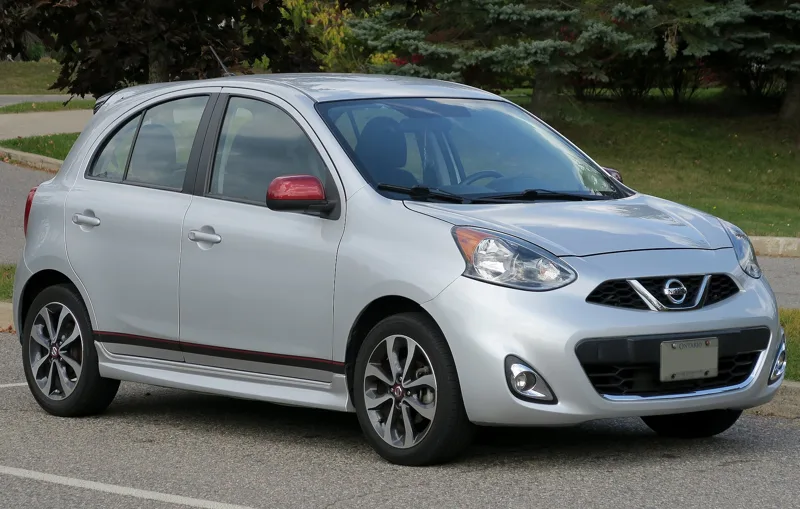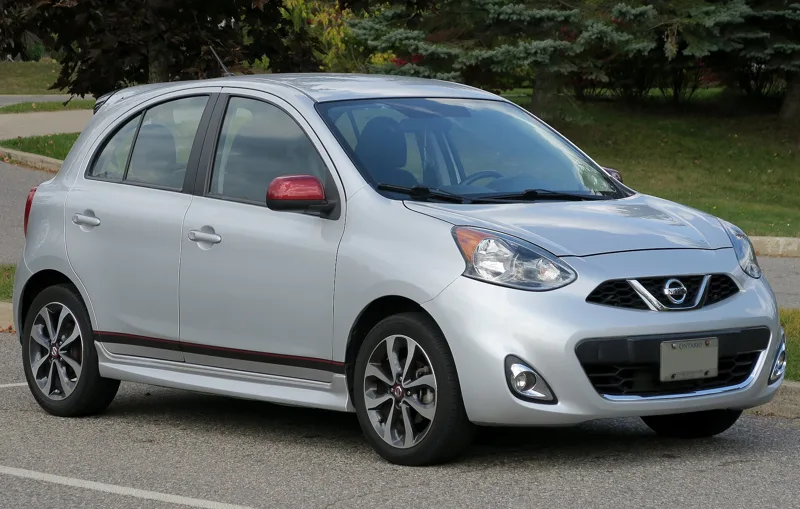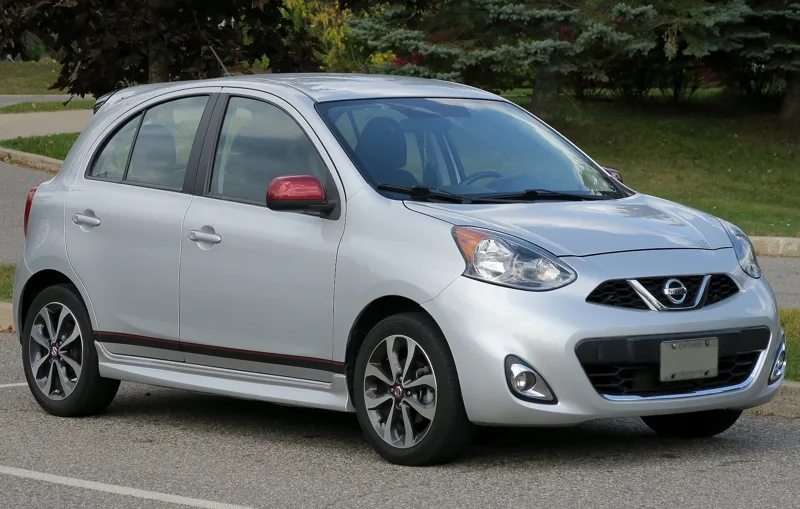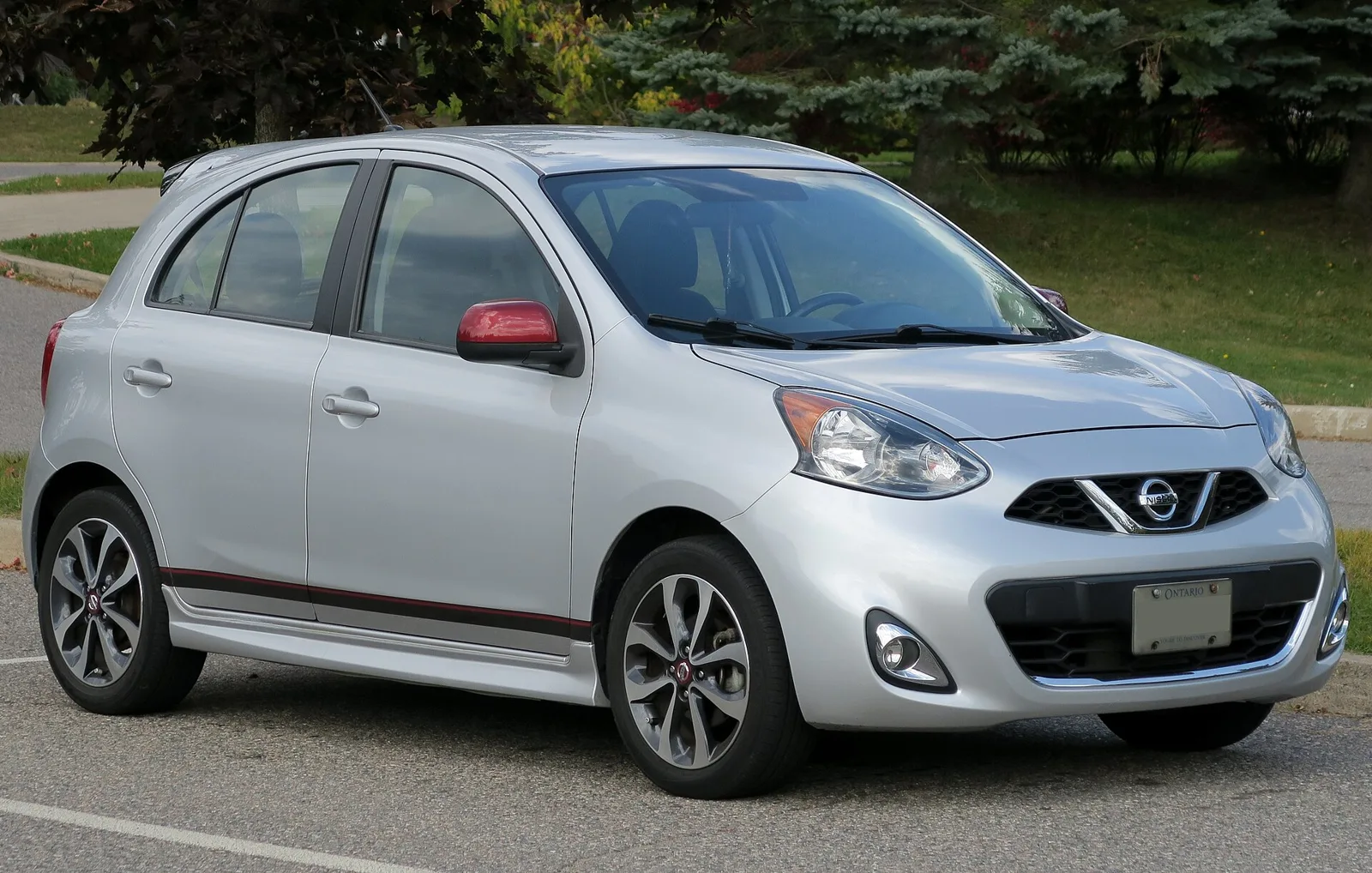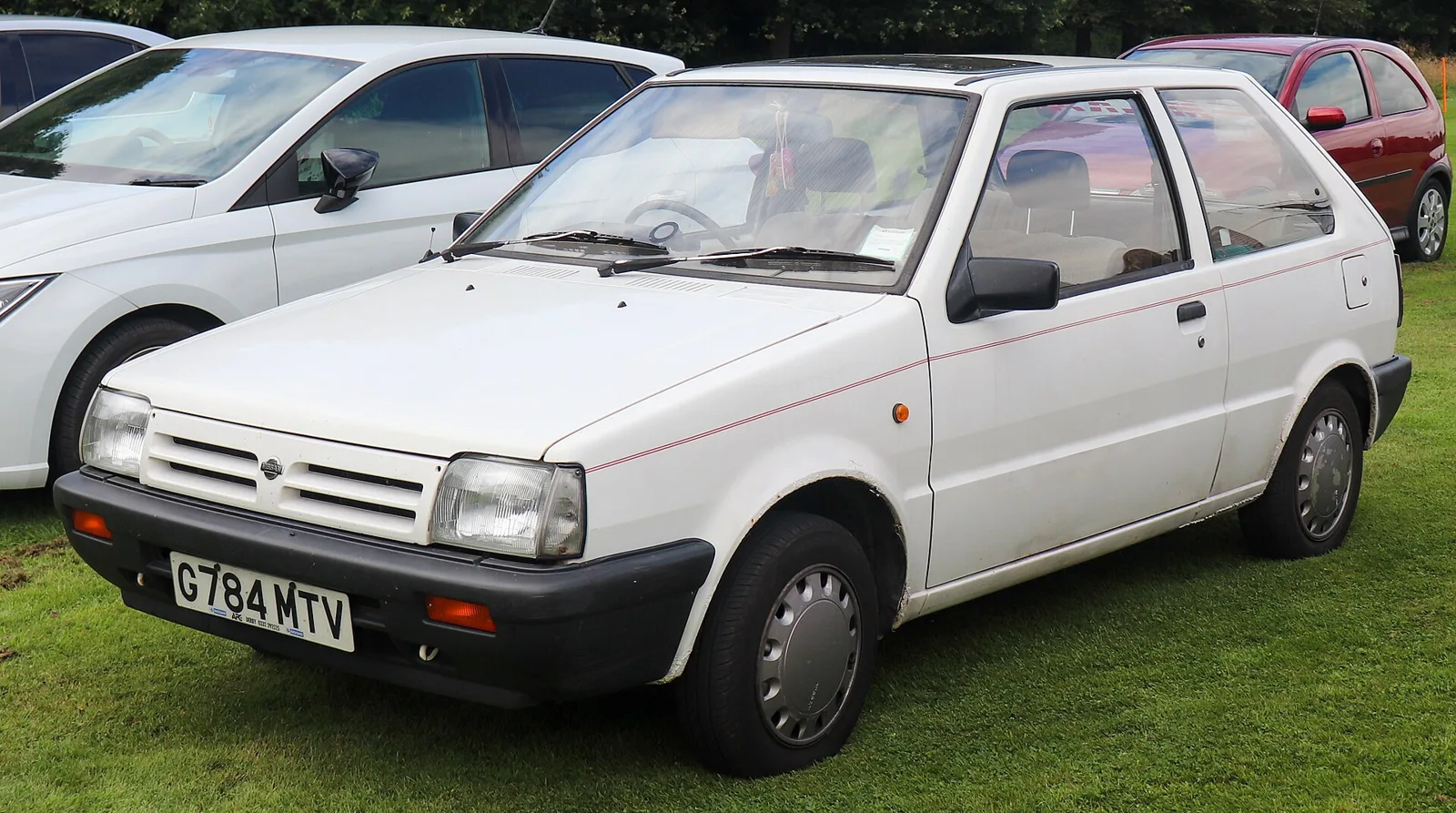
A 987 cc hatchback built from 1982 to 1992, with a turbo version, a rally-ready R and a naming contest that drew 5.65 million entries.
Built by Nissan from 1982 to 1992, the March K10 used a 987 cc MA10S engine, offered a five-speed manual on some grades and added a turbo version later. Its public naming contest drew 5.65 million entries, and the range spawned a rally R and a Super Turbo.
The Nissan March K10 was a compact hatchback that Nissan Motor built from 1982 to 1992. It was conceived as an answer to a small car that General Motors had in development at the time, and it was built in a new plant equipped with 216 industrial robots. Its 987 cc engine, a turbo version and a rally-focused R gave the range a wide spread of character.
Where did the March K10 come from?
Development took place at the Ogikubo plant in Momoi, Suginami ward, Tokyo, a site that had belonged to the former Prince Motor Company. It was the last model that plant developed. The chief engineer, Ito, had come over from Prince, and the car was meant to be the trump card against that rival small car.
Nissan's presentation material set out four goals. The car would offer very low fuel consumption with easy handling, interior room one class above its size, a nimble drive that defined a new 1000 cc category, and a stylish, individual look.
A naming contest drew 5.65 million entries for a car that did not yet have a name.
How did Nissan keep the price down?
Nissan built a new factory, and its Murayama No. 3 plant, with a monthly capacity of 20,000 units at the time, fitted 216 industrial robots across the body, paint and assembly lines. The count exceeded the world standard of the day. Nissan also placed orders outside its own group and widened its list of business partners, which cut costs and secured high quality.
Ito later praised Ishihara, saying he had been very effective at bringing design, testing and purchasing staff into one team.
Who designed the March K10?
Giorgetto Giugiaro produced the basic design, and Nissan's own team adjusted it for production. The finished car appeared as the NX-018 at the 24th Tokyo Motor Show in October 1981, shown as an export-specification reference car with five seats and a two-box hatchback layout that was already fixed.
The exterior is built on a wedge shape, with flush panels and full doors that carry built-in roof drip rails. Its slanted nose, steeply raked windscreen, tapered bonnet and duck-tail roof end together reached a drag coefficient of 0.39. At the front, square halogen headlamps and a horizontal-bar grille give the car a sporty face, while the rear combination lamps are rounded into one smooth surface.
What was the cabin like?
The March's cabin looked wider than its outside suggested. The dashboard is tray-shaped, and the meters sit in a compact cluster with green backlighting. Three-door front seats have bold shoulder cut-outs and high backs, and a curved, lightweight backframe helps the driving position. With a seat slide of 205 mm, front and rear passengers both get enough legroom.
Five-door models have lower front backs, larger headrests and bolstered side supports, with double raschel upholstery. The body makes wide use of high-tensile steel. Together with the engine, that let the basic E grade weigh 610 kg (1,345 lb), the lightest in its class.
Paired with rack-and-pinion steering, a joint allowing 46.5 degrees of articulation gave a 4.4 m turning circle, the tightest of any Japanese small passenger car. The interior measures 1,715 mm long, 1,305 mm wide and 1,145 mm high. The front track is 1,345 mm, the rear track 1,330 mm, the full doors are 1,260 mm long and the door opening is 955 mm high.
What engine did the March K10 use?
The standard engine was the MA10S, a 987 cc (60.2 cu in) unit with an electronically controlled carburettor. Nissan developed it for the March with an aluminium cylinder block and a hollow crankshaft. In automatic form it weighed 69 kg (152 lb), making it the lightest small engine in the world.
Buyers could choose a four-speed manual, the Nissan Matic three-speed automatic, or a five-speed manual on some grades. Manual cars used a dry single-plate diaphragm clutch and automatics a torque converter, and both had floor shifters. Fuel was unleaded regular petrol, and the tank held 40 L.
Fuel economy was a selling point. The five-speed manual car was approved at 21.0 km/L on the 10-mode cycle, and a notified figure of 32.5 km/L applied at a steady 60 km/h. Japanese versions carry an E- prefix in their model codes, such as E-K10, which marks compliance with the 1978 emissions rules for passenger cars carrying ten or fewer people.
How did buyers respond?
Demand was strong from the start. Nissan had set a monthly target of 10,000 units, but about 4,000 orders arrived in the first week. The March Birth Fair on 30 and 31 October brought the tally to 10,300, meeting the monthly goal inside ten days.
Early buyers included many newcomers: 34% had come to Nissan for the first time and another 20% bought the March as a second car. Men made up 67% of them and women 33%. Some 48% were 29 or under, and 66% of the women fell in that age group. Regional markets accounted for 64% of sales, and surveys showed that style, interior space and price were well received.
The campaign image talent was Masahiko Kondo. The catchphrases, both used on the early model, were 'Match's March' and 'Super idol'.
How did the naming contest work?
The concept car had a long pre-launch campaign that began on 29 October, before its show debut, and the public was invited to propose the name. Nissan had run a naming contest only once before, 16 years earlier, with the Sunny. The winning name was March. Thirty winners received a car, 30 more won overseas holidays, and 10,000 people got a T-shirt bearing the new name.
Entries rose daily and passed 1.5 million by the end of November, including those from overseas. In the end there were 5.65 million, about one for every 20 Japanese people. The original closing date of 20 December was pushed back, and 20 more overseas tickets, for Hong Kong and Macau, were added. Young people under 30 and women made up six in ten entrants.
Which grades did the March offer?
Four three-door hatchback grades arrived first: E, L, S and G. The range later widened to canvas-top and five-door cars, the Turbo, the R and the Super Turbo, with further grades such as Collette and Pumps! along the way.
E was the basic type, stripped to fundamentals and aimed at business use. L was the basic model for families and young buyers, and it was dropped in the January 1989 minor change. S added a trip meter and more equipment for a practical luxury feel. G had a sportier interior and was the image leader, offered with a four-speed manual, a three-speed automatic and a five-speed manual. Engine-speed-sensitive power steering was an option on G, which was also dropped in January 1989.
Collette arrived in April 1983, based on G, with lattice-pattern napped tricot seats marked MARCH, cloth door trim and a premium radio cassette stereo. Pumps! followed in September 1986, aimed at fashion-conscious women. It was the first car in Japan that let owners change the main seat fabric, in seven sherbet tones, and the colour combinations totalled 117,649.
The i.Z special edition, added in January 1988, was based on L and fitted with side guard mouldings and hydraulic power steering. Canvas-top versions could open their roof with one push. The anniversary version of June 1983 carried a 50th-anniversary emblem, and the Turbo White Select of April 1986 came with its body unified in white.
What made the March Turbo stand out?
The March Turbo arrived in February 1985 as the only litre-class car with a four-cylinder engine. It was also the first car in that class to pair a high-performance turbo with sequential injection, and it was rated at 76 PS (75 hp) after the January 1989 revision.
Where the other grades used electronic carburettors, the Turbo ran an engine control system called ECCS, which had been reserved for higher-end cars, and a newly developed small turbocharger. A new U-turn-type long intake and a four-cylinder siamese block boosted low-speed torque. Handling stayed close to the naturally aspirated car. Fuel economy was notified at 18.0 km/L with the five-speed manual and 14.2 km/L with the automatic, both on the 10-mode cycle.
The suspension gained a rear stabiliser, revised springs and bushings. Widening the front track by 5 mm and upsizing the tyres lifted the minimum turning circle to 4.7 m. Dual exhausts tuned the sound. Inside, a dedicated meter hood housed a fuel gauge, a water temperature gauge and a main meter set mixing analogue and digital displays, and the steering wheel showed the engine's performance curve.
Changes during the Turbo's life included:
- August 1987: a new steering wheel shape, with new seat patterns and upholstery.
- August 1987: a power steering option, which allowed the EGR system to be dropped on cars so fitted.
- August 1987: turbo stripes on the lower door edges and a turbo logo on the back door.
- August 1987: a full-colour option for mirrors, mud guards, wheel covers, spoiler and bumpers.
In January 1989, with a minor change across the whole K10 series, the Turbo was revised again. Model codes were K10GFTP for the five-speed manual and K10GATP for the automatic. The turbo lost much of its flashy look and shared the Super Turbo's rear spoiler and dual exhaust, so it looked close to the normal grades.
What were the March R and Super Turbo?
The R was the competition base for the first-generation March, sold only as a three-door with a five-speed manual. It competed mainly in domestic rallies such as the All Japan Rally Championship. Its engine combined a supercharger and a turbocharger, the first such twin-charge system in Japan.
A front viscous coupling limited-slip differential was fitted as standard. The suspension parts were strengthened and the front discs enlarged, and the brake boosters on all four wheels were upsized. Power steering was omitted to make room for auxiliary equipment, which gave the R a power-to-weight ratio of 6.72.
The Super Turbo, sold from January 1989, was the road-going version of the R. Its engine was reduced to 930 cc from the base 987 cc, so that it would fit the 1,600 cc class once the supercharging factors of 1.7 (international) or 1.4 (domestic) were applied. Nissan called the arrangement double charge, and it was the only system of its kind on a Japanese car. Low-speed response came from the supercharger and high-speed power from the turbo.
The layout made the front heavy, repairs after a failure were costly, and sales were not a success. The model was not offered on the next generation. Torque steer and a strong tuck-in when lifting off in corners made it hard to control, so it was a spirited, unruly car.
Which spin-offs came from the March?
Several pike cars were built on the March. The Be-1 (BK10), Pao (PK10) and Figaro (FK10) were very popular. The racing formula car Saurus Junior (NSJ-91) was another derivative. The Be-1 became known as a zaitech car, because used examples resold for nearly twice their purchase price.
Key specifications
| Specification | Detail |
|---|---|
| Years built | 1982 to 1992 |
| Standard engine | MA10S, 987 cc (60.2 cu in), electronically controlled carburettor |
| Super Turbo engine | 930 cc, MA09ERT, twin-charged |
| Turbo output | 76 PS (75 hp) from January 1989 |
| Engine weight | 69 kg (152 lb), automatic specification |
| Body weight, E grade | 610 kg (1,345 lb) |
| Turning circle | 4.4 m; 4.7 m on the Turbo |
| Interior length | 1,715 mm |
| Fuel tank | 40 L |
| Fuel economy, five-speed manual | 21.0 km/L, 10-mode, approved figure |
| Fuel economy, Turbo | 18.0 km/L with five-speed manual, 10-mode, notified figure |
| Drag coefficient | 0.39 |