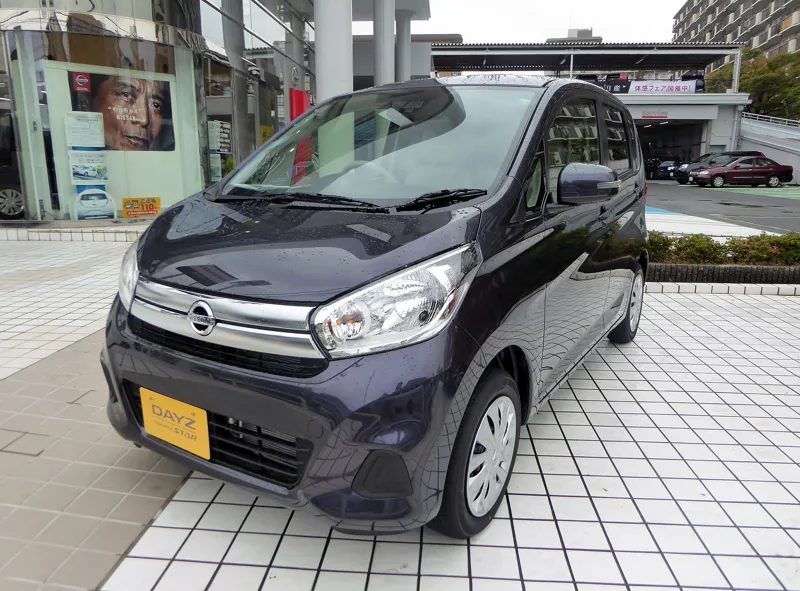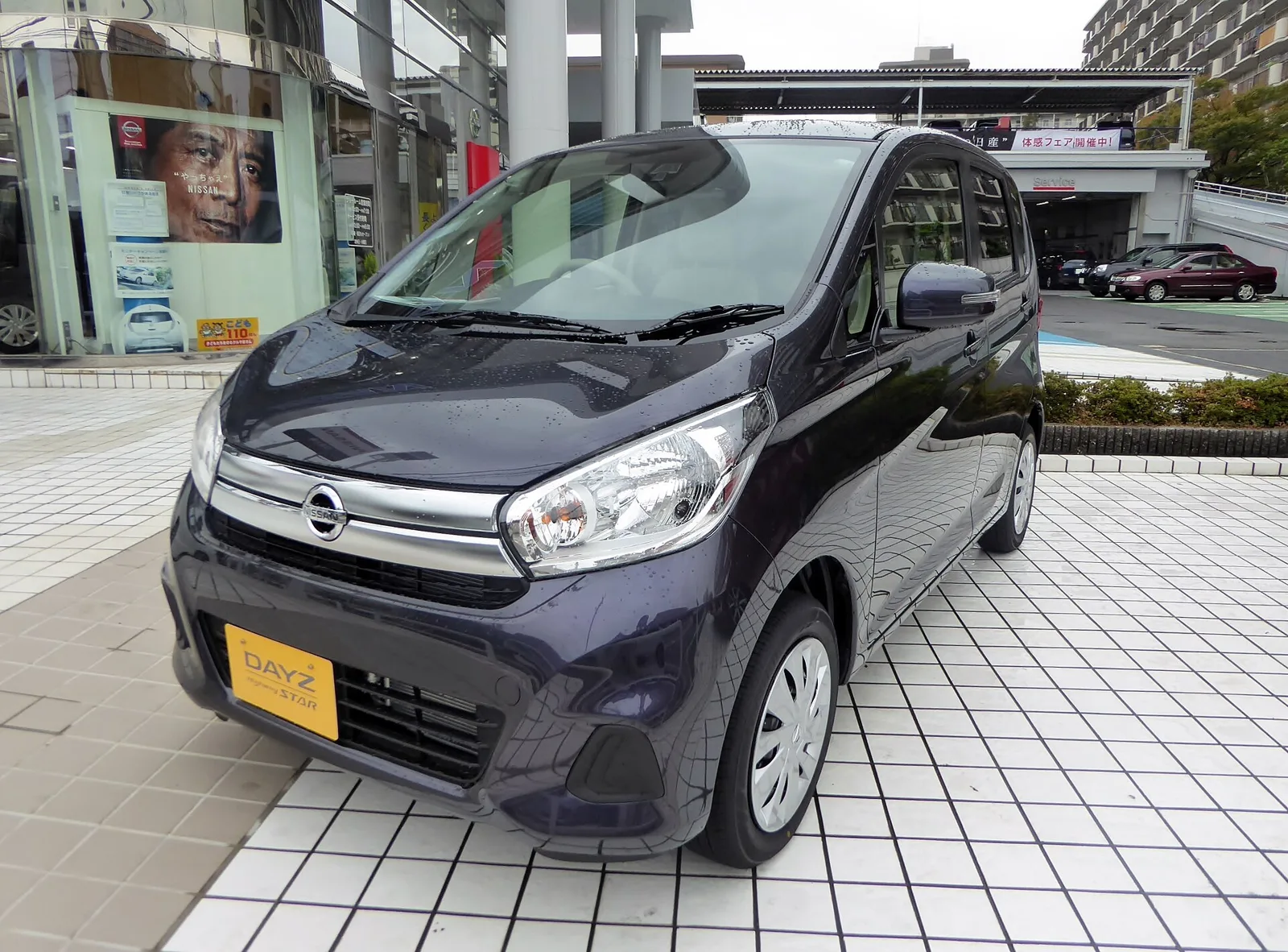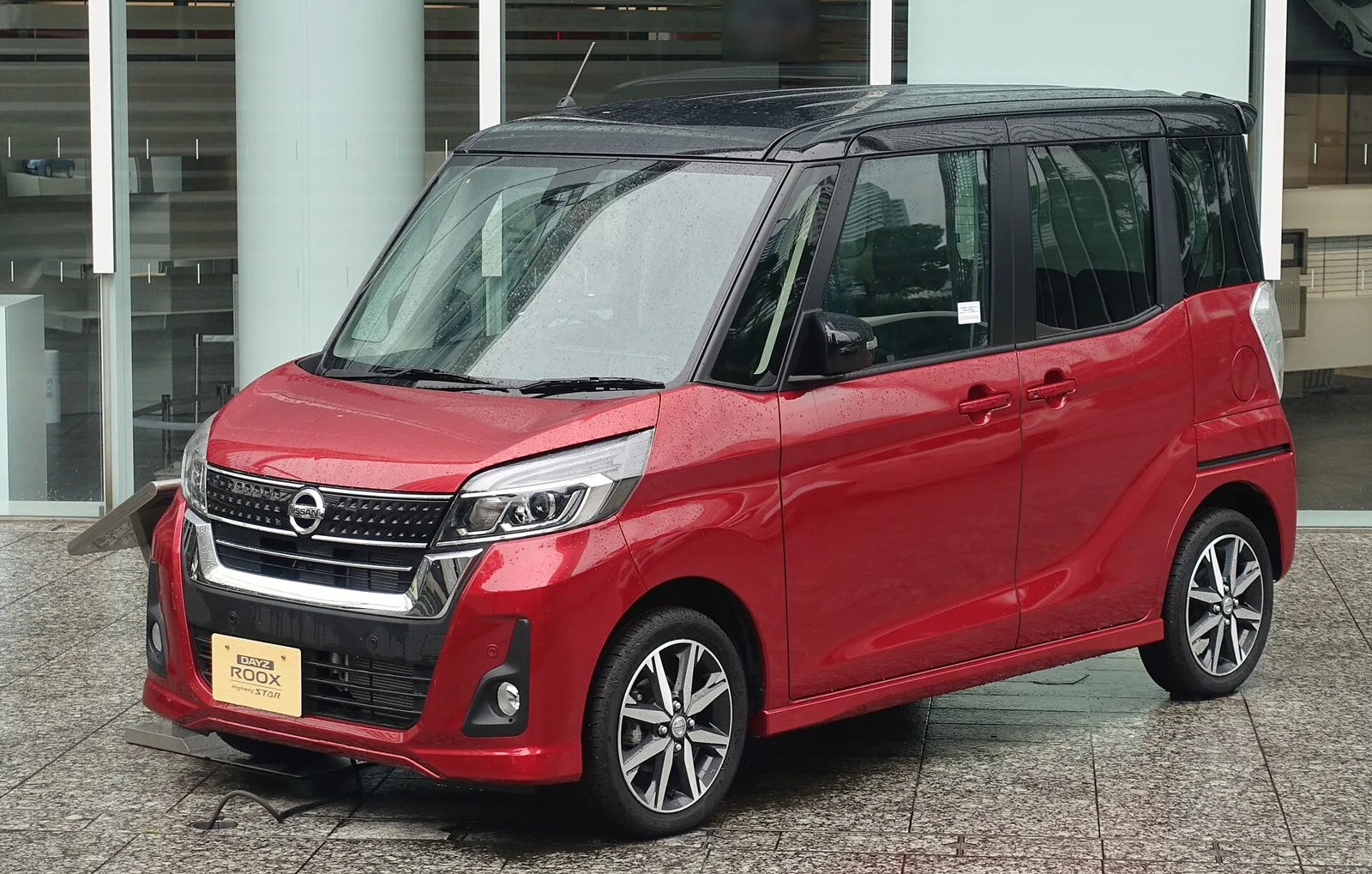
A super-high kei wagon planned by the Nissan and Mitsubishi joint venture, sold as the Dayz Roox by Nissan and the eK Space by Mitsubishi, from 2014 to 2020.
The Dayz Roox was Nissan's kei tall wagon from February 2014 to March 2020, built by Mitsubishi for NMKV. It was 155 mm taller than the Dayz, offered as a standard model or a Highway Star, and sold as the eK Space at Mitsubishi.
The Dayz Roox was a kei tall wagon, which Nissan sold in Japan from February 2014 until March 2020. Its formal name was DAYZ ROOX, and it was a super-high wagon, a shape that puts a lot of cabin height into a small body. NMKV developed it for both companies, and Mitsubishi Motors built every example.
It was the second model in Nissan's Dayz series and the successor to the Roox that had left the market in March 2013. The result was a tall family wagon with sliding doors, a sense of space and a choice of a standard model or a sportier Highway Star.
When did the Dayz Roox go on sale?
The name was confirmed on the Dayz teaser site on 25 March 2013, and the exterior design was published on 3 October 2013. Nissan officially announced the car on 13 February 2014, and it went on sale the same day. Orders for the first month reached 28,000 units, which Nissan said was 5.6 times its monthly target of 5,000.
It was the second model in the Dayz series, announced in June 2013. Advance orders opened on 8 November 2013, about three months before the formal launch.
A Mitsubishi-built kei wagon that Nissan sold as the Dayz Roox, with a Highway Star version and an eK Space twin.
Why did Nissan and Mitsubishi share the car?
NMKV is the joint venture of Nissan and Mitsubishi, and it planned the product and carried out development for both companies, using the strengths of each. The same car was sold by Mitsubishi as the eK Space. Mitsubishi built all of them, so the registration lists Mitsubishi Motors Corporation as the maker.
The Nissan in-house code was BA0, but the registration type was Mitsubishi's B21A, while the eK Space carried B11A. Of all the Roox models, this is the only one designed mainly by Mitsubishi, which is why its high and low beam switching works as a two-stage lever with flashing for passing.
How big was the Dayz Roox?
Measured against the Dayz, the Dayz Roox adds 155 mm (6.1 in) of height. Against the earlier Roox it stands 30 to 40 mm (1.2 to 1.6 in) taller, and its wheelbase is 30 mm (1.2 in) longer. The interior height of 1,400 mm (55.1 in) was enough to carry a 27-inch bicycle inside the cabin.
The target buyers were wider than young parents. Families who had finished raising children were targeted as well, including buyers switching from minivans such as the Elgrand, SUVs such as the X-Trail and estates such as the Stagea.
What features set the Dayz Roox apart?
Several features came over from the Dayz: the around view monitor, a touch-panel automatic air conditioner and super UV-cut insulating green glass for the front doors. The sliding doors could also be opened remotely, with a button on the door working whenever the intelligent key was on the person, even with both hands full.
The standard model had a chrome bar across the radiator grille, and its lower bar ran into the headlamps to make the front look wider. The Highway Star used a massive bumper and aero parts to suggest stability and an aerodynamic feel. Its chrome grille was enlarged, and the second bar was made thicker so that it blended into the headlamps.
How did the Dayz Roox's powertrain work?
The 3B20 engine powered every version, and the Highway Star Turbo used an intercooler turbo version of the same unit. The transmission was the Xtronic CVT. Naturally aspirated cars stopped their engine automatically at around 9 km/h and below, which saved petrol through idling stop, and they also carried a battery assist system that stored braking energy.
Battery assist used a high-output alternator to charge a nickel-metal hydride battery during deceleration, and the stored power ran the electrical equipment. The eK Space's version of the same idea was called assist battery. Idling stop also came to the Highway Star Turbo in April 2015, which improved fuel economy across most grades.
The naturally aspirated cars were part of Nissan's PURE DRIVE line, so a PURE DRIVE emblem sat on the lower right of the rear. That changed in December 2016, when the car left the PURE DRIVE range and the emblem was removed.
What did the 2014 special editions and the 2015 update add?
Built on the X and the Highway Star X, the December 2014 special editions X V Selection+Safety II and Highway Star X V Selection+Safety II carried emergency braking, misoperation assist and VDC as standard. The X V Selection+Safety II also had SRS side airbags. Four other grades could take the first two items as a set option: the S, the Highway Star S, the X G Package and the Highway Star Turbo.
The April 2015 update made those systems standard across the range. Emergency brake, misoperation assist, SRS side airbags and VDC, which had been options or standard depending on the grade, became standard on every car. The S gained an option without emergency brake. The engine and transmission were retuned, idling stop reached the Highway Star Turbo, and the seats received a water-repellent finish on all positions.
How did the exterior change in December 2016?
The December 2016 minor change renewed the front face. The radiator grille's chrome bars were made thinner, and the front took on a wider look inspired by Nissan's V-motion. The Highway Star received a V-motion grille combined with a large-opening bumper, which set it apart from the eK Space in a clear way.
Rider changed its grille and bumper design and added LED bumper illumination and fog lamps. The new Bolero came with a large and small dot-pattern grille in chrome, a chrome finisher on the front bumper and aluminium wheels in a dedicated design as standard.
Grade structure at a glance
| Model or grade | Role | Notable equipment |
|---|---|---|
| Dayz Roox S | Standard-line grade | Super UV-cut green glass for the front, no seat-back table |
| Dayz Roox X | Standard-line grade | Around view monitor, ivory interior only |
| Highway Star X | Highway Star grade | Ebony interior, optional premium brown trim |
| Highway Star X Turbo | Turbo grade | Idling stop, LDW from May 2018 |
| Highway Star G Turbo | G turbo grade | Steering switches, six speakers, remote auto sliding doors on both sides, cruise control |
| Highway Star X G Package | Option package on X | Six speakers, remote auto sliding doors on both sides, 15-inch aluminium wheels |
Which body colours could buyers choose?
Body colours totalled 14 in May 2018, with three exclusive to the S and X, two exclusive to the Highway Star and four common option colours. Most of the palette matched the eK Space, although some names were different. Chocolate Brown Pearl, for example, became Mocha Brown Pearl.
Premium Sunshine Orange 4-coat Metallic and Lemon Lime were set for the S and X, and neither was offered on the eK Space. Ocean Blue Pearl was exclusive to the Highway Star, and Sparkling Red Metallic was also set. Pink Gold Metallic came to the Highway Star as well, while Premium Purple Pearl was an option on the S and X. Titanium Grey Metallic, Cool Silver Metallic and White Pearl 3-coat Pearl were the exceptions to the otherwise shared range.
Two-tone roofs were the other variation. Air Grey Pearl Metallic with Lemon Lime was an exclusive Highway Star pairing, while Ice Blue Titanium Metallic with White was for the S and X. The Rider and Bolero custom cars had their own two-tone pairings too, such as Black Pearl with Sterling Silver Metallic on the Rider.
What interior choices did buyers have?
The Highway Star came with ebony trim as standard, and buyers could add a brown Premium Gradation Interior as a manufacturer option. The S and X used ivory interiors only.
The Rider gained a lattice-patterned seat fabric with purple thread in December 2016. The Bolero had leather-look seats in black and marsala red, with vanity mirrors for both front seats.
Why did sales stop in 2016?
On 20 April 2016 Mitsubishi Motors withdrew the car from sale because it was one of the models involved in the company's fuel economy falsification. From 4 July 2016 orders, production and sales restarted in stages. Before that, on 21 June 2016, the Ministry of Land, Infrastructure, Transport and Tourism had published its re-check results.
The re-check found that fuel economy differed from the declared figures by as much as 16% on the re-tested models, while exhaust values and safety standards met national rules. The ministry instructed Mitsubishi Motors to correct its fuel economy figures, and the type certification of the eK series was not revoked. The corrections were then made, and the 4WD Highway Star Turbo no longer met the 2015 standard.
How did the 2017 and 2018 updates change the range?
In April 2017 the V Selection special editions returned with new specifications. The X V Selection gained a silver-finished piano-style power-window switch base, while the Highway Star X V Selection moved to the brown Premium Gradation Interior as its interior trim. The Highway Star X V Selection took a Black Pearl and Pink Gold Metallic two-tone as its special colour, while the X V Selection took Air Grey and Blossom Pink.
The May 2018 update, shared with the Dayz, moved the emergency brake to a camera-based Intelligent Emergency Brake covering vehicles up to 80 km/h and adding pedestrian detection. The misoperation collision assist gained forward pedestrian detection and low-speed collision mitigation, and it worked in reverse too. Highway Star received lane departure warning as standard, and the colour line-up changed again.
How did the Dayz Roox end?
On 25 February 2020 Nissan announced the third-generation Roox, which went on sale from 19 March 2020, and production of the Dayz Roox ended at the same time. Only stock was sold after that, and the model finished on 18 March 2020, when it was replaced by the new car.
Which Autech Japan versions were offered?
Autech Japan offered the Rider and the Bolero on the Dayz Roox, and it also supplied the Rider Black Line, introduced in 2014 with dark chrome on the front grille and back door moulding, and a dark metallic front bumper. The Black Line added a dedicated LED daytime running light that was an option on the standard Rider.
The Anchante passenger slide-up seat, part of the Life Care Vehicle line, turned the passenger seat outside the car, which made getting in and out easier. It was announced in July 2014 and went on sale on the same day.