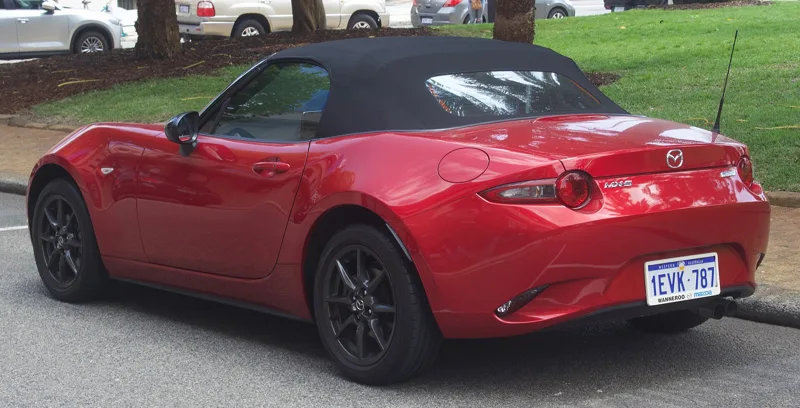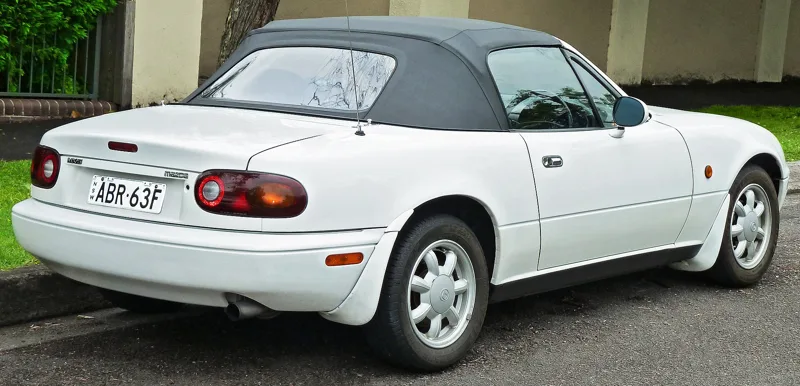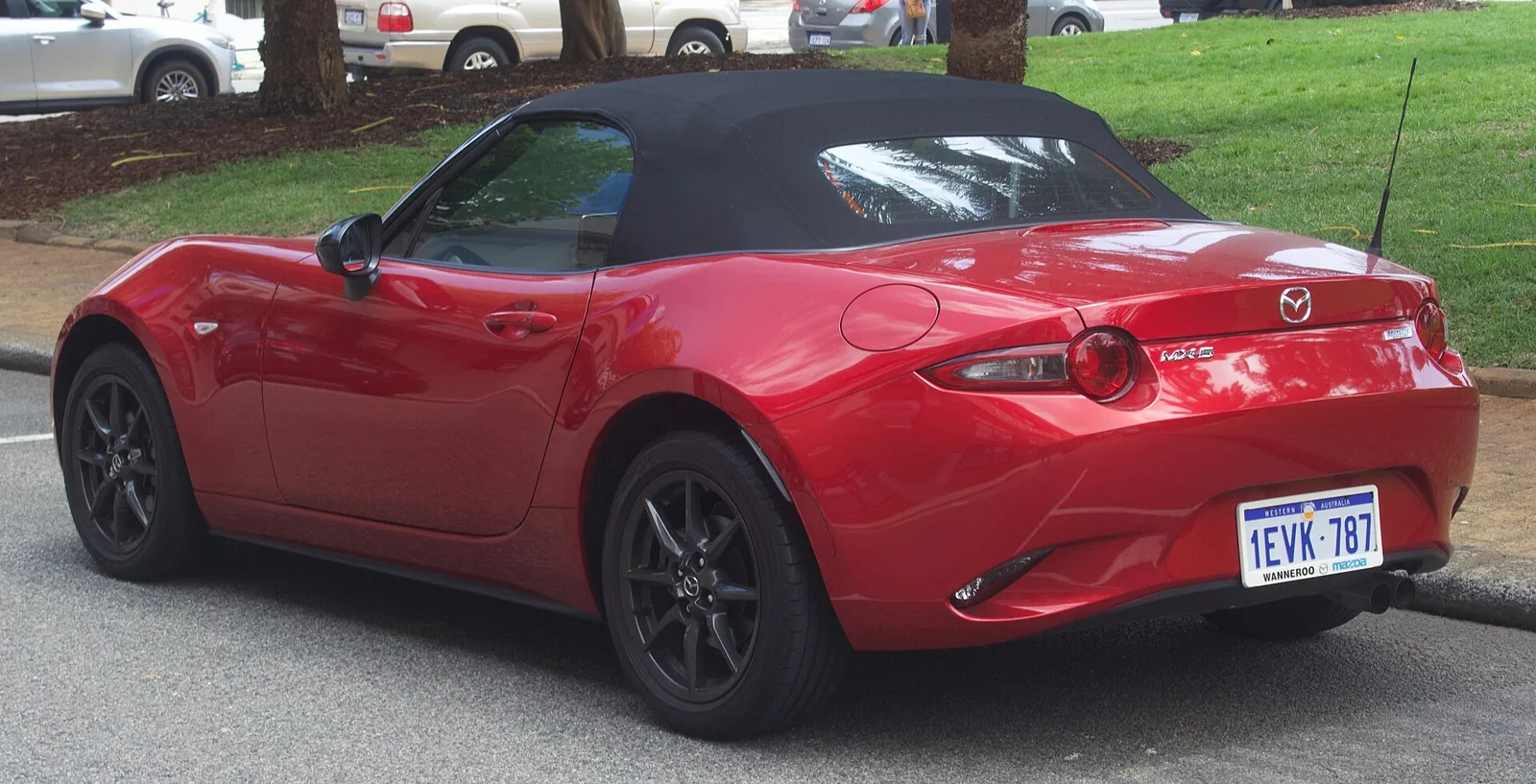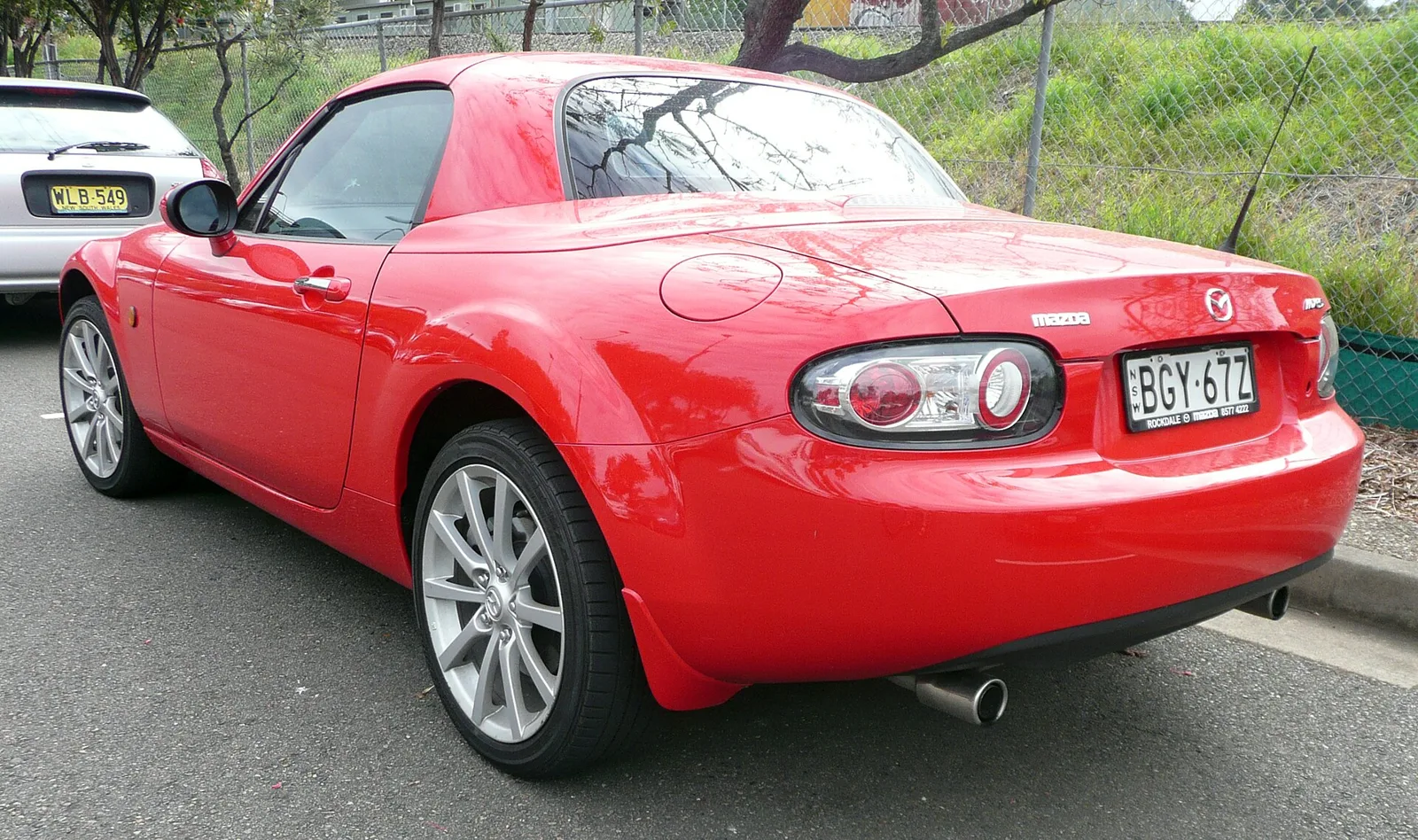
A new body by Yasushi Nakamuta, the first retractable hardtop in the MX-5 line and a decade of special editions from 2005 to 2015.
Built from 2005 to 2015, the NC was the third-generation Mazda MX-5 and the first to offer a retractable hardtop. Its US engine was a 2.0 L making 124 kW (166 hp), and the line later gained a 2009 facelift and a long run of special editions.
The Mazda MX-5 NC was the third generation of the roadster, built from 2005 to 2015. It was the first MX-5 to offer a retractable hardtop, and it was honoured in Japan at launch. Its new body and chassis made it a clear break from the NB, even though the basic formula stayed the same.
What made the NC different from the NB?
The NC was a clean break from the NB. Yasushi Nakamuta designed its exterior and reused almost no NB parts, the only exceptions being the fender-mounted turn signals on non-US models and some rear differential internals. Moray Callum was chief designer, and a 2003 concept called the Ibuki previewed the new shape.
The chassis also changed. The suspension moved from four-wheel double wishbones to a front wishbone and rear multilink arrangement, a layout shared with the Mazda RX-8. Traction control and stability control were fitted, and Car and Driver measured a skidpad figure of 0.90g.
The NC also brought the first retractable hardtop to the MX-5 line. That gave the roadster a second identity, with a folding polycarbonate roof that did not reduce trunk space when stowed.
A folding hardtop, a 2.0 L engine and a decade of special editions turned the third-generation MX-5 into a roadster with several lives.
How was the NC's engine range arranged?
The engine line-up varied by market. In the United States the 2.0 L (120 cu in) MZR LF-VE DOHC inline-four produced 124 kW (166 hp) and 190 Nm (140 lbf ft) of torque. It was paired with a five- or six-speed manual, or with the six-speed automatic, which lowered output to 118 kW (158 hp).
Australia received the same 2.0 L rated at 118 kW (158 bhp) and 188 Nm (139 lbf ft). The six-speed manual and a limited-slip differential were standard there. In Europe buyers chose between that 2.0 L, tuned to 118 kW (158 bhp) and paired with a six-speed manual, and a smaller 1.8 L (110 cu in) MZR L8-VE making 94 kW (126 bhp) and 167 Nm (123 lbf ft) with a five-speed gearbox.
A six-speed automatic with steering-wheel paddle shifters was an option, and a limited-slip differential could be added to the six-speed manual.
How quick was the NC on the road?
Performance depended on engine and market. Car and Driver measured 0-97 km/h (60 mph) in 6.5 seconds for the US-spec 2.0 L. Manufacturer figures for Europe were 9.4 seconds to 100 km/h (62 mph) for the 1.8 and 7.9 seconds for the 2.0.
The car also ran into a tax problem in Japan. Its exterior width went beyond the limit for the mid-size vehicle tax class, so Japanese buyers faced additional costs of ownership from the start.
What did the retractable hardtop add?
The Power Retractable Hard Top arrived in July 2006 as a two-piece folding hardtop designed by Webasto and made of polycarbonate. It needed 12 seconds to raise or lower, and the first customers took delivery in late August 2006. Names varied by market.
The hardtop was not free. It added 36 kg (79 lb) over a comparably equipped soft-top, and the 0-100 km/h (62 mph) sprint slowed to 9.6 seconds in 1.8 form and 8.2 seconds in 2.0 form. To cope with the extra mass, the suspension received slightly stiffer springs.
Mazda also gave up one of the soft-top's two storage bins behind the seats to make room for the mechanism, and fitted a steel trunk lid where the soft-top had aluminium. Better aerodynamics still lifted top speed: the 1.8 rose from 196 to 200 km/h (121.8 to 124.3 mph), and the 2.0 from 210 to 215 km/h (130 to 134 mph). These figures apply to European-spec cars.
Which special editions came between 2005 and 2008?
The early years brought a run of special editions. The Troy Lee Designs MX-5 was a one-off shown at the 2005 SEMA Show, the 3rd Generation Limited was a launch edition with a run of 3,500 cars, and the MS-R package sharpened the car for club racing. Each one showed a different side of the NC.
The 3rd Generation Limited added chrome accents, stainless steel scuff plates and 17-inch wheels, with Velocity Red as an exclusive colour. Of the 3,500 built worldwide, 300 went to the UK, 750 to the US and 150 to Canada.
The MS-R package, introduced in 2007, was designed for Sports Car Club of America Showroom Stock B and C-Stock competition and built on the SV model. It added a limited-slip differential, a front shock-tower brace, underbody bracing, 17-inch alloys, Koni shock absorbers, racing sway bars, higher-rate springs for a lower ride height and a rear lip spoiler.
The Roadster Kurenai Concept, shown at the 2007 Tokyo Auto Salon, was a PRHT in Radiant Ebony with chrome accents and a red leather and Alcantara interior. The 2008 Special Edition came in Icy Blue with an exclusive Dark Saddle Brown folding top and blue-stitched leather. It was limited to 105 PRHT units in Canada and 750 soft-tops in the US.
The Europe-only MX-5 Niseko, named after the Niseko Mt. Resort Grand Hirafu, was offered as a 1.8 soft-top or a 2.0 PRHT, with the five-speed manual as the only gearbox. The UK received 800 units, made up of 240 soft-tops and 560 hardtops.
What changed in the 2009 facelift?
Mazda first showed the update at the 2008 Paris Motor Show and at the Science Museum in London, then at the 2009 Chicago Auto Show. Japanese sales started on December 9, 2008, at Mazda and Mazda Anfini dealers.
The front was restyled with a larger grille and new head and fog lamps, borrowing elements from Mazda's newer models. The side skirts, rear bumper and tail lights were also reworked. Soft-top Touring and Grand Touring cars had a mesh grille with a chrome frame, while the PRHT Roadster Coupe added chrome inside the headlamps and on the outer door handles.
Inside, the instrument panel had darker features and new gauge graphics. A protrusion from the door pockets was removed to create more legroom in the cabin.
The 2.0 L (1,999 cc) engine made 125 kW (167 bhp) at 7,000 rpm with the manual, with 190 Nm (140 lb ft) at 5,000 rpm. The automatic version made 118 kW (158 bhp) at 6,700 rpm. The manual's redline rose by 500 rpm to 7,200 rpm, and the fuel cut moved to 7,500 rpm. Suspension and gearbox were fine-tuned too, and an automatic was introduced in Europe for the first time.
Which special editions stand out from 2009 to 2012?
The 2009 to 2012 period was crowded with limited editions, many built to mark 20 years of MX-5 production. Some were concept cars, some were European or UK runs, and several were tied to particular markets. The Superlight, the 20th Anniversary Edition and the Sport Black are among the most distinctive.
The Superlight was a concept commemorating 20 years of MX-5 production, designed at Mazda's studio in Frankfurt and unveiled at the 2009 Frankfurt Motor Show. Its body was built from light materials aimed at better performance, handling and fuel economy, and the car had no windshield. Even so, it tipped the scales at 1,000 kg (2,200 lb), 59 kg (130 lb) more than the first-generation NA 1.8.
The 20th Anniversary Edition for Europe was a soft-top with the 1.8 engine, and only 2,000 were produced. It was unveiled at the 2010 Geneva Motor Show in True Red, Crystal White Pearl or a new Aurora Blue. The UK took 32% of production, about 600 cars, on the soft-top 1.8 SE.
The UK-only Miyako came in two forms, the 1.8i and the 2.0i, with 500 of each built. Medici leather trim with red stitching, a six-speaker audio system and a Thatcham Category 1 alarm were among the features. The 2.0i also had a limited-slip differential and stability and traction control.
The Sport Black of 2011 was a UK-only limited edition of 500 cars, with a 120 kW (160 PS) 2.0 L engine and Sport Tech equipment, inspired by the MX-5 GT race car. It came in Brilliant Black with sand-coloured stitching and dark gunmetal 17-inch wheels, and it went on sale in mid-July 2011.
How did the concepts of 2010 to 2012 compare?
Several concepts and show cars appeared in the early 2010s, each with a different purpose. Some were shown at the SEMA Show, others at the Tokyo Auto Salon and the Leipzig Motor Show. Together they show how far Mazda pushed the roadster beyond the showroom specification.
The 2010 Super20 used a DPTune reflashed ECU with a supercharged Cosworth motor, an ACT clutch, MAZDASPEED coilover shocks, Racing Beat hollow anti-roll bars, StopTech brakes and 16-inch Enkei wheels.
The MX-5 Spyder shown at the 2011 SEMA Show was a soft-top created by Mazda North American Operations with Magna Car Top Systems. It had a single-panel grenadine-red roof made by Haartz, a turbocharged MZR 2.0 running on BP's isobutanol, a lithium-ion racing battery and Brembo brakes.
The second 2011 Super20 was finished in Hyper Orange Mica with a glossy black hardtop and orange stripes. It carried Racing Beat exhaust and anti-roll bars, Power Slot rotors, black 16-inch Enkei racing wheels and 245/45ZR16 Toyo tyres, with rear and front wheel spacers to widen the track.
The Yusho, introduced at the 2012 Leipzig Motor Show, was the most extreme road car of the set. Its supercharged 2.0 L engine, with a Flyin' Miata supercharger kit and Cosworth pistons and rods, produced 241 PS (177 kW; 238 hp) and 274 Nm (202 lb ft) at 5,450 rpm. The car reached a top speed of 240 km/h (149 mph), and Yusho is the Japanese word for victory.
How did the 2012 update change the NC?
In July 2012, for the 2013 model year, the NC received a refresh. Coordinated black and silver details appeared on both soft-top and hardtop cars, the front bumper grille opening grew larger, and the fog lamp design and lip spoiler were revised. Active Bonnet technology was added for pedestrian protection, and new 17-inch aluminium wheels were introduced.
Mazda retuned the ECU on manual cars for a more linear throttle response and changed the brake booster to modulate braking more smoothly. The engine itself was left alone.
In the US the Touring trim was replaced by Club trim. Club added black headlamps and mirror covers, 17x7-inch gunmetal alloys, Bilstein dampers, a limited-slip differential, body-coloured dash trim and more pronounced splitters. Club came only in True Red, Brilliant Black, Crystal White Pearl or Liquid Silver Metallic.
What were the 2013 and 2014 special editions?
Two late NC specials stand out. The BBR Mazda MX-5 GT270 was a run of 100 cars, while the Jota was a production version of the 2012 MX-5 GT concept. The 25th Anniversary Edition of 2014 was built in 1,099 units.
Brodie Brittain Racing, based in Brackley, England, fitted 2.0 Sport Tech Roadster Coupes with an intercooled turbocharger, a remapped ECU and suspension upgrades. The package raised output to 200 kW (268 bhp), limited top speed to 240 km/h (150 mph) and gave 0-97 km/h (0-60 mph) in 4.9 seconds. It cost GBP 29,995 including the car and came with a 12-month warranty.
The Jota was built in Kent by Jota Sport and went on sale in March 2014, exclusively through the approved Mazda dealer Lodge Garage in the UK. Its modified, normally aspirated 2.0 L engine was rated at 151 kW (203 bhp), and the car also had lowered suspension and carbon fibre parts. It reached 0-97 km/h (0-60 mph) in 6.4 seconds, cutting 1.5 seconds from the standard car's time.
Only four Jota units were made: two press cars and two production cars. The press cars have since been converted back to Recaro editions, so only two units exist today. The original price was GBP 29,995.
The 25th Anniversary Edition was a PRHT with a 2.0 L engine. Every car was finished in Soul Red Metallic with Brilliant Black A-pillars, roof panels and mirror covers. Light Stone heated leather carried 25th anniversary logos in the headrests, and the engine had matched pistons, a lightened flywheel and a forged crankshaft. It went on sale in the UK on August 1, 2014, and sold out in the US within 10 minutes.
Did the NC have a motorsport legacy?
Motorsport ran through the NC's story in several ways, from a dedicated package for club racing to a race-inspired concept. The MS-R package targeted SCCA classes, while the Sport Black and the later Jota took cues from the MX-5 GT race programme. Each of those projects brought race thinking to road buyers.
In August 2019 Mazda Motorsports and Winding Road Racing announced Spec MX-5 for the United States, a racing class built around the NC. It was designed to be affordable, techable, reliable and fun to drive for club racers. Cars use Roush Performance cylinder heads, Penske shocks, Eibach springs and sway bars, Pagid brake pads and Toyo tyres, with a curb weight of 2,500 lb (1,100 kg). Events were planned from 2020.
How did critics receive the NC?
Reviews of the third-generation car were broadly positive. Jeremy Clarkson argued that the MX-5 offered better value than almost anything on sale in Britain, and he compared it favourably with a Mustang and a Ferrari. Top Gear's reviewer gave it seven out of 10 and said the rear-drive retro formula still had plenty of life.
The NC collected awards along the way. It was a finalist for the 2006 World Car of the Year, won Favorite Convertible at the 2012 Autocar Indonesia Reader's Choice Awards, and took the 2014 What Car? Best Fun Car title in its Used Car of the Year awards. It also took Car of the Year Japan honours for 2005-2006, and it featured on the Car and Driver 10Best list each year from 2006 to 2013.
What were the Mazda MX-5 NC specifications?
| Specification | Detail |
|---|---|
| Production | 2005 to 2015 |
| US engine | 2.0 L (120 cu in) MZR LF-VE, 124 kW (166 hp), 190 Nm (140 lbf ft) |
| Automatic output (US) | 118 kW (158 hp) |
| Australian engine | 2.0 L, 118 kW (158 bhp), 188 Nm (139 lbf ft) |
| European 1.8 | 1.8 L (110 cu in) MZR L8-VE, 94 kW (126 bhp), 167 Nm (123 lbf ft) |
| 0-97 km/h (US 2.0) | 6.5 seconds (Car and Driver) |
| 0-100 km/h (Europe) | 9.4 seconds (1.8); 7.9 seconds (2.0) |
| Hardtop | Power Retractable Hard Top, 12 seconds, adds 36 kg (79 lb) |
| PRHT 0-100 km/h | 9.6 seconds (1.8); 8.2 seconds (2.0) |
| PRHT top speed | 200 km/h (124.3 mph) for 1.8; 215 km/h (134 mph) for 2.0 |
| 2009 facelift 2.0 | 125 kW (167 bhp) at 7,000 rpm manual; 118 kW (158 bhp) automatic |
| Superlight | 1,000 kg (2,200 lb); 93 kW (125 hp) from 1.8 L |
| Jota (2014) | 151 kW (203 bhp), 0-97 km/h in 6.4 seconds |
| 25th Anniversary (2014) | 1,099 units, PRHT with 2.0 L |