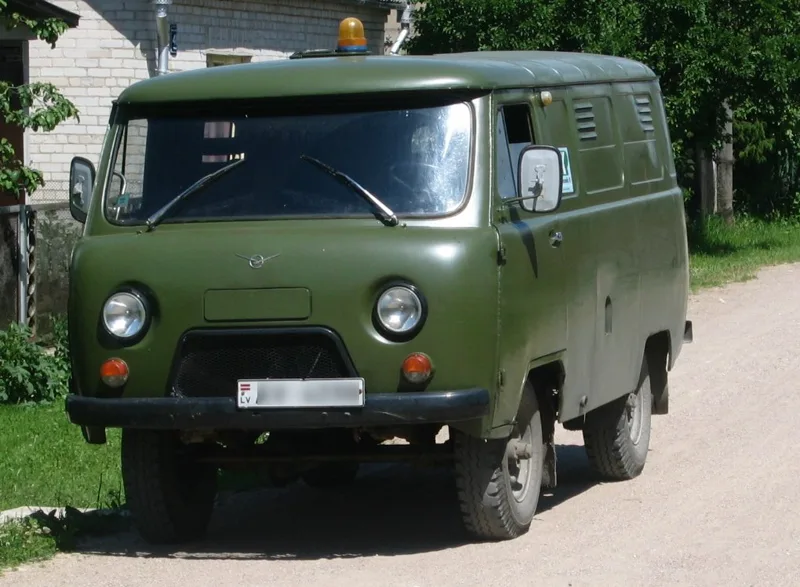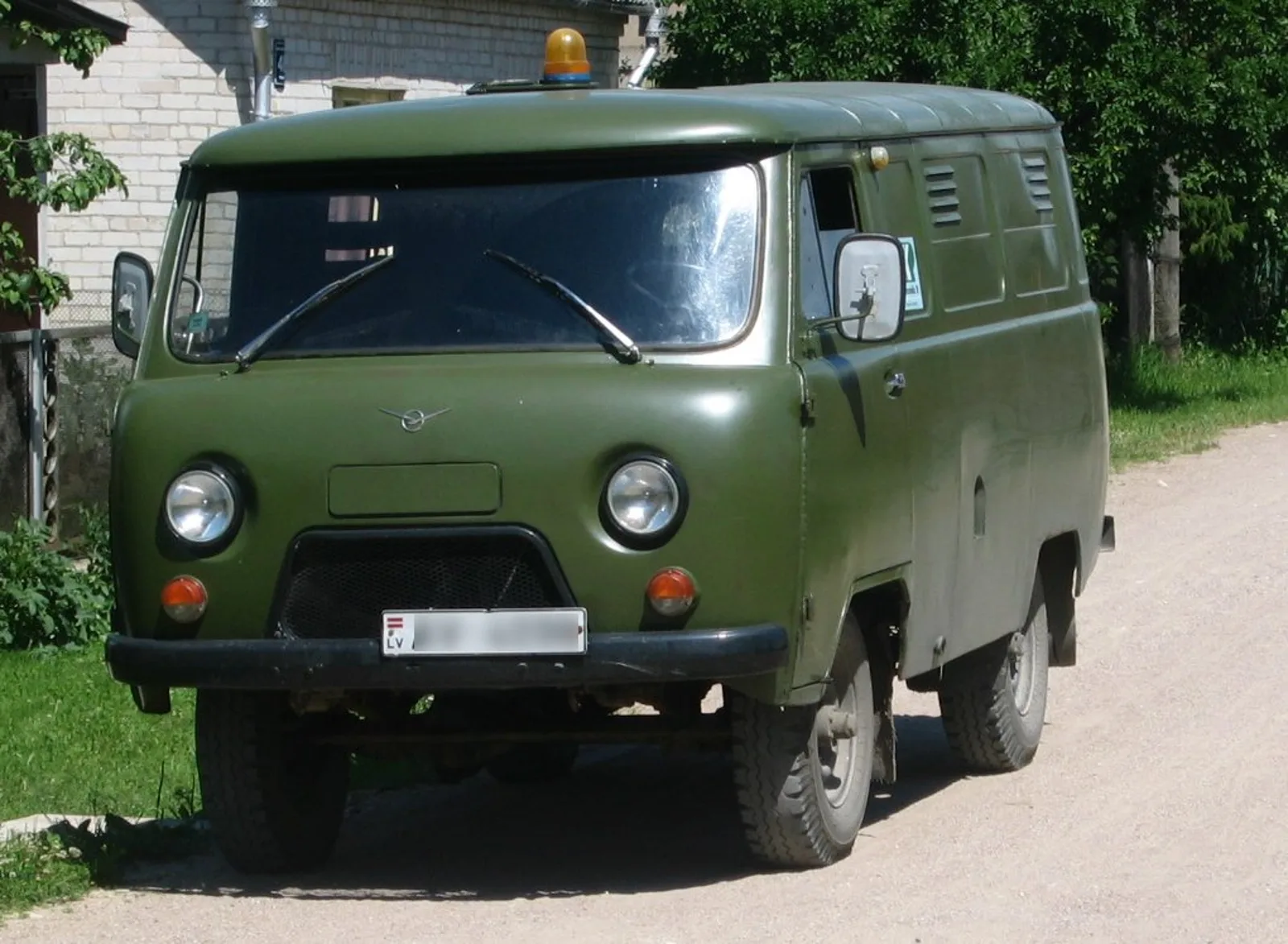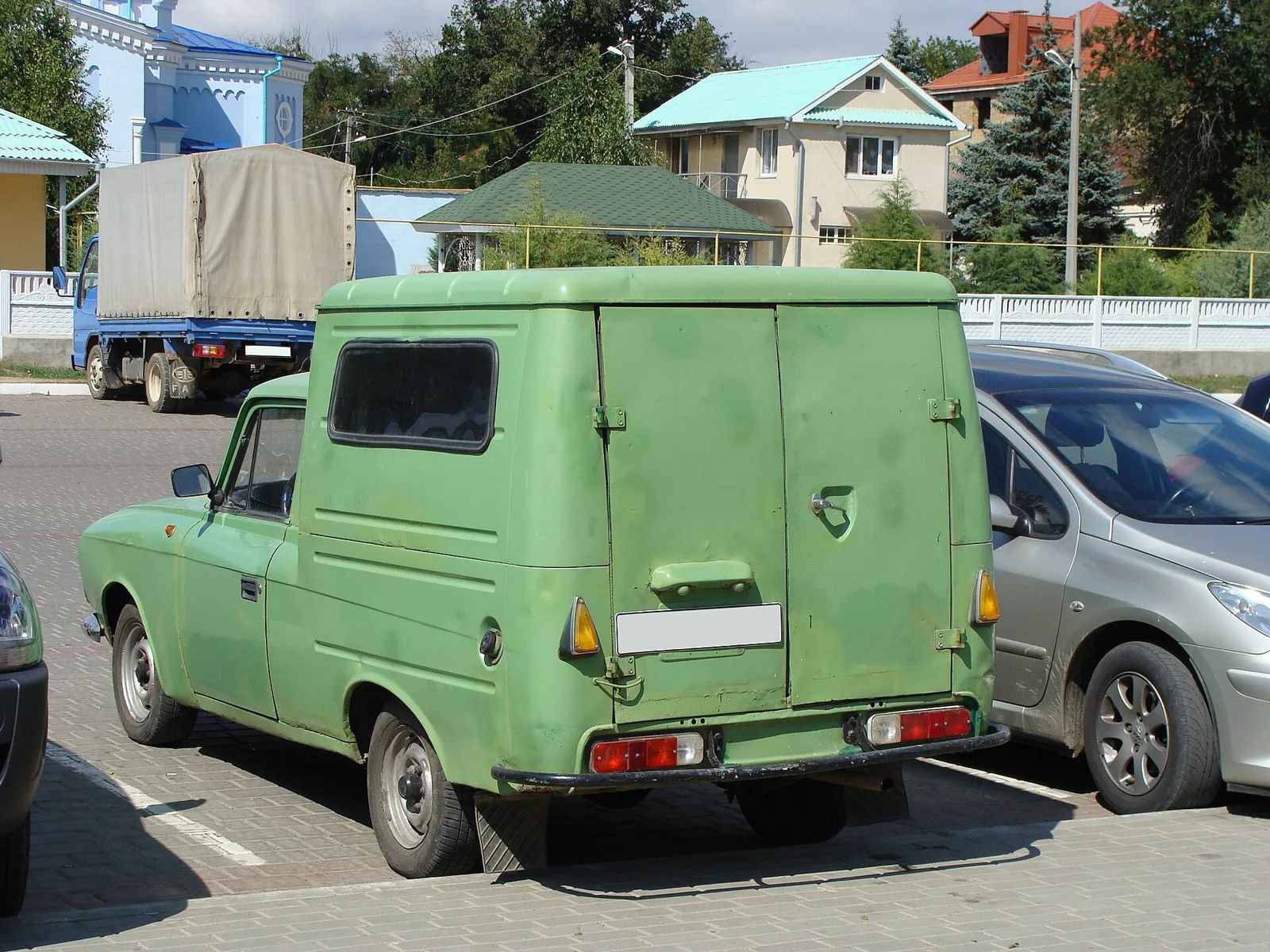
A panel van and pickup built on the Moskvitch 412 platform at Izhevsk, the Izh 2715 ran from 1972 to 2001 and became a fixture of Soviet and early Russian business.
Built by Lada Izhevsk from 1972 to 2001, the Izh 2715 was a van and pickup derived from the Moskvitch 412. Its 1.5-litre engine and largely unchanged design lasted 29 years, and it became the most common light commercial vehicle in the Soviet Union.
The Izh 2715 was a family of light commercial vans and pickups built at Izhevsk, starting in 1972. It was structurally based on the Moskvitch 412 passenger car, used a 1.5-litre engine and stayed in production with only minimal changes until 2001. Later it reached private owners and export markets.
Where did the Izh 2715 come from?
The Izh 2715 grew out of the Moskvitch 433/434 van, which Lada Izhevsk built between 1968 and 1973 on the Moskvitch 412 platform. That van had a low roofline and a rear hatch that opened upwards, which made the cargo area awkward to reach. Izhevsk engineers set out to make it more useful.
By 1970 the Izhevsk team had prototypes with the body trimmed away directly behind the cab, over the rear wheels. The new rear was either a rectangular cuboid structure (Izh-6F) or a cargo bed (Izh-6G). Those prototypes had a high centre of gravity, so they needed further work before series production.
The production version took the designation Izh-2715 under the new model numbering system. Its cargo compartment formed part of the lower body, while the upper housing was a separate piece fitted at the end of assembly. That was necessary because the commercial vehicles had to run on lines designed for Moskvitch-412 sedans.
A van built on a passenger car platform that outlived the Soviet Union and kept Russian traders moving.
How did the Izh 2715 differ from the Moskvitch van?
The Izh had raised roof panels and sides that rose almost vertically at the rear, giving a wider and taller cargo bay than the Moskvitch van. Its cargo space measured 2.6 m3 with a height of 1,170 mm, compared with 1.5 m3 and 875 mm in the Moskvitch. The roof over the load area was raised, and the new body made the difference easy to see.
Twin rear doors, mounted symmetrically, opened to a height of 1,060 mm and a width of 1,040 mm. A partition with a window separated the cabin from the cargo area, and the spare wheel was stored behind the passenger seat. The design was practical for loading, which was the whole point of the project.
The trade-off was rigidity. The Izh had less body rigidity and cargo sealing than the Moskvitch, which made it less suitable for some goods. Payload was between 350 and 400 kg, a useful figure for a small van in that era.
What was the Izh-27151 pickup?
The Izh-27151 pickup with a tailgate arrived in 1974, driven mainly by export demand. Pickups were less practical in the Soviet Union, where goods needed better protection from weather and theft, so output stayed far below the van: 4,200 units in 1974 and 5,000 in 1975.
The nominal payload was 400 kg, but in practice the pickup could carry from 500 to 600 kg. A window in the rear wall of the cabin was protected by a vertical grille. The platform measured 1,655 mm long and 1,440 mm wide, with a floor height of 565 mm.
Export vans and pickups were usually better finished, with rectangular headlights like those of the Moskvitch 412 and a chrome grille and bumper. Domestic cars generally had round headlights and body-coloured grilles and bumpers. Export pickups carried the Moskvitch 1500 GR name, while Western markets saw the Elite Pick Up badge.
How did the van change in the 1980s and 1990s?
In 1982 the Izh 2715 received a limited modernisation that followed updates to the Moskvitch-412 sedan. The van became the Izh 2715-01 and the pickup the Izh 27151-01. The electrical and braking systems were improved, with dual-circuit brakes, and the payload capacity rose by 50 kg.
The front end was refreshed with a black-painted grille. The turn signals and parking lights moved beside the grille instead of sitting below the round headlights. Recessed door handles borrowed the Moskvitch 2140 design, and the seats became more comfortable, while the light switch moved from the floor to the steering column.
The standard engine became the detuned UZAM-412DE, with 67 hp, which was suited to lower-quality A-76 petrol. Export versions kept the earlier UZAM-412 for AI-93 fuel. Through the 1980s, single-panel windows replaced the vent glasses, and the mirrors moved from the fenders to the doors.
Early 1990s changes included a single straight rear bumper that also served as a step, and a reworked taillight arrangement. A plastic front bumper appeared from 1995, but owners often swapped it for the old metal bumper because it was easily damaged.
Was there an extended pickup?
Yes. The extended pickup, designated Izh 27151-013-01, was introduced in 1982 mainly for Finland and Latin American markets. It stayed in small-series production until 1997, and its bed grew from 1650mm to 2050mm by adding a 400mm overhang.
Rather than a new bed mould, the extension was grafted onto the existing bed, and the tailgate moved back with it. When fully loaded the longer version handled worse, because the unbalanced rear overhang lightened the front wheels. Exported extended pickups typically came with rectangular headlights.
An extended van intended among other uses as an ambulance was developed in the early 1990s, but it never entered production.
What was the Izh 27156 cargo-passenger car?
The Izh 27156 was a cargo-passenger version introduced at the end of 1988. It added two folding two-person benches along the cargo walls, large partly sliding side windows and an extra window in the left rear door. Its cargo-passenger status let ordinary Soviet citizens own one, and the design drew its inspiration from the French Matra Rancho.
Operational drawbacks included no heating in the rear section and exhaust fumes and rain leaking through the doors and windows. Production was small at first, but it rose from 536 units in 1990 to 4,260 in 1994. It was the first vehicle of its kind in the Soviet Union and Russia, and 19,994 units had been built by the end of production in 2001.
Some basic 1990s versions lacked rear side glazing because parts were hard to source. Owners also fitted UAZ-452 side windows in place of the embossed faux windows on standard vans, since they matched the dimensions exactly.
Who could buy an Izh van?
Vans and pickups were treated as means of production and sold only to state institutions, enterprises and socialised commerce. From 1975 until the late 1980s, registering one for private use was banned. Partial reforms under perestroika finally let certain cargo-passenger vehicles reach private owners in the second half of the decade.
The Izh 27156 was the model designed for that purpose. It was classified as a passenger car and produced in small quantities from 1988. Once the political system changed, restrictions on owning commercial vehicles were lifted altogether.
During the economic transformation of the early 1990s, the affordable vans became tools for businesses and small-scale trade, including cross-border trade. Despite falling production, they helped the IzhAvto plant survive through the 1990s.
Services also relied on the vans. Since 1982, RBTM workshop vehicles were built in Ryazan for repair teams working on electronic and household equipment. Some were exported to socialist countries, to Finland, and to markets in Latin America and Africa.
What were the Izh 2715's nicknames?
Its body shape resembled a shoe with a high bootleg, which earned it the nicknames kabluk and kabluchok, meaning heel and little heel. In Ukraine and nearby parts of Russia it was known as pirozhok, or little pie, because it often delivered baked goods.
The pirozhok name first belonged to the Moskvitch 433, 434 and 2734 station wagon based vans. As those vehicles disappeared from the streets, the Izh 2715 inherited the name because it took over their role. Soviet policy scrapped a commercial vehicle after it accumulated 250,000 km, which removed the older vans quickly.
Both nicknames are also used for other vehicles with the same body style, including the ZAZ-11055 Tavria Pickup and the earlier generations of the Volkswagen Caddy.
Why did exports matter so much?
Export demand was the reason the pickup existed at all. Foreign customers wanted a pickup with a tailgate, and the Izh 27151 gave them one from 1974. Export vehicles were also built to a higher finish than domestic cars, which signalled a different market and a different buyer.
The car travelled well beyond the Soviet Union. Extended pickups were aimed mainly at Finland and Latin American markets, while Western customers bought the pickup as the Elite Pick Up. The RBTM workshop vehicles also reached socialist countries, the West including Finland, and buyers in Latin America and Africa, where low price and durable construction helped them sell.
Exports also shaped the specification. Export versions kept the UZAM-412 engine for AI-93 petrol, while the standard domestic unit was the detuned version adapted to A-76 petrol. That split reflected the fuel available in each market.
Why did the Izh 2715 outlive the Izh 2717?
Despite the newer Izh-2717 van of the 1990s, the Izh 2715 stayed in production until 2001 because demand continued. The Izh-2717 had quality issues at first and cost one and a half times as much, which left room for the older van.
The older design also suited specialist bodies. Agropromprogress also built a refrigerated body in 2000, the lowest-priced option of its kind in Russia. Conversions like that were easier on a van the market already knew well.
The longevity of the design is the clearest measure of its success. A vehicle that began production in 1972 and kept its basic structure until 2001 carried through 29 years of very different economic conditions with little more than detail changes.
Izh 2715 specifications at a glance
| Specification | Detail |
|---|---|
| Body | Unibody steel, 2-door, 2-seater |
| Overall size, L x W x H | 4,130/1,590/1,825 mm (1,470 mm for pickup) |
| Wheelbase | 2,400 mm |
| Track, front and rear | 1,270/1,270 mm |
| Load bay, L x W x H | 1,600/1,440/1,160 mm |
| Kerb weight | 1,015 kg (Izh 27156: 1,095 kg) |
| Gross vehicle weight | 1,615 kg |
| Engine | UZAM-412DE, 1,478 cc, 67 hp (or 75 hp) at 5,800 rpm |
| Torque | 100 Nm at 3,500 rpm |
| Transmission | 4-speed manual; final drive 4.22:1 |
| Top speed | 125 km/h |
| Fuel use | 6.9 l/100 km at 80 km/h |
| 0-100 km/h | 19 seconds |