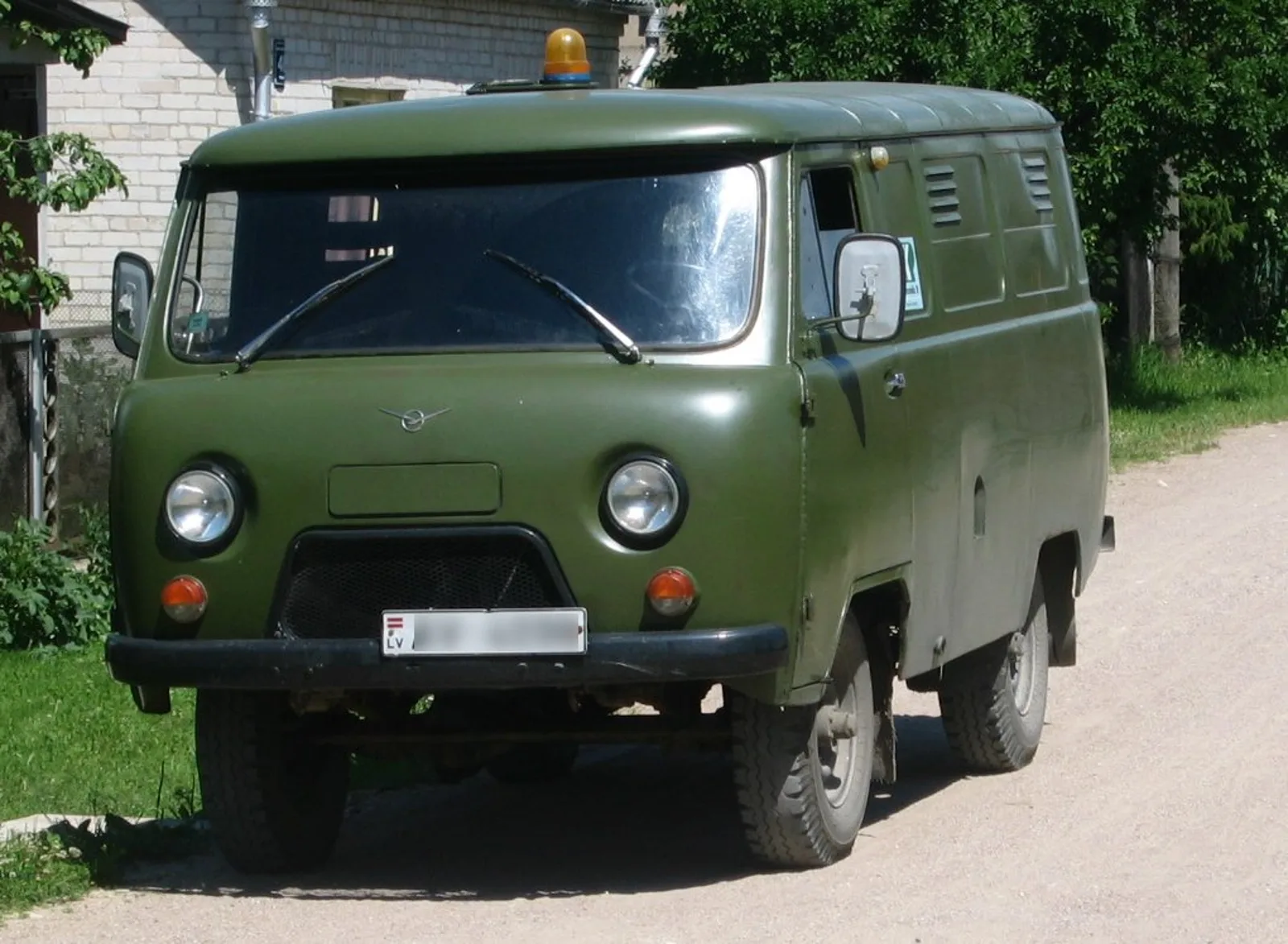
A Soviet-era four-wheel drive van built by the Ulyanovsk plant since 1965, known as the Bukhanka and still in production decades later.
Built at the Ulyanovsk plant from 1965, the UAZ-452 is a Soviet-designed four-wheel drive van with a cab-over-engine layout. Its nickname, Bukhanka, means loaf, a name it earned from its shape, and its design goes back to army requirements set in 1954.
The UAZ-452 is a Soviet-era van built by the Ulyanovsk Automobile Plant since 1965. It has a body-on-frame structure and a cab-over-engine layout, and it was first designed for the Soviet Armed Forces. The van became known as the Bukhanka, or loaf, after its shape.
What is the UAZ-452?
The range covers four-wheel drive vans and light trucks, each with body-on-frame construction and a cab-over-engine layout. Its earlier relatives were the UAZ-450, built from 1958 to 1965, and the UAZ-451, built from 1961 to 1982.
The army was the first customer, and from 1985 onward the van received updates. The lineup also received new four-digit model numbers under Soviet vehicle index standards set in 1966.
A Soviet army van with a loaf's nickname that has outlasted most of the vehicles built alongside it.
Why is it called the Bukhanka?
The UAZ-452 has been widely known as the Bukhanka, which means loaf, after its resemblance to a loaf of rye bread. The ambulance version was nicknamed Tabletka, meaning pill.
From the 2010s UAZ has collectively referred to the variants as SGR, the old commercial lineup. The name Bukhanka has nonetheless stayed with the vehicle among its owners and in popular use.
How did the van begin in 1954?
In 1954 the Soviet Ministry of the Automotive Industry asked UAZ's design department for a light off-road freight vehicle, needed quickly by the army. The base was the chassis of the GAZ-69, which was assembled at the factory at the time.
After debate with specialists at NAMI, the cab-over-engine design was chosen. The first prototype was designed by Vladimir Ariamov, and its black-and-white paint job earned it the nickname soroka, meaning magpie.
The prototype was tested across the Karakum Desert, the Pamir Mountains, Kazakhstan and Oymyakon. Later development by Evgeny Starostin and Lev Shemarin smoothed the design, and the final form was finished by Shemarin shortly before it was due in Moscow for approval.
How did the UAZ-450 reach production?
UAZ readied the design for serial production in 1958, aiming for 4000 units a year. The van was shown at VDNKh in Moscow that June, and early examples had front suicide doors.
The UAZ-450 was offered in four bodystyles: van, ambulance, minibus and truck. Most vans were used as ambulances, and they could seat up to four stretchers or six on the benches, with one accompanying person.
The vehicle was tested with railroad wheels so that it could be used as a railcar. It was not comfortable for passengers on the move, because the suspension stayed that of the standard model.
Why was the UAZ-451 a separate model?
In 1958, before the UAZ-450 was finished, a rear-wheel drive version was ordered, and it received the UAZ-451 index. The main problem was that the front axle was overloaded, so the engine was moved 73 mm (2.9 in) down.
The truck competed with the GAZ-51 in testing. The UAZ-451 entered serial production in 1961, but the minibus and ambulance models were cancelled.
What changed in the UAZ-452?
Since 1960 UAZ had been testing upgrades for the 450 model, and the work was finalised in 1963. The new vehicles received an OHV engine based on the GAZ-21 Volga, a 4-speed manual transmission and a facelift that removed the roof windows.
Vehicles built until 1979 had old-style lights, with colourless turn signals and round rear lights. Models after 1979 received amber signal lights and slightly larger, rectangular rear lights, and the fake windows were removed.
How was the van upgraded in 1985?
In 1985 the van was upgraded and spun off into separate submodels, including the UAZ-39625, UAZ-3962, UAZ-3303, UAZ-3909 and UAZ-2206. The upgrade added international-standard lighting, alarms, a new dashboard and a new speedometer.
The brakes were redesigned, and the engine was upgraded so that its power output rose to 99 hp from the previous 78 hp.
What were the later updates?
In the early 2000s the van received new plastic side mirrors taken from the GAZ GAZelle van, along with headrests on the front seats. The minibus seats were also given headrests, and the pickup truck gained a metal body in place of a wooden one.
In March 2011 the UAZ-39625, UAZ-3962 and UAZ-2206 received ABS brakes, power steering, seat belts and the Euro-4 engine as standard equipment.
What engine and running gear did the UAZ-452 use?
The engine was placed between the driver and the passenger seats. It was the 75 hp (55 kW) 2.4-litre UMZ-452MI inline-four, the same unit used in the UAZ-469, and it could run on gasoline as low as 72 octane, with 76 preferred.
Its body typically has two front doors, one single-wing door on the right and a double-wing door at the back, with variations between models. Fuel ports on the left and right sides lead to two separate fuel tanks.
As of 2024 the UAZ-452 was the oldest vehicle design still in production. That longevity is one of the reasons it remains a familiar sight in parts of the former Soviet Union.
Which UAZ-452 variants were built?
The 1965 to 1985 range included the UAZ-452 cargo panel van with a windowless rear section, the UAZ-452A medical transport and the UAZ-452D light flatbed truck with a wooden platform. The UAZ-452A medical version is covered in more detail below.
The UAZ-452V was a passenger minibus with eleven seats, and the UAZ-452E variants had shielded electrics for work near airfields and radio communication centres. The UAZ-452AS, a cold-weather medical prototype, was trialled in Yakutia in the winter of 1976 but never entered production.
The UAZ-452G was a planned true ambulance from 1971, with a single stationary stretcher and seats for medical staff. It was successfully trialled, but it never entered production for reasons that are not recorded.
What were the post-1985 models?
The UAZ-3741 is a panel van updated from the UAZ-452, while the UAZ-3962 is a medical transport updated from the UAZ-452A. The UAZ-2206 is a passenger minibus updated from the UAZ-452V, and the UAZ-3303 is a light flatbed truck updated from the UAZ-452D.
The UAZ-3909 arrived in 1994 as a mixed cargo and passenger minibus, with five seats and a table at the front of its rear section. The UAZ-39094 followed in 1997 as a double-cab flatbed with an extended wheelbase.
The UAZ-39625 arrived in 2000 as an alternate cargo-passenger minibus. It reuses the UAZ-3962 body shell and seven foldable rear benches, but it carries no medical markings or equipment.
How did the van perform in Ukraine?
During the Russian invasion of Ukraine, mounting losses of supply and utility vehicles meant UAZ-452 vans were deployed to the front lines. Reports described the vans as having poor comfort and a weak engine, with no shock absorbers.
Commentators also noted that the thin steel panels offer little protection against drone strikes, and that the fuel tanks under both flanks made the van prone to catching fire. By 2024 destroyed vans had become a common sight in Ukraine.
Russian troops were seen fitting caged armour to the vans, and some were covered in Kontakt reactive armour, including the windshield. Armour of that kind was not designed to handle the charge inside the reactive blocks, so the modifications could make the vehicle more dangerous for its crew.
What is the UAZ-452's place in the market?
The van is listed as used in a number of countries, among them Cuba, Egypt, Mongolia and Vietnam, as well as Russia and several former Soviet states. Its users range from military and government fleets to rural operators.
Its ambulance role is one of its lasting strengths, because the van can reach remote places that other vehicles cannot. Its simple, rugged design is the reason it has stayed in production for so long.
What did the medical versions carry?
The UAZ-450A medical transport could carry eight sitting patients on foldable benches or four lying patients on wall-mounted stretchers. Its body walls meant there was no side door for the rear compartment, which made access inconvenient.
The UAZ-452A carried six sitting patients or four lying patients. It had two seats in the cab and a seventh rear seat for a medical assistant, and a rotating searchlight and medical identification light sat on the cab roof.
The UAZ-452A carried limited medical equipment and was meant only to take patients to the nearest hospital, so it was not a true ambulance in the strict sense. The planned UAZ-452G was intended to fill that gap, but it never reached production.
Which rural and passenger versions were sold?
The UAZ-451M and UAZ-451DM were rear-wheel drive models built from 1965 to 1982, and they were used mainly on collective farms and in other rural work. The UAZ-452V was a passenger minibus that was planned as public transport but never employed in numbers.
The UAZ-451DM took an M suffix rather than a new index, because the UAZ-451 already used the updated platform. Four-wheel drive mattered less in those rural roles than it did in military use.
The UAZ-452V had eleven seats, with two in the cab and three rows of three in the rear. It was meant to run beside the RAF minibuses in public service, but insufficient production numbers meant it was used in the same utility and military roles as the other vans.
What were the extended and cargo variants?
The UAZ-33036 arrived in 1996 as an extended wheelbase version of the UAZ-3303, stretched in wheelbase while keeping the same bed size. It was discontinued in the mid-2000s, as was the UAZ-39095, which had an extended wheelbase and a sleeper section behind the cab.
The UAZ-3741 kept the panel van role, and its variant with shielded circuits was renamed UAZ-37411. The shielded electrics suited work near airfields and radio communication centres.
What are the key UAZ-452 figures?
| Specification | Detail |
|---|---|
| Built by | Ulyanovsk Automobile Plant (UAZ) since 1965 |
| Engine | 2.4-litre UMZ-452MI inline-four, 75 hp (55 kW) |
| Engine output before 1985 | 78 hp |
| Engine output after 1985 | 99 hp |
| Fuel | 72 octane minimum, 76 preferred |
| Fuel tanks | Two separate tanks, with ports on both sides |
| Planned annual output (1958) | 4000 units |
| UAZ-451 production | 1961 to 1982 |
| UAZ-450 production | 1958 to 1965 |
| Minibus seating (UAZ-452V) | Eleven seats |