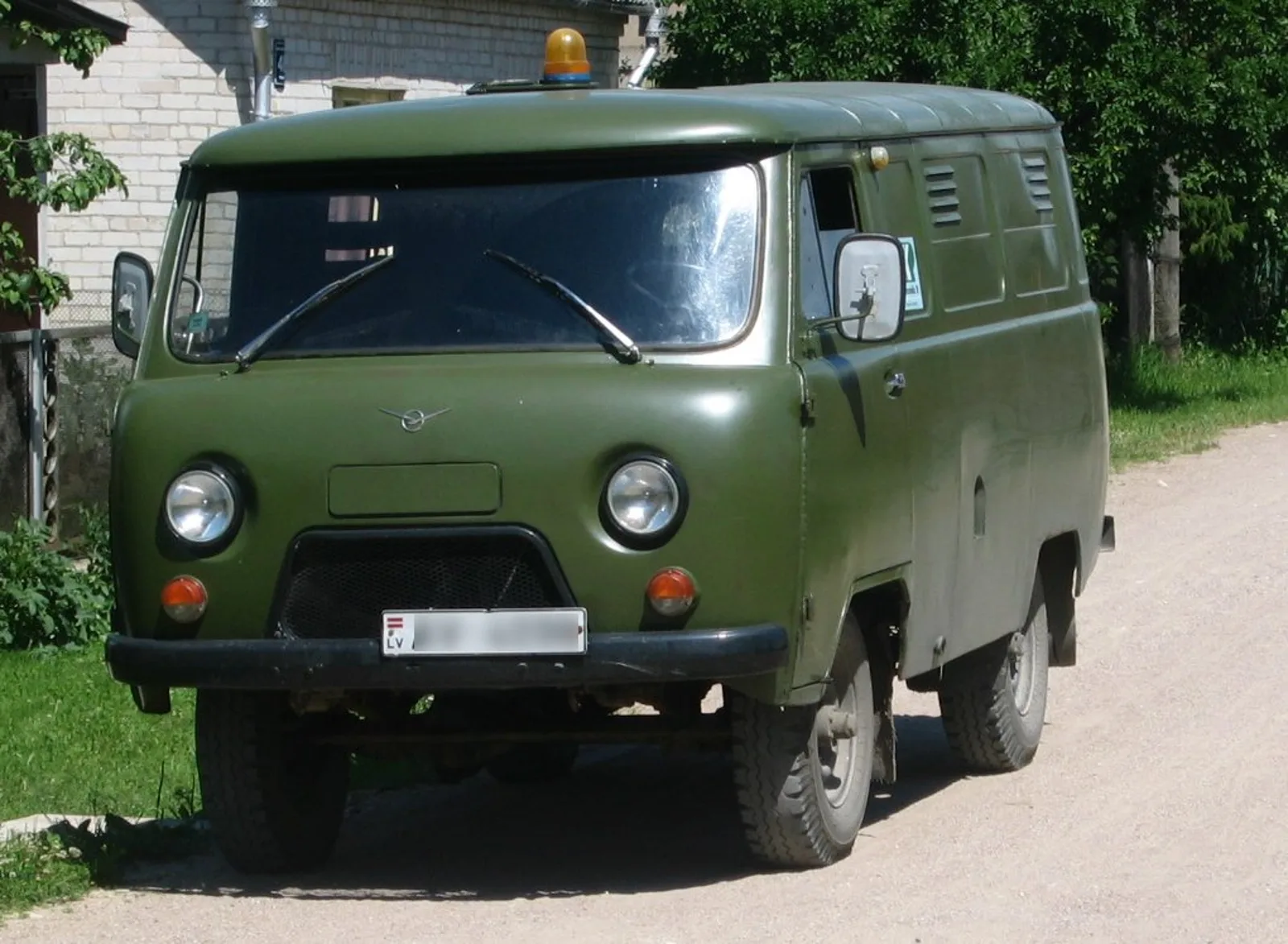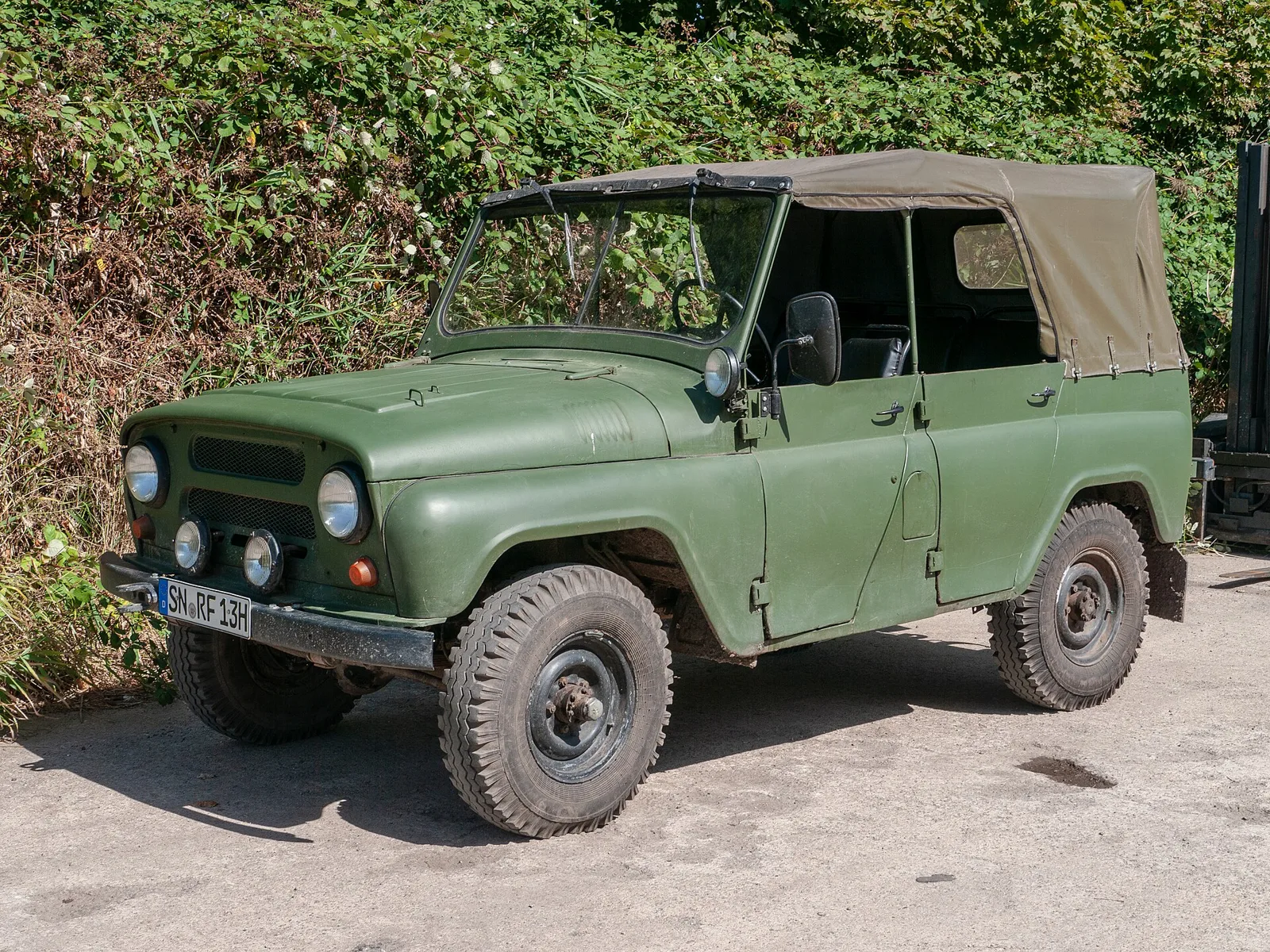
A plain, repairable military utility vehicle from 1971 whose variants ran from border-troop hardtops to amphibious and medical models.
The UAZ-469 is a Soviet off-road military utility vehicle built by UAZ from 1971. It used a 2,450 cc petrol engine and 4-wheel drive. Between 1.65 and 2 million units were built, including variants, and the model later carried the names UAZ-3151 and UAZ Hunter.
The UAZ-469 is an off-road military light utility vehicle that UAZ began building in 1971 for the Soviet armed forces and other Warsaw Pact militaries. It combined a 2,450 cc four-cylinder petrol engine with 4-wheel drive and a rugged live-axle chassis, and it later went on sale under the names UAZ-3151 and UAZ Hunter.
Its reputation rested on a simple, durable layout that could cross rough ground and was easy to repair. Soviet state agencies relied on it wherever a robust off-road vehicle was needed, and the basic formula stayed recognisable through decades of revision.
Where did the UAZ-469 come from?
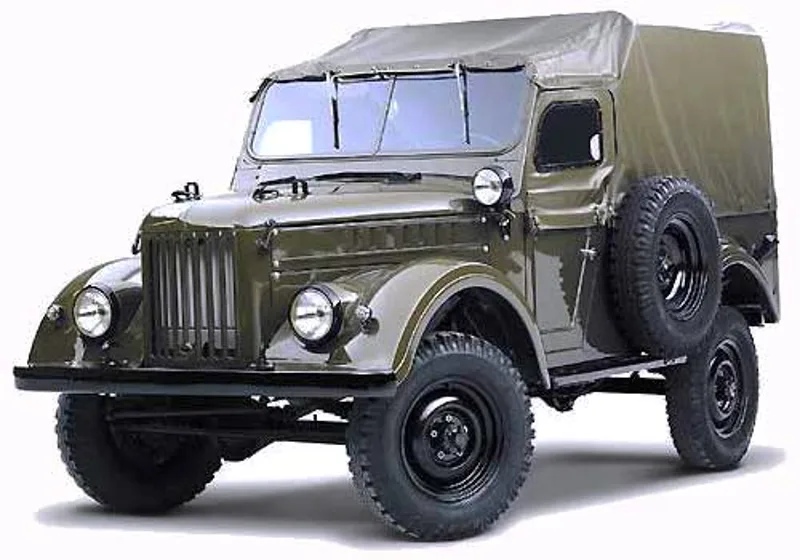
The vehicle was designed in response to a 1956 Soviet Army order for a replacement for the outdated GAZ-69. Early plans called for an amphibious machine with a rear engine, but the brief was simplified and the first prototypes were called UAZ-460.
Those prototypes had 400 mm of ground clearance, yet they proved prone to rollovers, so the design was reworked. A later V4-powered unibody, the UAZ-471, was also dropped, because putting it into series production would have meant rebuilding the plant.
The first UAZ-469 arrived in 1961 with 300 mm of clearance. Its engine was the 2,445 cc UMZ-452MI inline four producing 75 hp (55 kW), the same unit fitted to the UAZ-452, and it accepted petrol with an octane rating down to 72, although 76 was the preferred grade.
That engine was not limited to the UAZ. Several Soviet models, the GAZ-21 Volga among them, used it as well.
Series production was held back because the Soviet Union was also funding costly VAZ and KamAZ plants, so output only started in 1971. The first cars were military versions with 300 mm (12 in) of clearance, and the civilian UAZ-469B, with 220 mm (8.7 in), followed in 1973.
A plain, repairable Soviet off-roader that outlived its own nameplate and became the Hunter.
How did the UAZ-469 engine and drivetrain work?
The UAZ-469 ran a water-cooled 2,450 cc petrol inline four rated at 75 hp (55 kW) at 4,000 rpm, with peak torque of 166.7 Nm (123.0 lb ft) at 2,200 rpm. Power passed through a 4-speed manual gearbox and a 2-speed transfer case to all four wheels.
The carburettor system ran on 76-octane petrol, and the fuel tank held 78 litres. Some later cars were fitted with a 2.7 L (2,693 cc) engine producing 112 hp (82 kW), which was used between 2010 and 2013.
Refinements arrived with the 1985 models, which gained a single windshield with automated wipers, new lights, dual-circuit brakes, better heating and a modernised drivetrain. The civilian UAZ-469B also had longer PTO shafts and a single-stage main gear with no final drive.
How heavy and how big was the UAZ-469?
Standard figures give an external length of 4,025 mm (158.5 in), a width of 1,785 mm (70.3 in) and a height of 2,050 mm (80.7 in). The wheelbase measured 2,380 mm (93.7 in), with an empty weight including fuel of 1,650 kg (3,638 lb) and a maximum gross weight of 2,450 kg (5,401 lb).
The standard tyres were 215 SR 15 on 6L x 15 wheels, and the front and rear tracks each measured 1,453 mm (57.2 in). The front axle was a live unit on coil springs and the rear was a live unit on leaf springs, with drum brakes on both axles.
Ground clearance was the main trade-off between the two versions, with 300 mm (12 in) for the military car and 220 mm (8.7 in) for the civilian B. Shortened and stretched bodies also appeared, the Shalun with a 2000 mm wheelbase and the Gusar with a longer one.
When did production begin and how many were built?
Series production of the UAZ-469 began in 1971 with a military version that had 300 mm (12 in) of ground clearance. A civilian UAZ-469B followed in 1973. Between 1.65 and 2 million units were built across the model and its variants, and exports reached eighty countries.
Most cars went to the army and state agencies, although many were later sold as surplus to private owners. New industry designation standards led to a renaming in 1985, when the UAZ-469 became the UAZ-3151 and the UAZ-469B became the UAZ-31512.
Civilian production ended in 2005 because of new emission standards, while manufacture of the UAZ-31512 for the Russian Army carried on until 2011.
What were the main UAZ-469 variants?
The family grew into a long list of versions, from a military car and a nuclear, biological and chemical resistant model to a hardtop for border troops, a police patrol car, a medical utility and short and long wheelbase bodies. Export editions modified in Italy used several different engines.
- UAZ-469 / 3151 is the specialised military car with 300 mm (12 in) of clearance.
- UAZ-469RKh is the version with nuclear, biological and chemical resistance.
- UAZ-31515 Burevestnik is a hardtop built from 1980 for the Soviet Border Troops.
- UAZ-469AP / 31512-UMM is a police patrol car with an insulated five-door metal body.
- UAZ-469BG / 3152 is a medical utility fitted with places for nurses and a stretcher.
- UAZ-31514 Hunter is a civilian hardtop that entered production in 1993.
- UAZ-2315 is a pickup based on the 31514, introduced in 1996.
- UAZ-3150 Shalun is a short wheelbase version of 2000 mm with a removable roof and doors.
- UAZ-3153 Gusar is a stretched long wheelbase version, introduced in 1996.
- UAZ-3159 Bars is a wider version of the long wheelbase model, introduced in 1999.
- UAZ-3907 Jaguar is an amphibious version with two propellers on the rear axle.
The Italian Martorelli versions were heavily modified after export, and their engines varied widely. The Explorer used a 2,445 cc UMP-451M petrol engine with 75 hp, the Marathon a Peugeot XD2 diesel of 2,498 cc with 76 hp, the Dakar a turbodiesel from VM Motori of 2,400 cc with 100 hp, and the Racing a 1,995 cc Fiat petrol engine with 112 hp.
What did the UAZ-469 achieve off-road?
In 1974, three stock UAZ-469B cars became the first vehicles to reach the summit of Mount Elbrus. The climb took 38 minutes to reach 4200 m above sea level, and the drivers said engine power fell by about 40% at altitude, yet none of the cars broke down.
The expedition was led by Aleksei Berberashvili, an engineer at the Nalchik High Mountain Geophysical Institute. He had already ridden up Elbrus on a custom-made bike, making him the first biker to conquer the mountain.
On the same day the cars were also helping a rescue mission, carrying emergency equipment to people stuck on the mountain.
The power loss was reported at around 40%, but the result showed how well a plain, rugged design could cope with thin air.
How did the UAZ Hunter carry the name forward?
The UAZ Hunter arrived in 2003 as an updated UAZ-31514 hardtop that replaced the base models. It became the base model in 2005, and after a 2015 decision to discontinue it, the factory reversed course the following year. The Hunter name then carried the design through a run of special editions and a facelift.
Early exports reached Germany and a few Asian markets under the name UAZ Tigr, until General Motors objected to its resemblance to the Opel Tigra. In Germany the car was then renamed Baijah Taigah.
A 2010 Victory Day edition revived the original UAZ-469 nameplate, and a 2011 facelift brought back the classic bumpers while removing plastic trim. Later years brought a steady flow of special editions and anniversary runs.
In 2021 the Czech company MW Motors began building an electrified Hunter called the Spartan. The project had been introduced in 2019, but COVID-19 pandemic delays pushed its assembly back.
The full-scale invasion of Ukraine in 2022 brought western sanctions, and the Spartan assembly was stopped. The Indian Force Gurkha took its place, and the Expedition trims had to stop for 2023-2024.
How many people fitted into a UAZ Hunter?
On June 4, 2010, a UAZ Hunter carried 32 people including the driver, with the passengers and driver weighing 1900 kg together. The previous record was 23 people in a Kia Spectra, and the feat was recorded in The Guinness Book of Records.
The stunt was staged with the Rumyantsev State School of Circus and Variety Art. The car had to cover the minimum distance of 10 metres with everyone still inside, and it managed the run without losing a single passenger.
Feats like this showed how far a utility design could be pushed, and they gave the Hunter public attention well beyond the military market.
What limited editions did UAZ release?
UAZ released a steady run of limited editions after the Hunter's 2003 debut. They included a 2010 Victory Day car under the UAZ-469 name, a Beach and an Expedition edition in 2011, a Trophy model in 2013, a Jungle Edition in 2016 and a 45th anniversary car in 2017.
The 2015 Victory Series, launched to commemorate the Victory Day and the decision to stop the Hunter, wore a livery drawn from aircraft in a Soviet wartime film called Only Old Men Are Going Into Battle.
The 2017 45th anniversary edition came in teal and white and was limited to 469 copies. In 2022 the 50th anniversary run assembled 50 softtop cars under the original UAZ-469 nameplate, the first return of that name since 2010.
How was the UAZ-469 used in military service?
The UAZ-469 served with Soviet forces and many other armed forces, and its service history runs from the Yom Kippur War to the Russo-Ukrainian War. Former operators included Afghanistan, East Germany, Egypt and Mali, and Lebanon used the vehicle in its civil war.
The Lebanese Armed Forces and some militias used it during the Lebanese Civil War (1975-1994).
The Chinese Beijing Auto Works BJ-212 is an off-road vehicle based on the UAZ-469, which shows how far the design travelled beyond the Soviet Union.
What are the UAZ-469 specifications?
The UAZ-469 combined a 2,450 cc petrol engine, 4-wheel drive and a 4-speed gearbox with an empty weight of 1,650 kg (3,638 lb) and 220 mm (8.7 in) of ground clearance on civilian cars. The table gives the main figures for the standard model, with the military clearance noted alongside.
| Specification | Detail |
|---|---|
| Engine | 2,450 cc petrol, inline four, water cooled |
| Power | 75 hp (55 kW) at 4,000 rpm |
| Torque | 166.7 Nm (123.0 lb ft) at 2,200 rpm |
| Fuel | 76-octane petrol, 78 litre tank |
| Transmission | 4-speed manual, 2-speed transfer case, 4-wheel drive |
| Axles | Live axles, coil springs at front, leaf springs at rear, drum brakes |
| Tyres and wheels | 215 SR 15 on 6L x 15 |
| Empty weight | 1,650 kg (3,638 lb) with fuel |
| Maximum gross weight | 2,450 kg (5,401 lb) |
| Dimensions | 4,025 mm (158.5 in) long, 1,785 mm (70.3 in) wide, 2,050 mm (80.7 in) high |
| Wheelbase | 2,380 mm (93.7 in) |
| Track, front and rear | 1,453 mm (57.2 in) |
| Ground clearance | 300 mm (12 in) military; 220 mm (8.7 in) civilian |