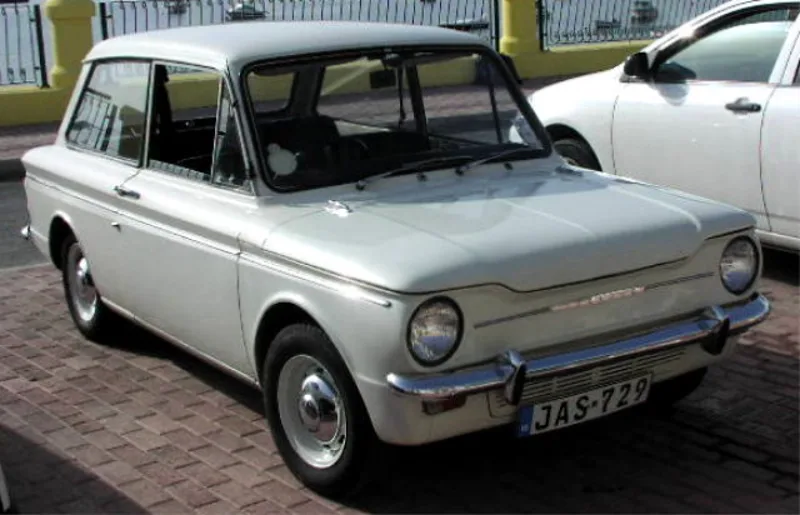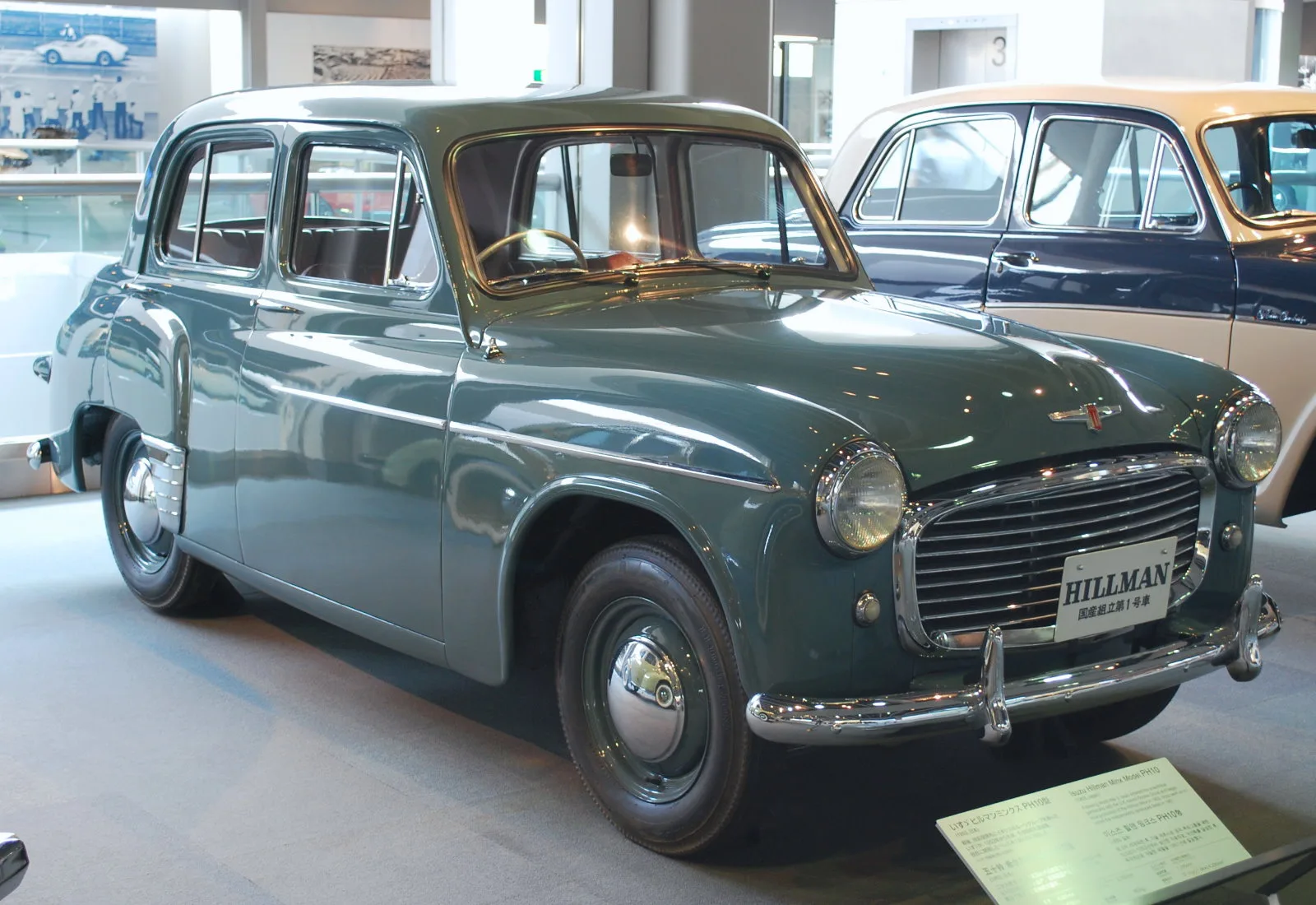
Built by Isuzu under a Rootes licence from 1953 to 1964, the Hillman Minx was the first foreign car that Japan's trade rules pushed towards full local production.
The Isuzu Hillman Minx was a middle-sized family car built in Japan under licence from Rootes from 1953 to 1964. It reached full Japanese production in 1957, and 57,729 were built before the Minx was phased out in June 1964.
Between 1953 and 1964, Isuzu built a line of mid-sized family cars in Japan under a licence from Rootes. In broad terms they matched the Mk VI to Mk VIII and Series 1 to 3A Minx sold in Britain, though the Japanese versions drifted apart as local production grew. Their story is a case study in how Japan's trade policy shaped the car industry.
How did Isuzu come to build the Hillman Minx?
Isuzu traces its roots to Tokyo Ishikawajima Shipbuilding, founded in 1893. That company signed an agreement with the British maker Wolseley Motor in 1918, and in 1922 it began local production of the Wolseley A9, the first passenger car made in Japan. The business became Isuzu Motors in 1949.
The Hillman deal came out of the post-war rush by Western carmakers to sell in Japan. Rootes was one of six companies that studied the Japanese market by April 1952, alongside Renault, Standard, Opel, Fiat and Chrysler. Rootes then became the first to reach an agreement with Isuzu, after its own plans were turned down.
A British family car, licensed to a Japanese maker under strict trade rules, that became fully Japanese-built by 1957.
What rules did Japan set for foreign carmakers?
In June 1952 the Ministry of International Trade and Industry (MITI) set a policy on the entry of foreign manufacturers. Foreign firms could enter only through technical agreements with existing local chassis makers, and MITI said smaller European cars suited Japan better than large American ones.
MITI also limited the foreign currency that could be spent on imports, allocating enough for 1200 cars per manufacturer each year. A further October 1952 policy barred foreign capital for sales operations, allowed it for production that helped local industry, and guaranteed royalty and patent payments.
Under that policy, technology agreements had to reach 90% domestic parts within five years, and manufacturing rights had to pass to Japanese companies. Imports of raw materials that Japan could not produce were still permitted.
Why did Rootes need Isuzu?
Rootes had first proposed its own CKD factory in Japan, which MITI opposed. An alternative with Ikegai Motors, in which Rootes would import parts and sell the finished cars, was rejected too. The Isuzu agreement was the arrangement that finally met MITI's terms.
What did the Isuzu-Rootes agreement allow?
Isuzu received sole rights to import every type of vehicle that Rootes made. It also gained the right to build the Hillman Minx and Commer delivery vans, starting with CKD assembly and moving towards domestic production.
Isuzu would pay Rootes a royalty of 25 pounds for each car after the first 2,000. It also paid 50,000 pounds, which Rootes was not to remit to Britain but to use for a sales and service network in Japan. Its earnings were likewise to remain in Japan.
The agreement could be ended after five years on one year's notice. If nobody ended it, it would run for 25 years.
When did the first Isuzu-built Minx leave the line?
The first Isuzu-built Hillman Minx rolled off the assembly line on 28 October 1953 at Isuzu's new Omori factory. It was known in Japan as the PH10 and was essentially the Mk VI Hillman Minx, with a 1265 cc side-valve engine and a column-shift manual gearbox.
The cars were assembled from knock-down kits and sold through the Yamato Motor Company from 12 November 1953. The early models kept the British design almost unchanged, so the car was in effect a Hillman built in Tokyo.
How did the PH10 to PH12 models develop?
Rootes in Britain updated the Minx every year, usually launching a new model late in the year. Isuzu followed a similar path. The PH10 gave way to the PH11, the Mk VII Minx, in August 1954, and the PH11 was replaced by the PH12, the Mk VIII Minx, in February 1955.
The PH12 used the new 1390 cc overhead valve engine that Rootes had introduced with the Hillman Mk VIII. The earlier cars had been strongly marketed as Hillmans, with Japanese brochures that were translations of English ones and models that looked distinctly Western.
For the PH11 and PH12, brochures advertised four body styles: a four-door sedan, a two-door convertible, a two-door Californian coupe and a two-door estate. It seems likely that only the four-door sedan was actually built in Japan, with the other styles imported if they were sold at all.
How quickly did local content rise?
At the start, in October 1953, only about 6% of each car's value came from Japan. Tyres, tubes and batteries were local, and so was the paint work. By October 1954 the share had reached about 18%.
MITI began to suspect in 1955 that Isuzu was moving too slowly, although the delay partly reflected Rootes' plans for a new engine and a new body. Local production reached 30% in November 1955 and 50% in August 1956, when the engine and gearbox were added to the locally made list.
During 1957 the major body components were built in Japan, taking the total to 100%. On 28 October 1957, exactly four years after the first car, the first fully Japanese-built Hillman was finished.
What was the Audax Isuzu-Hillman?
In 1956 Rootes released the new Audax Minx, a completely new body that kept some mechanical parts from the Mk VIII, including the overhead valve motor. Isuzu built it as the PH100, which went on release on 19 September 1956.
Isuzu then introduced the Super Deluxe in January 1958, priced above the Minx. In March 1958 it added a more basic Standard model, designated PH50, at a lower price. The Standard replaced the mid-range Minx, leaving two trims in the lineup.
How did the Minx's engine and power change?
In August 1958 the range was facelifted to resemble the Series 2 Hillman Minx, as the PH200. Power rose to 55 bhp in the Super Deluxe from 46 to 50 bhp, and the car was now rated for six passengers.
In October 1959 the PH300 brought Series 3 styling. It gained an enlarged 1494 cc engine in two forms: the Standard made 60 bhp at 7.5:1 compression, and the Super Deluxe made 62 bhp at 8.5:1.
The PH400 followed in October 1960, resembling the Series 3A Minx, though the Japanese cars kept the smaller windscreen of the earlier Minx. Minor revisions in 1961 and 1962 did not change the model designation. In April 1963 power reached 68 bhp for the Standard and 70 bhp for the Super Deluxe.
Isuzu never fitted the 1592 cc engine that Rootes introduced in the Series 3C Hillman in 1962. The cars kept four-speed column-shift manuals and drum brakes until the end.
What extras did the Super Deluxe offer?
Isuzu did not change the Minx's looks after 1960, but it kept improving the specification, particularly on the Super Deluxe. These cars ended up better equipped than their UK counterparts.
Early Super Deluxe cars received full instrumentation, including an ammeter, an oil pressure gauge and a clock, along with a radio. Later additions included a lockable glovebox, a handbrake warning light and reversing lights, self-dipping headlights and a boot-mounted air-conditioning system.
What was the Hillman Express estate?
Rootes introduced an Audax Minx estate in 1957, with four doors and rear windows that wound down. Isuzu chose not to build that car. It produced its own estate, the Hillman Express, which was quite different from the Rootes version.
The Express had a different roofline, two doors, sliding rear passenger windows and horizontal bars on the load-area side windows. Its single-piece tailgate opened to the side, and the front seat was split one third of the way across, on the driver's side. Isuzu marketed it as a delivery van during the week and a family estate at weekends.
The Express is pictured in a 1960 brochure, and it probably arrived in August 1958 with the PH200 facelift. It used the low-compression engine from the Standard Minx and carried the designations PT100, PT200 and PT300.
When did the Minx end and what replaced it?
Rootes tried in 1961 and 1962 to extend the period in which Isuzu could build Hillmans. It hoped the market might be liberalised so that fully imported cars could be sold through its dealers, and it was even ready to give up its royalties. The deal did not happen, largely because Isuzu was moving to make cars of its own.
The first of these was the Isuzu Bellel, introduced on 11 April 1961. It was a conventional four-door sedan, weighing 1,190 kg (2,624 lb), with a 2-litre (1991 cc) engine. It was a size above the Minx, so it did not replace it.
The real successor to the Minx was the Isuzu Bellett, introduced in June 1963. It was a little smaller than the Minx and had lower styling, and it came in Standard, DeLuxe and Sport trims with 2- and 4-door bodies. Its engines were a 1471 cc petrol unit and an 1800 cc diesel, and an estate, the Bellett Express, used 1300 cc and 1500 cc engines.
Isuzu kept building the Minx until June 1964. By then 57,729 Isuzu Hillmans had been made.
What are the Isuzu Hillman Minx specifications?
| Specification | Detail |
|---|---|
| Built | 1953 to 1964, under licence from Rootes |
| First model (PH10, 1953) | 1265 cc side-valve, column-shift manual |
| PH12 (1955) | New 1390 cc overhead valve engine |
| PH300 (1959) | 1494 cc; Standard 60 bhp, Super Deluxe 62 bhp |
| April 1963 revision | 68 bhp Standard; 70 bhp Super Deluxe |
| Transmission | Four-speed column-shift manual to the end |
| Local content | 6% in 1953; 100% by 28 October 1957 |
| Total built | 57,729 Isuzu Hillmans |