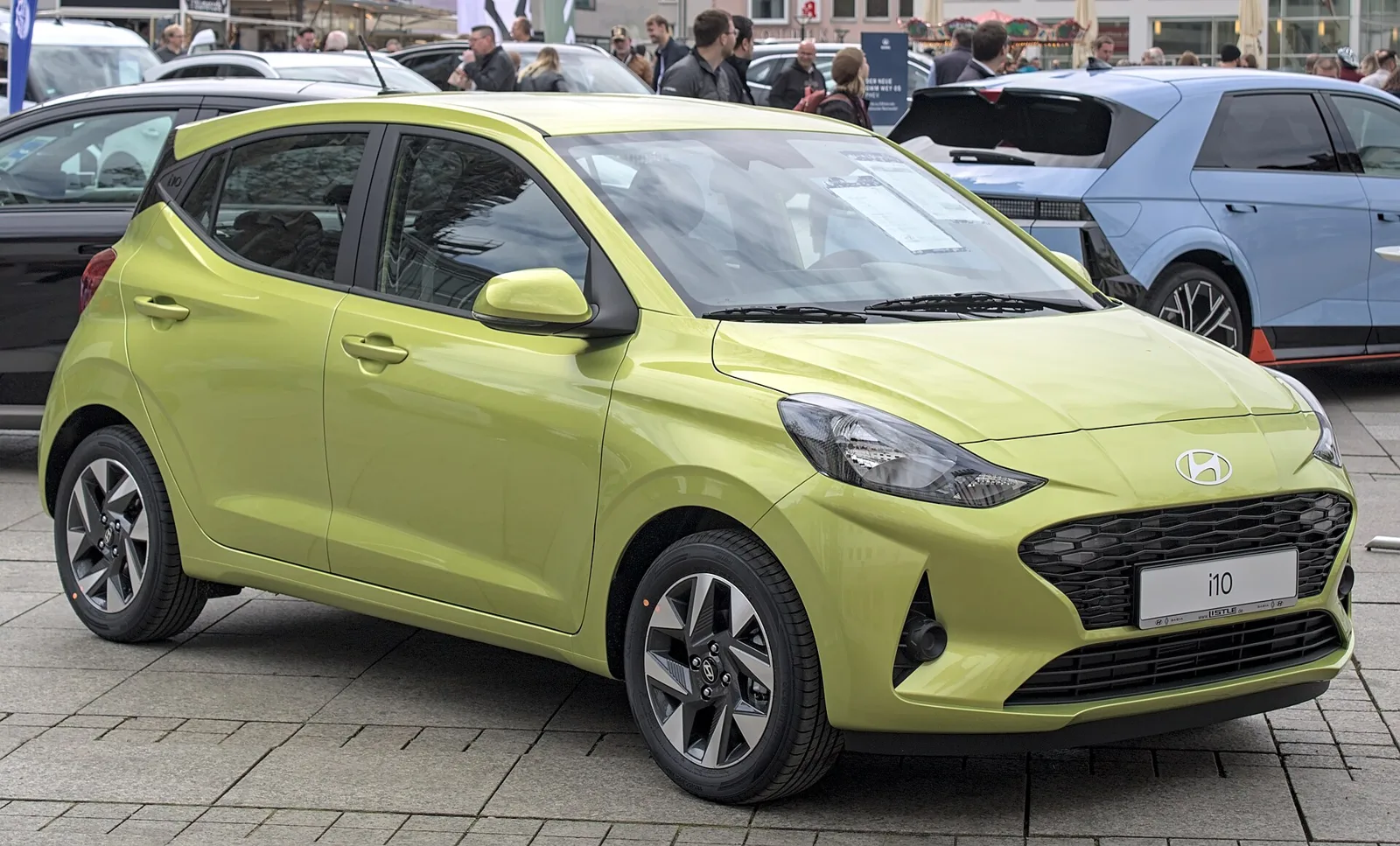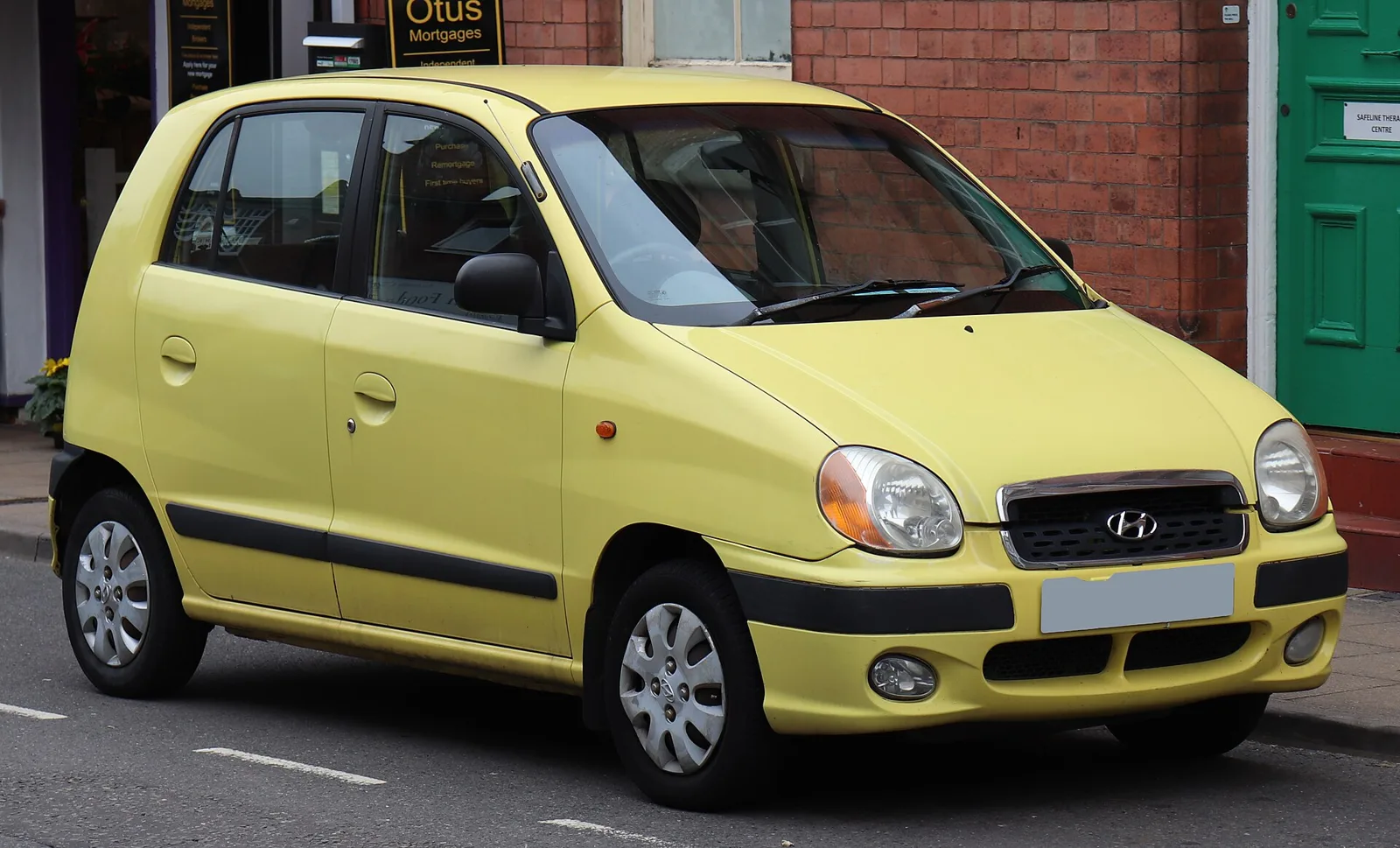
A low-cost minicar built for emerging markets, sold across Europe and Asia, and revived in India as the Santro long after its European debut.
Built by Hyundai in South Korea between 1997 and 2014, the Atos was a five-door city car sold under several names. It was replaced in most markets by the i10 in 2007, and an electric version was shown in 1997.
The Hyundai Atos was a compact five-door city car that Hyundai built in South Korea from 1997 until 2014. It was designed to be cheap to build and simple to run, and it was sold in Europe, Asia and India under several different names. Its later life as the Santro in India kept the nameplate in use until 2022.
Where did the Hyundai Atos come from?
The Atos began as a Hyundai minicar project in October 1995, after the South Korean rival Daewoo had already put a city car into production. Hyundai aimed the car at South Korea, Europe and India, and it went from blank sheet to production in 23 months.
The programme cost a total investment of 155 million dollars. Europe had a strong market for small city cars at the time, and Hyundai hoped the Atos would find buyers there as well as at home.
The company's goal was a car that was extremely compact and economical to sell. It was meant to be a simple, affordable product that could reach buyers in emerging markets as well as in wealthier European cities.
A five-door city car built for emerging markets, sold in Europe and Asia, and revived in India as the Santro.
How was the original Atos designed?
Hyundai released the Atos in September 1997. It was under 3.50 meters long, yet it used a soft, rounded design and a body with a minivan-style interior that made the most of the space available. The car had five doors and seated five people.
The front of the car had round headlights and bumpers left in raw plastic. The rear lights sat in an upright position close to the rear window, and the tailgate was very large, which made it easier to reach the luggage area.
The luggage capacity was 263 liters with the seats in place, and that rose to 1064 liters once the rear seats were folded down. The dashboard was simple, with a large shelf in front of the passenger seat and two central vents with the climate controls.
Safety equipment was limited. Driver and front passenger airbags, along with ABS, were either paid options or standard only on the top models, which reflected the car's low price point.
What engine did the Atos use?
The Atos launched with a four-cylinder 800 cc Epsilon petrol engine. Overseas models used a 1.0-litre four-cylinder Epsilon instead, a bigger unit that gave more performance.
The Epsilon was a small, economical unit, and it matched the car's brief as a cheap city car. The larger engine was a sensible step for markets outside South Korea, where the smaller unit was not the only choice.
The 1.0-litre engine stayed in the car through the Atos Prime years. In the second facelift of 2003, a 1.1 Epsilon 12-valve replaced it, which is covered in more detail below.
How was the Atos engineered underneath?
Hyundai built a specific base platform for the Atos. It kept the mechanical layout plain and cheap to build, since emerging markets demanded a low price.
Front-wheel drive was used, with a MacPherson strut up front and a torsion beam at the back. Front disc brakes were paired with rear drum brakes, a combination that kept cost down while still delivering adequate stopping power for a small car.
The Atos was among the first compact A-segment city cars sold in Europe with five doors. That was a practical choice for buyers who wanted easy access to the rear seats and the luggage space, and it helped the car stand out in its class.
How did the Atos Prime differ from the original?
The Indian version, the Santro, was tailored to local preferences, with output beginning in October 1998. The roof came down 4.5 centimeters, and the tail was redesigned with new lights, tailgate and bumpers.
It made its debut as the Kia Visto at the Busan Motor Show, held on 17 May 1999, with European sales planned through the Kia network. European Hyundai dealers opposed that plan, because the Visto would compete with the Atos they already sold.
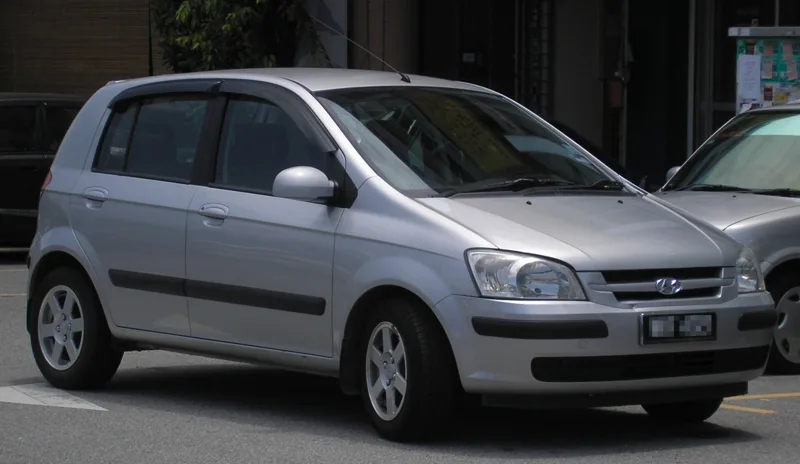
By the close of 1999 Hyundai had changed the name to Atos Prime and pitched it as the better-equipped version. The original Atos carried on, refreshed with new lights, bumpers and trim. The Atos Prime reached Europe in December 1999.
The Prime had a less spacious interior than the original, but its lower roof gave better aerodynamics. Its trunk was smaller, with capacity of 219 liters, rising to 889 liters with the rear seats reclined.
What changed in the 2003 facelift?
The second facelift arrived in September 2003 with an entirely new nose and tail. The new headlights, bonnet and bumper gave the car a more angular style, and the rear was new as well, with a fresh hatch and lamps. Only the doors, the side panels and the cabin came across from the Prime.
The 1.1 Epsilon, a 12-valve unit, produced 59 hp (44 kW; 60 PS), a step up on the 1.0 it replaced. The five-speed manual remained the standard gearbox, with a four-speed automatic offered as an option.
A slight facelift followed in 2005, with a new fascia and wheel designs. European engines were updated to the Euro 4 standard at the same time, and the power rose to 63 horsepower.
Which other names did the Atos use?
The original car was also marketed as the Atoz and the Amica, and in India it was sold as the Santro. The Atos Prime took the Amica name in the United Kingdom.
In South Korea and Indonesia, the Visto name covered the Atos Prime. The Visto was a rebadged Atos Prime, and the Atoz was the name used in Indonesia for the original car.
In Malaysia the car was locally assembled by Inokom and carried the Inokom Atos badge. The Inokom Atos Prima followed in 2006 with the Atos Prime front and the original Atos rear, which made it a hybrid of the two generations.
How did the Atos become the Santro in India?
Hyundai's Indian venture began in 1997 with the Atos, sold locally as the Santro. The name came from Saint-Tropez, the French city known for fashion, since Hyundai wanted the car to look fashionable.
The Indian car was built at Hyundai's factory in Chennai. Its main rival then was the Maruti Suzuki Zen. The first-generation styling drew mixed reviews, but power steering and price carried the car.
In 2003 the first generation gave way to a second, known in India as the Santro Xing, and it sold very well. Exports from India to Asia and Oceania were also large.
In its final years the Santro became a popular choice as a hatchback taxi. Sales still ran near 30,000 units a year when the decision was taken to end production, and the nameplate returned in October 2018 before being discontinued again in 2022.
What were the Indian Santro variants and prices?
Three variants launched in India in 1998. The base model came with air conditioning and black bumpers and was listed at 2,99,000 INR ex-showroom.
The Santro DX 1 added front power windows, central locking, better upholstery, body-coloured bumpers, a rear wiper, washer and defogger, front fog lamps and full wheel covers. It was priced at 3,49,000 INR.
The Santro DX 2 added power steering and rear seat belts, and it was priced at 3,69,000 INR. Its styling was often criticised, and its looks were the most common complaint.
Later versions included the Santro Zip Drive in 2000, in which every variant gained power steering and a new grille. The Santro Zip Plus followed in 2002 with clearer-lens headlamps and taillamps, plus an improved engine, and the Santro Xing arrived in 2003.
How did the Atos sell in Indonesia and Pakistan?
In Indonesia the Atoz and the Kia Visto arrived in 2000, powered by the 1.0-litre G4HC unit. They were first sold as complete built-up units, with the Atoz from South Korea and the Visto from India.
From 2001 the Atoz was built in knock-down form at Hyundai Mobil Indonesia's Bekasi site in West Java. Visto imports from India carried on until 2004, when the Picanto took over.
A June 2005 facelift gave the Atoz the Atos Prime front, leaving the original rear in place. A 1.1-litre G4HG unit with fuel injection also came in, the same engine that powered the Picanto. Production of the Atoz ended in 2008, and the i10 took its place from March 2009.
Trim came in two grades, with GLX as the base and GLS above it. The Visto was offered in Que trim before a zipDrive trim replaced it in 2002. In Pakistan the Santro was launched in 2000 and discontinued in 2013.
Was there an electric Atos?
Hyundai unveiled an electric vehicle based on the Atos at the 1997 Frankfurt Motor Show. The Atos EV weighed 1,173 kg (2,585 lb) with its battery pack, which held 24 nickel metal hydride batteries.
A 6.6 kW charger carried on board could top the batteries up fully in seven hours. In stop and go city driving the Atos EV could travel more than 193 km (120 mi), and its top speed was 129 km/h (80 mph).
The electric car was a demonstration of what the platform could do rather than a production model. Its range and charging time were the figures that defined its practical use in town.
What awards did the Atos win?
The car was recognised in Malaysia. It was named the best compact car in the Initial Quality 2004 study in Malaysia, and it was awarded best car of the year in 2006 in the same market.
The honours came in Malaysia, where the Inokom-built car gave the Atos a second life in Asia long after its European sales had peaked.
How did production of the Atos end?
Most markets switched to the Hyundai i10 in 2007, while Indian output ran on until late 2014. That gave the Atos a long tail in one of its largest markets, after it had already left the mainstream European line-up.
In India the Santro nameplate was revived in October 2018 and discontinued again in 2022. The name had by then outlasted the original Atos by several years, which shows how strongly it was tied to Indian buyers.
What are the Hyundai Atos specifications?
| Specification | Detail |
|---|---|
| Body | Five-door hatchback, five seats |
| Years | 1997 to 2014 |
| Engine | 996 cc, four-cylinder, 12 valves |
| Top speed | 160 km/h (99 mph) |
| Trunk | 263 liters, up to 1064 liters |
| Peak power | 40 kW (54.4 PS; 53.6 bhp) |
| Emissions | 151 g CO2/km |
| Transmission | Five-speed manual, four-speed automatic option |
| Fuel economy | 6.4 L/100 km (44 mpg-imp; 37 mpg-US) |
| Peak torque | 82 N-m (60 lb-ft) |
| 0-97 km/h (0-60 mph) | 14.6 seconds |
| Replaced by | Hyundai i10, 2007 in most markets |