A boxy, durable Volga built in Gorky from 1970, which ran as taxis across the USSR, was sold in Belgium and gained a 1986 update.
Built by the Gorky Automobile Plant from 1970 to 1986, the GAZ-24 was a robust Soviet sedan with a 2,445 cc four and a four-speed manual. An updated GAZ-24-10 followed until 1992, and taxis, wagons and a diesel export version to Belgium kept the name in service.
The GAZ-24 Volga was a large Soviet sedan built by the Gorky Automobile Plant from July 1970 to 1986, with an updated GAZ-24-10 following until 1992. It was a practical, robust car that became a status symbol, a taxi staple and, in Belgium, a diesel-powered export. Its heavy, boxy build earned it the nickname barzha, which means barge.
How did the GAZ-24 come about?
The GAZ-24, first called the M-24, was developed to replace the GAZ-21 Volga of the 1950s. Development was mostly finished in 1966, when 12 third-series prototypes were built and approved. The car was unveiled towards the end of 1967, but only 32 units were built in 1968, mainly for road tests, followed by 215 in 1969.
Full-scale manufacturing began on 15 July 1970, and 18,486 cars were built that year. The first Volgas built in 1968 and 1969 are often called preserial because they came before the main production run. Export sales began in 1971, and the car was shown at the London Motor Show in 1970.
A heavy, simple Soviet Volga that won its reputation in taxi ranks rather than showrooms.
What did the GAZ-24 look like?
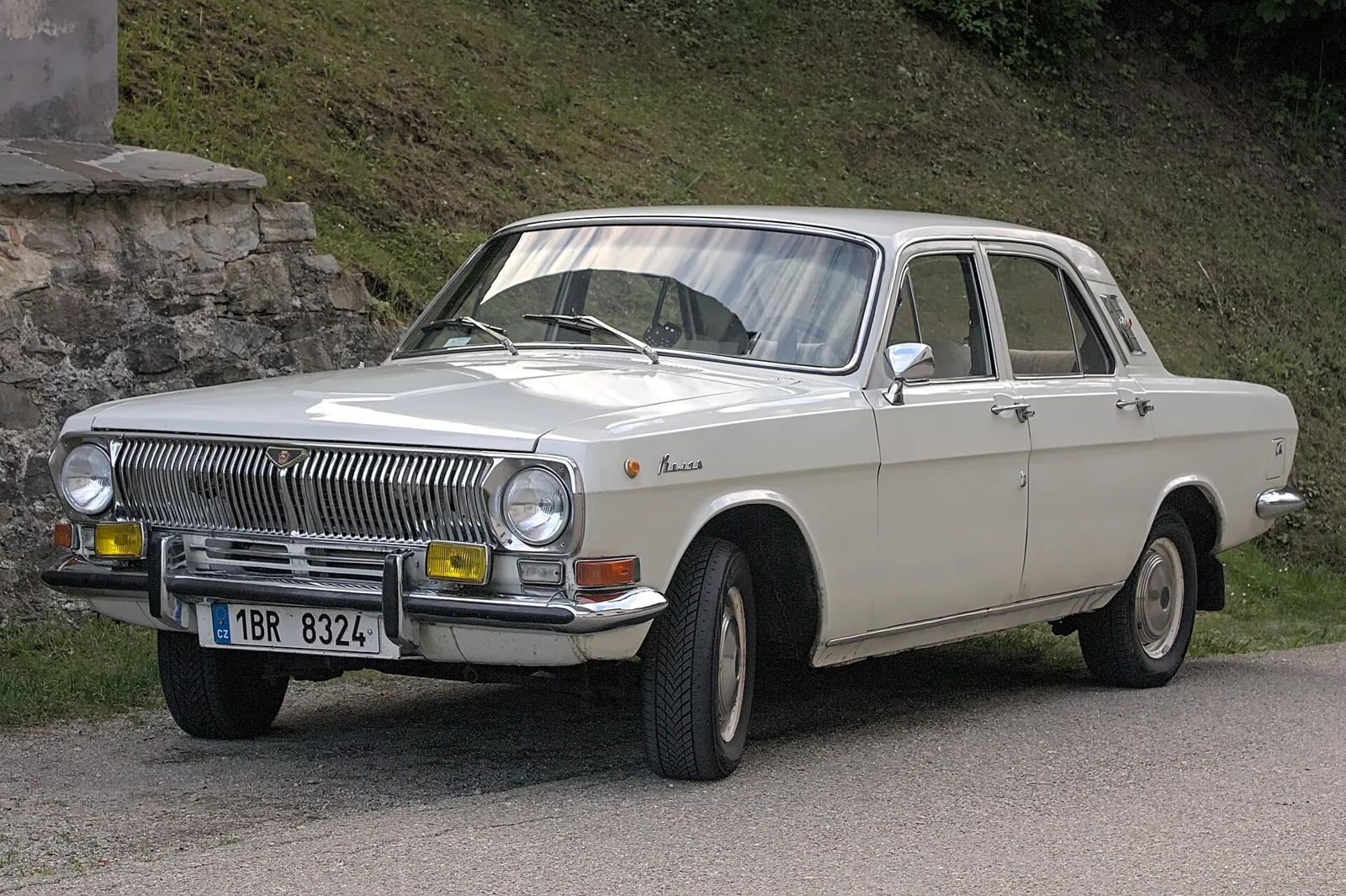
Compared with the GAZ-21, the new Volga had a longer wheelbase of 2,800 mm (110 in), against 2,700 mm (106 in). It was also slightly shorter overall, at 4,735 mm (186.4 in) against 4,810 mm (189 in), and substantially lower, at 1,490 mm (59 in) against 1,620 mm (64 in). The width stayed the same, but the boxier body and flat roof gave a generous interior with room for five or six people.
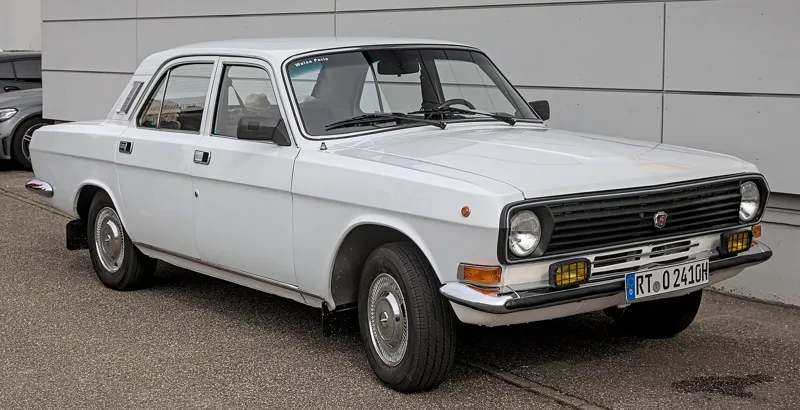
Some styling cues carried over from the older car, including the vertical taillights, the baleen plate grille and small fins on the rear fenders. Signature details of the GAZ-24 were chromed rhombic vents on the C-pillar, dashboard handles with ivory plastic inserts, and two chromed fangs under the front bumper.
- Interior colours: red, brown or light grey, often contrasting with the outside
- Official cars: usually black outside and red inside
- Dashboard: aluminium, painted in the exterior colour with safety padding on the top
- Early cars: ribbon speedometers that filled with red like a thermometer
How was the GAZ-24 engineered?
The standard engine was an aluminium-block overhead-valve inline-four of 2,445 cc, the ZMZ-24D, which produced 95 metric hp (70 kW) with one twin-choke carburettor. It was an evolution of the ZMZ-21A. Only a four-speed manual with a floor-mounted shifter was offered, although GAZ had prototyped an automatic and a column-shift manual.
The car kept its kingpin front suspension and recirculating ball steering for their proven reliability. Brakes were improved with a hydraulic vacuum servo and an independent parking brake. Power steering was never offered, and the reinforced unibody construction added weight compared with foreign rivals.
How did the taxi and wagon versions develop?
Volga cars were almost the only taxis in the USSR. The GAZ-24-01 taxi appeared in 1971 with an easy-to-wash all-vinyl interior, a low-compression ZMZ engine that ran on 76 octane fuel, a taximeter under the dash and a checkerboard stripe on the front doors. Most were eventually painted lime-yellow.
The four-door station wagon, the GAZ-24-02, arrived in 1972 with three rows of seats and room for seven or eight passengers. Its rear springs were stiffer, allowing a payload of 400 kg (880 lb). Wagons were restricted to hospitals, state shops, taxi companies and government bodies, with private buyers needing a special permit.
- GAZ-24-03: ambulance-specification model, introduced in 1973
- GAZ-24-04: taxi variant of the station wagon
- GAZ-24-07: fitted for liquefied propane from 1977
- GAZ-24-11, 24-12, 24-13 and 24-14: 1986 taxi, estate, ambulance and taxi estate variants of the GAZ-24-10
Did the GAZ-24 have a V8 version?
From late 1974 a V8-powered version was built in small numbers, the GAZ-24-24. It used an aluminium 5,530 cc ZMZ V8 derived from the GAZ-13, rated at 190 PS (140 kW), with one four-barrel carburettor, dual exhaust and a three-speed automatic from the Chaika. Its 105 L fuel tank and drum brakes kept it close to the standard car.
The GAZ-24-24 was used by the KGB as an interceptor and escort car, running as an outrider in front of government Chaika and ZIL limousines. Enthusiasts nicknamed it the Double and the Chaser, and a later version, the GAZ-24-34, carried a 195 PS (143 kW) ZMZ-503.10 V8 from 1987 to 1992.
What changed in the 1970s and early 1980s?
The car changed little between 1970 and 1974, with minor modifications such as a new trunk lock and rear bumper. A dashboard with a simulated wood insert appeared in 1973, and the ignition switch moved from the dash to the steering column in 1975, which also brought a dial speedometer.
Seat belts were offered from 1977. The 1976 to 1978 refresh added bumper guards, yellow front fog lamps, side indicators on the front fenders and fitted front and rear belts, and the interior was rebuilt with new vinyl and cloth seats. For the 1980 Summer Olympics, a special fleet with two-tone white and yellow paint accompanied the Olympic Torch.
What was the GAZ-24-10 upgrade?
By the 1980s the GAZ-24 needed an update, but a full replacement was not affordable. The GAZ-3102 had been approved in 1981, yet the cost of refitting the plant ruled out mass production. Instead, GAZ retrofitted many of the 3102's features into the older body in a simplified form, and the result was the GAZ-24-10, built from 1985 to 1992.
The mechanical upgrade used the ZMZ-402 engine, rated 100 hp (75 kW) on 92 octane petrol, or the ZMZ-4021 at 90 PS for common 76 octane fuel. Performance was 0 to 100 km/h in 19 seconds, a top speed of 147 km/h (91 mph), and fuel use of 9.3 L/100 km (25 mpg-US). The price was 16,300 rubles, against 15,300 for the GAZ-3102.
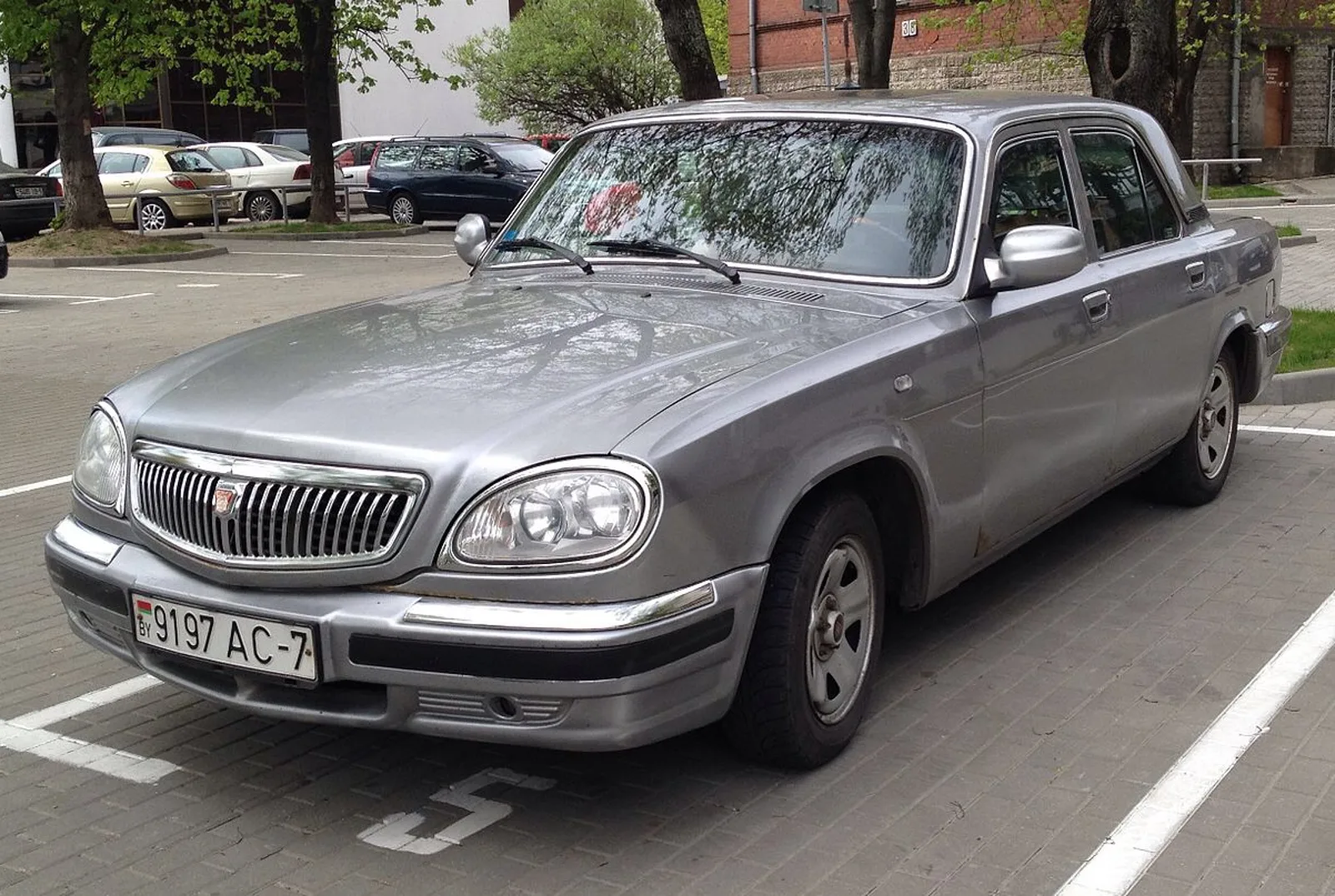
The body changes were cosmetic. The chrome was simplified, the bumpers became black plastic, the fog lamps were made rectangular, and the baleen grille was replaced with a plastic version. The estate followed as the GAZ-24-12 in early 1987. Thanks to the upgrade, the car remained a success within the Eastern Bloc, but it was never exported beyond it.
How was the GAZ-24 sold in Europe?
Many Volgas were assembled in Antwerp by Scaldia-Volga S.A. Cars were shipped to Belgium without engines and fitted with Indenor diesels from the Peugeot 404. The 2.1-litre unit gave 62 PS (46 kW) until the 2300 D arrived for 1980, and the 2.3-litre XD2 offered 70 PS (51 kW). These were called M24D and M24DB, while Soviet-engined cars were sold as M24 and M24B.
The petrol engine disappeared from Western European price lists by the end of the 1970s. Volga sales were never large, with 255 diesel cars sold across Europe in 1982 and 215 in 1983. In Austria the car was sold as the Wolga Attache GAZ-24, and most buyers in these markets were taxi drivers who valued its price and robustness.
How did the V8 Volga compare with the standard car?
The V8 version added a great deal of performance. Its 5,530 cc aluminium ZMZ V8, derived from the GAZ-13, produced 190 PS (140 kW), against 95 metric hp from the standard 2,445 cc four. It also carried a 105 L fuel tank and a three-speed automatic borrowed from the Chaika.
Despite the extra power, the V8 kept the standard car's drum brakes. Enthusiasts nicknamed it the Double, and the KGB used it as an interceptor and escort car.
Why did GAZ never replace the GAZ-24?
GAZ never successfully developed a direct successor to the GAZ-24, which remained the company's last mass-produced car. Instead, a slightly longer, facelifted and more luxurious model called the GAZ-3102 was produced from 1982, with a simplified and cheaper GAZ-31029 version added later.
Later attempts, including the GAZ-3105, GAZ-3111 and the Volga Siber, were unsuccessful, and apart from the Siber only a few dozen cars were produced. Production of the GAZ-31105 derivative ended in 2010, after several facelifts of the luxury line.
What nicknames did taxi drivers give the Volga?
Taxi drivers gave the Volga family a set of affectionate names. The sedan was called the Shrimp because of its slim look and the two fangs under the front bumper, which resembled a shrimp's claws. The earlier GAZ-21 was nicknamed the Holy Cow, and the station wagon was known as the Shed for its vast interior space.
Those names reflected how the cars were used day to day. Wagon taxis could carry cargo with a payload of 400 kg (880 lb), and many Volgas in service had covered extraordinary distances, with several engine rebuilds behind them.
What was the GAZ-24 like inside?
The cabin was built for durability and practical seating, with bucket seats that had lower bases and room for five or six people. Early cars were trimmed in red, brown or light grey, and the interior often contrasted with the outside colour.
Later updates brought more comfort. Seat belts were offered from 1977, and the 1976 to 1978 refresh gave the seats more convenient vinyl and cloth upholstery, with a new cushion and a wider range of interior colours, including yellow, lime green and dark blue.
Specifications at a glance
| Specification | Detail |
|---|---|
| Standard engine | 2,445 cc ZMZ-24D inline-four, 70 kW (95 metric hp) |
| Transmission | Four-speed manual |
| Wheelbase | 2,800 mm (110 in) |
| Length | 4,735 mm (186.4 in) |
| Height | 1,490 mm (59 in) |
| GAZ-24-10 output | 100 hp (75 kW), 0 to 100 km/h in 19 seconds |
| V8 version | 5,530 cc, 190 PS (140 kW) |