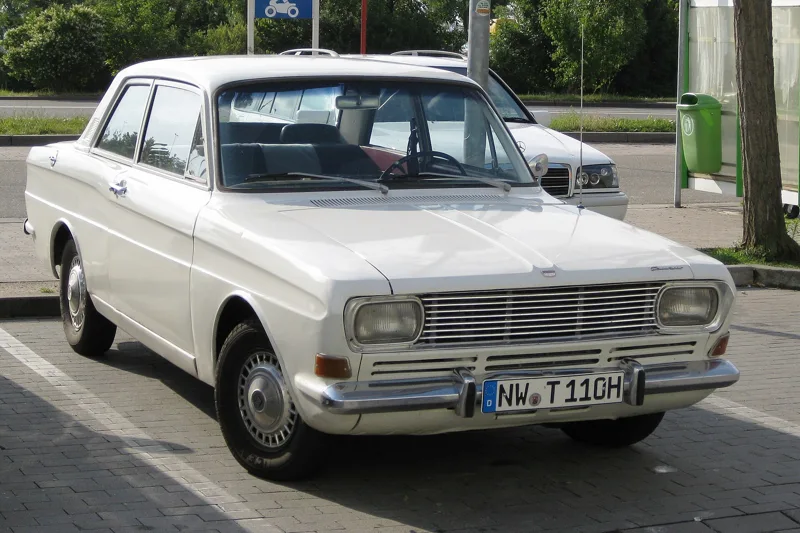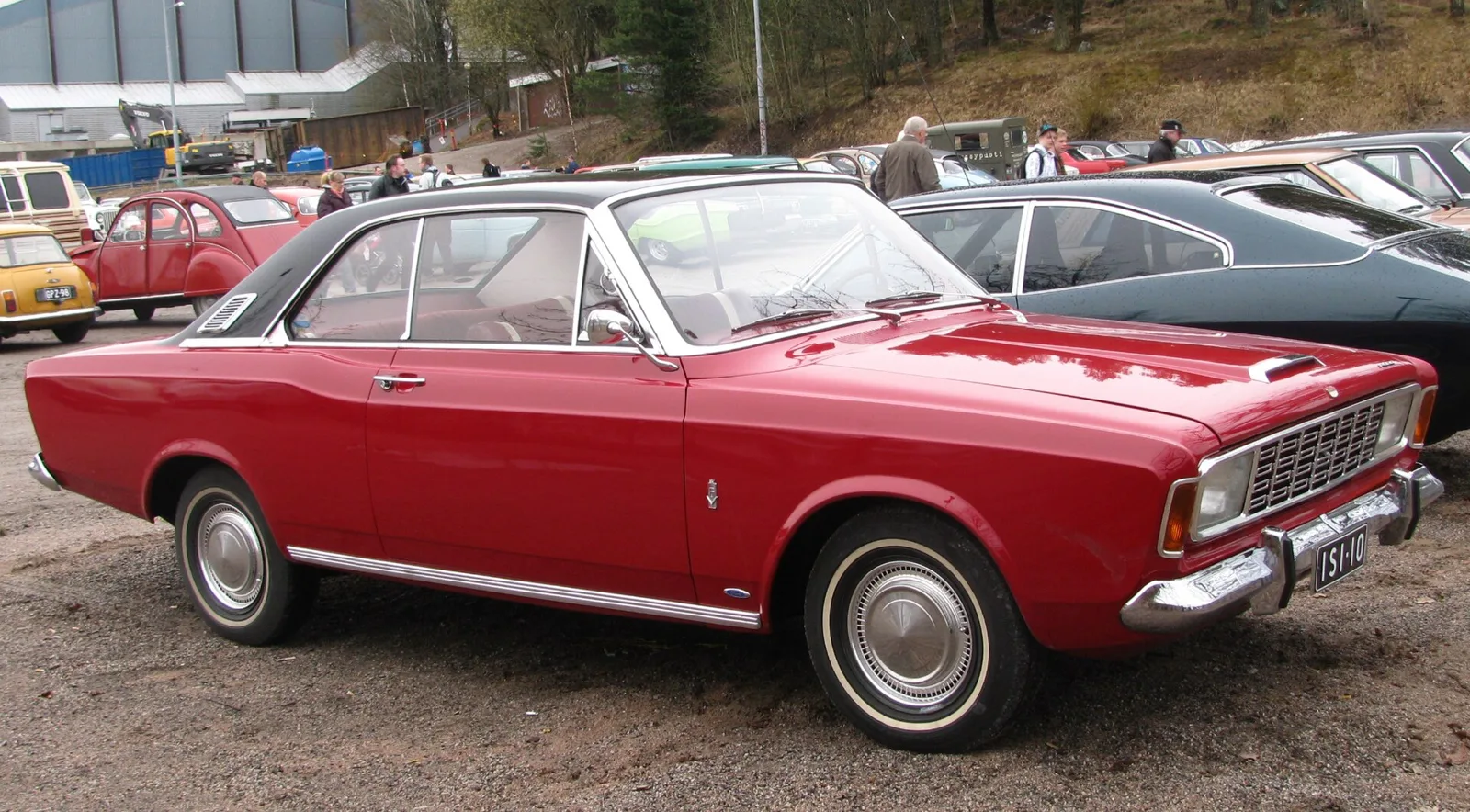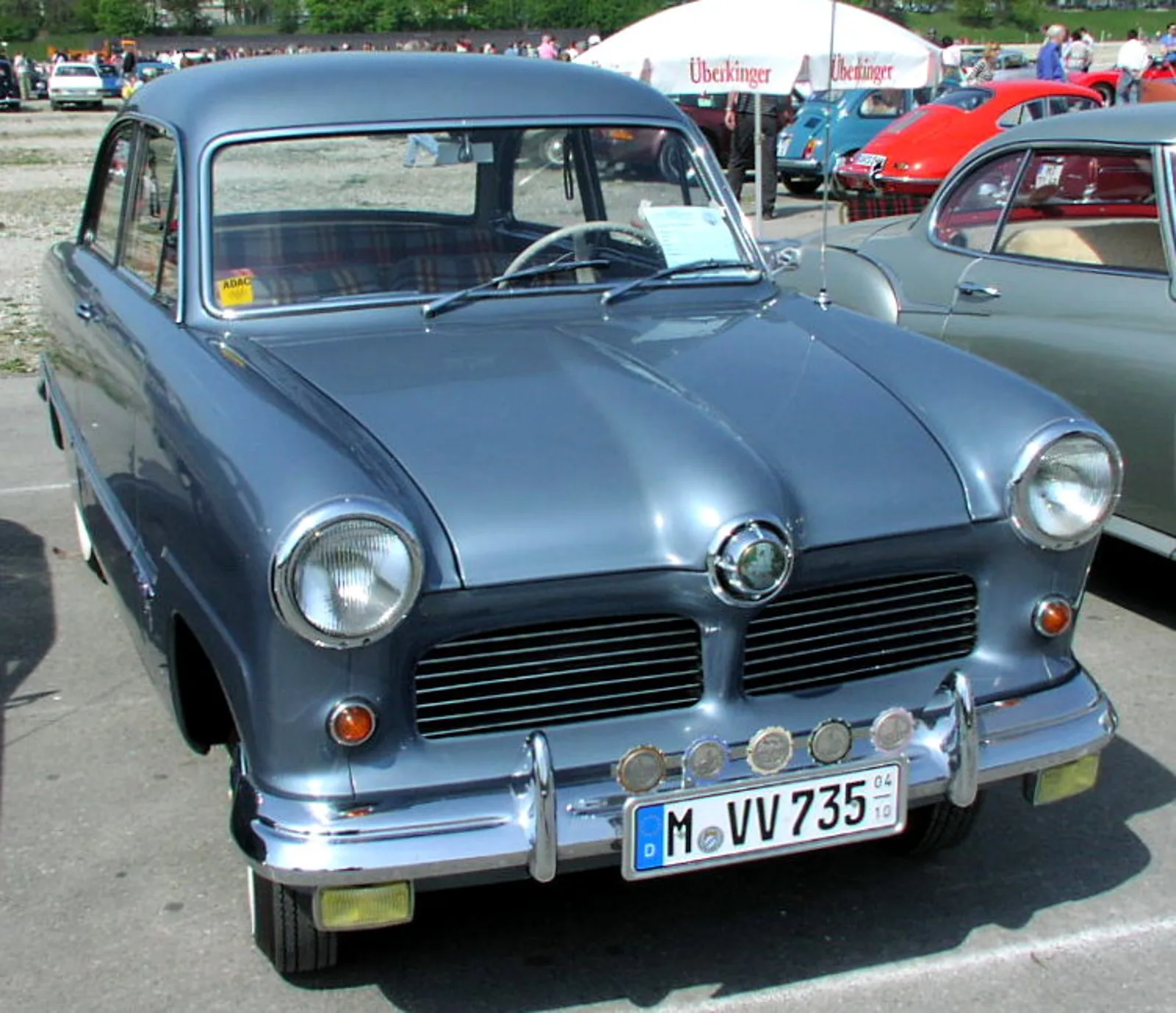
Ford Germany's ponton small car of 1952, from the Weltkugeltaunus roundel and the 1,172 cc side-valve engine to the Side-stripes Taunus of 1959 to 1962.
The Ford Taunus P1 was a small Ford Germany family car built from 1952 to 1962, with a ponton three-box body and a monocoque structure. It was sold as the Taunus 12M, with the larger-engined 15M added from 1955 to 1959.
The Ford Taunus P1 was a small family car that Ford Germany built from 1952 until 1962. It was sold as the Taunus 12M and, from 1955 to 1959, as the larger-engined Taunus 15M. The P1 was replaced in 1962 by the Taunus P4.
The P1 gave Ford a modern car at a time when many German rivals were still selling designs rooted in the 1930s. Its three-box ponton body was the kind of shape that would soon become mainstream, and its launch placed Ford ahead of the field.
How did the Taunus P1 come about?
Work on Ford Germany's new ponton car started in 1949. The project was complicated by management decisions that had to cross the Atlantic, an exercise made harder when international calls had to be booked ahead. The result was a body style that was new to German buyers.
The first blueprint was an American one: Ford's US engineers sketched a ponton car modelled on the Studebaker Champion, which had reached the American market only a few years before. Cologne production engineers adapted that proposal for the German market, producing a car that was new for German buyers.
The car's most distinctive feature was a large roundel on the nose. Where the Studebaker displayed a propeller, Ford's roundel showed half a globe, and that bold decoration led buyers to call the car the Weltkugeltaunus, or Globe Taunus.
A ponton three-box Ford with a half-globe roundel that outsold its rivals for a decade, then gained side stripes in 1959.
Why was the P1 built with a monocoque body?
Dearborn's sketch specified a monocoque body, a construction that German engineers had seen on the 1937 Opel Olympia. Ford's German arm had little hands-on knowledge of it, having spent most of the 1940s building light trucks. In a monocoque, the body itself carries the structural loads.
The predecessor Taunus of the 1930s had been bodied by Ambi Budd, a Berlin pressed-steel specialist that lost its plant after the war. Ford then had its bodies made by competitors and specialists in northern Germany, including Volkswagen and Karmann.
Cologne management looked for help from rival German carmakers to develop the processes needed for the monocoque P1, but those firms had their own priorities. In the end it was Ford of France that gave the support needed to set up the P1 production lines at the company's Cologne plant.
How did the Taunus 12M get its name?
Naming was messy. Hunsruck was the first choice for the successor to the Taunus, but it was rejected shortly before launch, perhaps because Dearborn managers struggled to say it. In the end the car became the Taunus 12M, a name that combined old and new.
The company then proposed Taunus 12 Meisterstuck to set the new car apart from the ageing Taunus that was still on sale. The name Meisterstuck, meaning masterpiece, turned out to be protected by a German bicycle manufacturer, so Ford had to use Taunus 12M instead.
The figure 12 stood for the 1.2-litre engine, and the letter M was all that remained of Meisterstuck. The result was a neat fix, if a convoluted route to it.
What engine did the Taunus 12M use?
The plan had been a 1,498 cc overhead-valve engine, derived from the unit intended for the earlier Taunus. Cost constraints intervened, and the launch car instead used a 1,172 cc side-valve engine, the same design that had powered its predecessor and the Ford Eifel of 1935.
Side-valve engines already looked old-fashioned in 1952. Analysis of the cars at the 1952 Paris Motor Show showed that 48 of the exhibits used overhead valves and only six used side valves. Ford was still fitting side-valve engines to its entry-level Taunus a decade later, which left the model looking outclassed under the bonnet.
The rear wheels received 38 PS (28 kW), which was up on the earlier car, and the gain probably came from a higher compression ratio and better fuel octane levels across Europe.
What was the Taunus 12M like to drive and ride in?
The two-door body was modern and slab-sided, but it rode on 13-inch wheels that kept costs down and left more room for passengers and luggage. The front wheels had independent suspension, a contrast with the original Taunus, while the rear kept a rigid axle that German customers already knew.
The launch car came only with a three-speed gearbox, controlled by a column-mounted lever. The old Taunus had offered a four-speed option since 1950, so the new car was in some ways a step back. A four-speed box finally arrived as an optional extra in May 1953.
Early cars came with one bench seat running the width of the cabin, instead of the separate front seats that most European makers fitted. That American touch gave the Taunus a certain glamour in a West Germany that looked to the United States for its models.
How were the bodies and versions offered?
The saloon was joined by a cabriolet from December 1952, built by the Cologne coachbuilder Karl Deutsch. A three-door kombi or estate version joined the range in May 1953, widening its appeal beyond the family saloon. Each body style shared the same basic engineering.
Early cars had poor workmanship in places, which disappointed some buyers. Over time, though, the car came to be regarded as a high-quality product, with the roomy body helping its reputation.
At launch the Taunus 12M cost 37% more than its predecessor, which made it expensive for a market still recovering from the war. The Volkswagen Beetle, a 1200 cc small car, was gaining ground at the same time, and its lower price was hard to beat.
Why did Ford introduce a stripped-down Taunus 12?
By the close of 1952 the old Taunus had gone from showrooms, and management chose to sell a plainer version of the new car in December. Chrome and other extras were stripped away, putting it more than 10% below the 12M's price.
The basic car had two individual front seats with simple steel frames and a thin plastic covering, and its gear lever sat in the floor between the seats. That was considered old-fashioned at the time. The basic model was sold only as a two-door saloon.
Buyers who wanted the column gear change could upgrade it for only forty marks, and the stripped-down car was quietly dropped once incomes rose across Germany.
How did the Taunus 12M change through its life?
The 1955 update gave the 12M a single-piece grille in place of the split chrome design, and the globe still sat above it. Its basic layout changed little through these updates, and the main changes were in trim, grille and options.
By 1955 the 12M could be bought for under 6,000 marks. From 1957 the car could be ordered with the Saxomat automatic clutch, an option other German makers also sold. The 1958 update swapped the broad chrome bars for a more restrained grille, and the globe stayed for one more year.
What was the Taunus 15M?
In early 1954 the Taunus at last got the 1500 cc engine that engineers had earmarked for the range since 1939. The 1,498 cc unit put it into contention with four middle-weight rivals: Opel's Rekord, Borgward's Isabella, Fiat's 1400 and Peugeot's 403.
Ford Germany lacked the money for a new model of its own in that growing segment, so it fitted the 1,498 cc engine to the Taunus 12M body and sold the result as the 15M. The two cars shared almost every component except the engine block and cosmetic touches, which included a different front grille.
The new engine was based on a unit first developed for the 1939 Buckeltaunus. This time the side-valve layout gave way to overhead valves, which reflected developments in England, where the Ford Consul had gained an overhead-valve engine in 1951. The crankshaft was hollow rather than solid, a weight-saving measure.
The 15M offered the same body styles as the 12M, and buyers could specify the Saxomat clutch with its three-speed gearbox.
What was the Taunus 15M de Luxe?
The September 1955 update also brought a Taunus 15M de Luxe into the range. It had a more elaborate grille and a two-tone paint scheme, and its price included features that had been optional extras, such as a windscreen washer, reversing lights, tubeless tyres, vanity mirrors and a headlamp flasher.
Many of those features were common on North American cars, and they added a transatlantic glamour that suited a country where US troops were stationed in large numbers and kept Germans up to date with American trends.
After the 1958 facelift the 15M and 12M shared the same front grille for the first time, a sign that Ford was losing enthusiasm for promoting the 15M as a separate model.
Why did the Taunus change again in 1959?
Ford's American managers concluded by 1959 that selling the 12M and 15M separately had stopped making sense. The 15M had struggled against Opel, which had been dominating the middle-weight sector with a fresh version of its Olympia Rekord almost every year from 1953 to 1957.
Ford had also introduced its Project 2, the Taunus 17M, in 1957. That larger, flamboyantly styled car was a stronger competitor to Opel and to the Borgward Isabella, which had grown into something close to an icon by the late 1950s.
For 1959 the 15M was withdrawn, the globe was finally removed from the nose, and the smaller Taunus wore a broad painted band on each flank. That stripe gave it the nickname Seitenstreifentaunus, or Side-stripes Taunus.
The car's underpinnings were now almost 25 years old, and it competed largely on price. A 1959 entry price of 5,555 marks came close to the cost of the much smaller Volkswagen, so the car offered plenty for the money.
From September 1959 buyers could pay 110 marks extra to get the 15M's 1.5-litre engine in the 12M. Cars with that engine were called simply Taunus 12M Super.
How did the Taunus P1 end?
By 1961 the Taunus 12M looked outdated and outclassed, with an engine, suspension and gearbox that still followed the designs of 1935 in many respects. Its competitors had moved on, and the Side-stripes Taunus was losing ground in the sales charts.
Output stopped in August 1962, with 555,463 cars completed. Its successor, the P4, carried the 12M name onto Ford's first front-drive model built in Germany, which used a compact V4.
The side-stripe period was short but substantial. Between 1959 and 1962 Ford built 245,614 Side-stripes Taunus models, and 56,843 of them had the larger 1.5-litre engine.
What were the Taunus P1 specifications?
| Specification | Detail |
|---|---|
| Production | 1952 to 1962, 555,463 cars |
| Launch engine | 1,172 cc side-valve, 38 PS (28 kW) to the rear wheels |
| Taunus 15M engine | 1,498 cc overhead-valve, from 1954 |
| Wheels | 13-inch at launch |
| Front suspension | Independent, with a rigid rear axle |
| Gearbox | Three-speed column change; four-speed option from May 1953 |
| Taunus 12M sales | 247,174 by the time the globe was removed |
| Taunus 15M sales | 127,942 |
| Side-stripe sales | 245,614 from 1959 to 1962, including 56,843 with the 1.5-litre engine |