How Ford built its police range from the 1992 Crown Victoria Police Interceptor to today's trucks, SUVs and first certified electric pursuit vehicle.
Ford's police range covers cars, trucks and SUVs, organised around the Interceptor and Responder badges. It has run from the 1992 Crown Victoria Police Interceptor to the electric F-150 Lightning Pro SSV, certified for police use in 2023. The range has moved from sedans to trucks over that time.
Ford's police line is a set of cars, trucks and SUVs sold to law enforcement and emergency services, grouped under the Police Interceptor and Police Responder names. The company has built fleet versions for police work since the 1950s, and the Interceptor badge has been its main police label since 1992.
Buyers in the United States, Canada and Mexico account for most sales, and the main rivals are the Chevrolet 9C1 and Dodge's Charger and Durango Pursuit models. Outside North America the range has found only modest uptake. The lineup has also shifted heavily toward trucks and utility vehicles, so that by 2025 no sedan remained in it.
How is the Ford police range organised?
Ford divides its police vehicles into two broad groups. Interceptor models are regular Ford products adapted for frontline police and emergency crews, while Responder models suit patrol work that stops short of the most demanding frontline tasks. The Responder line began in the mid-2010s.
Alongside those two names sit Special Service Vehicles, usually abbreviated SSV. These are built for support jobs such as moving prisoners or working off-road, and for duties that never involve chasing suspects.
Before the Interceptor badge existed, Ford sold cars to police departments directly, although those cars were not sold under that name. The badge came later as a way of tying the police range together.
Ford has built police cars since the 1950s, and by 2025 its police range was almost all trucks and SUVs.
Where did the Interceptor name come from?
The Interceptor name dates back to 1951, when Ford attached it to an optional flathead V8 for the 1949 Ford. That engine formed part of the car's Police Package, and the name stayed on Police Package motors through the 1950s.
The Crown Victoria of 1979 to 1991 carried the P72 code for its fleet cars. None of those cars used the Police Interceptor name, which arrived only with the 1992 model.
What was the Crown Victoria Police Interceptor?
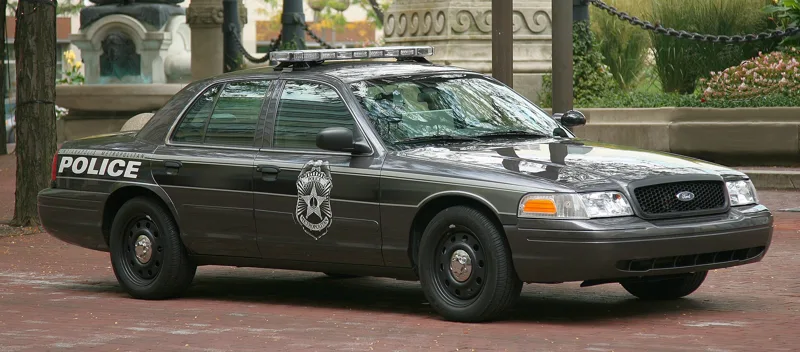
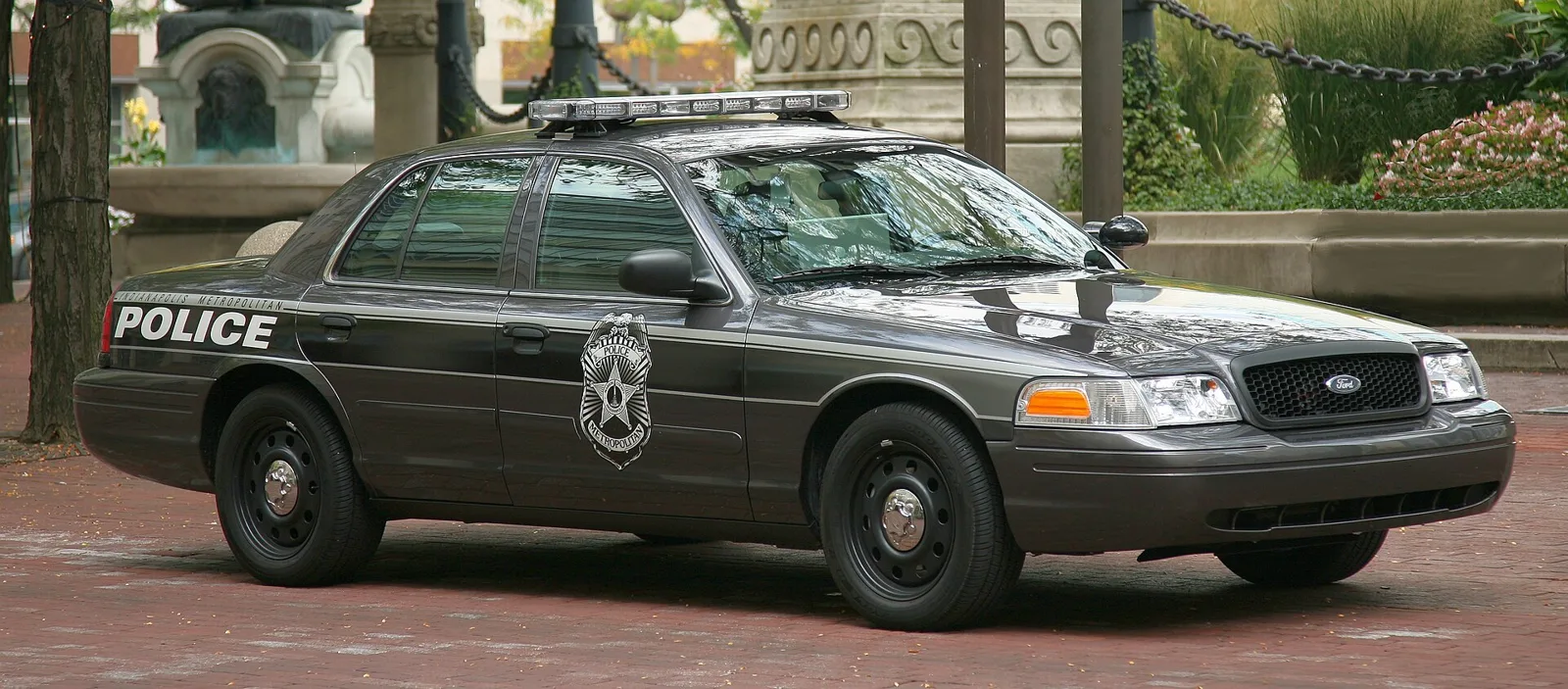
The Crown Victoria Police Interceptor, usually called the CVPI, debuted in 1992 as the first Ford police car to carry the Interceptor name. It was based on the first-generation Crown Victoria and used a 4.6-liter Modular V8 with either an AOD/AOD-E or a 4R70W automatic.
Through its first generation, from 1992 to 1997, the CVPI was almost indistinguishable from the civilian car, and that held true through a 1995 facelift. The 1998 redesign mirrored the civilian Crown Victoria again, but as the decade turned, police versions gained a honeycomb grille in place of the civilian slatted one.
For unmarked cars, Ford offered a Street Appearance Package that made the CVPI look like the civilian model. The civilian Crown Victoria was dropped in 2008, while the police version stayed on sale.
The CVPI ended with the 2011 model year. The last one went to the Kansas Highway Patrol, which turned it into a retro-style parade car. Its successors appeared in 2012 as 2013 models.
What replaced the Crown Victoria?
The CVPI's successors were police versions of the sixth-generation Taurus and the fifth-generation Explorer. Called the Police Interceptor Sedan and Police Interceptor Utility, they reached the market for the 2013 model year after a 2012 launch. Both were built on platforms Ford already used for civilian models.
The sedan rode on the Taurus platform and the Utility on the Explorer, which gave fleet buyers a car-based option and an SUV-based option for different jobs.
How did the Police Interceptor Sedan work?
The Police Interceptor Sedan, or FPIS, started with a naturally aspirated 3.5-liter V6 that it shared with the standard Taurus. A 3.7-liter aluminium-block V6 from the Mustang followed as an upgrade shortly after launch. Buyers could choose between a naturally aspirated engine and a turbocharged one.
The EcoBoost sedan used the 3.5-liter V6 from the SHO, rated at 365 hp (272 kW; 370 PS). Every version had all-wheel drive, except that the naturally aspirated 3.5 could be ordered with front-wheel drive.
From 2014 a four-cylinder engine borrowed from the civilian car was offered in a Special Service trim for detective and administrative roles. The sedan could also carry newer safety kit such as blind spot monitoring, a rear camera, reverse sensing and electronic stability control.
Why did the Police Interceptor Sedan end?
The sedan's survival owed much to police demand. Ford weighed ending Taurus output in the United States in 2015, but the police sedan was a main reason to keep building it. In 2018 the company said the Taurus would stop, and in March 2019 both the Taurus and the police sedan ended.
The sedan's replacements were the Police Interceptor Utility and the Police Responder Hybrid Sedan. The hybrid was a different kind of car, and it was dropped in 2020 alongside the Fusion it was based on.
What is the Police Interceptor Utility?
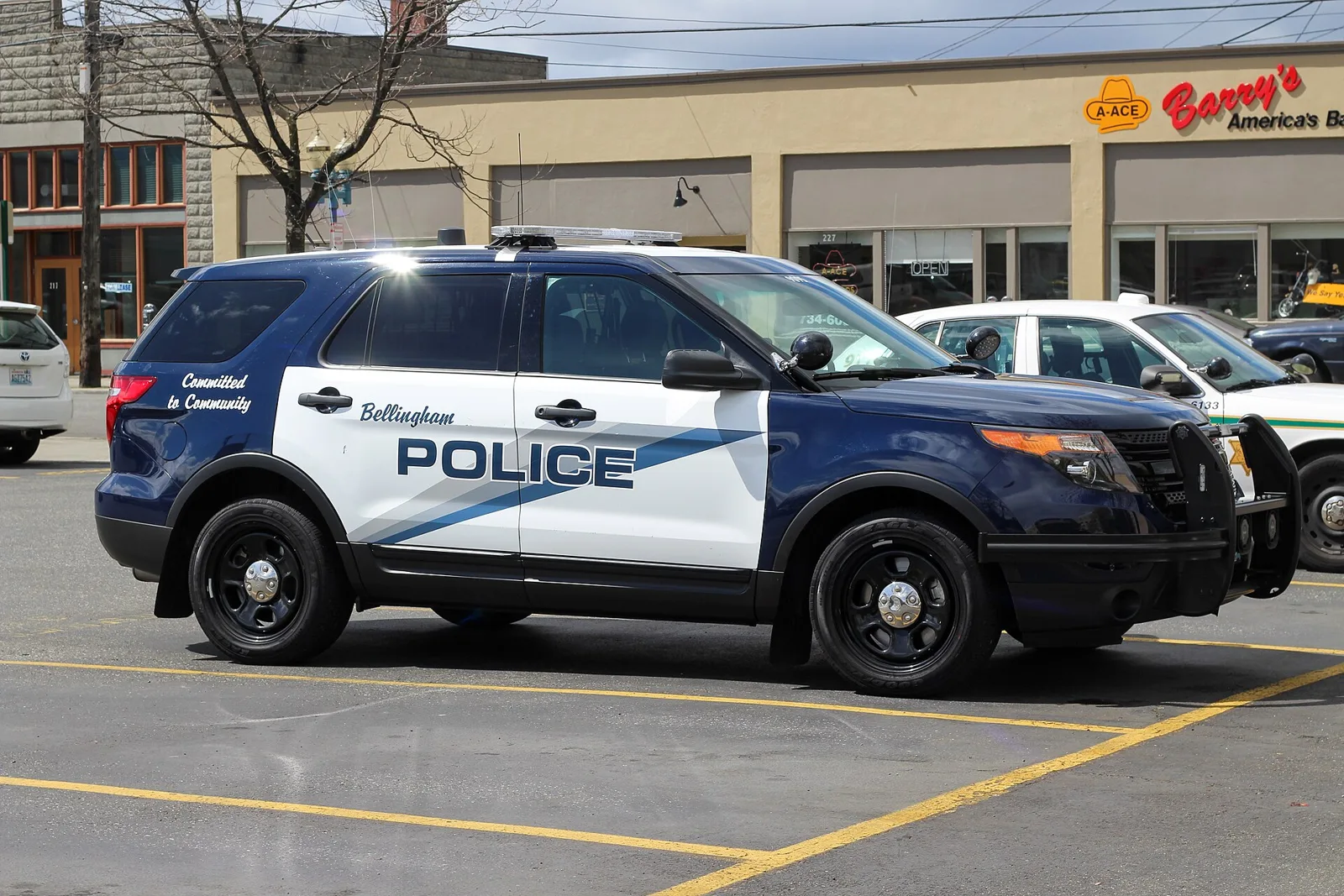
The Police Interceptor Utility, known as the FPIU, is the range's SUV. Its debut came in the 2013 model year, when it was built on the fifth-generation Explorer, and the 3.7-liter V6 was its standard engine, and it was the SUV counterpart to the sedan that launched alongside it.
A 3.5-liter EcoBoost V6 borrowed from the SHO became an option in 2014, with 370 PS (272 kW) on tap. The Utility came with all-wheel drive, larger brake rotors, upgraded ABS and traction control, a more efficient cooling system and emergency equipment.
A column-mounted gear selector freed up space on the centre console for radios and other equipment. In the 2020 model year a second-generation Utility arrived on a rear-wheel-drive platform derived from the sixth-generation Explorer. With the sedan gone, the Utility is the only Police Interceptor in production as of 2025.
What is a Police Responder?
Police Responder vehicles are patrol cars built for less demanding work than the Interceptor range, which covers jobs such as highway patrol. The Responder name began in the mid-2010s, and Ford often pairs it with the SSV designation for specialist vehicles.
An SSV is a vehicle built for one particular job. Examples include prisoner transport, off-road patrol and cars that are never meant to chase suspects, so the designation tells fleet buyers what a vehicle is for.
Was the Police Responder Hybrid Sedan a success?
The Responder Hybrid Sedan debuted for the 2019 model year and was built on the second-generation Fusion Hybrid. It targeted city departments, which tend to see fewer high-speed incidents than highway units, and it became the first hybrid cleared for pursuit driving.
Reception was split. The Salt Lake City Police Department took 110 units, but officers said the cabin felt cramped and the car lacked all-wheel drive. Several of them pushed the city toward Utilities instead.
In New York City, where Fusions were already in service before the Responder appeared, the police valued the hybrid for its fuel economy and its agility in dense traffic. The model was dropped in 2020, when the Fusion itself ended.
How does the F-150 Police Responder perform?
The F-150 Police Responder came out for the 2018 model year on the 13th-generation F-Series. It is a four-door SuperCrew with the FX4 off-road package, and Ford calls it the industry's first pursuit-rated pickup, a claim that comes from Ford itself.
The truck can tow up to 7,000 pounds. Its twin-turbo 3.5-liter V6 runs a 10-speed automatic, and the package adds a stronger alternator, better brakes, skid plates underneath and a vinyl rear compartment.
Testing by the Michigan State Police and the Los Angeles County Sheriff's Department in 2021 found it to be the quickest police vehicle of its time. It reached 0-60 mph in under 6 seconds, with a top speed of approximately 150 mph recorded in those tests.
What other Special Service Vehicles does Ford build?
Ford's other SSVs include the F-150 SSV, which focuses on towing, and the Expedition SSV, built for heavy-duty and tactical jobs. The Transit Prisoner Transport Vehicle covers prisoner moves. Each shares a support-first brief rather than the pursuit role. Each one is built on a model that civilian buyers can also order.
The F-150 SSV appeared for 2013 and is the utility-minded sibling of the Responder. It comes as a standard truck, an XL CrewCab or an FX4 off-road model. The engine choice runs from a 5-liter V8 to a twin-turbo 3.5-liter V6 or a 3.5-liter hybrid, all paired with a 10-speed automatic.
The Expedition SSV, introduced for 2018, sits on the fourth-generation Expedition. It is available in standard and MAX sizes, and it has an electronic limited-slip rear differential.
The Transit Prisoner Transport Vehicle arrived for 2015 on the fourth-generation Transit. Buyers can choose among three roof heights and three lengths, on two wheelbases, with single, double or triple prisoner inserts. Under the skin sits a twin-turbo 3.5-liter V6 with intelligent all-wheel drive.
Which Ford police vehicles are electric?
Only one electric model sits in the Ford police lineup: the F-150 Lightning Pro SSV, which arrived for 2023. It is the first fully electric vehicle certified for police use, and it is built on Ford's electric pickup. It was the most recent addition to the lineup as of 2025.
The Lightning Pro SSV is close to the standard electric truck, but it adds Responder parts, including steel intrusion plates behind the front seatbacks, a modular dashboard for equipment and a vinyl rear compartment. Its Pro Power Onboard inverter can supply power at a crime scene.
The Mach-E arrived in 2021 and has been taken up by several forces in the United States and Canada. Ford of Europe made it available to British police that same year, yet it is not a formal fleet model, and a 2024 fleet trial set it against the Chevrolet Blazer EV, which could mean Ford is weighing a police version.
Why does Ford dominate police fleets?
Ford has enjoyed a near-monopoly in US police vehicles since the late 1990s. General Motors ended its B platform in 1996 and Chrysler ended its M body vehicles in 1989, which left fewer rivals to compete for those orders. Ford's grip on the segment has lasted for decades.
Many police buyers preferred Ford's body-on-frame design, which they found easier to repair and maintain than unibody construction. When the Panther platform was retired in 2011 without a body-on-frame successor, many departments stayed loyal to the brand and kept ordering Fords.
Carmakers from abroad that run large North American plants have not entered the police market either. Toyota, for instance, has never sold police cars in the US.
What are the main Ford police vehicles?
| Vehicle | Introduced | Based on | Status |
|---|---|---|---|
| Crown Victoria Police Interceptor | 1992 | First-generation Crown Victoria | Final model year 2011 |
| Police Interceptor Sedan | 2013 | Sixth-generation Taurus | Discontinued March 2019 |
| Police Interceptor Utility | 2013 | Fifth-generation Explorer; second generation for 2020 | In production as of 2025 |
| Police Responder Hybrid Sedan | 2019 | Second-generation Fusion Hybrid | Discontinued 2020 |
| F-150 Police Responder | 2018 | 13th-generation F-Series | In lineup as of 2025 |
| Expedition SSV | 2018 | Fourth-generation Expedition | In lineup as of 2025 |
| Transit Prisoner Transport Vehicle | 2015 | Fourth-generation Transit | In lineup as of 2025 |
| F-150 Lightning Pro SSV | 2023 | F-150 Lightning | Only electric model as of 2025 |