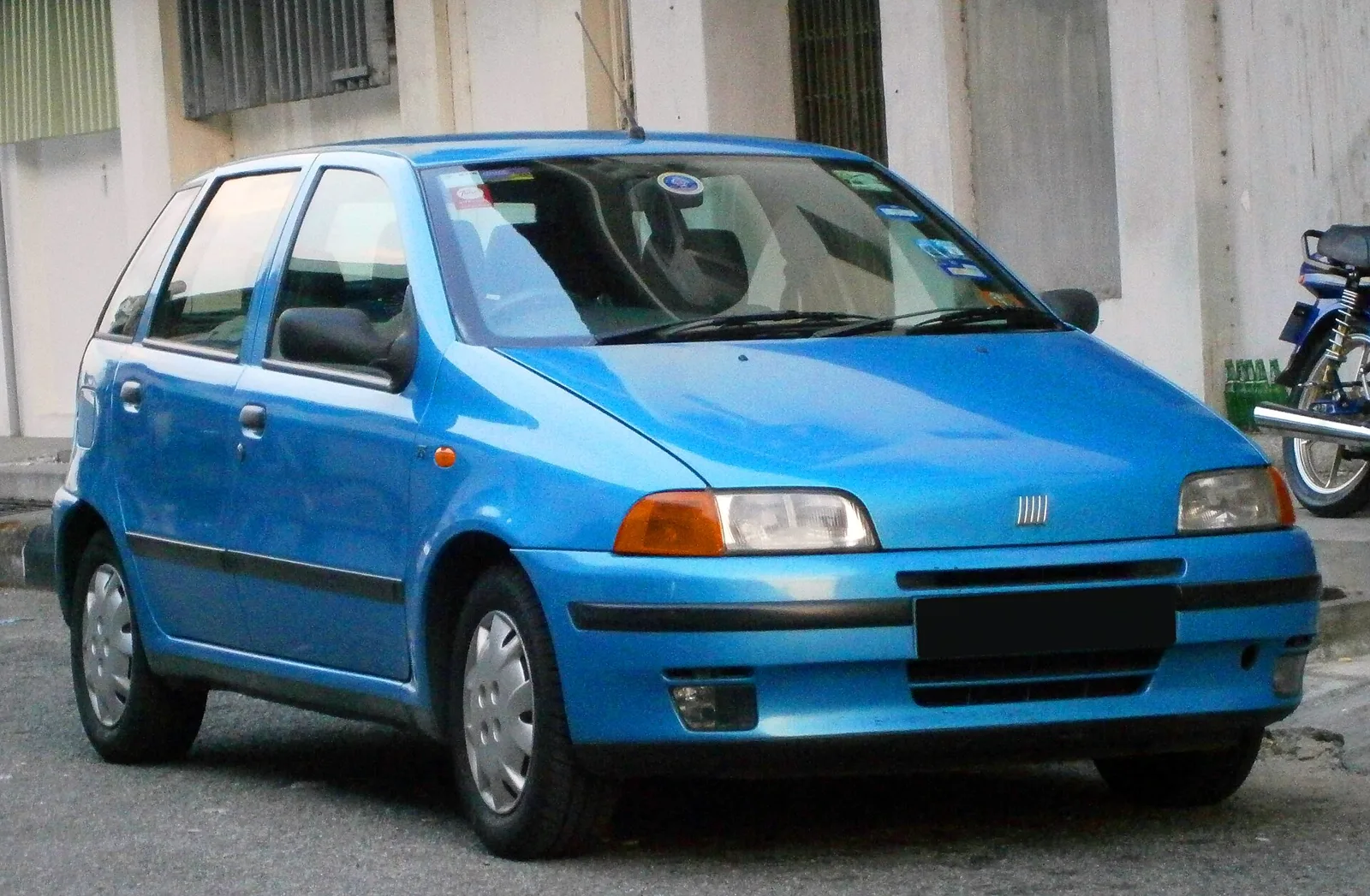
Fiat's first Punto, built from 1993 to 1999, with the 133 PS GT, the Bertone Cabrio, Euro 2 changes and a long life in police service.
A 1993 small car from Fiat, drawn by Giugiaro, the Punto sold until 1999 and won the 1995 Car of the Year title. Its turbocharged 1,372 cc GT made 133 PS until the 1997 Euro 2 update reduced it to 130 PS.
The 1993 Fiat Punto was the first of a family of small cars, designed by Giorgetto Giugiaro as the heir to the Uno. It was built until 1999 and sold well across Europe, and its GT was the sportiest version in the range.
Where did the Punto come from?
The Punto was Fiat's 1993 small car, styled by Giorgetto Giugiaro as the successor to the Uno, and it sold until 1999. It won Car of the Year in 1995, and its 1,372 cc GT, with 133 PS, was the sporty top of the range until a 1997 Euro 2 update cut its output to 130 PS.
The model, project number 176, first appeared at the Frankfurt Motor Show in 1993. It was 7 cm longer than the Uno it replaced, measuring 376 cm (148.0 in) in length, 145 cm (57.1 in) in height and 162 cm (63.8 in) in width. Giugiaro also received the Compasso d'Oro for the design.
Critics and buyers responded very positively. In 1995 the Punto was also Italy's best-selling car in both petrol and diesel form. It had sold around 640,000 units in its first year, from 1993 to 1994, and it reached one and a half million cars in just a year and a half of sales.
A small Giugiaro hatchback that sold well across Europe, with a 133 PS turbo GT at the top of its range.
What was the layout and safety package?
The Punto followed the conventions of its era, with a front engine, front-wheel drive and a two-volume body with a rear hatch. Its crash structure was designed to deform in a controlled way, and an inertia fuel cut-off switch came as standard on all versions.
The body came as a three-door or five-door, with 14 colours and 31 versions at launch. One of those versions was a sporty GT. The model range offered three trim levels with petrol engines, and the choice of gearbox was a five-speed manual or an electronically controlled continuously variable automatic.
The gearbox choice mattered too. The 55 6Speed, which could take a six-speed manual, used a shorter final drive than the five-speed car, adding pace and responsiveness.
Front seats had an anti-submarining cross member to stop the pelvis from sliding forward. Airbags were electronically triggered and optional for the driver and front passenger, except on some versions, combined with pyrotechnic pretensioners on the seatbelts. ABS was an option on most trims, and the raised brake lights were a first, making the car more visible to drivers not directly behind it.
What made the GT special?
The GT used a 1,372 cc (83.7 cu in) engine, the same as the second-series Fiat Uno Turbo, fitted with an IHI VL7-2 turbocharger and intercooler. It produced 133 PS (98 kW; 131 hp), could exceed 200 km/h (124 mph) and reached 100 km/h in 7.9 seconds.
The engine itself derived from the Fiat 128 unit. The GT came with the standard equipment of the ELX versions plus heated body-coloured mirrors, 14-inch alloy wheels with 5.5J rims and 185/55 tyres, side skirts, headlamp washers, four-sensor ABS, height-adjustable headlamps, sport seats with an adjustable driver's seat, a leather steering wheel and a leather gear knob and gaiter.
Optional extras were two airbags, with the driver's airbag becoming standard in 1995, air conditioning, dedicated leather interiors and the other options available across the range.
How did the GT change over its life?
The first restyle, dated 1995, replaced the headlamps with smoked units, painted the side skirts in body colour and changed the GT logo on the tailgate. The second, in 1997, mainly added GT logos to the seats and made air conditioning standard, while the output was reduced to 130 PS to meet Euro 2 rules.
The 1995 cars also received a new steering wheel shared with the Fiat Barchetta and Fiat Coupe, a white instrument panel in place of black, lower and more enveloping seats, and flat, padded door panels. The red stripe was removed from the bumper protectors.
The 1997 changes were more significant under the bonnet. The head, idle valve and camshaft were replaced to meet Euro 2 limits, which brought the GT to 130 PS and a 0-100 km/h time of 8.2 seconds. The braking system was also strengthened, and the dashboard changed from light grey to dark.
The Abarth that never was, and the Cabrio
Fiat had decided early on that the GT should not be the most powerful Punto. A model called Abarth was planned, with few cosmetic differences from the GT beyond more bulging wings, but with a much larger engine. Fiat was undecided between 1,800 cc and 2,000 cc, aiming for around 150 horsepower. The Punto Abarth was never put on sale.
The Punto Cabrio appeared in 1994 with bodywork by Bertone, differing from the saloon in its rear lamps as well as its outline. It used a 1.2 of 60 PS or a 1.6 of 88 PS. Later in 1997 a 1.2 16-valve of 86 PS took the place of those engines. Sold from the summer of 1994, about twelve thousand examples were ordered within a few months across Europe.
Which trims and engines did the range offer?
Trims ran from the spartan S, through the intermediate SX, to the ELX, which had body-coloured bumpers and 14-inch wheels. Engines ran from a 1,100 cc petrol, which could take a six-speed manual, to 1,600 cc petrol and 1,700 cc diesel, with the 1,372 cc GT at the top of the petrol range.
The ELX also came with remote door locking, front fog lamps and warning lights for doors not closed, non-working brake lights and worn brake pads. Options included radio preparation, ABS, power steering and air conditioning. Diesel versions had power steering as standard, even in the cheapest trims, always paired with 14-inch wheels.
Special trims included the ED, which took a 55 S and lengthened its gear ratios to save fuel, and the HSD (High Safety Drive), built on the 75 SX with airbags fitted as standard, servo steering, rear head restraints, ABS and headlamp levelling. The Sporting replicated part of the GT on normal engines, with shorter gear ratios.
A van was also offered with a 1.1 petrol engine or a 1.7 diesel. The Fiat Barchetta spider was built on the Punto's chassis.
Range by version, 1993 to 1996
| Version | Engine | Power | Top speed |
|---|---|---|---|
| Three-door 55 S/SX | 1,108 cc | 54 PS | 150 km/h |
| Three-door 60 S/SX | 1,242 cc | 60 PS | 160 km/h |
| Three-door 75 S/SX/ELX/HSD | 1,242 cc | 73 PS | 170 km/h |
| Three-door 90 SX/ELX/Sporting | 1,581 cc | 88 PS | 178 km/h |
| Three-door GT | 1,372 cc | 133 PS | 200 km/h |
| Three-door TD S/SX/ELX | 1,698 cc | 71 PS | 163 km/h |
| Cabrio 60 S | 1,242 cc | 60 PS | 150 km/h |
| Cabrio 90 ELX | 1,581 cc | 88 PS | 170 km/h |
What did the 1997 update change?
The 1997 update brought a 16-valve version of the 1,242 cc Fire engine, and the 85 16v replaced the 90. The model also received new colours, new wheel trims and darker interiors, with an instrument panel of a different design that had already appeared in 1996. Road tests quoted 0-100 km/h in 11.7 seconds for the 85 16v.
The 16-valve Fire first appeared on the sister Lancia Y in the same year. The first 999 cc Fire had appeared on the Autobianchi Y10 in 1985, and the 1,242 cc unit was still among the best engines of its capacity for power and efficiency. The new engine gave a clear saving in fuel, and also a saving on insurance premiums.
The Sporting used the same sports suspension, springs, dampers and anti-roll bars as the GT, and its engine and gearbox made it about 70 kg lighter than the GT. A shorter final drive helped its acceleration, and magazine tests of the time gave it 10.9 seconds to 100 km/h, with the standing kilometre covered in a little over 32 seconds.
The GT dropped from 133 to 130 PS because of the Euro 2 rules, and the naturally aspirated diesel was dropped, since it had sold poorly. The TD was offered at two power levels, 60 PS and 70 PS, through different turbocharger settings.
Concept cars and the Punto Racer
Giannini built a more extreme GT called the Punto Drago, which was sold on the market of the day. Bertone built the Punto Racer on the basis of the Cabrio and showed it at the Turin Motor Show in 1994. It stayed a prototype, and it is kept at the Volandia museum.
The Racer's lines were more aggressive and aerodynamic, and with its rigid roof it had a lower drag coefficient than the base car. Its engine was the 88 PS Punto 90 unit with multipoint injection. Boneschi designed the Doblone, a six-wheel pick-up using the Punto's front end and mechanics, which was presented in 1994.
Other concept cars based on the Punto were shown at the Turin show that year. They included the Surf by Coggiola, the Lampo by I.De.A Institute, the Scia by Maggiora, the Sport Monomille by Zagato, the Firepoint by Italdesign Giugiaro, the Marazzi Cabrio Wagon and the Beach by Scioneri.
Sales, police use and the 1998 range
Between 1998 and 1999 the Punto was the best-selling foreign car in France. It also found good demand in almost all European countries, including the United Kingdom, Germany and the Netherlands.
In 1998 the range was updated with Sole, Star and Stile trims. Sole replaced the S, Star replaced the SX with standard air conditioning, and Stile replaced the ELX but lost its double-reflector headlamps.
Italian and San Marinese forces such as the State Police, the Carabinieri and the Fire Brigade ran Puntos on service duty during the nineties and the two-thousands. Production ended in 1999, when the second generation took over.