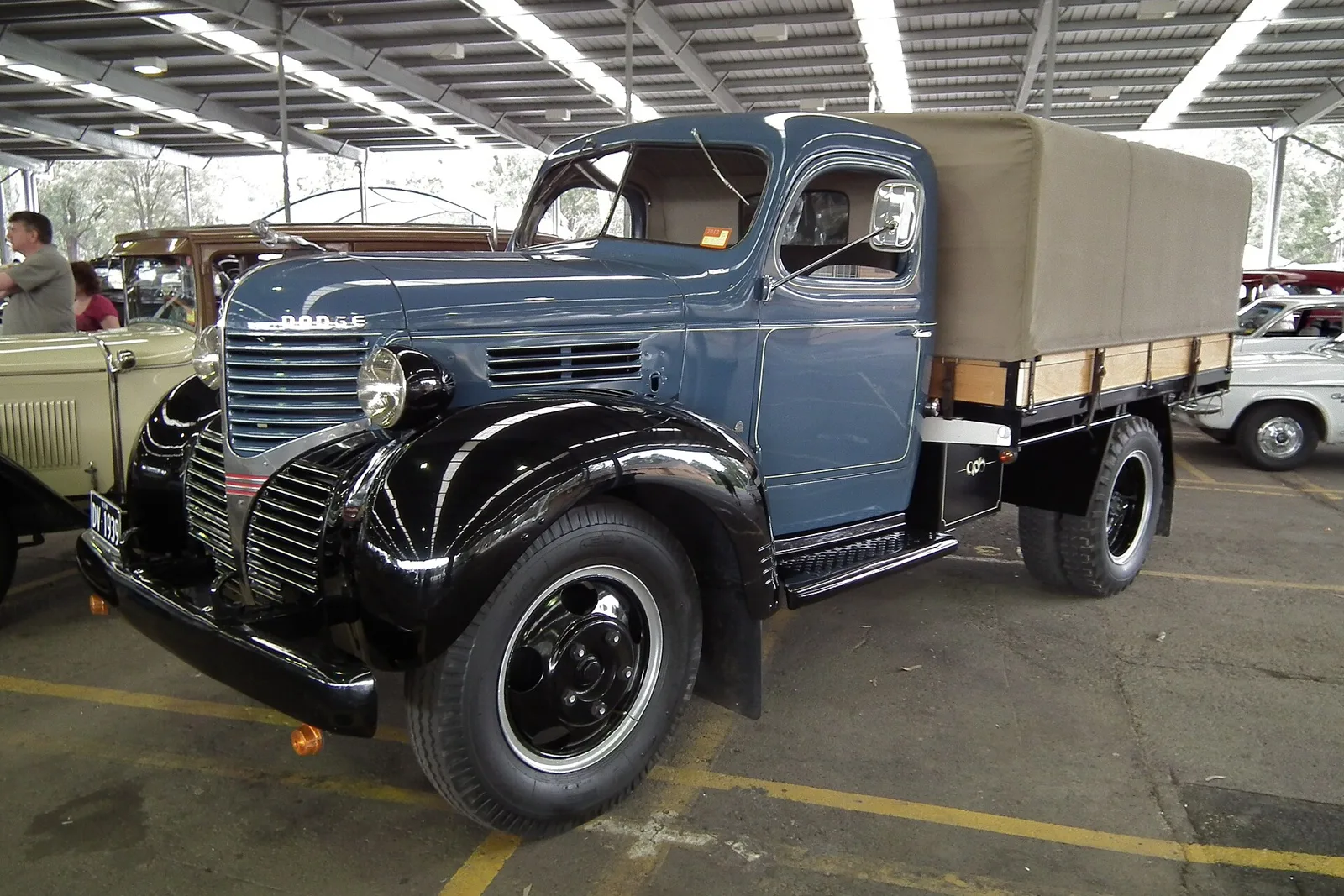
Streamlined Job-Rated trucks offering as many as 175 basic chassis models, the family that led to military 4x4s and the Power Wagon.
Between 1939 and 1947 Dodge sold a family of Job-Rated trucks, from half-ton pickups to three-ton cabs. Each used a Chrysler flathead six, and the range fed into military 4x4s and the Power Wagon, which made it a key chapter in Dodge's truck history.
The Dodge T, V and W series was a range of trucks built from 1939 to 1947 and sold under the Job-Rated name. Payload classes ran from half a ton to three tons, and every model used a Chrysler flathead six-cylinder engine. The same range also gave rise to Dodge's first light-duty military 4x4s, which later evolved into the Power Wagon.
Collectors still rate the series as the most popular pickups among Dodge truck enthusiasts. Author Don Bunn, a historian of Dodge trucks, has described the Job-Rated line as a very significant segment of the company's history, so it is worth understanding how the range was built and why it mattered.
Where did the Job-Rated trucks come from?
Dodge introduced the range for 1939 as a completely redesigned line of trucks. The series used T for 1939, V for 1940 and W from 1941, and the W name stayed in use until the last sales in 1947. The first mass-produced trucks came from the large new Mound Road plant at Warren.
The catalogue had deeper roots. From 1925 Dodge worked alongside Graham Brothers, and Dodge and Graham trucks were sold through Dodge's dealer network in capacities from half a ton to three tons. In May 1928 Power Wagon magazine counted 1,842 possible configurations of models, styles, payload ratings, wheelbases and options, which shows how large the range had already grown before the 1939 redesign.
Job-Rated trucks were configured for the task in hand, and their flathead sixes and military 4x4s laid the groundwork for the Power Wagon.
What made the Job-Rated idea different?
Job-Rated meant a truck specified for a particular task. Buyers chose from payload classes, bodies, wheelbases, axles, springs and brakes to suit their work, and Dodge even likened the process to buying a pair of shoes. The result was a catalogue of as many as 175 basic chassis models.
The numbers were striking. Six different payload classes and more than twenty wheelbase lengths were offered, with engine sizes to match, from the smallest half-ton pickups up to three-ton tractor cabs. In 1940 alone, 20 different truck frames were produced at the same time. By 1947 the company was building 31 chassis frames across 17 wheelbase lengths.
What did the trucks look like?
The trucks followed the Streamline Moderne style that dominated the industry in the 1930s. Every model shared all-steel cabs with a barrel-shaped front base and a sharp V-shaped grille. Long, crowned fenders carried embossed speed lines, and a two-piece sloped windshield could be opened for airflow. Headlamps sat in bullet-shaped pods, and the heavy-duty trucks simply stood taller on bigger wheels and tyres.
Changes after the first year were modest. In 1940 the trucks adopted sealed-beam headlamps with marker lights mounted on the housing, and the grille was slightly revised in 1941. The chrome lower strips were dropped after the war, but the overall look stayed largely unchanged through 1947 because engineering and production took priority.
What engines powered the Dodge trucks?
Every Job-Rated model used a straight six-cylinder flathead engine that Plymouth had originally developed. The half-ton trucks started with 3,299 cc (201.3 cu in) and 70 hp (52 kW) in 1939, while the larger three-quarter and one-ton trucks used 3,569 cc (217.8 cu in) and 77 hp (57 kW).
Power climbed steadily. The half-ton reached 79 hp (59 kW) in 1940 and 82.5 hp (61.5 kW) by 1941. The three-quarter and one-ton trucks went from 82 hp (61 kW) in 1940 to 85 hp (63 kW) in 1941. From 1942 the half-ton received a 218 cu in six that produced 95 hp (71 kW) gross after the war, while the one-ton adopted a 3,772 cc (230.2 cu in) engine with 102 hp (76 kW).
Transmission choices were simple by later standards. A three-speed manual came as standard, and a four-speed unit was available as an option. A larger clutch was among the post-war upgrades.
Were diesel engines available?
Yes. Dodge offered its own diesel engine in the larger K and L models, and it was one of only two American automakers, with Mack, to make its own diesel engines before World War II. Sales stayed small, with 75 units in 1939, 134 in 1940 and 195 in 1941.
Dodge was the first of the Big Three US manufacturers to offer a diesel-powered truck, and Chrysler engineered and built its heavy-duty diesels in-house. From 1941 the diesel engines came with an additional 6-volt auxiliary generator, which powered the lights, instruments and horns.
What did the model codes mean?
Model codes combined a series letter, a second letter that generally signalled the payload rating, and a number. The TC, VC and WC half-tons used a 295 cm (116 in) wheelbase, the TD-15, VD-15 and WD-15 were three-quarter-ton models, and the TD-20 and TD-21 families were one-tonners.
The rule was loose. As the second letter moved through the alphabet the rating usually rose, but not consistently. G and H models were rated at one and a half tons and 2 tons, K models at 3 tons, and the L models were an exception, rated at 2 tons. The J models arrived in 1946 as WJ-55 to WJ-59, rated at two and a half tons.
Suffix letters added more detail. An M in third place marked a cabover body, as in WFM, WGM and WHM. An A marked a two-speed rear axle, as in WFA-32 or WHMA-47, and an X marked extra equipment such as a brake booster, a power take-off or four-wheel drive. A D marked a model offered with a diesel engine.
What bodies were offered?
Buyers could order a pickup, a cab and chassis, a cowl and chassis, or a bare chassis for a custom body. Pickups covered the half-ton, three-quarter-ton, one-ton and one-and-a-half-ton classes, and the long one-ton used a 9-foot bed on a 338 cm (133 in) wheelbase. Half-ton trucks on the 295 cm (116 in) wheelbase also came as panel vans or canopy trucks.
The one-and-a-half-ton pickup and the long one-ton with the nine-foot bed were dropped after the war. The post-war options list included an electric driver's wiper, a heater, a chrome windscreen frame, an adjustable visor, a driver's armrest, a dome light, turn signals, an airfoam seat with leather upholstery and an AM radio. Oversize tyres and a four-speed transmission were also available.
How did the US Army use Dodge trucks?
Dodge supplied the US Army with its first four-wheel-drive truck in 1934. Around 1,700 RF-40-X-4 trucks followed in 1938, based on the company's 1936 fore-point design, and a further 292 TF-40-X-4 trucks came in 1939 on the new T-series chassis for the Army.
Between late 1939 and 1940 Dodge won more Army contracts for half-ton and one-and-a-half-ton 4x4 trucks built with as many commercial parts as possible. The VC-1 to VC-6 models, known internally as the T-202 series, kept stock front sheetmetal and a 3,299 cc (201.3 cu in) engine. The T-207 series followed with a military hood and fenders, and it used a 218 cu in six making 85 hp.
Later military trucks were uprated to three-quarter-ton with a 230 cu in engine producing 92 hp. Built from 1942 until the war ended, they became the Dodge WC series of military trucks.
Around 30 Dodge trucks were converted into armoured vehicles by the French in Syria before the Second World War. Known as the Automitrailleuse Dodge Tanake, each carried a 37mm M1916 cannon, two or three FM 24/29 light machine guns and a crew of 5. They served the French Foreign Legion in both Vichy and Free French units, and later the Syrian government in the 1948 Arab-Israeli War.
Which Canadian models were built?
Chrysler Corporation of Canada built 180,816 military Dodge trucks between 1939 and 1945. Its Canadian range included the D15, a 3/4-ton 4x2 with engineering code T-222, and the D60S and D60L, 3-ton trucks on 3,500 mm (136 in) and 4.1 m (160 in) wheelbases with beefed-up rear axles.
The Canadian trucks used a 236.6 cu in (3,877 cc) engine that was unique to them. The Canadian models also had beefed-up rear axles, which suited the heavier loads they were built to carry.
What was the T-234 China and Burma truck?
The T-234 was a special-order truck built as part of Allied cooperation with China against Japan. Dodge built 15,000 between October 1944 and March 1946 for the Ledo Road, a 7,600 km (4,700 miles) route from India to China over the Himalayas.
Generalissimo Chiang Kai-shek asked President Roosevelt for two-and-a-half-ton trucks able to handle the Burma Road, and he set out specifications personally. The engine had to be at least 300 cu in, and the transmission needed five speeds. The trucks had a near-standard civilian closed cab with right-hand drive, because Burma was under British rule, plus a flat military grille, brush guard and wide, almost flat fenders to keep mud from clogging the wheels.
Dodge fitted heavy-duty springs, steering gear and tri-metal aircraft-grade bearings, along with aeroplane-type shock absorbers. The radiators had an overflow tank that returned cooled water to the sealed system, and a 60-gallon fuel tank was standard. Ground clearance was 33 cm (13 in), with a 50 degree approach angle and a 28.5 degree departure angle. Even so, the average truck lasted only about five trips.
How did the series lead to the Power Wagon?
The Job-Rated trucks formed the basis for Dodge's first light-duty military 4x4s, the 1940 VC series. Those trucks later developed into the Dodge Power Wagon, which is widely recognised as the first factory four-wheel-drive commercial pickup in the world.
Don Bunn noted that the Job-Rated range also gave Dodge its first diesel-powered truck among the Big Three, a milestone that sat alongside the military work. The front sheetmetal of the T-234 truck bears a striking resemblance to that of the post-war Power Wagon, and it may well have influenced the design.
How did General Motors respond?
General Motors introduced new trucks for Chevrolet and GMC in 1941, promoting them as trucks suited to every trade. Both the Dodge Job-Rated range and the GM Art Deco trucks are recognised as prime examples of 1930s Streamline Moderne design, and both reflected the same style trend in American industry.
The GM trucks were marketed as the right choice for every job, which mirrored Dodge's own pitch for a truck configured around the work. The two makers therefore competed on the same idea of matching a vehicle to its task, with styling that followed the streamlined fashion of the day.
What were the key specifications?
| Specification | Detail |
|---|---|
| Model years | 1939 to 1947 (T, V and W series) |
| Half-ton wheelbase | 295 cm (116 in), TC, VC and WC |
| Half-ton engine, 1939 | 3,299 cc (201.3 cu in), 70 hp (52 kW) |
| Half-ton engine, 1941 | 82.5 hp (61.5 kW) |
| Three-quarter and one-ton engine, 1939 | 3,569 cc (217.8 cu in), 77 hp (57 kW) |
| Three-quarter and one-ton engine, 1941 | 85 hp (63 kW) |
| One-ton engine from 1942 | 3,772 cc (230.2 cu in), 102 hp (76 kW) |
| Transmission | Three-speed manual standard; four-speed optional |
| Basic chassis models | As many as 175 |
| Diesel units sold | 75 in 1939, 134 in 1940, 195 in 1941 |
| T-234 China and Burma truck | 15,000 built, October 1944 to March 1946; 60-gallon fuel tank |
| Canadian military output | 180,816 trucks, 1939 to 1945 |
Read alongside the model code notes, the table shows how the engine and wheelbase changed with each payload class. The one-ton figures do not apply to the half-ton trucks, and the diesel counts refer only to the K and L models that carried the optional engine.