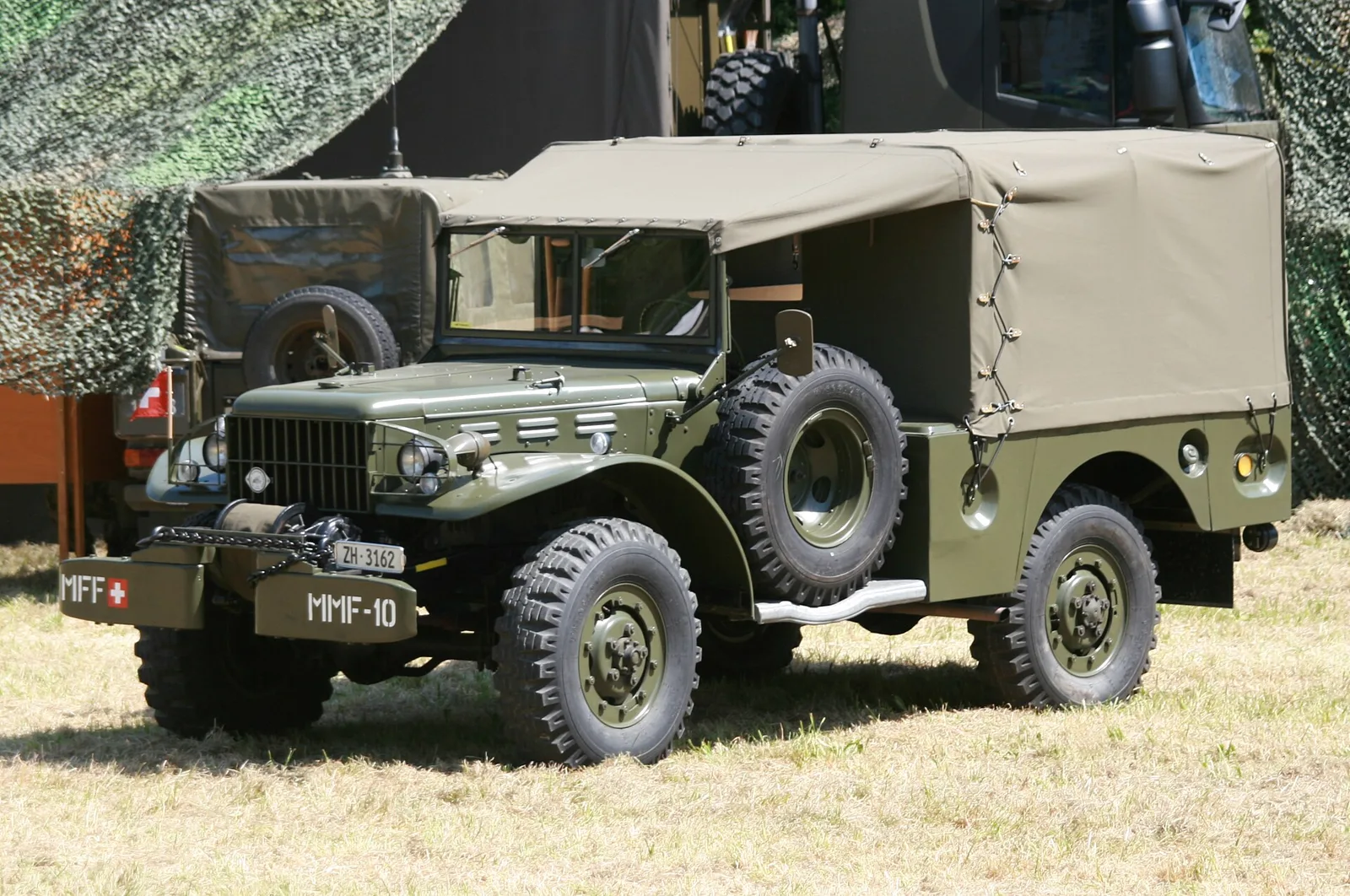
Dodge's World War II family of 4x4 and 6x6 military trucks, built in dozens of variants and known to soldiers as Beeps.
A family of trucks from half-ton 4x4s to six-by-six models, the WC series was built during the Second World War. Soldiers called them Beeps, and the WC-51 and WC-52 three-quarter-ton weapons carriers were the most common models. The total reached more than 380,000 vehicles for the war.
The Dodge WC series was a family of light and medium military trucks that Chrysler built under the Dodge and Fargo marques during World War II. Its members ranged from half-ton 4x4s to three-quarter-ton trucks and stretched 6x6 models, and soldiers nicknamed them Beeps. Chrysler and Dodge supplied over 380,000 of them to the war effort.
Where did the WC series begin?
Dodge had supplied the US military with light wheeled vehicles since before the United States entered the First World War, when some 12,800 Dodge cars and light trucks were used as ambulances, repair trucks and reconnaissance vehicles. Its first four-wheel drive truck came in 1934, an experimental one-and-a-half-ton model.
The Army ordered 796 of those K-39-X-4 units, and Timken supplied the driven front axles and transfer case. The Timken transfer case was the first part-time design, letting the driver engage four-wheel drive with a lever inside the cabin. The 1934 trucks served well enough that further Army contracts followed.
A family of military trucks that Dodge built in more variants than most of its rivals could count, and that the soldiers called Beeps.
How did Dodge win the half-ton contracts?
Dodge developed its light trucks in 1936 on distinct truck-style chassis, and the Warren Truck Assembly plant opened in 1938 for mass production of light and medium trucks. The 1939 T-, V- and W-Series job-rated trucks followed, available in an unprecedented number of sizes and configurations.
By mid-1940 the Army had decided it preferred Dodge to build the light-duty four-wheel drives. Dodge outbid GMC's 1939 ACK-101 half-ton truck, and it also beat Marmon-Herrington and International. In the summer of 1940 the largest government truck contract of the year went to Chrysler's Dodge and Fargo divisions for more than 14,000 mostly 4x4 trucks.
How did the 1940 VC series work?
The VC series was the first light 4x4 that the Army mass-produced, with 4,640 units built across six variants. Its Dodge code was T-202, and it was based on the 1939 TC half-ton civilian truck with the same 116 inch wheelbase. The Army's first ever scale procurement of light four-wheel drive vehicles began with it.
The VC engine was a 201.3 cubic-inch straight six, rated at 79 hp (59 kW) against the 70 hp of the civilian TC. The transmission had four speeds, and the single-speed transfer case only shifted drive to the front axle. On the road the truck stayed rear-wheel drive, which prevented binding in corners.
What were the VC variants?
The VC-1 command reconnaissance car was the most common, with 2,155 units. It was followed by the VC-5 open-cab pick-up with troop seating, at 1,607 units, and the VC-3 closed-cab pick-up with bed seating, at 816 units. The VC-2 radio command car made 34 units, the VC-4 closed pick-up made four, and the VC-6 carry-all made 24.
None of the VC trucks came with a winch. The VC-1 and VC-2 used a dedicated open five-seater body built by the Budd Company, while the pick-ups and carry-all kept the same bodywork as their civilian counterparts.
How did the WC half-ton models evolve?
The half-ton WC series was an all-military evolution of the VC, retaining the military G-505 supply code. It used wide-open simplified fenders and a single round grille in place of the civilian art-deco front. Production passed through three engineering versions, T-207, T-211 and T-215, over a very short span.
The T-207 range used an 85 hp engine with 217.7 cubic inches, and in August 1941 the T-211 engine grew to 230.2 cubic inches and 92 hp (69 kW). The T-215 introduced a military dashboard with round gauges in place of the civilian square ones, and the rear brakes became 14 inch drums from the T-211 onward.
How many half-ton WC trucks were built?
About 77,750 four-wheel drive half-tons were produced from late 1940 to early 1942 under War Department contracts. With 1,542 two-wheel drive units that kept civilian sheet metal, the half-ton WC series reached about 79,300 units, and the grand total of all half-tonners, VC and WC, was almost 84,000.
The 1,542 rear-wheel drive units were coded T-112 and had civilian bodywork with bulbous fenders and a one-ton on-road rating. They show how one platform could carry many body styles, a principle that defined the whole family.
What body styles did the half-ton models use?
Half-ton ambulances, WC-9, WC-18 and WC-27, sat on a longer 123 inch wheelbase and used a fully enclosed all-steel box body. Command reconnaissance cars such as WC-6, WC-15 and WC-23 served the command role, while radio cars were WC-8, WC-16 and WC-25.
The panel vans were WC-11, WC-19 and WC-42. The WC-42 radio panel vans numbered 650, and almost half of all panel van production went to the British Empire under Lend-Lease. Telephone service trucks WC-39, WC-43 and WC-50 served the Signal Corps, and emergency repair trucks such as WC-14 and WC-20 supported field ordnance work.
What was the three-quarter-ton G-502?
In late 1941 Dodge uprated the WC series to three-quarter-ton off-road capacity under the G-502 supply code. The bodies were shorter, lower and wider, with a 98 inch wheelbase and a much wider track, while service parts stayed about 80 percent interchangeable with the half-ton models.
Dodge was the Army's only producer of three-quarter-ton trucks during the war, building 255,193 of them from April 1942 to August 1945. The 92 hp L-head six carried over from the later half-ton models, and the windshield on the 1942 trucks could fold forward flat onto the hood, as on the quarter-ton jeeps.
What were the WC-51 and WC-52 weapons carriers?
The WC-51 and WC-52 were the volume models, with pick-up and troop-carrying bodies that seated a full eight-man squad on benches set into the rear wheel wells and facing each other. The WC-51 had no winch, while the WC-52 carried a Braden MU-2 winch with a 7,500 lb (3,400 kg) capacity on a longer frame.
Production was 123,541 WC-51 and 59,114 WC-52, a total of 182,655 units. Nearly a quarter of these weapons carriers, 44,229 in all, went to allies under Lend-Lease, and the Soviet Union received 24,902 of them, using many to tow anti-tank guns.
What were the WC-53 to WC-58 models?
The WC-53 carry-all was mechanically much like the ambulance, but its body was the 1939 civilian carry-all modified with military fenders and a grille. It seated up to eight people and had a cabin heater, with 8,400 units built. The WC-54 ambulance followed, with 26,002 units built from 1942 to 1944.
The command cars were the WC-56, with 21,156 units built, the winch-equipped WC-57 with 6,010, and the radio WC-58, of which 2,344 were radio-equipped command cars. The command cars had fixed three-abreast bench seats and a folding map plank, but they were heavier and less manoeuvrable than the small jeeps.
What did the WC-55, WC-59 and WC-60 models do?
The WC-55 was an M6 37 mm gun motor carriage, built by Fargo in 1942 with 5,380 units produced. It carried the M3A1 anti-tank gun on the cargo bed facing rearward, and it was downgraded to WC-52 cargo trucks after improvements in enemy tanks made the 37 mm gun underpowered.
The WC-59 telephone maintenance truck had 549 units, and the WC-61 light maintenance truck had 58. The WC-60 chassis formed the M2 emergency repair truck, with 296 units built. The Signal Corps called the telephone trucks K-50 models, and the WC-61 was known as the K-50B.
What was the WC-64 knock-down ambulance?
The WC-64 reused the WC-54 chassis, but its body came as a knock-down kit so that more vehicles could be shipped at once. The rear box came in two parts, with the lower section fitted at the factory and the upper crated for field installation. Some 3,500 were built between the start of 1945 and the end of the war.
Most of the knock-down ambulances, 2,531 units, went to allies under Lend-Lease. The Free French received 1,123, the British Commonwealth 644, China 475, Brazil 149 and other Latin American republics 82.
What were the six-by-six WC models?
In 1943 Dodge stretched the three-quarter-ton into a six-by-six model, because the Army had enlarged its rifle squads from eight to twelve men. The G-507 added 48 inches (1.22 m) of length and an extra driven rear axle, and it used a dual-range transfer case taken from the 1940 VF-400 trucks.
The WC-62 had no winch, and 23,092 were built, while the WC-63 with a Braden winch totalled 20,132. The six-wheel drive production amounted to 43,224 units in all. The truck could run in six-by-four or six-by-six configuration, although its rear axles could not be disengaged.
How did the WC series serve its allies?
Almost 60,000 WC-series models went to the Allies under Lend-Lease. The bulk of those Dodges, over 44,000 units, were WC-51 and WC-52 three-quarter-ton troop and weapons carriers. Russia simply called them Dodge three-quarters, because they fitted no standard Red Army category.
About 6,344 of the WC-62 and WC-63 six-by-sixes were supplied to allies, with 4,074 going to the Free French forces and 2,123 to the British. Some 3,800 three-quarter-ton command cars also went abroad, mainly to Britain, the Free French and China, alongside 886 carry-alls.
What experimental and special models were built?
Twelve G-614 half-ton amphibious XAC-2 trucks, nicknamed Aqua-Cheetah, were built in 1942 by the Amphibian Car Corporation. One went to Britain for testing under Lend-Lease, and eleven were later rebuilt as G-552 XAC-3 amphibious three-quarter-tons. Neither Britain nor the US standardised them.
A single armoured car prototype was built on the six-by-six WC-62 chassis. Among the WC variants, the M6 gun carriage and the Signal Corps telephone trucks were the most specialised.
Key specifications
| Specification | Detail |
|---|---|
| Nickname | Beeps, first called jeeps from 1940 to 1942 |
| Half-ton engine (T-215) | 230.2 cubic inches (3,772 cm3), 92 hp (69 kW) |
| Half-ton wheelbase | 116 in (2.95 m), 123 in for ambulances |
| Three-quarter-ton wheelbase | 98 in (2.49 m) |
| Three-quarter-ton output | 255,193 built, April 1942 to August 1945 |
| WC-51 production | 123,541 units |
| WC-52 production | 59,114 units, with Braden MU-2 winch rated 7,500 lb (3,400 kg) |
| Six-by-six output | 43,224 built, WC-62 at 23,092 and WC-63 at 20,132 |
| WC-54 ambulance | 26,002 built from 1942 to 1944 |
| WC-64 knock-down ambulance | 3,500 built in 1945 and to the end of the war |
What did the WC series leave behind?
After the war Dodge developed the three-quarter-ton WC into the civilian Dodge Power Wagon, and in 1951 the WC series was replaced by the very similar three-quarter-ton Dodge M-series. The WC family therefore fed directly into Dodge's postwar truck line.
The WC-54 ambulance is a familiar sight in the TV series M*A*S*H, which is set in the Korean War. The WC series also appears in the film Oppenheimer, in Los Alamos, and Dodge command cars feature in many World War II films.