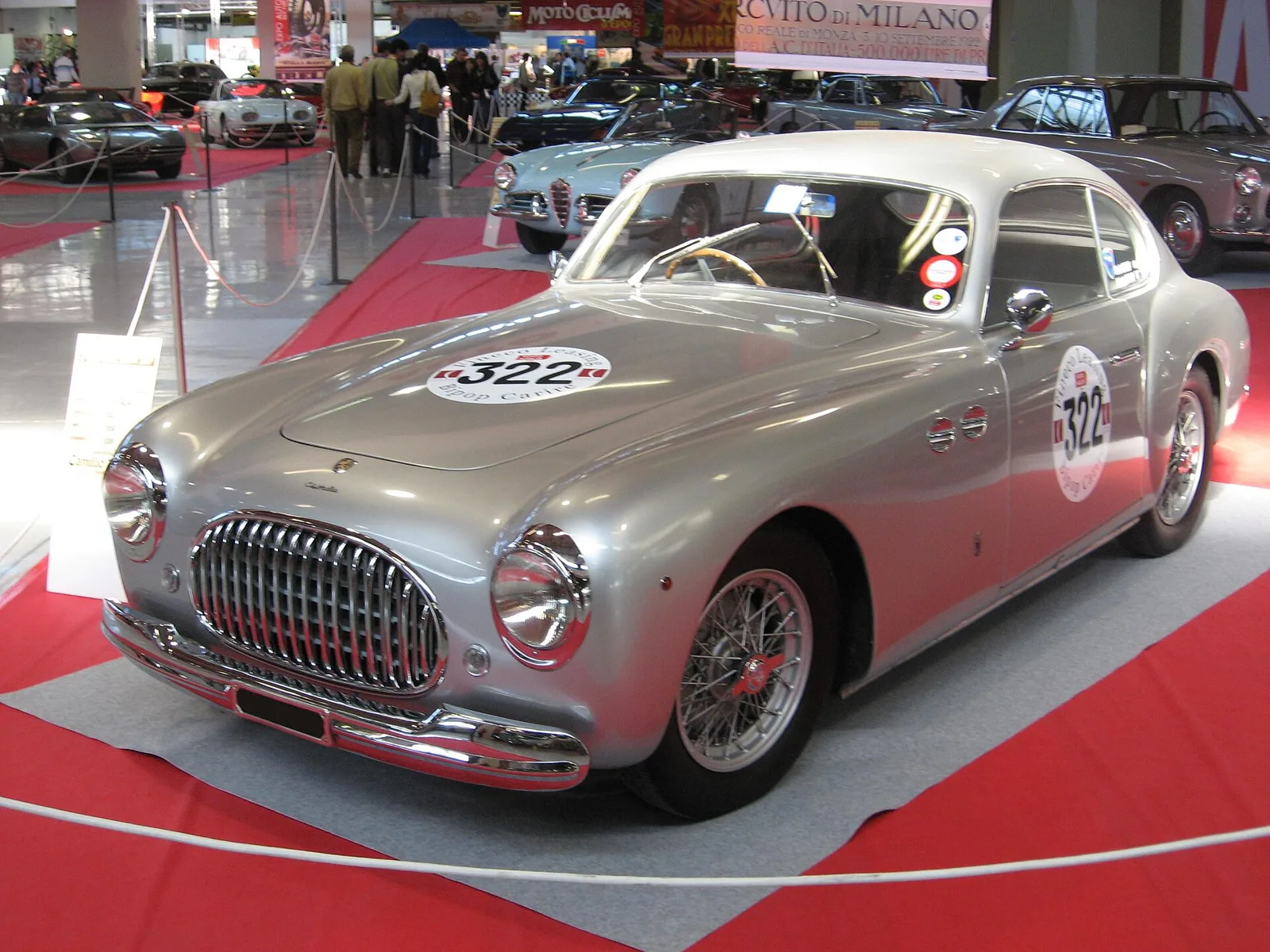
A tubular-framed post-war gran turismo from Turin, built between 1947 and 1952, and the first car to enter a museum of modern art.
The Cisitalia 202 was a 1947 gran turismo from Turin with a tubular steel frame and a 55 PS four-cylinder engine. Built until 1952, it became the first car kept in a museum of modern art, and its Pinin Farina coachwork set a pattern for later Italian gran turismo cars.
The Cisitalia 202 was a sports car built by the Turin firm Cisitalia between 1947 and 1952. It is important for two reasons: it was the first car permanently displayed in a museum of modern art, and it can be considered the first post-war Italian gran turismo.
Where did the Cisitalia 202 come from?
Cisitalia was founded at the end of the Second World War by Piero Dusio, a Turin industrialist, sportsman and semi-professional racing driver. The company aimed to build racing cars and road gran turismo cars, and its first car, the D46 single-seater, was built in several examples.
The timing mattered. Most major Italian makers had only revised their pre-war cars, because production had been stopped by the war in 1940. Cisitalia offered something new in the preview ahead of the first Italian Grand Prix after the war, held on a street circuit in Milan's Portello district rather than at Monza.
Dusio's early success was a car with a tubular frame and Fiat 1100 components. From that work two cars followed: a two-seat racer, the 202 S MM or Spyder Nuvolari, and a road model, the future 202 Coupe, which would carry over what the team had learned.
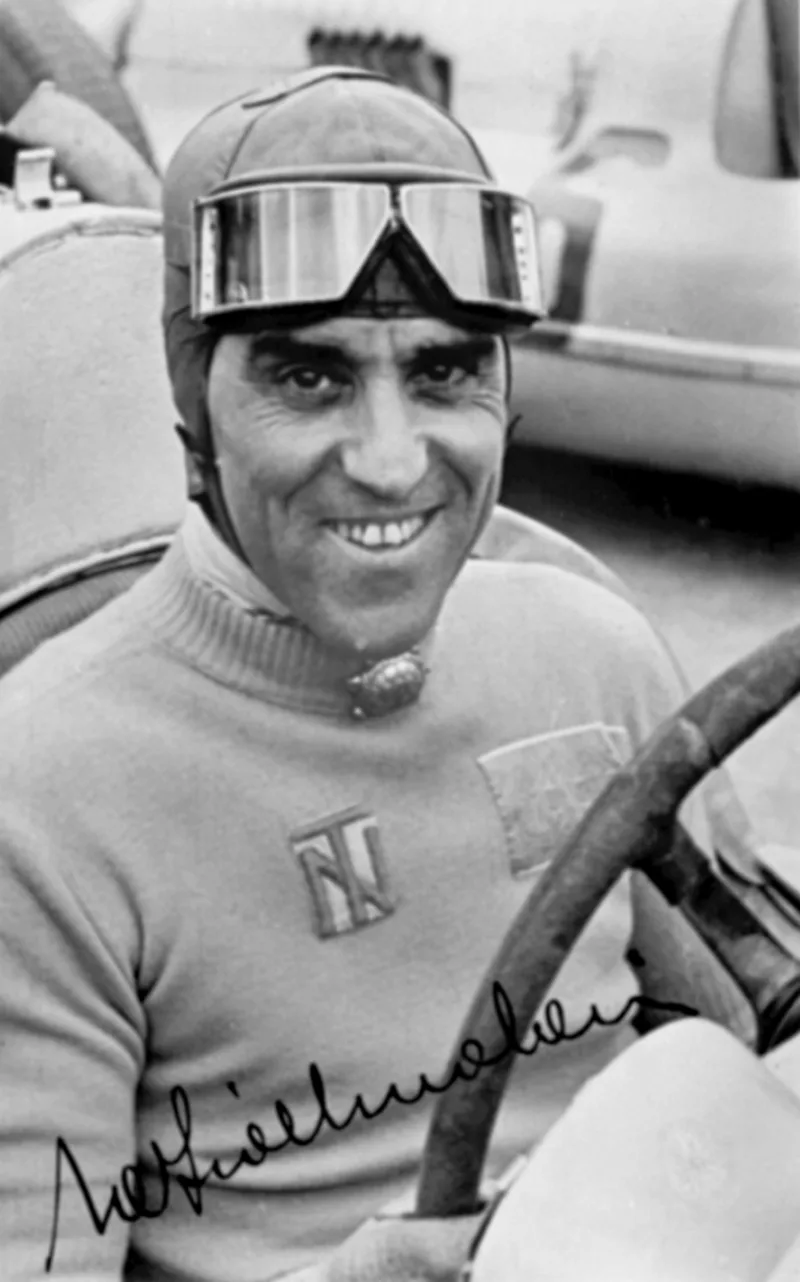
At the 1947 Mille Miglia the Cisitalia team ran five cars, two experimental berlinettas and three 202 S MM spiders, and in June it took second, third and fourth places. Tazio Nuvolari finished second, having led the race for long stretches until a violent thunderstorm slowed him on the final section.
The first car to enter a museum of modern art was a tubular-framed road car from Turin.
Who designed the Cisitalia 202?
Giovanni Savonuzzi was in charge of the project at Cisitalia, with the valuable help of Dante Giacosa, who was on loan from Fiat. Battista Pinin Farina built most of the bodies, while Alfredo Vignale, then chief panel beater at the Farina works, went on to become an inventive independent coachbuilder.
The design was a meeting point between the new and the old. The car carried first-class technical content from the D46 and the 202 S MM, and it was clothed in a modern body that set the pattern for the Italian gran turismo that followed. It still kept a link with the best pre-war coachwork.
No single person was the car's only father. Each body was made entirely by hand by the craftsmen at Pininfarina, at the Farina works and later at Vignale, so every example differed slightly from the others while keeping the same basic lines.
How did the 202 look?
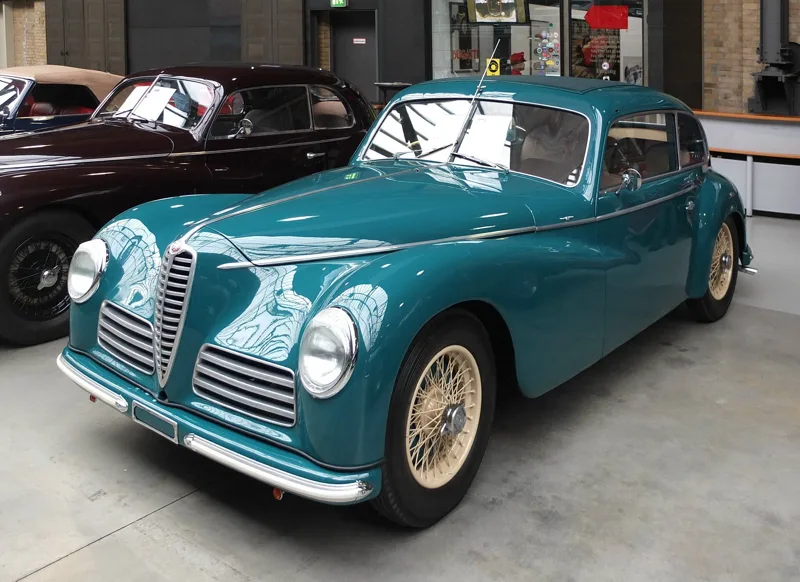
The coupe was a two-box berlinetta with a simple front. An oval opening for cooling was covered by a grille of 23 convex vertical aluminium slats, and round headlamps sat on top of the wings inside a chrome frame. The bumper was a thin metal strip in body colour, without overriders.
The profile followed the Ponton style while keeping a link with pre-war bodies that had separate wings. The bonnet line dropped to highlight the front wings and ran back to the door, while the flank was sculpted just behind the door to suggest the rear wings.
The roof blended into an almost truncated tail. The rear lamps, a bumper identical to the front one and a small hatch over the spare wheel, which also housed the number-plate holder, were all fitted there. There was no boot lid, so the boot was reached from inside the cabin.
For the first time the maker's name appeared on the tail of a car. The Cisitalia script was in italics, in lettering that copied the hand of Corrado Millanta, a well-known motoring journalist.
The interior was simple but well finished. Drivers got the wheel on the left and a floor gear lever as standard; right-hand drive and steering-wheel gearchange could be specified at no extra cost. Behind a three-spoke wheel with a Bakelite rim sat two large round dials, the speedometer with odometer and the rev counter.
The painted dashboard held the secondary controls, the ashtray and, on request, a car radio. A glovebox sat in front of the passenger seat, and the floor was carpeted throughout. The two separate seats could be trimmed in leather or fabric, in colours of the owner's choice.
Tubular frame and mechanics
The tubular frame, made of chrome molybdenum steel, came from the aircraft industry. It was one of the 202's great innovations, because no road car had used one before, and sports cars until then had been built on ladder frames. Savonuzzi chose it for being lighter and more rigid than the ladder frames of the day, at the same weight, and because it let the engine sit lower, which improved handling.
The inline four-cylinder was derived from the Fiat 1100 but reworked in depth, so much so that only the cast-iron block was original. The aluminium head was new, with overhead valves, two per cylinder, worked by pushrods and rocker arms. Gears drove a single camshaft sitting in the block. The crankshaft, connecting rods and pistons were specific to the car, and the engine used dry-sump lubrication.
The rear axle and the four-speed gearbox came from the Fiat 1100. The front suspension and steering were borrowed from the 500 Topolino, and the steering was very hard to work at low speeds. The wire-spoked wheels were covered by hand-finished aerodynamic spats, which made the brakes, all drums, less efficient.
Cisitalia 202 specifications
| Specification | Detail |
|---|---|
| Engine | Inline four-cylinder, 1,089 cc (66.5 cu in), bore and stroke 68 x 75 mm |
| Output, Gran Sport | 55 PS (54 hp) at 5,500 rpm |
| Output, Sport and Sport Special | 50 PS (49 hp) and 60 PS (59 hp) |
| Gearbox | Four-speed manual; floor lever standard, steering-wheel control on request |
| Frame | Tubular, chrome molybdenum steel |
| Weight | 780 kg (1,720 lb) |
| Top speed | 165 km/h (103 mph) |
| Price | 3,900,000 lire |
| 202 D, 1952 | 2.8-litre BPM marine engine, 185 PS (182 hp), De Dion rear axle from the Lancia Aurelia B20 GT |
Why did the 202 reach a museum?
One of the Pinin Farina bodied 202s became the first car to enter the permanent collection of a museum of modern art. Earlier it had been shown at the Triennale in Milan and at the Villa d'Este elegance contest in Cernobbio, before crossing the Atlantic to New York.
From 1951 the Museum of Modern Art in New York displayed a 202. Its director, Arthur Drexler, called the car a sculpture in motion when it was shown.
How was the 202 built and sold?
The Cisitalia factory built the tubular chassis with its mechanics. The body was not made in-house: it was made of Itallumag, a special aluminium alloy, by an outside coachbuilder. Because the bodies were hand-finished, even the coupes differed from one another.
A cabriolet built alongside the coupe shared the main lines of the berlinetta, except for its manual hood. It should not be confused with the 202 SMM or Spyder Nuvolari, which was also an open car but was built expressly for competition.
The design changed only in detail over production. After chassis 130, known as version B, the grille was simplified and became chrome-plated brass, and the windscreen moved from a flat split pair to a single curved unit. A new double-barrel carburettor lifted power to 60 PS (59 hp), the bonnet was hinged at the front instead of opening to either side, and the boot could now be opened from outside.
The exact number built is not known for certain, but reliable sources speak of one hundred coupes and berlinettas, plus some sixty cabriolets, made by Turin coachbuilders between 1947 and 1949. In that year Cisitalia went into controlled administration, although the last cars were still sold up to 1952.
What came after the 202?
Piero Dusio and his son Carlo drove the 202 D in the 1952 Mille Miglia, where it retired. That year four or five examples were built with a 2.8-litre BPM marine engine producing 185 PS (182 hp), and they used a De Dion rear axle from the Lancia Aurelia B20 GT.
The tubular-frame 202 then came to an end, but the brand carried on. About 50 cars were built on the 1100 ladder frame with a tuned Cisitalia engine. Later the 35 and 36 DF Volo Radente bodied the new Fiat 1100/103 chassis, again with tuned Cisitalia mechanics.
Cisitalia headed towards closure after that, which came in 1964, following a few special cars based on the Fiat 600.