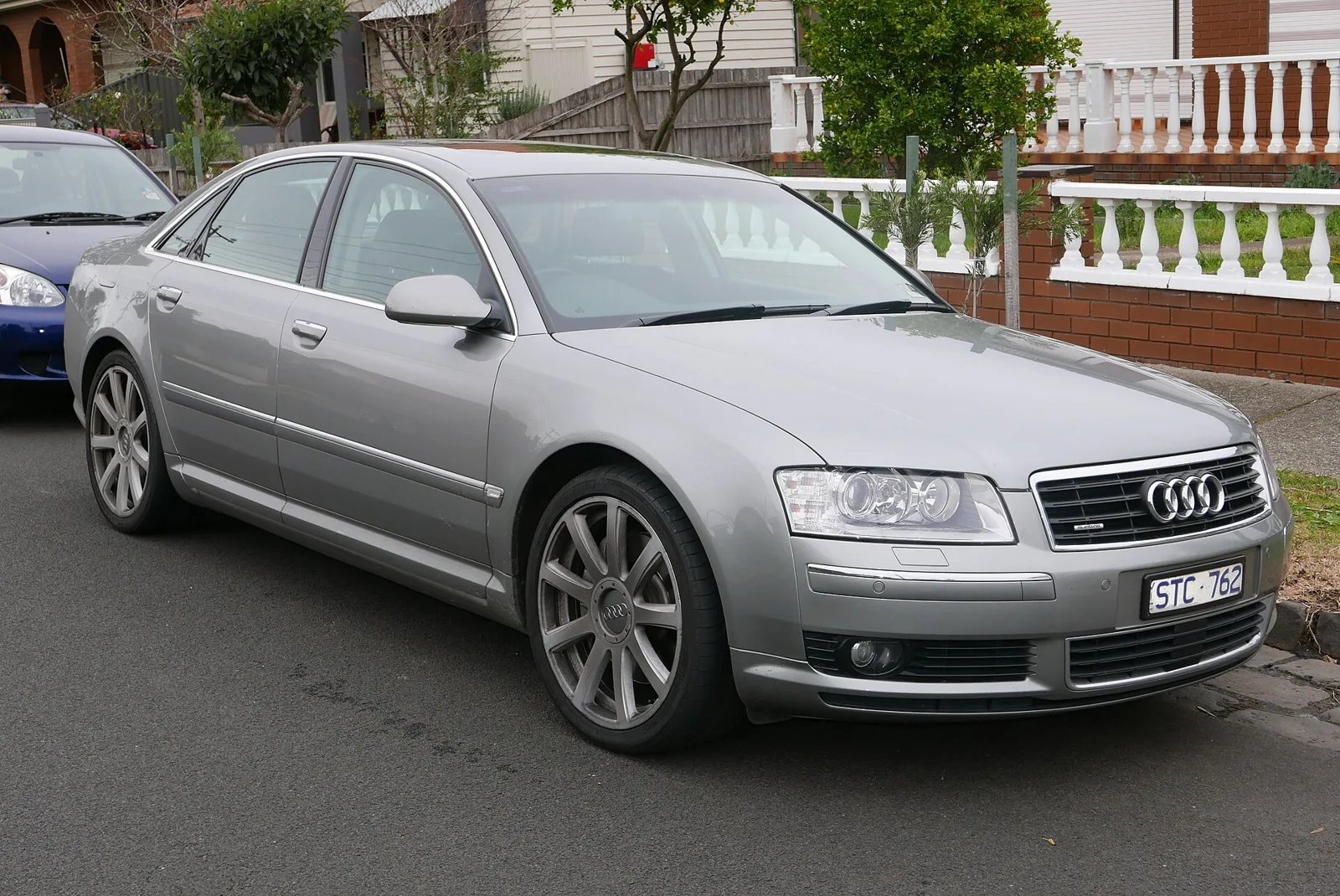
Audi's second-generation A8 paired an aluminium body and electronically managed air springs with V8 power, and it shared many parts with the Volkswagen Phaeton.
Built between 2002 and 2010, the Audi A8 D3 was the brand's second-generation luxury saloon. It combined an aluminium body and air suspension with V8 power, and it shared many parts with the Volkswagen Phaeton, its twin. The version most loved by enthusiasts was the long-wheelbase A8L W12.
The Audi A8 D3 was the second generation of the German brand's luxury flagship, built from 2002 to 2010. It was the twin of the Volkswagen Phaeton, offered in the same versions and sharing many of its components, and it used an aluminium body with electronically managed air suspension.
It was a spacious car, and the A8L W12 was the version most loved by enthusiasts, though prices have fallen a long way since launch.
Where did the A8 D3 come from?
The new generation was presented in Paris in October 2002. Audi wanted to build on the technical content of the previous car and make the flagship safer, more capable and more comfortable. The company drew on the success of the first-generation A8 when it set the brief for the new model.
The name Typ 4E identified the car internally. Its wheelbase came in standard and long versions, and the long-wheelbase A8 L made the rear seats roomier for passengers.
An aluminium flagship with air suspension and V8 power that passed largely unnoticed on the road.
How did the A8 D3 look?
Thanks to the success of the first-generation A8, Audi's management had the new model developed to reinterpret its styling in a more up-to-date way. The designers combined sobriety with the elegance needed for this type of car, in line with the brand's new styling direction. Although it was a completely new car, the styling updates focused on the front and rear. The rectangular light clusters came from the second-generation A4, which had introduced that style two years earlier.
The grille was split in two by the bumper strip, and the lower section housed two air intakes for cooling the brakes and two fog lights. The bonnet was reworked, and the rear was the most changed area, with a softer line and trapezoidal lights mounted higher than before. A drag coefficient (Cx) of 0.27 compared with 0.29 for the previous A8 showed how far the smoothing of shapes and edges had been taken.
The cabin confirmed, and improved, the roominess of the earlier car. The driving position was sober, marked by a dashboard assembly of linear but not trivial design, and the centre console blended smoothly into both the dashboard and the central tunnel.
Inside, the layout was linear but not plain. Two main dials sat in front of the driver, with a water temperature gauge and fuel level indicator in the lower part of the instrument panel. A small display between the speedometer and rev counter gave auxiliary readings. The dashboard was built from horizontal layers in leather, burr walnut and good-quality plastic.
What changed in the cabin's controls?
The centre console had only two air vents where there were once three. In place of the central vent, a retractable display served the satellite navigation system. At the base of the console sat the knob for the MMI system, which managed both the multimedia functions and the car's set-up.
Seats and door panels were covered in leather, and the rear panels carried burr walnut inserts to raise the level of finish.
How was the A8 D3 built?
The second generation kept a longitudinal front engine, but this time it was paired with four-wheel drive across the whole range, at least in the early years. Front-wheel-drive models arrived later in the career.
The body was an aluminium-alloy monocoque weighing only 215 kg (474 lb). Simplifying the construction replaced groups of small components with single, more rigid pieces, which made the structure lighter and stiffer. Torsional rigidity rose by 60% compared with the outgoing model, and the design also aimed to improve passive safety by helping the structure absorb impacts.
How did the A8 D3's suspension work?
The front suspension used double wishbones in aluminium alloy, and the rear used trapezoidal links with directional control. The real novelty was the electronically managed air spring system, with electronically controlled dampers working alongside it.
The braking system used self-ventilated discs on both axles.
Which V8 engines did the A8 D3 launch with?
At launch the second-generation A8 came with two V8 engines, both twin-cam designs with five valves per cylinder. The 3.7 displaced 3697 cc (225.6 cu in) and produced 280 PS (206 kW; 276 hp), while the 4.2 displaced 4172 cc (254.6 cu in) and delivered 335 PS (246 kW; 330 hp).
Both engines were paired with a six-speed automatic gearbox.
What changed in 2003 and 2005?
The first updates arrived in May 2003, when the range gained its first diesel, a 4-litre V8 turbodiesel common-rail engine with 275 PS (202 kW; 271 hp). At the same time a long-wheelbase version called the A8 L returned, with its wheelbase extended by 13 cm (5.1 in). It was offered with the 4.2 petrol and the 4.0 diesel.
The 2005 restyle brought a 4.2 TDI, in reality a 4.1 with 4135 cc (252.3 cu in), producing 326 PS (240 kW; 322 hp). It replaced the 4-litre diesel in the summer. A new 3.2-litre V6 with direct petrol injection, rated at 260 PS (191 kW; 256 hp), replaced the earlier 3-litre with indirect injection. The single-frame grille, previously reserved for the W12, was extended to the whole range.
A year later the 3.7 with 280 PS was removed from the price list, and so was the 4.2 with 335 PS. The 4.2 was replaced by a new V8 of 4163 cc (254.0 cu in) with direct injection and 350 PS (257 kW; 345 hp).
What was the S8?
The S8 arrived at the same time as the new V8, a sporty-minded version of the flagship. It used a 5.2-litre V10 with direct injection, rated at 450 PS (331 kW; 444 hp). The engine was partly derived from the unit in the Lamborghini Gallardo, which at the time had a 5-litre V10 with indirect injection producing 520 PS (382 kW; 513 hp).
The S8's chassis was tuned for a sportier feel, with electronically managed air suspension running specific programmes. Carbon-ceramic front discs could be specified on request. Outside, the car was identified by its lettering, 20-inch wheels with low-profile tyres and twin split exhaust tailpipes.
How did the A8 D3 end its career?
In August 2007 the car received its mid-life restyle. Changes were small, as is usual for Audi, and included indicators on the outer mirror caps and longer reversing lights at the rear. The grille was slightly revised, and the cabin gained wider options for personalisation and trim combinations.
The base engine became a new 2.8-litre V6 producing 210 PS (154 kW; 207 hp), offered only with front-wheel drive. The 2007 update was the last big change in the range. After three years with no novelties, the model was retired in July 2010.
Was the A8 D3 good value?
Prices for the A8 D3 vary widely from version to version, and the car has suffered heavy depreciation. Running costs should not be underestimated.
The A8L W12 is the version most loved by enthusiasts. It carries an engine worthy of a true supercar, which lets it cover many kilometres in maximum comfort.
The boot offers 502 litres, which is enough for several large suitcases. The car is roomy for families even though it was not designed for that purpose. Its luxury interior and size mean it passes largely unnoticed on the road, unlike many saloons in the same sector.
Audi A8 D3 specifications
| Specification | Detail |
|---|---|
| Type | Luxury saloon, front-engined |
| Built | 2002 to 2010 |
| Internal code | Typ 4E |
| Twin model | Volkswagen Phaeton |
| Body weight | 215 kg (474 lb), aluminium monocoque |
| Drag coefficient | Cx 0.27 |
| Launch V8s | 3697 cc (225.6 cu in), 280 PS (206 kW; 276 hp); 4172 cc (254.6 cu in), 335 PS (246 kW; 330 hp) |
| S8 V10 | 5.2-litre, 450 PS (331 kW; 444 hp) |
| Gearbox | Six-speed automatic |
| Long-wheelbase version | 13 cm (5.1 in) longer |
| Boot | 502 litres |