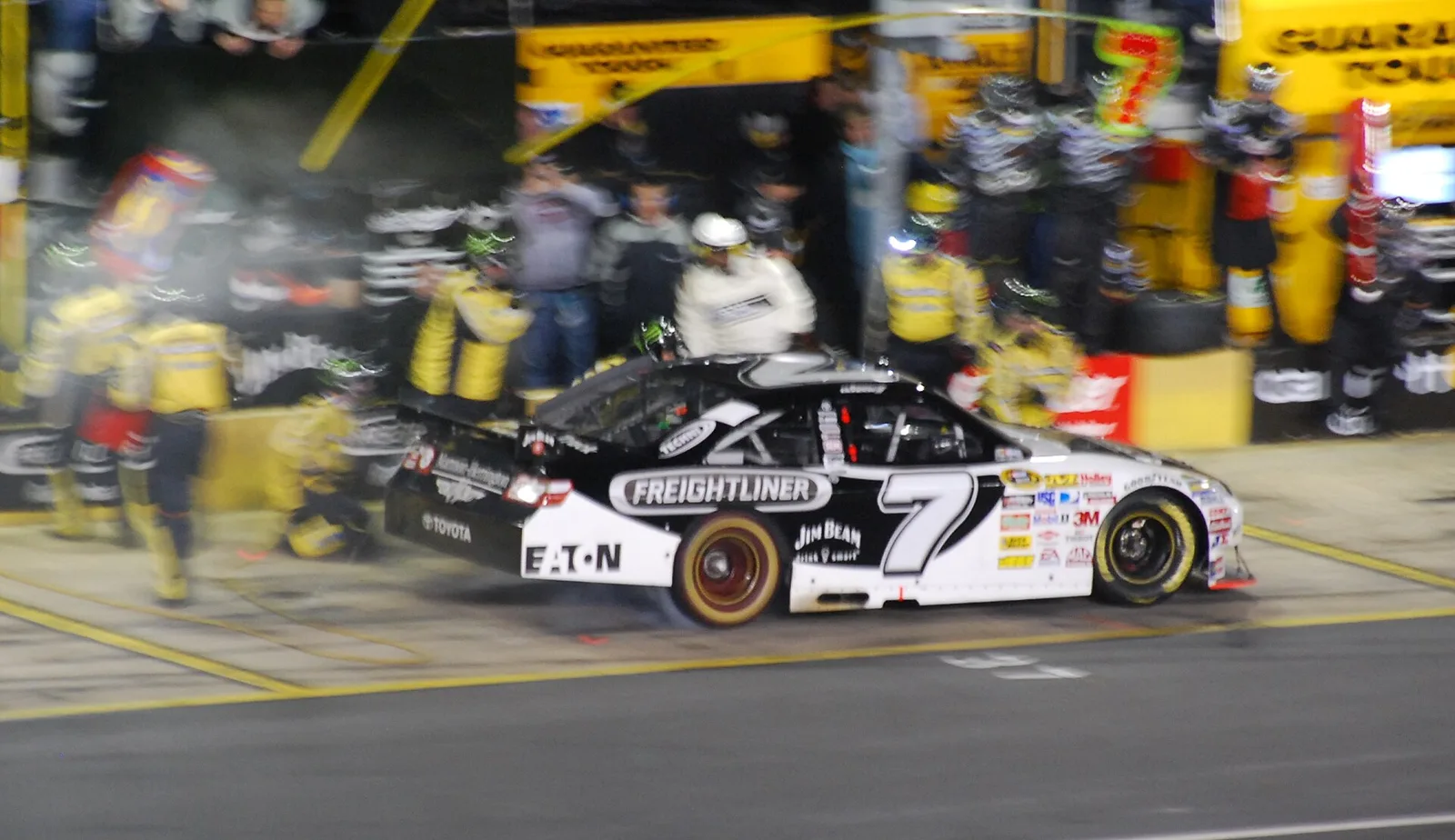
Built in 2005 around Robby Gordon's own NASCAR career, the team won once at Richmond, produced a breakout 2007 season and closed its Cup operation after 2012.
Robby Gordon Motorsports was a race team formed in 2005 to carry Robby Gordon's NASCAR career. Formed to carry Robby Gordon's NASCAR career, it recorded one win at Richmond in 2004 and 30 top-ten finishes before closing its NASCAR operation after 2012. It then became a vehicle builder for Stadium Super Trucks.
Robby Gordon Motorsports, usually called RGM, was a race team set up in 2005 to carry Robby Gordon's own NASCAR career. It raced in the Cup and Xfinity series until 2012, and it recorded one win, at Richmond in 2004, plus 30 top-ten finishes. After 2012 Gordon closed the NASCAR operation, and the company became a builder of vehicles for the Stadium Super Trucks series he owns.
How did Gordon's team start?
Gordon had raced Champ Car open-wheel cars in 1999 before he moved to NASCAR. In 2000 his team, Team Gordon, co-owned with John Menard and Mike Held, entered the Cup Series. It struggled and closed at the end of the season, and Gordon then drove for Morgan-McClure Motorsports.
In 2004 the former Team Menard base in North Carolina returned to Gordon and John Menard. Gordon started a part-time Busch Series team with Fruit of the Loom as primary sponsor and the No. 55 on the car. It was his best Busch season statistically, with more than 15 top-ten finishes, and in September he won at Richmond in the self-owned car. That win was his first on an oval, and it drew public attention to Robby Gordon Motorsports.
At the end of 2004 Gordon left Richard Childress Racing, his Cup team, to bring the new operation into the Cup Series.
A team built around one driver's ambitions, with a memorable 2007 and a NASCAR exit that led to a race shop for another series.
What was the 2005 season like?
Gordon bought the defunct Ultra Motorsports for 2005, with Menard as a business partner and Jim Smith listed as owner for provisional points. Menard built the engines, but they were prone to failure, so RGM changed to Dale Earnhardt, Inc. engines. The partnership with Fruit of the Loom broke down in a sponsorship dispute and a lawsuit, which was settled out of court in 2006.
Jim Beam became the pivotal sponsor, and smaller backers included Menard's, Red Bull, Mapei and Camping World. While running a full Cup programme, the team cut back on its Busch starts. Gordon's Busch car finished with two top-ten results, including a narrow runner-up finish at Watkins Glen, and at the inaugural Mexico City race he qualified second before an engine failure.
The Cup season was disappointing. Gordon had only two top-ten finishes all year. At the Sylvania 300 he was in contention until a caution, and a dispute with Michael Waltrip ended with Gordon throwing his helmet at Waltrip's car. The helmet was later signed by both drivers and auctioned for Hurricane Katrina relief, selling to GoldenPalace.com for $51,000.
| Year | Series | Highlight |
|---|---|---|
| 2004 | Busch | Win at Richmond in the No. 55 Fruit of the Loom car |
| 2005 | Busch | Narrow runner-up at Watkins Glen |
| 2007 | Cup, Ford Fusion | 15th at the Daytona 500, 16th at Sonoma |
| 2008 | Cup, Dodge Charger | 8th at the Daytona 500, then a penalty |
| 2009 | Cup, Toyota Camry | Third at Charlotte after a red flag ruling |
| 2010 | Cup, Toyota Camry | Second at the Toyota/Save Mart 350 |
Did the team have a good Busch and Cup record in 2006?
Gordon came close to another Busch win in 2006 at Watkins Glen, where he led ten laps before Kurt Busch passed him with about 15 laps left. On the final lap Gordon tried to pass on the inside and the two cars locked together, and Busch held the lead. Busch later praised the fight, saying it reminded him of a battle with Ricky Craven at Darlington in 2003.
In October 2006 the team signed with Ford Racing for a Ford Fusion in 2007, sponsored by Jim Beam, Mapei, Camping World and Monster Energy, with Roush and Yates engines.
What was the 2007 breakout season?
In 2007 RGM had its best year. Gordon was on course for 25th at the Daytona 500 but a last-lap accident left him 15th. He finished 17th at Las Vegas and qualified second at Sonoma, where he led for 35 laps only to slip to 16th after pit stop shuffling.
Later in 2007 Gordon was involved in the controversial race at Circuit Gilles Villeneuve, NASCAR's first event there. He passed Marcos Ambrose for the lead but was turned around in turn three under a caution, and NASCAR dropped him to 13th for the restart. He refused and was black-flagged, then wrecked Ambrose and kept running. He crossed the line first, but Kevin Harvick was later declared the winner, and NASCAR parked Gordon for the next morning's Pocono race. He later apologised but maintained his call was a poor one.
Gordon then gave Ambrose his second RGM car, the No. 77, for the Watkins Glen race to make amends. The car missed qualifying because of rain. At Watkins Glen Gordon drove from 29th to fifth, although Ron Fellows held him off in the final laps.
What went wrong in 2008?
In January 2008 Gordon hired Frank Kerr as crew chief. RGM switched to Dodge Chargers with Evernham engines, and Gordon finished eighth at the Daytona 500. A nose mix-up during testing then led to a 100-point penalty and a $100,000 fine, and Kerr was suspended for six races. Fans and the sponsor Jim Beam ran a "Rally for Robby" campaign against the penalty, and on 5 March the National Stock Car Racing Commission reinstated the points. The fine rose to $150,000, and Kerr left after ten races.
Late in 2008 the team faced a lawsuit with GEM over a possible merger. The suit was dropped, but the partnership was dissolved, and Gordon moved to Penske Racing engines.
How did RGM operate in 2009 and 2010?
For 2009 Gordon switched to Toyota, his fourth manufacturer in four years. He ran 35 of the 36 races, with David Gilliland driving at Richmond. His best finish came in the Coca-Cola 600, when he was classified third after a red flag. Had David Reutimann and Ryan Newman pitted before the stoppage, Gordon would have won. The team finished 34th in owners' points, and a second team, the No. 04, ran briefly with P. J. Jones.
In 2010 RGM aligned with BAM Racing, and Monster Energy sponsored some Cup events. The Toyota/Save Mart 350 produced a second-place finish for Gordon, while Ted Musgrave's car missed the Gillette Fusion ProGlide 500, the team's first qualifying failure since 2005. Gordon's return to Montreal ended 14th after he ran out of fuel on the last restart.
Gordon then stepped out of the No. 7 for Kevin Conway, who brought ExtenZe as sponsor and drove mainly as a starter-and-parker. The team finished 32nd in owners' points. The BAM partnership dissolved mid-season, and Gordon announced plans to sue BAM for breach of contract.
What ended the NASCAR operation?
Gordon returned to the Cup Series in 2011 for 25 races, with the Speed Energy drink as a sponsor, and his best finish was 16th at the Daytona 500. Kimi Raikkonen tested Gordon's car at Infineon, but he crashed it and the plan for an extra car fell through. In 2012, during practice at Bristol, the car's electronic fuel injection shorted out beyond repair and the team withdrew. It was announced that it would next race at Sonoma, which was its last Cup attempt.
Gordon later said he had been unhappy with the gap between large and small teams in spending. In 2013 RGM did not race in NASCAR at all, as Gordon launched the Stadium Super Trucks. NASCAR gave the No. 7 to Tommy Baldwin Racing and later to Spire Motorsports, where Daniel Suarez drove it.
What did Gordon achieve outside NASCAR?
Gordon switched between CART and IRL teams through the 1990s and early 2000s, driving for Chip Ganassi's operation, Andretti Autosport and others. He fielded his own open-wheel team in 1999 and once more for a one-off Indianapolis stint in 2004.
Off-road he won the Baja 500 three times, in 1989, 1990 and 2005. He was declared the 2009 winner but later stripped of the title in a controversial ruling. At the 2012 Dakar Rally he won the final stage amid a dispute over tyre inflation. The complaint was found to be false, and he won the event by 15 minutes.
What is the legacy of RGM?
RGM is best known as a series of short-lived projects built around Gordon's own driving. Its NASCAR record was modest, but the team produced a memorable 2007 season and a few strong finishes at tracks such as Charlotte and Sonoma.
Today the team's race shop builds the Stadium Super Trucks, so the business survives in a different form. Gordon's Dakar Rally stage win in 2012 came in the same year the NASCAR operation was withdrawn, which shows how far his racing interests had spread. The organisation's shifts through Ford, Toyota and Dodge also show how changing manufacturer support shaped the team's fortunes.
Why did RGM change manufacturers so often?
RGM's equipment changed almost every year. In 2007 it ran Ford Fusions with Roush and Yates engines, after signing with Ford Racing in October 2006. For 2008 it switched to Dodge Chargers with Evernham engines, a move that began with a nose mix-up in testing and was followed by the penalty controversy. Gordon then switched to Penske Racing engines after the GEM dispute, and in 2009 he moved to Toyota, the team's fourth manufacturer in as many years. He returned to Dodge in 2011.
Each change meant the team had to rebuild its engineering and crew links, and its results moved up and down with the equipment it was running at the time.
Who else drove for RGM?
Besides Gordon, a long list of drivers took RGM cars. Kevin Conway, who had been released from his ride at Front Row Motorsports, brought ExtenZe as sponsor and drove the No. 7 in 2010, starting and parking in five of the seven races he ran. David Gilliland drove at Richmond in 2009 and finished 24th, while P. J. Jones ran the second car, the No. 04 in 2009 and the No. 07 in 2010. Ted Musgrave's failure to qualify for the Gillette Fusion ProGlide 500 in 2010 was the team's first miss since 2005, and Bobby Labonte drove at New Hampshire that year.
When Gordon attempted the 2012 Daytona 500, Joe Nemechek was the only other full owner-driver in the series. That underlined how few NASCAR teams were run by their own drivers at the time.