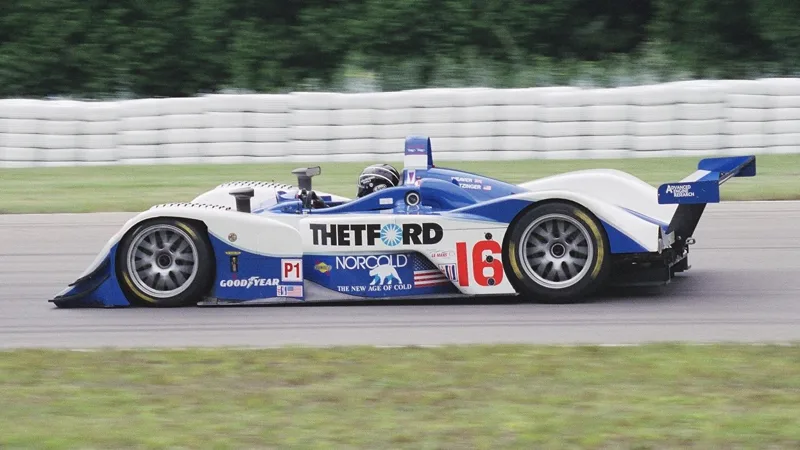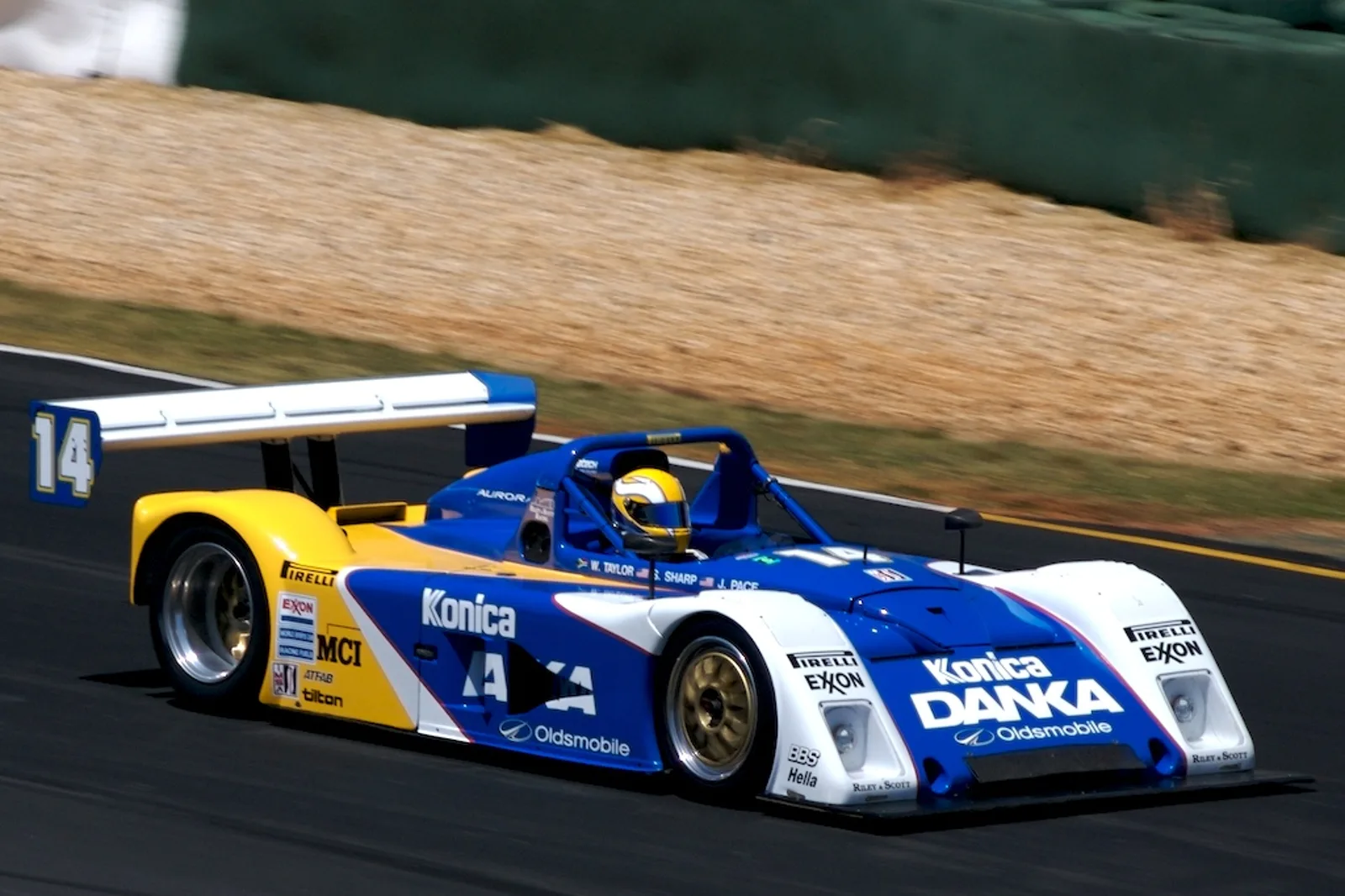
Designed in 1993 for the World Sports Car category, the Mk III went on to 47 overall wins across IMSA, Rolex and American Le Mans Series fields.
Conceived for IMSA's World Sports Car class in 1993, the Mk III was built by Riley & Scott Cars. Its 1995 to 2005 career brought 47 overall victories across North America and Europe, and its last overall win came in 2002.
Few sports prototypes of the late 1990s had a career as long or as varied as the Riley & Scott Mk III. Built for a low-cost category, it raced on both sides of the Atlantic, carried championships in four different series and went to customer teams from Dyson Racing to Robinson Racing. This is how the car was conceived, built and campaigned.
What was the Riley & Scott Mk III?
The Riley & Scott Mk III was an open-cockpit sports prototype built for the World Sports Car category. Designed in 1993 by Bob Riley, Bill Riley and Mark Scott, it won 47 overall races in North America and Europe before its last win in 2002.
The car paired a steel tube frame with carbon fibre panels. Its engine bay was large enough for the naturally aspirated American V8s that privateers in IMSA already used, and its bodywork was low in drag while still producing substantial downforce.
A low-cost open-cockpit prototype that ended up winning titles in four championships and on two continents.
Where did the Mk III come from?
Bill Riley began work on a design in 1993 to meet IMSA's World Sports Car regulations, which aimed at cheaper open-cockpit prototypes. The first concept drew little interest, so no car was built for the 1994 season, and the project was shelved.
That first concept was radical. Its radiators sat at the front beneath a sloping nose, and tapered rear sidepods opened up the space around the rear wheels and exposed much of the chassis floor. The extreme aerodynamics were later dropped in favour of a simpler layout.
Dyson Racing hired Riley & Scott in 1994 to improve its Spice DR3, which ran a Ferrari engine. Once that work was complete, the Riley brothers returned to their own car with fresh knowledge from the Dyson programme, and Dyson agreed to replace its Spice with two new Mk IIIs for 1995.
How was the production Mk III designed?
The redesigned Mk III was simpler and cheaper for customers to buy and run, yet it was still meant to be fast enough to win overall. It used a steel tube frame, a 5-speed transmission, double wishbone suspension with pushrod-actuated coil springs and power steering as standard.
Aircraft designer John Roncz developed the carbon fibre and Kevlar bodywork with Bob Riley, using early computational fluid dynamics software to refine the shape. Final aerodynamic testing took place at a Lockheed wind tunnel. The nose sloped down to a front splitter, with a wide central intake feeding a flat radiator, and the hot air exited through vents on top of the nose.
Teams could fill a set of square holes in the sidepods with panels of different shapes, opening or closing the cooling to suit an engine, a circuit or the weather. A full-width roll hoop behind the cockpit was required by the rules, and an arched intake for the engine airbox sat beneath it.
How many Mk IIIs were built, and at what cost?
Riley & Scott built 17 Mk IIIs between 1995 and 1998, at a price of about $285,000 for a chassis without an engine. In 1999 the company built four more cars to a revised second specification, and several teams upgraded their own cars to match it.
The revised cars had minor alterations rather than a new concept, but they kept the original car competitive for several more seasons. Owners could choose their own engine, and most ran the V8s that IMSA privateers already knew well.
What did the Mk III C change?
The Mk III C, which debuted in 2001, was the last variant the company developed. Five chassis were built, and four of them raced. It gained a 6-speed X-Trac gearbox in place of the 5-speed, an optional Megaline paddle-operated gear change, four headlights and an aerodynamic windscreen, while keeping the steel tube and carbon layout.
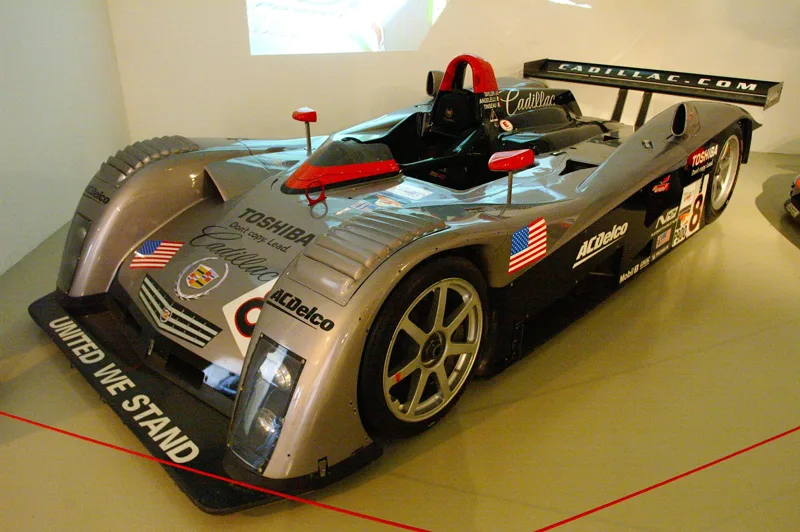
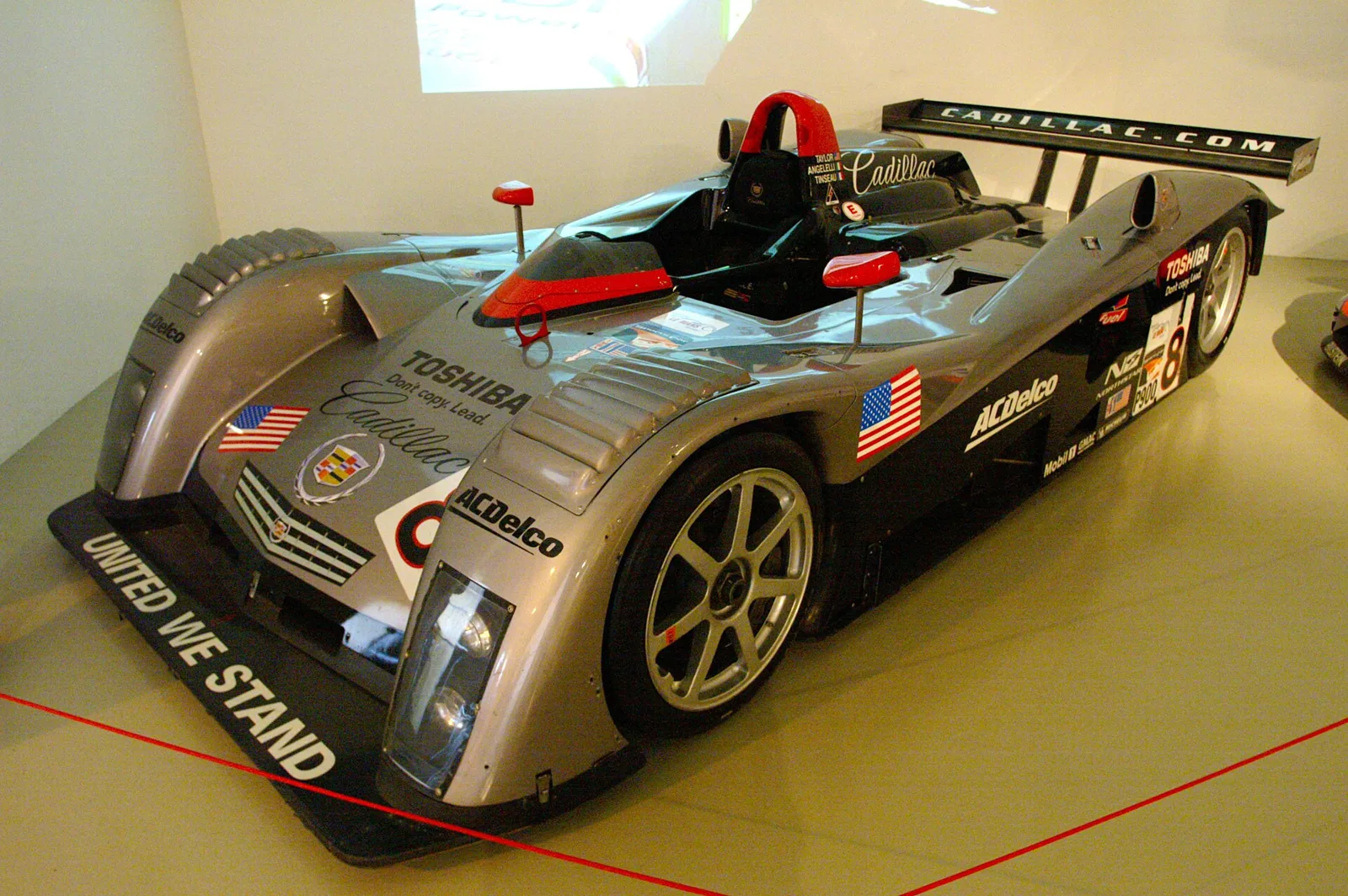
The change of direction came from Riley & Scott's work for General Motors. The company had built the Northstar LMP for Cadillac, which borrowed elements of the Mk III but used a carbon fibre monocoque, a roll hoop over only the driver's seat and lower-mounted radiators. When it came time to update the Mk III, the team started again and carried over some of those advances.
The Mk III C had a rounder nose, slimmer radiator openings and lower bodywork, and its standard roll hoop sat directly behind the driver's seat, carrying the engine intakes. An optional extension was offered for the Rolex Sports Car Series, which required it.
How did the Mk III race from 1995 to 1997?
The Mk III's first season brought Dyson Racing its first results. Its car qualified sixth at the 24 Hours of Daytona, but a Ford engine failure ended its race after eleven laps. In March at Sebring the team qualified fifth and finished 37th, its first finish in an endurance race.
The second Dyson car was ready for the Grand Prix of Atlanta in April, and James Weaver won in the first chassis, giving Riley & Scott its first victory as a constructor in only its third IMSA GT event. Dyson's second chassis then took three straight wins at Watkins Glen, Sears Point and Mosport, along with the Mk III's first pole position at Mosport.
Dyson closed the season with a one-two at New Orleans. Weaver finished second in the drivers' championship, two points behind Fermin Velez of Ferrari, and the Mk III had shown it could win against the Italian cars of the period.
General Motors pushed Oldsmobile Aurora V8s into the Riley & Scott-backed Doyle Racing team, and in 1996 Doyle won the Daytona 24 Hours and the Sebring 12 Hours. Wayne Taylor took the WSC Drivers Championship, and Oldsmobile won the Manufacturers Championship. Doyle's car also went to Le Mans, qualified ninth and retired after fourteen hours with a transmission problem.
In 1997 Dyson won Daytona for a second straight year, and Ferrari stopped a repeat at Sebring. Dyson then won five of the nine remaining races, Butch Leitzinger took the drivers' title and Ford secured the manufacturers' title, a clean sweep for the Mk III in that season.
How did the Mk III fare from 1998 to 2000?
In 1998 the car ran in both the IMSA GT Championship and the new United States Road Racing Championship. Dyson Racing won the USRRC teams and manufacturers' titles and James Weaver took the drivers' title, while Dyson also won three IMSA GT events and gave Leitzinger a second straight drivers' title.
Outside North America the car found wins too. Team Rafanelli's BMW-supported Mk III took an IMSA GT victory, and the French Solution F team of Philippe Gache won the final round at Kyalami, South Africa, finishing third in the teams' championship.
The Series 2 Mk III arrived in 1999 and returned to victory at Daytona for Dyson, its third win there in four years. The USRRC season was then cut short, and Dyson's drivers Leitzinger and Elliot Forbes-Robinson were crowned champions on the results they had banked. Dyson finished nine seconds behind the winning BMW at Sebring 1999 as the IMSA GT Championship gave way to the American Le Mans Series.
Away from North America, the Mk III's Le Mans efforts went poorly in 1999. Solution F's two Mk IIIs were retired after 74 laps, while a Japanese Autoexe entry, relabelled as an LMP99, ran out of fuel at the Fuji 1000 km.
In 2000 the company turned its attention to the Cadillac Northstar programme, so upgrades to the Mk III were scarce. The cars remained competitive, though. Robinson Racing won the second round of the Rolex Sports Car Series with a Judd V10 engine, and Dyson's four victories that season brought another teams' title and a drivers' title for Weaver.
What happened to the Mk III from 2001 to 2005?
The Mk III C debuted at Sebring in the American Le Mans Series in 2001 and finished fifth, then earned a podium at the Grand Prix of Mid-Ohio. Dyson won at Homestead-Miami Speedway, and Robinson Racing's new car suffered a heavy practice accident at Watkins Glen that required a long rebuild.
Riley & Scott's owners, Reynard Motorsport, went bankrupt in 2002, and Riley Technologies took over care of the Mk III C cars. Dyson returned to the original Mk III for its Rolex campaign, won four races in a row and took another teams' title, with Chris Dyson finishing two points short of the drivers' crown.
The Daytona finale in 2002 was the last win for the original design. Rolex rules then made the Mk III ineligible from 2003, so the cars were pushed into ALMS and endurance events. At Le Mans in 2002 a Riley & Scott entry failed after 13 hours, and the Matthews car suffered an engine failure after 15 hours the following year.
Development of the Mk III C ended in 2003, and a few teams kept racing it. American Spirit Racing ran a Lincoln-badged V8 through the season and reached fifth at Laguna Seca. Autocon Motorsports ran a car in the 12 Hours of Sebring and finished seventh, and the line closed at the 2005 Monterey Sports Car Championships at Laguna Seca.
Which championships did the Mk III win?
| Season | Series | Title or result |
|---|---|---|
| 1995 | IMSA GT | James Weaver second in drivers' championship; first Mk III win at Atlanta |
| 1996 | WSC | Wayne Taylor drivers' title; Oldsmobile manufacturers' title |
| 1997 | WSC | Dyson teams' title; Butch Leitzinger drivers' title; Ford manufacturers' title |
| 1998 | USRRC | Dyson teams' title; Ford manufacturers' title; James Weaver drivers' title |
| 1998 | IMSA GT | Butch Leitzinger second consecutive drivers' title; Ford constructors' title |
| 1999 | USRRC | Butch Leitzinger and Elliot Forbes-Robinson crowned champions |
| 2000 | Rolex | Dyson teams' title; James Weaver drivers' title |
| 2002 | Rolex | Dyson teams' title; last win for the original Mk III at Daytona |
What variants did customer teams build?
Private teams built several variants, the best known being Team Rafanelli's Italian car, R & M's SR01 and Robinson Racing's modified Mk III C. Each one answered a specific problem the owners had with the standard car.
Rafanelli first ran a BMW V8 in 1998, then bought a Judd GV4 V10 for chassis #014. The team reshaped the nose into a gentle curve, extended the intake and tail, and fitted a new rear wing to suit the ALMS. That car won the 1999 Grand Prix of Atlanta, the only ALMS victory for any Mk III, and the team finished sixth in the Teams Championship before moving on to a prototype of its own.
Target 24 was founded in 1996 by Paolo Radici and Fabio Montani, and it ran one of the original chassis that year. Montani bought a Series 2 car in 1999, and when the team reorganised as R & M in 2000 it began building a replacement. The SR01 project started in mid-2001 with a new carbon fibre monocoque that kept many parts from the Mk III, and the car raced through the 2002 FIA Sportscar Championship, earning several third-place finishes.
Robinson Racing was one of the first buyers of a Mk III C, chassis #001. Automotive designer John Mills rebuilt its front end, replacing the nose radiator with side channels and cooling radiators fed from the sides, and he moved the exhaust into vertical towers ahead of the rear wheel arches. The modified car debuted at the 2002 Daytona 24 Hours, retired with gearbox trouble and finished third twice later that year.
Why does the Mk III still matter?
The Mk III is remembered for its 47 overall race wins and for titles in four championships. Every one of those results came from a design that was first conceived as a low-cost alternative to the closed GTP cars of the era.
The car's legacy also lives on in the cars themselves. The Autocon Mk III C with chassis #01-002 was the last of the line still in use when it was retired at the end of 2005. Robinson's modified car is still driven today in historic events, now fitted with a 5.0 litre Judd GV5 that replaced the earlier GV4 engine.