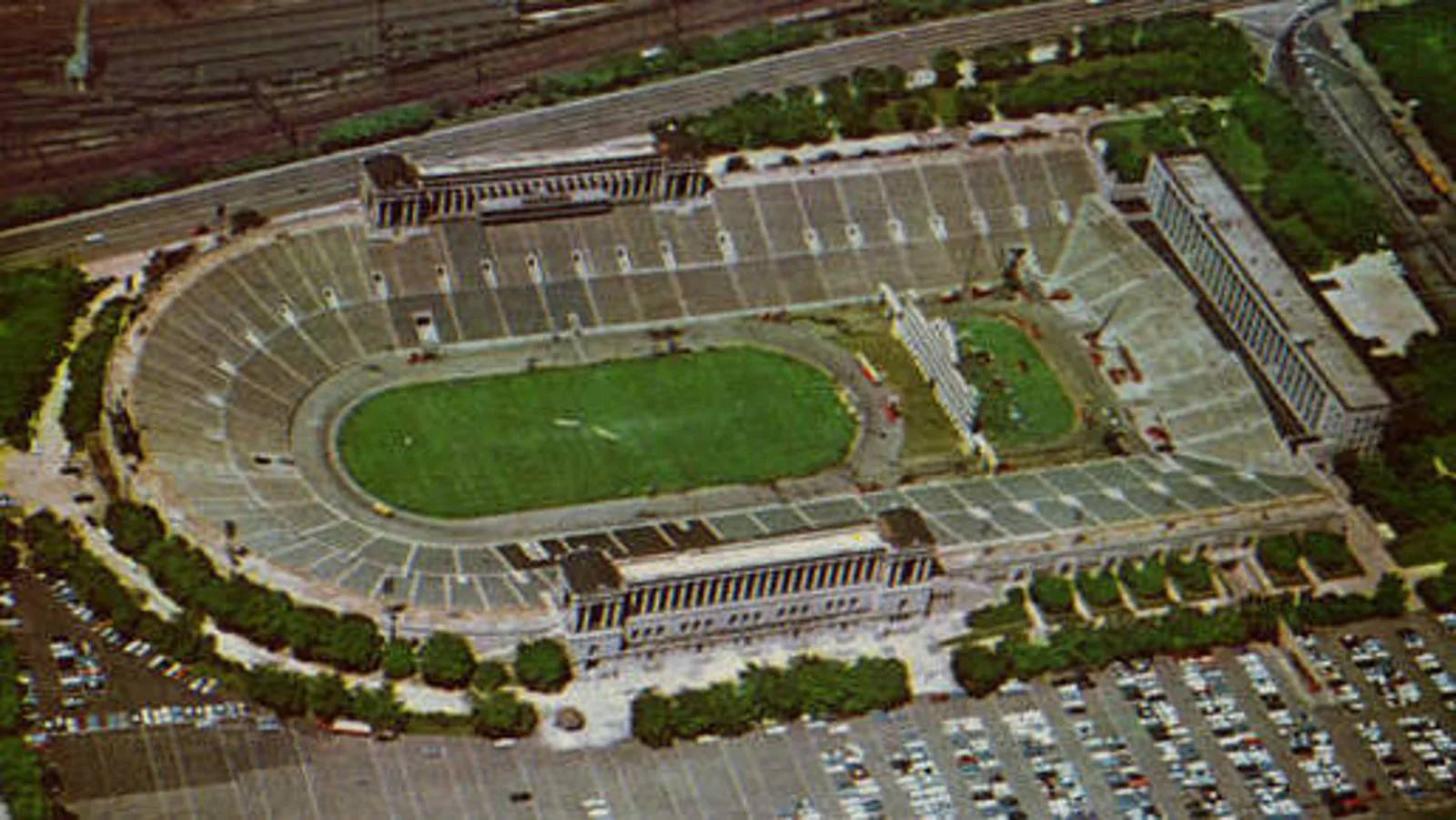
For more than two decades Soldier Field held a short oval inside its football bowl, drawing crowds of tens of thousands before racing ended in 1970.
Soldier Field held auto racing from 1935 to 1970, on a short track set inside the football bowl. Midget cars drew the biggest crowds, NASCAR raced there in 1956 and 1957, and the last auto race was held in July 1970.
From the 1940s until 1968, Soldier Field in Chicago was a working motor racing venue. It had a short oval inside the football bowl, and midget cars, stock cars and hot rods raced on it through the summers. The track closed for good in 1970, and the stadium's football seating was rebuilt over the space it had used.
How did motor racing start at Soldier Field?
Motorsport at the stadium began in an unexpected way. The opening event on September 5, 1924 mixed athletics with motoball, a game that combined motorcycles with polo, and it was held for a police association. Real car racing took another decade to arrive, and the first auto racing event took place in 1935.
The stadium's track began as a quarter-mile oval. The first auto race was won by Marshall Lewis, a midget racing star, on May 19, 1935, in front of 20,000 spectators. The race was held on a cinder track that had been laid inside the stadium in the 1930s. In June 1939 a temporary wooden track was built with banked turns for a single event, and by 1941 the track had become a clay surface.
The track was paved with asphalt in 1946. The work was carried out after the Chicago Auto Racing Association was founded under Art Folz, which began regular midget races on the track that year. Racing then paused after the summer of 1942, when wartime fuel restrictions and the switch of the auto industry to military vehicles brought a halt to events.
A football stadium that spent three decades as a short track, until the Bears and a permanent north stand ended it.
How did the track's shape change over the years?
The track began as a quarter-mile oval, and the stadium's cinder surface had been in place since the decade before. In 1956 it was extended to a half-mile layout that reached into the north end of the stadium. It was paved again in 1961 to restore that half-mile oval, and an eighth-mile go-kart track was built in the north end at the same time.
Barriers were placed inside the track to protect the football pitch, which was regularly used for college games. The arrangement was unusual, and it had few parallels in modern professional motorsport. Only the Bowman Gray Stadium in North Carolina was a comparable case, which says a good deal about how unusual the Soldier Field layout was.
What did a race night at the stadium look like?
Through the summer of 1947, races ran almost every weekend between June and late September, which made the stadium a summer fixture. Racing events in the 1950s often drew more than 20,000 spectators, and sometimes 30,000 or 40,000. The races proved popular outings for families, and drivers such as Tom Pistone became local names through those weekly crowds. Midget racing had already drawn 20,000 people to the first event, won by Marshall Lewis, so the stadium's audience was established early.
Andy Granatelli ran local race nights every week, planned to keep big crowds entertained. That annual event, which sold more than 30,000 tickets in 1954, was usually the best-attended race of its year.
Who promoted the races, and why did attendance fall?
Promoters such as Bill Schade and Carl Bledsoe organised races until 1964, when they stopped and no races were held in 1965. Bill Earnest began organising races again in 1966. Attendance had fallen by then, as Chicago's major league teams drew more attention away from the track.
The 1959 Pan American Games took over the stadium that year, and no races were held. Some racers later blamed that gap for a loss of interest in the track during the 1960s, and Andy Granatelli's departure as a promoter removed another source of energy from the venue.
Why did midget racing become a tradition at the stadium?
Midget racing was the stadium's backbone for decades. The World's Championship Midget Automobile Race of June 1939 was run by the AAA Contest Board, with a $10,000 purse for a five-race series, and more than 90,000 spectators attended. Its proceeds went to the Shriners' Hospital for Crippled Children in Chicago, and the event built the largest wooden oval of its day.
That oval was 0.25 mile (0.40 km) long, with 30 degree banked turns and a track width of 28 feet (8.5 m). Engineers estimated that drivers could reach 100 miles per hour (160 km/h) on it. The oval cost $25,000 to erect and was used for the 1939 championship, which Ronnie Householder won as the finale of the event.
Following the war, midget racing flourished on the track and drew regular crowds. In 1948 Prince Bertil, Duke of Halland, took a midget car out for a lap of fun during an official visit to Chicago. The 100 Lap National Championship was held on July 23, 1954, and a midget race on July 20, 1957 was one of the earliest races at the stadium to be televised.
The national midget tradition continued into the 1960s. Mike McGreevy won the last United States Auto Club midget feature on July 23, 1966. The final season of midget racing at the stadium was 1968, when races were run by the United Auto Racing Association.
How did NASCAR come to the stadium?
Stock car racing was introduced to the track in 1950, and NASCAR held races at the stadium in 1956 and 1957. To accommodate them, a new half-mile layout was added in 1956 by paving a longer track into the north end of the stadium. The first NASCAR Convertible Division race there was run on June 30, 1956, and Tom Pistone beat Curtis Turner by three car lengths after overtaking him in the 194th lap.
The Soldier Field 500 was held on September 9, 1956, with an unusually large purse and distance for a convertible race. On July 21, 1956 Fireball Roberts won the NASCAR Grand National race, which is today regarded as the only one run on the stadium's short track. Roberts beat Jim Paschal by a single car length in a 200-lap race, and attendance was 14,402.
NASCAR's last event at the stadium came on June 29, 1957, when Glen Wood won a 100-lap Convertible Division race over Possum Jones. The 1958 MARC Racing Series race, held on July 18 and won by Fred Lorenzen, was one of the stadium's last major stock car events before racing ended.
Who were the stadium's leading drivers?
Tom Pistone won more races at the track than anyone else, with 38 events. He won several championships in the 1950s, including the stock car title in 1953, 1954 and 1955. His victory in the first NASCAR convertible race was the biggest of his career up to that point. His 38 wins are the most recorded for any driver at the track, a mark that few could approach.
Jim Rathmann started his career at Soldier Field in 1948 and later won the Indianapolis 500 in 1960. Promoter Andy Granatelli was another central figure, organising weekly local races that were designed to entertain large crowds. The Chicago Park District Police Benevolent Association Gold Trophy Race was run each year from 1946 to 1958 and was often the best-attended race of the season.
Which stock car championships were decided at the track?
The track's annual stock car championship started in 1949, when Gil Michaels won. Jim Rathmann took the title in 1950 and 1951, Sal Tovella won in 1952, and Pistone took the crown in 1953, 1954 and 1955. Fred Lorenzen won the 1956 title, and Don Oldenberg won in 1957 and 1958.
Bryant Tucker won three straight championships from 1960 to 1962. In 1963 Sal Tovella returned to the top, and in 1967 the championship was organised by the United States Auto Club. The rookie and novice title, first held in 1956, was also decided each year.
What were the accidents and safety problems?
Accidents happened regularly, and some were serious. In 1951 two drivers were seriously injured in a three-car wreck during the Gold Trophy Race. In May 1954 two cars caught fire in a tag racing event, and the track crew put out the flames quickly.
A June 1956 race saw a car roll over twice before striking the south turn. In July 1950 a stock car broke through a steel gate behind which two people were standing, injuring both. The track's barriers were placed on the inside of the course to protect the football pitch, which was in regular use for college games.
Why did racing end at Soldier Field?
Racing largely ceased after the 1968 season. Chicagoans were turning to other sports, and the loss of Andy Granatelli as a promoter removed a major driving force. A number of short tracks had also opened around Chicago, competing for the same audience. The final auto race on the track was held on July 4, 1970, with drag races held during the American Legion's Independence Day celebrations.
The track was removed later in 1970. In 1971 the Chicago Bears moved into the stadium full time, and the stands were reconfigured with temporary northern stands to suit American football. A 1979 renovation built a permanent northern stand that cut off much of the original expanse, and that ruled out any return to racing.
What other motorsport took place at the stadium?
Motorcycles appeared in several forms. The International Motorcycle Association held a month of races at the stadium from July 4, 1934, and motorcycle stunts were part of the 1964 Tournament of Thrills. Joie Chitwood brought his Tournament of Thrills to the stadium in 1953 with races and stunts.
Hot rods had their own history there. In July 1947 a hot rod event drew 25,000 spectators, and in August 1947 another drew 24,000. Pat Flaherty won the hot rod division of the 1949 championship. The stadium also hosted tractor pulls and monster truck shows in the early 1980s, which damaged the turf and pushed organisers toward the Rosemont Horizon.
The parking lot later held drifting events. Formula DRIFT races took place there in 2005 and 2006, and a D1GP race in 2009. On June 8, 2019 the grounds surrounding the stadium hosted the Emirates F1 Chicago Festival, which included a Formula One car demonstration on a nearby street.
Key dates on the track
| Year | Event |
|---|---|
| 1935 | First auto race, won by Marshall Lewis on May 19 |
| 1947 | Races almost every weekend from June to late September |
| 1961 | Track repaved for the half-mile oval; eighth-mile go-kart track built |
| 1964 | Promoters Schade and Bledsoe stop; no races in 1965 |
| 1939 | World's Championship Midget Automobile Race, over 90,000 spectators |
| 1946 | Track paved with asphalt by the Chicago Auto Racing Association |
| 1956 | Half-mile layout added; first NASCAR race on June 30 |
| 1957 | Last NASCAR event, won by Glen Wood on June 29 |
| 1968 | Last stock car race, won by Sal Tovella on June 7 |
| 1970 | Final auto race on July 4; track removed later that year |