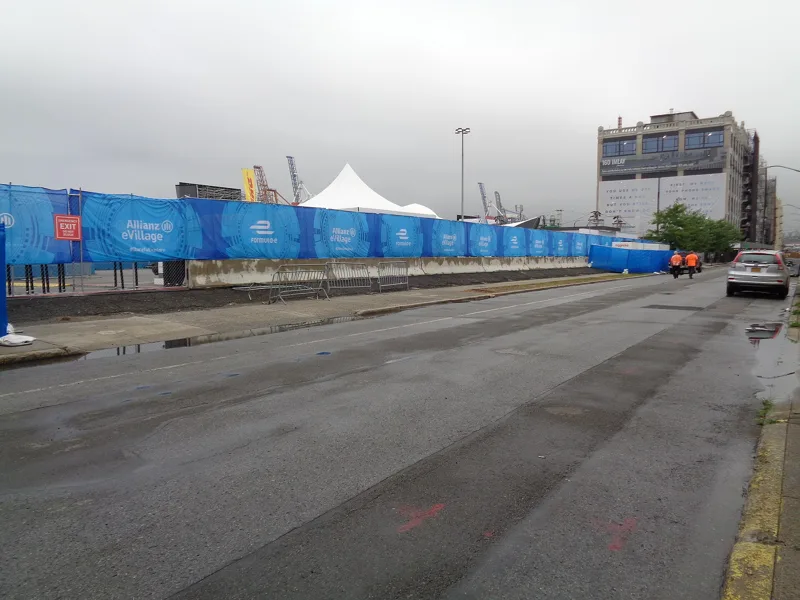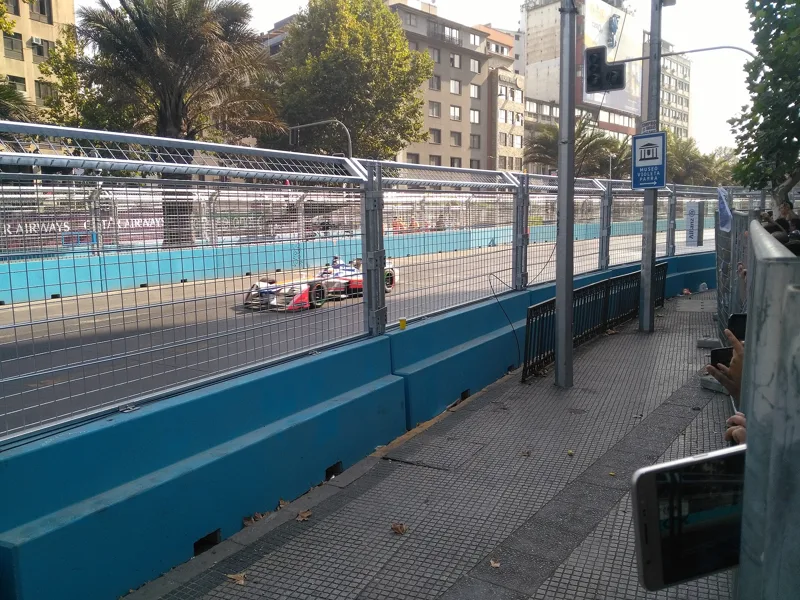
A Red Hook waterfront course built in under two weeks for the 2017 New York City ePrix, lengthened for 2018 and taken apart after its race weekend.
Built in 2017 for Formula E's New York City ePrix, the Brooklyn course covered 1.220 mi (1.963 km) with 13 corners in Red Hook. It was lengthened to 1.475 mi (2.374 km) for 2018, and Sam Bird won both races of the first event.
The Brooklyn Street Circuit was a temporary street course in Red Hook, on the western edge of Brooklyn, constructed for the city's Formula E race, the New York City ePrix. It was used for the 2017 race and reshaped for 2018, and it came after several failed attempts to land a major race in the city.
Motor racing in New York has a long past, from early city-to-county races to Vanderbilt Cup events on Long Island and a string of Formula One and NASCAR plans that never materialised. This article covers the course itself, how it was approved and built, the race weekends and the transport links that served it.
Where was the Brooklyn Street Circuit?
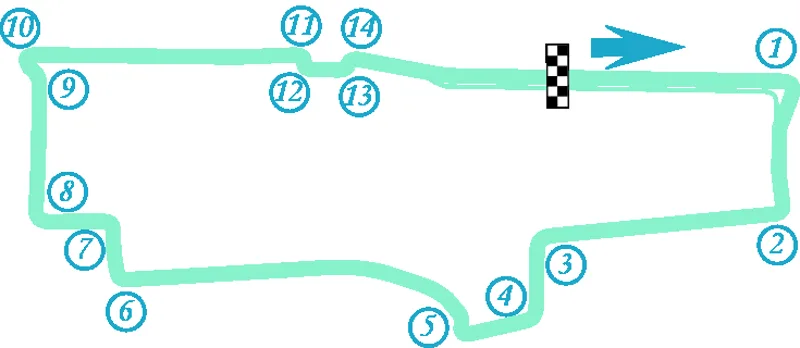
The circuit sat at the western end of Red Hook, next to the Brooklyn Cruise Terminal and by the Atlantic Basin, an inlet of Upper New York Bay. Its original 2017 layout was 1.220 mi (1.963 km) long, with 13 corners, and it followed the roads and car parks of the terminal, largely separated from the rest of Red Hook's street plan.
The Brooklyn-Battery Tunnel and the Red Hook Container Terminal lay to the north, with Bowne Street running along one edge. Wolcott Street closed off the south, while Imlay and Conover streets marked the eastern end, and Van Brunt Street, the main thoroughfare of Red Hook, ran one block east.
The main and second straights used the north-south stretch of Bowne Street beside Pier 11. The track then curved west, running alongside Clinton Wharf toward the Buttermilk Channel, giving views of Lower Manhattan's skyline and the Statue of Liberty.
Before the first race, driver Felix Rosenqvist described the layout as demanding and technical, and he likened it to the Circuit des Invalides in Paris.
A temporary Red Hook course that won its first race on the waterfront, grew for 2018 and left no permanent trace.
How did the circuit change for 2018?
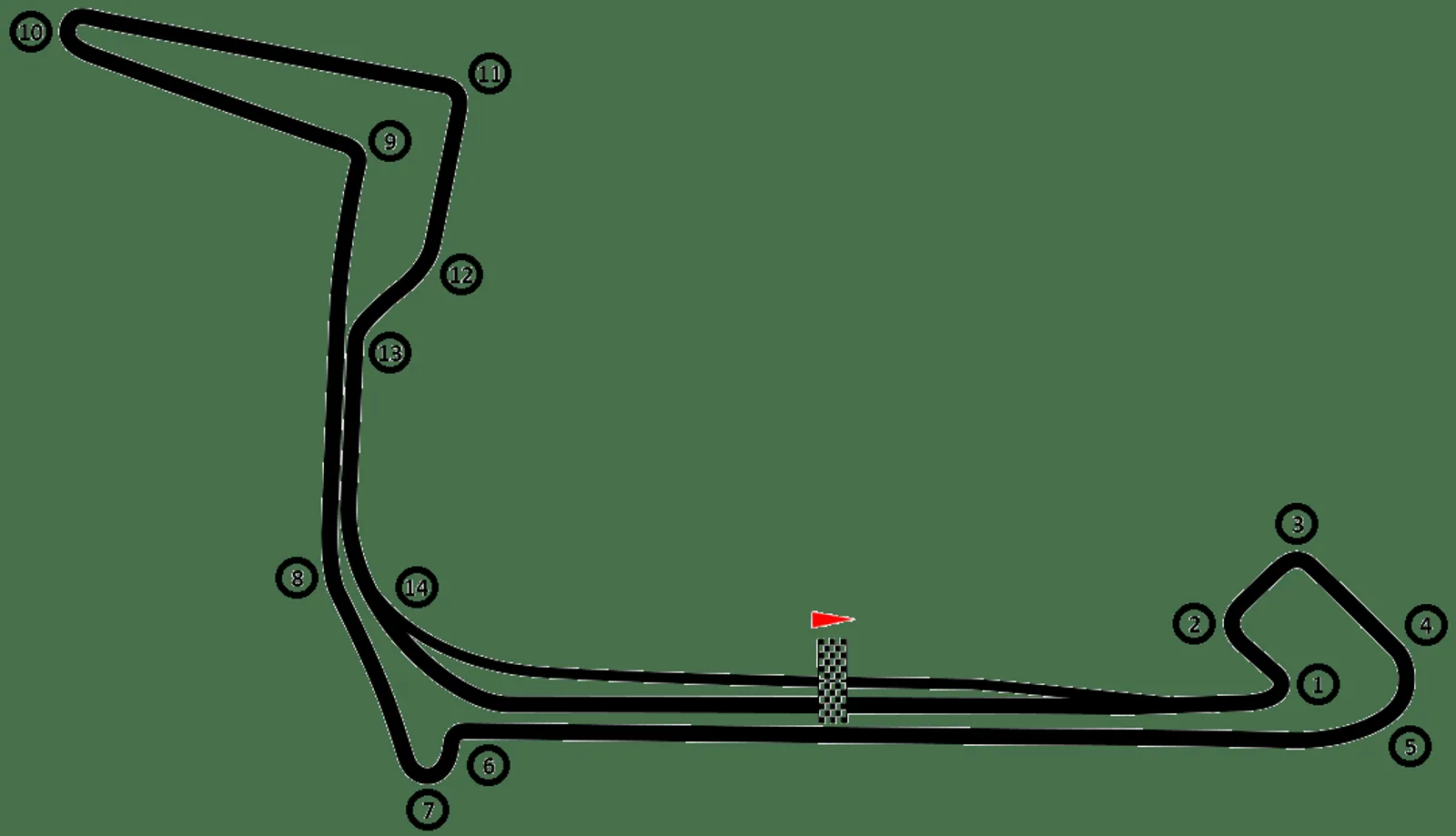
For 2018 the course grew to 1.475 mi (2.374 km) and stretched toward Summit Street and Hamilton Avenue, farther north and west. A four-turn complex replaced the original right-hand hairpin, adapting the track to Formula E's second-generation car, which carried more downforce and power.
The old hairpin at the far end of the main straight gave way to a sequence of four corners: one left-hander followed by three right-handers, which led onto the second straight. The change was made for the second-generation car, which arrived in the 2018-19 season and took over from the Spark-Renault SRT 01E.
The reshaped course ran farther north and west, reaching toward Summit Street and Hamilton Avenue. Organisers also moved the eVillage, reshaped the entrances and added two more gates, as described below.
Why did New York take so long to host a race?
New York had a racing past, including the Vanderbilt Cup, but a state crackdown in 1910 and repeated failed plans for Formula One, NASCAR and IndyCar meant the city went decades without a major street race. Formula E's electric cars were finally approved because they avoided noise and pollution.
Racing around the city goes back to 1896, when six cars ran between New York City and Westchester County. The Vanderbilt Cup started in 1904 under William Kissam Vanderbilt II, run over a 25-mile loop of dirt roads in Nassau County on Long Island.
The Long Island Motor Parkway, begun in 1908, was built to serve the race. A crash at the 1910 Vanderbilt Cup led the state legislature to outlaw racing outside self-contained circuits. The Vanderbilt Cup later ran at Roosevelt Raceway in Westbury in 1936 and 1937.
Other events came and went around the edges. The NASCAR Grand National Series raced at Linden Airport in 1954, and Wall Stadium in New Jersey hosted races in 1956 and 1958. A Formula Junior event revived the Vanderbilt Cup name in 1960, and Bridgehampton's sports car races carried it in 1965, 1967 and 1968.
Formula One ambitions returned more than once. Proposals in 1975 and again in 1983 put a Grand Prix circuit at Flushing Meadows-Corona Park in Queens or at the Meadowlands in New Jersey. Local opposition at Flushing Meadows ended that plan by 1985, while the Meadowlands staged a Champ Car event in 1984.
From 2003 a planned NASCAR track called Liberty Speedway was considered at several New Jersey and Staten Island sites. In December 2004 the International Speedway Corporation and The Related Companies bought a 675-acre Staten Island site for a planned 80,000-seat track, but protests over wetlands and traffic led NASCAR to cancel it in 2006.
Later schemes stalled as well. In July 2012 Paul Saryian, a candidate for the New York State Assembly, proposed reviving the Staten Island track and tying it to a bid for the 2024 Olympics. A Formula One Grand Prix of America planned for a New Jersey street circuit had fallen through by 2014.
Formula E's approach began in March 2014, when the series started working with New York City authorities. On 21 September 2016 FIA President Jean Todt, Formula E chief executive Alejandro Agag and city officials announced a July 2017 race at the Brooklyn Cruise Terminal. Officials approved it because the cars were electric and would not cause noise or air pollution.
Other sites had been considered. Governors Island was judged too expensive for a circuit, a Central Park course would have meant felling trees, and Liberty State Park in Jersey City lay outside the city limits.
How was the circuit built in such a short time?
Building work went in June 2017 to McLaren Engineering Group, a New York firm unrelated to the racing team, and to D'Onofrio General Contractors. Construction began on 2 July 2017, thirteen days before the first race, and most of the materials were sourced locally.
The job mixed temporary and permanent structures. Track barriers, curbs, grandstands, pedestrian bridges and cabling for broadcast and timing were brought in for the event and would move on afterwards, while existing signs and curbs had to be removed or redesigned.
Formula E supplied the fencing, and most other materials came from local suppliers. The cruise terminal's guardhouse stood in the middle of the planned course, so it was rebuilt to be portable, moved before the event and returned to its normal place afterwards. Much of the area was repaved.
A ribbon-cutting ceremony took place on 12 July 2017, when the race cars arrived. The first race followed on 15 July, and Bird won the second race on 16 July before the track was taken apart.
What was the race weekend like for fans?
Fans had two grandstands and pedestrian bridges across the course, plus an eVillage with technology displays and simulators. Entrances were spread around the site to ease access.
Grandstand 1 sat beside the main straight, opposite Pier 11 and just west of the start-finish line, from which the starting grid could be seen. The smaller Grandstand 2 stood just to the west, also beside Pier 11. Alejandro Agag said organisers had been cautious when designing the seating area.
The original 2017 layout had three entrances. One sat at Ferris and King streets near the paddock and podium, another by the NYC Ferry landing led to the grandstands, and a third on Pioneer Street near Van Brunt Street led to the eVillage by way of an overpass.
For 2018 the third gate moved a block north to Verona Street, and two new entrances were added: one at the corner of Imlay and Bowne, beside the new turns, and one at Brooklyn Cruise Terminal Pier 12. The eVillage was relocated behind Grandstand 1 and around the new turns, while the old site became race suites and an accreditation centre.
As at other Formula E events, the eVillage was a central attraction. It offered displays of technological innovations, electric and hybrid production cars, racing simulators and a driver autograph session before the race. Food and drink came from stands and local food trucks inside the event.
How did the inaugural races go?
Sam Bird of DS Virgin Racing won both races of the inaugural New York City ePrix on 15 and 16 July 2017. The track was dismantled once the weekend ended, and the 2018 event brought a longer, reconfigured layout.
The first race on 15 July went to Bird, and the second on 16 July went to him again. Teams and organisers then took the course apart.
The temporary nature of the event shaped how it was built. Its equipment was designed to be transported to the next venue, so the circuit was never a permanent fixture on the waterfront.
How do fans reach the circuit?
Public transport was the main way in. The B61 bus runs one block east of the circuit, the nearest subway stations are Carroll Street and Smith-Ninth Streets, and ferry users can land at Red Hook or at the Pier 6 stop in Brooklyn Bridge Park.
The B61 route links Downtown Brooklyn with Park Slope and Windsor Terrace. The two nearest subway stations are on the IND Culver Line, where the F and G trains run along Smith Street.
On race days shuttle buses were laid on from two points: Carroll Street, and the Atlantic Avenue-Barclays Center complex in Downtown Brooklyn. Those buses carried crowds the final stretch to the gates.
Ferry travellers had two options. The Red Hook landing sat beside entrance two of the track, and the Brooklyn Bridge Park Pier 6 stop was also near the site.
What are the key details of the Brooklyn Street Circuit?
| Detail | Figure |
|---|---|
| Location | Red Hook, Brooklyn, New York City |
| Original layout (2017) | 1.220 mi (1.963 km), 13 corners |
| Extended layout (2018) | 1.475 mi (2.374 km), with a four-turn complex at the end of the main straight |
| Construction start | 2 July 2017 |
| Ribbon-cutting | 12 July 2017 |
| Race dates | 15 and 16 July 2017 |
| Race winner | Sam Bird, DS Virgin Racing, both races |
| Builders | McLaren Engineering Group and D'Onofrio General Contractors |
| Nearest subway | Carroll Street and Smith-Ninth Streets, F and G trains |