Max Verstappen took pole and won both the sprint and the Grand Prix at the Red Bull Ring, while a flood of track limits penalties reshaped the finishing order.
Round nine of the 2023 Formula One World Championship was run on 2 July at the Red Bull Ring in Spielberg. Max Verstappen won the race for Red Bull Racing from pole, with Charles Leclerc second for Ferrari and Sergio Perez third, after taking the sprint pole and win earlier in the weekend.
Max Verstappen won both races at the 2023 Austrian Grand Prix, taking pole and the win in the sprint and the Grand Prix. The weekend was dominated by track limits, with more than a thousand reports and a large number of penalties that changed several finishing positions. Charles Leclerc was second in the race, and Sergio Perez completed the podium.
What was the 2023 Austrian Grand Prix?
The race was the ninth round of the 2023 Formula One World Championship and the 36th Austrian Grand Prix to count towards the title. It was the second of six sprint weekends that season, and it ran over the weekend of 30 June to 2 July around the Red Bull Ring, Spielberg.
Going into the weekend Verstappen led the drivers' table by 69 points from his teammate Perez, with Fernando Alonso third, a further 9 points behind. Red Bull led the constructors' table by 154 points from Mercedes, and it was 167 points clear of Aston Martin. The entry list was unchanged, with no stand-in drivers.
Pirelli supplied its C3, C4 and C5 compounds, designated hard, medium and soft, for teams to use over the weekend.
Pole, sprint and Grand Prix for Max Verstappen, and a race defined as much by track limits as by pace.
Why did McLaren bring upgrades to Spielberg?
McLaren's MCL60 had underwhelmed in earlier races, and Lando Norris had not finished higher than sixth all year, which he managed in Australia. The team prepared half an upgrade package for Norris's car, covering the sidepods, bodywork and floor.
Oscar Piastri was due to receive the same package at the British Grand Prix. The upgrade was a sign that McLaren was trying to close the gap to the leaders, although the car's competitive position in Austria would still depend on the qualifying session.
How did the sprint shootout rules change?
The tyre rules for the sprint shootout had been changed so that drivers who reached the third segment, SQ3, could use any set of soft tyres. Previously they were required to use new soft tyres. The change followed Norris's problem at the Azerbaijan Grand Prix, where he exhausted his allocation of soft tyres and could not run in SQ3.
How did practice and qualifying set the grid?
The only free practice session took place on 30 June at 13:30 local time, and Verstappen topped it ahead of the two Ferrari drivers, Carlos Sainz Jr. and Charles Leclerc. Qualifying followed at 17:00 local time, and it determined the starting order for the race.
The first session was red-flagged when Valtteri Bottas spun at turn one. Verstappen topped the session, with Kevin Magnussen second, but Verstappen's best time was deleted for a track limits violation. Pierre Gasly, Zhou Guanyu and Lewis Hamilton also committed violations, and Yuki Tsunoda, Nyck de Vries, Zhou, Logan Sargeant and Magnussen were eliminated.
In the second session, Verstappen's lap was deleted again at turn ten, which allowed Lando Norris to top the session for a moment. Perez was denied a place in the third session for the fourth consecutive time, after all of his second-session laps were deleted for track limits. Russell, Esteban Ocon, Oscar Piastri and Bottas were also eliminated.
Alexander Albon reached the third session for Williams and qualified tenth. Verstappen took pole, with Leclerc and Sainz making it two Ferraris in the top three. Lance Stroll outqualified his Aston Martin teammate Alonso to take sixth, while Alonso was seventh. Magnussen and de Vries both started from the pit lane after changes to their cars under parc ferme conditions.
How did the sprint shootout unfold?
The sprint shootout took place on 1 July at 12:00 local time. The track was damp after an early morning shower, so drivers could run any compound. Magnussen and Verstappen went out on mediums, while Albon and Logan Sargeant ran intermediates before switching to softs.
Sainz suffered a failure of his brake-by-wire system and had to go into the pit lane with smoke coming from his Ferrari. He could not set a lap until the car was repaired late in the session. Hamilton briefly topped the timesheets, but his time was deleted for track limits, and Verstappen, Zhou, Perez and Sargeant also lost their first times.
Oscar Piastri was blocked by Leclerc, who was penalised after the stewards investigated the incident. Leclerc was given a three-place grid penalty and dropped behind Piastri. Russell reported a hydraulics failure and was ruled out of the rest of qualifying, while Hulkenberg was third fastest behind Stroll and Alonso in the first part.
Verstappen took the sprint pole, with Perez second, which put the Red Bulls first and second on the grid. Sainz was fifth, Norris third, Hulkenberg fourth, Alonso seventh and Stroll eighth.
What happened in the sprint?
The sprint was held on 1 July at 16:30 local time, and it started in damp conditions with every car on intermediate-wet tyres. Perez had two near-misses with Verstappen, and he ran wide at turn three on the first lap, losing positions to Hulkenberg and Sainz.
Hulkenberg briefly ran second before Perez passed him, and Sainz and Stroll also went past. Verstappen led from then on, and he won from Perez. Several drivers, including Hamilton, Magnussen, Sargeant, de Vries and Zhou, boxed for dry tyres during the race.
Ocon and Russell fought over seventh in the final corner, with Ocon edging out Russell by 0.009 seconds. Bottas, who had qualified 19th, started the race from the pit lane after making a pit stop on the formation lap, so his grid place was left vacant.
How did the Grand Prix start and develop?
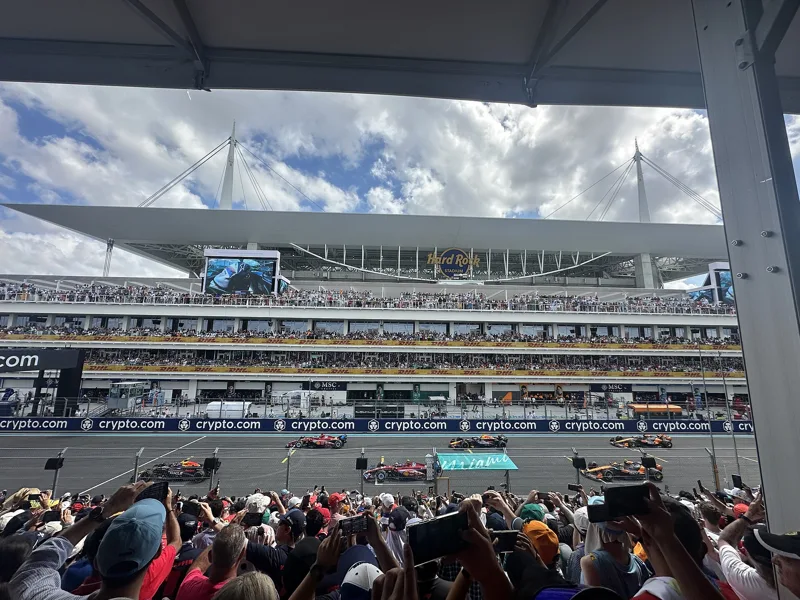
The race was held on 2 July at 15:00 local time in cloudy conditions. Verstappen made a good start ahead of the Ferraris, while Hamilton battled Norris for fourth. Tsunoda went into the gravel and collided with Ocon, damaging his front wing. The safety car was called out, and Tsunoda went into the pit lane to replace the wing. Magnussen reported ERS problems and joined him in the pits.
On the restart Verstappen built a gap to Leclerc, while Perez fought his way through the midfield, passing Ocon and then Russell. Norris reported several times that Hamilton was exceeding the track limits. Hamilton and later Tsunoda were shown black and white flags for unsportsmanlike conduct.
Nico Hulkenberg retired with a power unit problem, which brought out a virtual safety car. Sainz asked his team to let Leclerc through so he could challenge Verstappen, but the team instead pitted Sainz behind Leclerc, a slower stop that dropped him behind Hamilton and Norris.
Verstappen pitted, and Leclerc jumped him in the pit lane. Leclerc led for nine laps, the first time a Ferrari had led since the Azerbaijan Grand Prix, before Verstappen passed him with DRS. Perez climbed from 15th to third, and Verstappen won comfortably. Leclerc's second place gave Ferrari its 800th Formula One podium, and Verstappen also took the bonus point for the fastest lap.
Why were so many penalties handed out?
A large number of penalties were given during the race, and most were for track limits around the final two corners. Hamilton and Tsunoda were the first to receive five-second penalties. Tsunoda later received a ten-second penalty for further track limits violations, and he was also investigated over how he served his first penalty, a case that went his way.
Sainz, Albon, Gasly, Sargeant and Magnussen were also penalised for track limits. Only two drivers were punished for something other than track limits. Ocon received a penalty for an unsafe release during his pit stop, and de Vries received one for pushing Magnussen off the track.
Penalties kept coming after the race. Aston Martin protested the results, and the stewards handed out further penalties for track limits, leaving Ocon with a thirty-second penalty overall in addition to a five-second penalty for a different violation.
What happened after the race?
Aston Martin's protest succeeded. The stewards had been unable to review all 1,200 reports during the race, and once the review was complete they handed out twelve more penalties for track limits. Those penalties changed the final classification.
| Position | Driver | Team | Note |
|---|---|---|---|
| 1 | Max Verstappen | Red Bull Racing | Pole and win; fastest lap bonus point |
| 2 | Charles Leclerc | Ferrari | Ferrari's 800th Formula One podium |
| 3 | Sergio Perez | Red Bull Racing | Climbed from 15th on the grid |
| 4 | Carlos Sainz Jr. | Ferrari | Finished fourth, but received a ten-second penalty |
| 7 | Lewis Hamilton | Mercedes | Finished seventh, with a ten-second penalty |
| 12 | Esteban Ocon | Alpine | Finished 12th, with a total of 30 seconds added |