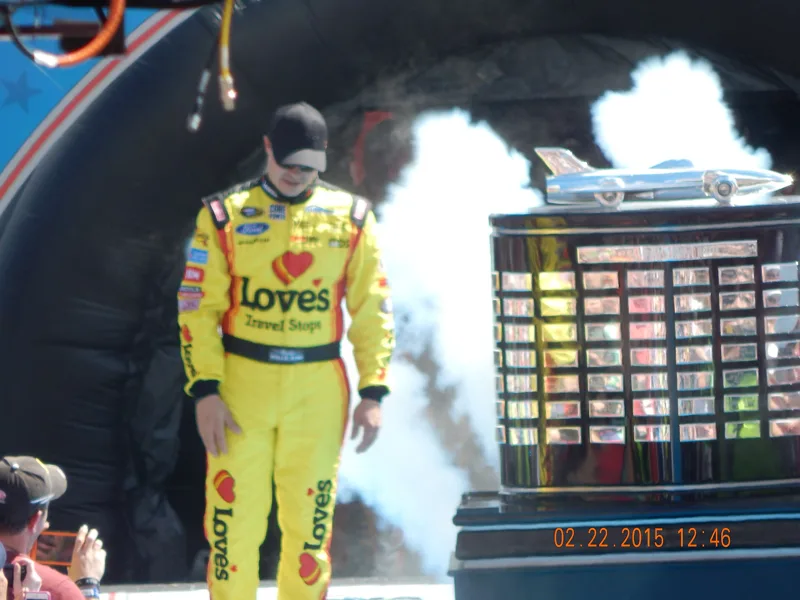
Matt Kenseth led 146 laps to win the NASCAR Sprint Cup race at Michigan, a race that also put NASCAR's high-drag package under heavy criticism.
Matt Kenseth won the 2015 Pure Michigan 400 at Michigan International Speedway, leading 146 laps from the pole. Kevin Harvick finished second and Martin Truex Jr. third, and the race was run under a high-drag package that drew strong criticism.
On 16 August 2015, NASCAR's Sprint Cup Series ran its race at Michigan International Speedway in Brooklyn, Michigan. Matt Kenseth won from the pole and led 146 laps before taking the chequered flag, with Kevin Harvick second and Martin Truex Jr. third. It was the 23rd race of the season, and it took place on a high-downforce package that drew heavy criticism from observers in the NASCAR media.
What was the Pure Michigan 400?
The race was contested over 200 laps on a 3.219 km (2.000 mile) D-shaped oval superspeedway. The venue lies in Cambridge Township, a short distance from the village of Brooklyn.
Kenseth's win was his 34th career victory and the third of his 2015 season. It was also his third win at Michigan International Speedway and his eighth Michigan victory for Joe Gibbs Racing.
The result also moved Toyota in the manufacturers' standings. Toyota left Michigan still 70 points behind Chevrolet, but it took second place from Ford, which had held that position before the race.
A high-drag package, a pole-sitter who never trailed for long and a lot of talk about restarts made Michigan a memorable race.
What was the championship picture before Michigan?
Kevin Harvick arrived at Michigan with a cushion of 42 points over Joey Logano in the Sprint Cup standings. Dale Earnhardt Jr. was 73 points back, Jimmie Johnson 76 back, and Brad Keselowski 104 points behind the leader.
Those gaps shaped how the weekend would be read, since a strong result at Michigan could narrow the distance to the leader.
Why was the high-drag package used at Michigan?
The high-drag setup was one NASCAR had already tried at the Indianapolis Motor Speedway a few weeks before. The package delivered high downforce, and the heat it created inside the cars soon became a concern.
The Indianapolis package was altered in one respect: each car now needed an extra duct on its right-hand window. Before the race, teams had been free to choose whether to fit one, but NASCAR made it compulsory because of the heat that built up in the cars.
Brad Keselowski warned during a teleconference that the team might see many car failures linked to heat, and that drivers would be hot and worn out after the race. He said the field was in for a handful of a race.
Who was on the entry list?
Officials published the field on Monday, 10 August, at 10:31 a.m. Eastern time, with forty-four cars on it. Forty-four cars were entered, and all of them had also raced the previous week at Watkins Glen apart from the No. 21 Wood Brothers Racing Ford.
Four drivers were changed for the race. Wise came back to the No. 32 Go FAS Racing Ford. Kvapil took the wheel of the No. 33 Hillman-Circle Sport Chevrolet, Brett Moffitt was back in the No. 34 Front Row Motorsports Ford, while Sorenson returned to the No. 62 Premium Motorsports Chevrolet.
How did practice and qualifying go?
Carl Edwards set the quickest time in the first practice, 36.726 seconds, which was 315.505 km/h (196.046 mph). Kevin Harvick led the second session with 36.964 seconds, and Martin Truex Jr. was quickest in the final session at 37.553 seconds, or 308.558 km/h (191.729 mph).
Kyle Busch had a major problem in the final practice. His car got loose exiting turn four, slid through the grass and destroyed its splitter, forcing his team to roll out a back-up car. He started from the rear of the field as a result. Austin Dillon also reported an engine that had no RPMs and was forced to change engines, which put him at the back too.
Matt Kenseth took the pole at 36.458 seconds, which equated to 317.826 km/h (197.488 mph). He said the team had a fast car and that the No. 1 starting spot was great. Joey Logano said qualifying had been difficult, and Jeff Gordon was keen to see how the package would work with 43 cars on the track.
How did the race start?
The start was planned for 2:46 p.m., yet the green flag came nine minutes late, with Kenseth leading the field to the green flag. Timmy Hill had blown his engine just as the field began to roll and went to the garage before the start.
David Ragan spun through the infield grass in turn one on the opening lap, which brought out the first caution. The race restarted on lap 6, and the second caution followed on lap 10 for debris in turn three. The debris was an oil pan from Hill's car, which had only just rejoined the race.
Racing resumed on lap 14, and lap 21 brought a scheduled competition yellow. Austin Dillon kept on track and inherited first place, while Kasey Kahne was penalised for speeding on pit road and rejoined at the back.
Dillon gave the lead back to Kenseth when he pitted on lap 41. Jimmie Johnson pitted unexpectedly on lap 49 with a flat tyre and rejoined 42nd, two laps down. Casey Mears's engine gave way on lap 54.
What happened in the first half?
Kenseth came in on lap 59 and passed the lead to Kyle Larson. Larson made his stop the following lap, and Jeff Gordon inherited the front. Gordon also stopped and gave the lead to Kyle Busch, who pitted the following lap and returned the lead to Kenseth. Michael Annett was given a drive-through penalty for having his crew over the wall too early.
The fourth caution came on lap 72 for debris in turn two. The race restarted on lap 77, and Kenseth gave the lead to Kevin Harvick when he stopped on lap 99.
In the second half, Harvick ran dry on lap 114 while heading for the pits, and Carl Edwards took the lead. Edwards stopped on lap 116 and handed the lead back to Kenseth. Debris in turn one brought out the fifth caution on lap 121, and Edwards stayed out and took over at the front.
Edwards botched the restart when the field went green again on lap 126. His teammate Kenseth shot past Austin Dillon to regain the lead. The sixth caution followed when Clint Bowyer was turned into the wall exiting turn two, and his car slid across the front of Ryan Newman's before hitting the inside wall again.
The race restarted on lap 131. Tony Stewart spun and went down onto pit road on lap 136, and Ryan Blaney made contact with the wall while trying to avoid him. That seventh caution dropped Edwards from second to 12th after an engine misfire.
How did the final laps play out?
The race restarted with 59 laps to go, and a number of cars began to pit for their final stops with 38 laps left. With 36 laps left Kenseth came in and gave the lead to Busch. Busch stopped with 28 laps left and gave the lead to Aric Almirola, who pitted with 25 laps to go, and Kenseth was back in front.
The eighth caution came with 17 laps to go, when Jimmie Johnson got loose in turn three and damaged his splitter. The race restarted with 13 laps remaining, and Kenseth pulled away to score his 34th career victory.
| Position | Driver | Note |
|---|---|---|
| 1 | Matt Kenseth | Won from the pole, led 146 laps |
| 2 | Kevin Harvick | Second place after running out of fuel on lap 114 |
| 3 | Martin Truex Jr. | Third place, close to Kenseth at times |
| 4 | Austin Dillon | Best career finish, after starting at the back |
| 5 | Denny Hamlin | Fifth place |
What did the drivers say after the race?
Kenseth said the team had had a great couple of months and had momentum going into the rest of the season. He said the crew had given him a rocket of a car, and that they planned to keep the run going.
Harvick said he was proud of his team, which had worked through handling issues early on and an out-of-fuel stop before getting back to the front. He called Kenseth the class of the field that day. Dillon said his best career finish had come from a strong pit crew and a plan that saved fuel, and that he had passed a lot of cars.
Truex said his team had passed many cars but could never get the track position it needed to fight for the win. He felt that his car had been close to the leader's, and he would have liked a chance to race Kenseth on equal terms.
How did the media judge the high-drag package?
Pete Pistone of MRN.com and Sirius XM NASCAR Radio praised NASCAR for trying new rules to improve the racing, but said the package used at Indianapolis and Michigan pointed the wrong way.
Jerry Jordan of Frontstretch.com said the package had fallen short of its goal at Michigan. He still applauded the attempt to make the racing better and safer.
Jim Utter of Motorsport.com was more critical, describing the package as a complete failure at both Indianapolis and Michigan, and adding that restarts were the only source of drama. Monte Dutton of Bleacher Report said NASCAR's rules experts had botched the package.
What were the race statistics and awards?
The race produced 16 lead changes among eight different drivers, and there were eight cautions for 31 laps. The race ran for 2 hours, 47 minutes and 18 seconds, averaging 230.868 km/h (143.455 mph).
Kenseth won the Coors Light Pole Award, led the most laps with 146, and took the Duralast Brakes Bake in the Race award and the American Ethanol Green Flag Restart Award. He also earned the Mobil 1 Driver of the Race award with a driver rating of 148.8.
Other awards went to Dillon, who took the Sherwin-Williams Fastest Lap with a time of 37.985 seconds on lap 26, and to Ryan Newman, who gained five positions for the Ingersoll Rand Power Move. Harvick and his crew chief, Rodney Childers, took the Moog Steering and Suspension problem-solver award, with the figure 0.300 seconds attached to it.
The NASCAR Sprint Cup Leader Bonus was not won at Michigan, so it rolled over to $200,000 for the next event.
How was the race broadcast?
NBC Sports carried the race on NBCSN in the United States, with Rick Allen, Jeff Burton and Steve Letarte in the booth. Pit-road reporting for television was handled by Burns, Massaro, Snider and Stavast.
The Motor Racing Network provided the radio commentary, also heard on Sirius XM NASCAR Radio. Moore, Striegle and Wallace worked the booth, while Dave Moody, Kurt Becker and others called the action from positions around the track.