A second straight win for Carl Edwards, a crash that exposed a gap in the wall, and a 100-point penalty that reshaped the championship within days.
Roush Fenway Racing driver Carl Edwards took the 2008 UAW-Dodge 400 from second on the grid. It was the third race of the 2008 Sprint Cup season, and a 100-point penalty issued after the race later moved Edwards from first to seventh in the points.
Carl Edwards won the 2008 UAW-Dodge 400 at Las Vegas Motor Speedway on 2 March 2008, taking his second straight victory of the season after a late red flag. Starting second on the grid, he covered 267 laps, or 640 km (400 mi), ahead of Dale Earnhardt Jr. and Greg Biffle.
Where did the race sit in the 2008 season?
The UAW-Dodge 400 was the third of 36 scheduled Sprint Cup races in 2008, so the championship was still wide open. Kyle Busch sat on top of the Drivers' Championship with 335 points, while Ryan Newman was six points back and Tony Stewart 19 points off the lead in third.
Kurt Busch and Carl Edwards followed in fourth and fifth. Kahne and Harvick came next, then Johnson, Biffle, Burton, Vickers and Truex to complete the top twelve. Dodge and Ford were level at the top of the Manufacturers' table with 12 points each, while Chevrolet and Toyota shared third on 10 points apiece.
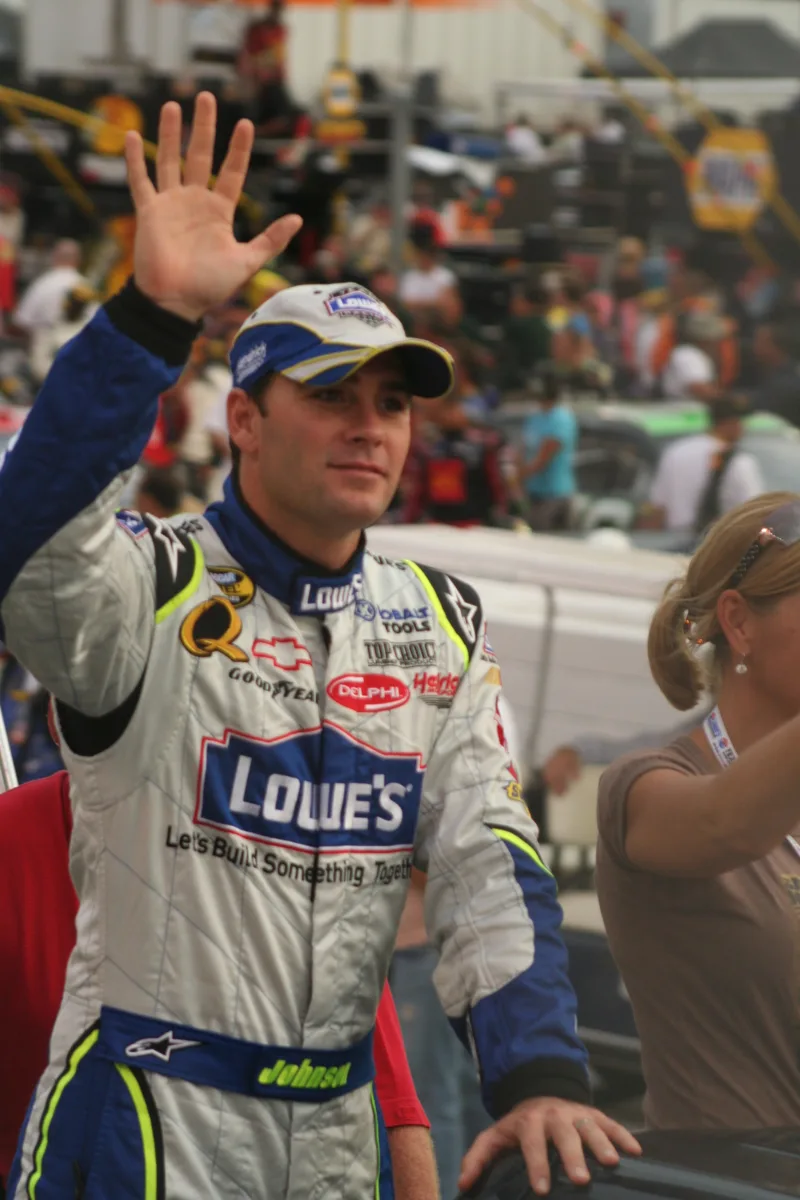
Jimmie Johnson was the defending race winner, and a fourth straight victory would have made him the first driver to win four consecutive Cup races since Jeff Gordon's four Southern 500 wins between 1995 and 1998. Johnson said he would approach the event no differently from a track where he had never won. Biffle was sure he could finish in the top five, and Kenseth, a two-time winner at the track in the early 2000s, hoped the Roush Fenway cars could fight for the win.
Edwards kept the win but lost 100 points, which left him seventh in the Drivers' Championship after he had been first.
What did practice and qualifying show?
Kyle Busch claimed the pole with a lap of 29.613 seconds, the third of his career, and Carl Edwards was 0.125 seconds slower to share the front row. Forty-seven drivers attempted to qualify, and NASCAR's procedure allowed 43 of them to race.
Early runners had an advantage, because the track was cooler, the air was denser and the surface offered more grip. Mark Martin qualified third, Jeff Gordon fourth and Mike Skinner fifth, while Allmendinger, Nemechek, Andretti and Sauter missed the field. Sauter had crashed at turn two on his first lap of qualifying.
Practice brought its own trouble. Kyle Busch was fastest in the first session at 30.009 seconds, and Matt Kenseth led the Saturday session at 30.321 seconds. Busch scraped the outside wall during that second session but kept his car, while in the final session Clint Bowyer hit the outside wall and had to switch to a back-up car after Kyle Petty made contact with him. Kahne led that last session at 30.580 seconds, and both Bowyer and Kahne were later sent to the back of the field for unapproved changes.
The January test had hinted at the pace. In the January test Kyle Busch's afternoon best was 295.073 km/h (183.350 mph), while Edwards posted 296.531 km/h (184.256 mph) in the third session. Busch later said his car had felt tight going into the first two turns, despite the speed he had shown.
How did the opening laps unfold?
Kyle Busch led the first twenty laps before Edwards got past him. Edwards began to press soon after the lap 13 restart, and Biffle went around Busch for second place, which left the two Roush Fenway cars clear at the front.
Edwards and Biffle had stretched their advantage to 3.0 seconds over Kyle Busch by the 42nd lap. Pit stops under green started on lap 48, and Edwards and Biffle came down pit road on lap 49, which handed the lead to Scott Riggs for a short spell. Edwards regained the front after the stops and kept it through the early running.
Gordon lost third on lap 22 when Biffle went past, and Kurt Busch climbed to fifth on the same lap. The early running was a fight for track position, and the leaders traded places regularly.
How many lead changes and cautions were there?
The race recorded 19 lead changes among nine different drivers and 11 cautions. Edwards led on four separate occasions, adding up to 86 laps at the front, more than anyone else in the field.
Kyle Busch regained the front on the 81st lap, and it stayed with him until Kenseth went by. Gordon took over on the 163rd lap, and Earnhardt went to the front on the 181st lap, holding it until Edwards took it back 14 laps later. The middle of the race was therefore a series of short leads rather than one long run at the front.
Which incidents brought out the yellow flags in the middle stint?
Robby Gordon's right-front tyre blew on lap 144, bringing another caution, and the leaders pitted under it. Later Carpentier was squeezed by Newman and slid into the inside wall, which produced the fifth caution.
Mayfield's right-front tyre burst on lap 171 without bringing a yellow flag, while Franchitti's contact with Riggs produced the sixth caution on lap 179. Kenseth, Edwards and the other leaders all made stops under those cautions, and each stop rearranged the order behind them.
Edwards himself had a pit-road problem during one of those stops. NASCAR ordered him to the back of the longest line because a crew member had let a tyre roll away from the pit box, and a later tyre from his car went outside the box without a penalty because a cameraman blocked his crew from retrieving it.
How badly was Tony Stewart hurt?
Stewart's right-front tyre burst, sending his car into the turn-two wall. Emergency workers helped him to a waiting vehicle, and he was taken to the infield medical centre for further examination.
Afterwards Stewart said his legs and hips had been tingling and that his lower back ached, and that the crash had scared him. The tingling eased after he left the infield care centre, and he still hoped to take part in a planned two-day test at Phoenix International Raceway.
What caused the red flag?
Jeff Gordon crashed on lap 262 after contact with Matt Kenseth, sending his car into the inside backstretch wall. Officials stopped the race for 17 minutes to clear debris, and the restart came with Edwards leading Earnhardt and Biffle.
The wall Gordon hit had no SAFER barrier, and his radiator came loose and landed in the path of oncoming cars. Kenseth slid but kept his car under control. Earlier, on lap 257, Kurt Busch's right-front tyre had exploded between turns three and four, ending his race, and he went for a mandatory check-up at the infield medical centre.
Who finished at the front?
Carl Edwards finished first, Dale Earnhardt Jr. second, Greg Biffle third, Kevin Harvick fourth and Jeff Burton fifth. David Ragan, Kasey Kahne, Travis Kvapil, Denny Hamlin and Mark Martin completed the top ten.
| Finish | Driver | Notes |
|---|---|---|
| 1st | Carl Edwards | Roush Fenway Racing; second win of the season and ninth of his career |
| 2nd | Dale Earnhardt Jr. | Hendrick Motorsports; led from the 181st lap until Edwards regained the lead |
| 3rd | Greg Biffle | Roush Fenway Racing; teammate of the winner, slowed by a slide on pit road |
| 4th | Kevin Harvick | Fourth place, one spot ahead of Burton |
| 5th | Jeff Burton | Fifth place, completing the top five |
Earnhardt said he had struggled on cold tyres after the restart and that the red flag had cost him a chance to win. Biffle said his car had been the quickest, but a slide on pit road cost him the track position he needed against Edwards.
What penalty did Carl Edwards receive?
Three days after the race NASCAR penalised Roush Fenway Racing, having found a fault with the lid of the oil reservoir encasement on Edwards's car. Edwards kept the win but lost 100 points, which left him seventh in the Drivers' Championship after he had been first.
The penalties also covered a device that allowed air to pass through the car. Crew chief Bob Osborne was fined $100,000 and suspended for six races, with the suspension running until 30 April 2008 and probation until 31 December 2008. Chris Andrews, the team's chief engineer, took over his role at the next event. Edwards and team owner Jack Roush also lost 100 driver and owner points, and Edwards forfeited the 10 bonus points he would have earned for winning, which counted toward the Chase seeding.
Geoff Smith, the president of Roush Fenway Racing, blamed a bolt that held the lid together, which had given way to vibration harmonics produced by the car and the track. Edwards called the infraction an absolute mistake and denied any intention to cheat. An internal investigation found no evidence that anyone had loosened the bolt deliberately. Toyota's Lee White said the car had gained 110 kg (240 lb) of downforce, and he later apologised for those remarks.
Why did the barrier gap become a talking point?
The inside backstretch wall had no SAFER barrier when Gordon was sent into it, and drivers said that was a gap NASCAR needed to close. After consulting with officials, crews installed a 520 m (1,700 ft) barrier along that wall in August 2008.
Gordon described the crash as probably the hardest hit he had ever taken, and he hoped Bruton Smith, chairman of Speedway Motorsports and owner of the Las Vegas track, would fit SAFER barriers along the inside walls. Biffle argued that circuit barriers should have no gaps and that every NASCAR track should have them.
Gordon admitted he had caused the incident. Kenseth said he had dropped back and then been squeezed as Gordon came across, and that the contact wiped out both cars whether or not it was intended.
How did the championship standings change?
Kyle Busch remained the Drivers' Championship leader, 20 points ahead of Ryan Newman, while Kasey Kahne climbed to third, 16 points ahead of Kevin Harvick. Ford moved to the top of the manufacturers' standings, five points in front of Dodge.
Edwards's penalty dropped him from first to seventh, and Biffle sat fifth on 427 points. Chevrolet moved three points clear of Toyota in the manufacturers' table, and the race drew 12.1 million television viewers. Pat Tryson, Kurt Busch's crew chief, said the team was glad the driver had emerged uninjured and that it would do better the next weekend.
How did the drivers react after the flag?
Edwards called the victory a very special win and said he felt close to the form he had shown in 2005. He added that winning the title was the team's number-one goal for the year, and he had no intention of letting the penalty distract from it.
Earnhardt said Edwards was too strong to beat that afternoon, and that he himself had been terrible on cold tyres. He said the red flag had cost him a shot at the race.
Gordon's crash also put the Roush Fenway and Hendrick drivers in the spotlight. Edwards and Biffle finished first and third for Roush, while Earnhardt Jr. was second for Hendrick.
For Edwards the weekend produced a result with two sides: a win earned on track, and a penalty that reshaped his title chances. For NASCAR, the race became a reminder that a wall gap could cost a driver a race, and the barrier installed in August was the answer that followed.