Dan Wheldon won the 89th Indianapolis 500 while rookie Danica Patrick, fourth on the grid and in the finish, dominated the headlines.
The 2005 Indianapolis 500 was the 89th running of the race, held on Sunday, 29 May 2005 at the Indianapolis Motor Speedway. Dan Wheldon won it, while rookie Danica Patrick finished fourth, the best result by a female driver in the event's history, which made her the race's standout story.
The 89th Indianapolis 500 was held on Sunday, 29 May 2005, and it was the premier event of the 2005 IndyCar Series season. Dan Wheldon won it, becoming the first British-born winner since Graham Hill in 1966. Rookie Danica Patrick finished fourth, which made her the best-placed female driver the race had seen.
Why was the 2005 race such a big event?
The race was the 10th Indy 500 sanctioned by the Indy Racing League, and it headlined the 2005 IndyCar season. Honda's engine made it a second straight Indy 500 win for the manufacturer. For car owner Michael Andretti, the result ended a long wait for an Indianapolis win.
Several rule changes shaped the month. Rookie orientation moved to opening day, Carb Day moved from Thursday to Friday, and single-point refuelling rigs became mandatory. The start was also moved to 12:00 p.m. EST, one hour later than before.
A British-born winner, a rookie in fourth and a race that turned on one woman's dash for the lead made 2005 unforgettable.
How did the track and the field change for 2005?
Over the winter the speedway was milled and resurfaced. Diamond grinding was used to smooth bumps in the corners, but a private test was called off because the uneven surface gave the turns two different grip levels. A week later the whole circuit was diamond ground to fix the problem.
The team line-up changed too. Rahal Letterman Racing kept Buddy Rice, the defending winner, and added rookie Danica Patrick. Newman/Haas Racing returned with Sebastien Bourdais and Bruno Junqueira, and Al Unser Jr. took a break from driving and did not enter. For the first time, no driver from the 1980s qualified for the field.
What happened when Buddy Rice was injured?
Rice suffered a concussion in a practice crash on 11 May, which kept him out of the race. Rahal Letterman then named Kenny Brack as his replacement. Brack had won the race in 1999 but had sat out the 2004 season while recovering from a serious crash in Texas in October 2003.
Brack qualified as the fastest car in the field, but he dropped out near the halfway point due to mechanical problems.
How did practice set up the front row?
Opening day focused on rookie orientation, and Patrick was the first car on track. Seven of the nine rookies passed their rookie test that day, and Patrick set the pace at 221.463 mph (356.410 km/h). Patrick's speed on the Monday, 222.741 mph (358.467 km/h), was the fastest lap of the month to that point.
On the Tuesday, Wheldon topped the timing sheet at 365.012 km/h (226.808 mph), and the veterans completed a day with no incidents. The next day Kanaan went quickest at 227.453 mph (366.050 km/h), and Patrick then took the top spot at 227.633 mph (366.340 km/h), the first time a female driver had topped the chart on a full day of practice since 1977.
Fast Friday was marked by a crash by Paul Dana, who wrecked his backup car for the second day in a row. Sam Hornish Jr. then flipped after hitting debris from that wreck, though he was uninjured. Tomas Scheckter set the fastest lap of the day, 227.804 mph (366.615 km/h), before rain closed the track.
How was pole day decided?
Rain washed out Saturday, so pole qualifying was pushed to Sunday, with bumping to follow the top 11 cars. Scott Sharp was first to make an attempt, at 227.126 mph (365.524 km/h), and Kanaan put himself on the provisional pole at 227.566 mph (366.232 km/h).
Patrick qualified fourth after a run that many felt could have won the pole, had it not been for a mistake on her first lap. Her first lap was a disappointing 224.920 mph (361.974 km/h), but her second lap rose to 227.638 mph (366.348 km/h). Her last lap, at 366.705 km/h (227.860 mph), was the quickest of the day, and her four-lap average of 365.328 km/h (227.004 mph) earned fourth on the grid.
Hornish bumped his way onto the front row later in the day, and Castroneves lost a place when he re-qualified. Jaques Lazier was bumped as the day ended.
How did the second weekend of qualifying play out?
The third day of time trials saw the field fill to 32 cars. Brack's 366.283 km/h (227.598 mph) was the quickest time in the field, but as a third-day qualifier he had to line up 23rd. A. J. Foyt IV put another car in the field after an engine blew earlier in the week.
On bump day, few teams were ready to attempt to qualify, and most used the morning and afternoon for practice. Arie Luyendyk Jr. made a run at 346.072 km/h (215.039 mph) that completed the field at 33 cars, but he was now the slowest car and on the bubble. Shortly afterwards A. J. Foyt Racing signed Felipe Giaffone, who had been shopping with his wife when the call came, and he bumped Luyendyk Jr. late in the day.
What happened in the race?
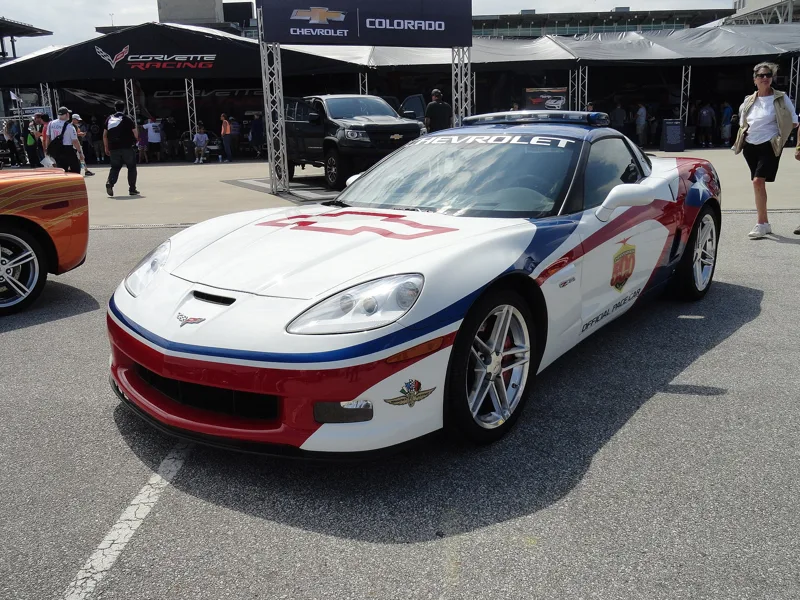
The race started at 11:58 a.m. EST behind a Chevrolet Corvette C6 pace car driven by Colin Powell. Kanaan took the lead into turn 1, but Hornish passed him in turn 3 and led the first lap. Kanaan retook the lead on lap 3, and the two traded the lead several times before a crash brought the first caution.
Larry Foyt crashed on lap 18 and was hospitalised, and most of the leaders pitted under the yellow. Kanaan won the restart off pit road. Hornish then took the lead on lap 38 and the race settled into a rhythm. A string of green-flag stops on lap 55 reshuffled the order, and Patrick found herself at the front on lap 56, the first time a woman had led a lap in the race's history.
On lap 78 Bruno Junqueira touched A. J. Foyt IV's car and crashed hard into the outside wall, which ended his season. Brack retired on lap 82 with a broken wishbone, and the race entered a long middle section that left Hornish and Kanaan battling for the lead.
Hornish smacked the outside wall on lap 147 while trying to pass Bourdais. Patrick then half-spun on lap 155 and was tagged by Tomas Enge, which caused a melee that dropped her to 11th, the last car on the lead lap. She returned to the lead on lap 172, after the other leaders pitted and she stayed out.
Wheldon caught Patrick on lap 186 and took the lead. Patrick held on for three laps before Wheldon passed her again. With less than three laps to go, Vitor Meira and Bryan Herta got past Patrick, and Wheldon pulled away. Bourdais then crashed in turn 3, which brought out the final yellow, and Wheldon won under caution one lap later.
What did the second week of practice bring?
Rain washed out Thursday's practice entirely. Rahal Letterman Racing had named Kenny Brack as Rice's replacement during the week, and nearly 2,500 laps were run in the Wednesday afternoon session. The field was becoming more settled as qualifying approached, and teams were preparing their cars for it.
Wheldon was fastest on the Wednesday at 365.836 km/h (227.320 mph), though Kanaan later bumped him off the top of the chart at 364.500 km/h (226.490 mph) in the final hour. Friday's session produced 2,228 laps without incident.
How did the Pit Stop Challenge go?
The 29th annual Checkers and Rally's Pit Stop Challenge was held on Friday, 27 May. A bracket of teams competed, and the final pitted Penske against Andretti Green. Hornish's crew defeated Bryan Herta in the final, which was the only Pit Stop Challenge win for Hornish and Penske's eighth overall.
What were the final results?
| Place | Driver | Detail |
|---|---|---|
| 1 | Dan Wheldon | Won under caution, first British-born winner since 1966 |
| 2 | Vitor Meira | Second place after passing Patrick late |
| 3 | Bryan Herta | Fuel strategy paid off for a third-place finish |
| 4 | Danica Patrick | Best finish by a female driver, beating Janet Guthrie's 1978 result |
| 5 | Buddy Lazier | Finished fifth despite a damaged front wing |
Patrick's fourth place broke the record set by Janet Guthrie for the best finish by a female driver, and she also set a record for the highest starting position by a woman. She became a household name almost overnight.
The rest of the top five was shaped by fuel and damage. Herta's fuel strategy worked out, and he came home third. Lazier finished a strong fifth despite nursing a broken front wing after contact with Scott Sharp earlier in the race.
Why did Danica Mania dominate the coverage?
Pre-race hype lifted the television audience and returned the IndyCar Series to the headlines after several lean years. Wheldon went on to win six races that year and took the series title. The term Danica Mania came from the attention she attracted during the month of May.
Patrick, though, became the centre of the story. A morning-after interview on Good Morning America followed, and she appeared on the cover of Sports Illustrated. Two weeks later other drivers embraced the attention, with Wheldon wearing a shirt stating that he had actually won the 500, while Rice wore a shirt calling himself Danica's teammate. Meira, who finished second, joked with a shirt of his own reading Danica's other teammate.
How was the 2005 race covered on television and radio?
ABC replaced Paul Page with Todd Harris as the 2005 lead broadcaster, with Brent Musburger hosting and Scott Goodyear as analyst. The coverage was criticised for focusing heavily on Patrick, and a comment that Harris made about her taking the lead drew complaints. Harris was removed from the booth at the end of the season and replaced by Marty Reid.
The IMS Radio Network carried the race, with Mike King as chief announcer and Pancho Carter as driver expert. Kevin Olson interviewed David Letterman before the race, a segment that became a fixture in later years.