Diesel exhaust fluid is two-thirds water and one-third urea, and a modern diesel quietly sprays it into the exhaust to turn nitrogen oxides into nitrogen and water.
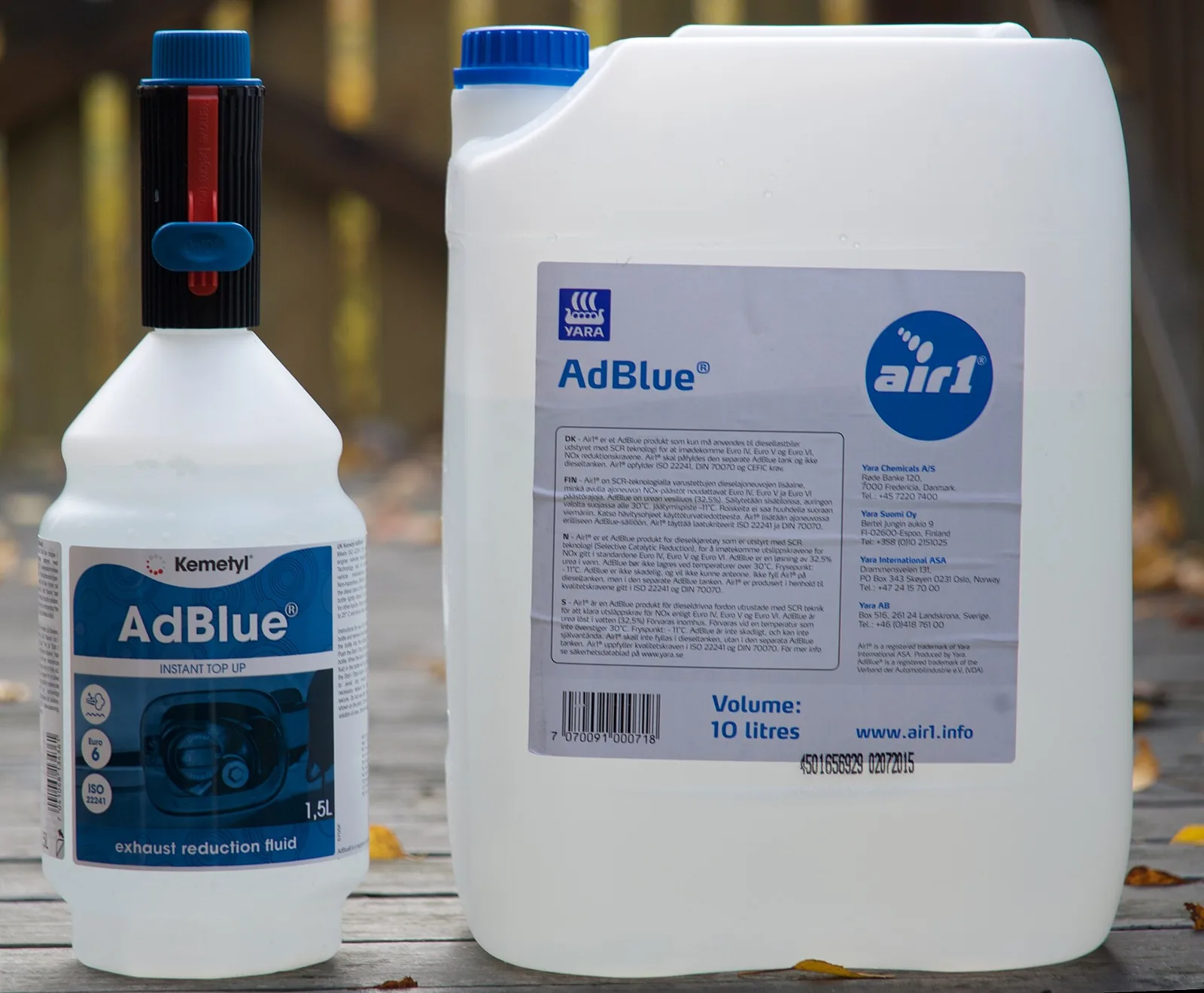
AdBlue is a brand name for diesel exhaust fluid, a solution of 32.5% urea and 67.5% deionized water. A diesel injects it into the exhaust, where heat turns it to ammonia and a catalyst uses that ammonia to convert harmful nitrogen oxides into harmless nitrogen and water.
AdBlue is two-thirds water. The rest is urea, and when China curbed urea exports in late 2021, South Korea sent a military transport aircraft to Australia to fetch more.
What is AdBlue?
AdBlue is the best-known brand name for diesel exhaust fluid (DEF), a liquid that cuts the air pollution a diesel engine makes. It is an aqueous urea solution of 32.5% urea and 67.5% deionized water, and selective catalytic reduction systems consume it to lower the nitrogen oxides in the exhaust.
The same liquid carries several labels. The international standard that defines it, ISO 22241, calls it AUS 32, short for aqueous urea solution 32%. The name AdBlue is registered as a trademark by the German Association of the Automotive Industry. Carmakers brand their whole systems too: BlueHDI at the PSA Group, covering Peugeot, Citroen and DS Automobiles, BlueTec at Daimler, and FLENDS at UD Trucks.
The fluid is the delivery vehicle: urea goes in, ammonia is made by exhaust heat, and the catalyst does the rest.
Why do diesel engines produce nitrogen oxides?
Diesels typically burn with more air than the fuel strictly needs. That lean mixture ensures soot burns fully and no unburnt fuel leaves the engine. The price is the excess air: it generates nitrogen oxides, known as NOx, from the nitrogen in the atmosphere, and these are harmful pollutants.
That is the problem SCR was invented to solve. A lean-burn engine cannot simply be tuned away from it, because the same excess air that keeps the exhaust clean of soot is what creates the NOx. The answer is to leave the combustion alone and clean the exhaust afterwards.
How does selective catalytic reduction use AdBlue to cut NOx?
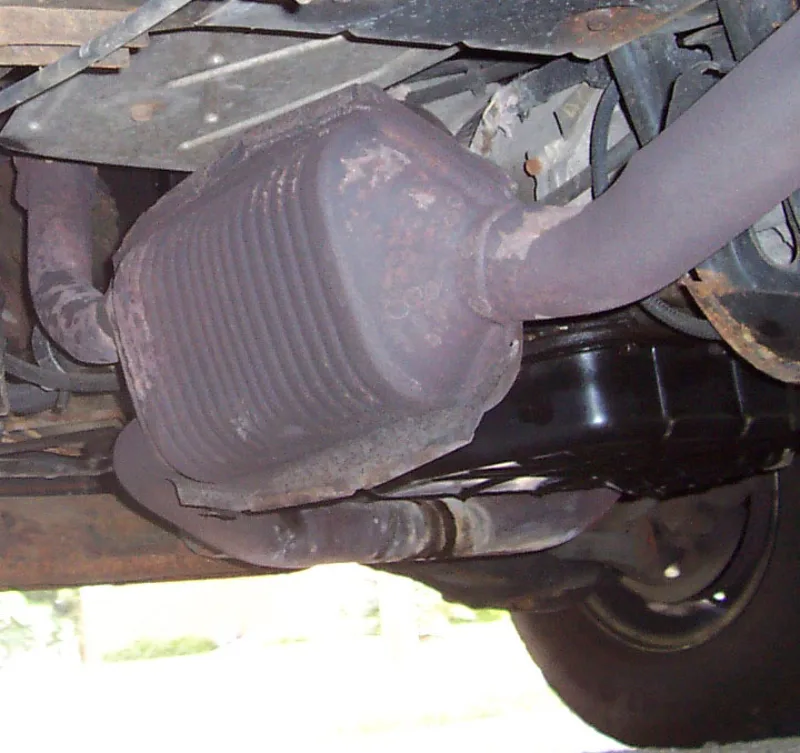
DEF sits in its own tank and is injected into the exhaust pipeline, where exhaust heat decomposes it into ammonia. Inside the SCR catalyst, the ammonia reduces the NOx into water and nitrogen, both of which are nonpolluting and leave through the tailpipe. The nitrogen that emerges is the same nitrogen the engine drew in from the air.
Picture the catalyst as a busy interchange. NOx molecules and ammonia meet on its surface, swap partners, and leave as nitrogen and water. The urea is simply the delivery vehicle for the ammonia, because the liquid is easier to carry and store than ammonia itself.
The chemistry inside the exhaust takes a few steps. Injected into the hot gas, the fluid loses its water to evaporation and the urea breaks down with heat into ammonia and isocyanic acid. The isocyanic acid then reacts with water vapour and breaks down into carbon dioxide and more ammonia. Overall, one urea molecule plus one water molecule gives two ammonia molecules and carbon dioxide.
With oxygen and a catalyst on hand, the ammonia then reduces two different nitrogen oxides, NO and NO2. The reactions are called standard SCR, NO2 SCR and fast SCR, and the balance between NO and NO2 decides which takes place and how quickly. The highest conversion comes when the two are present in equal amounts, especially at temperatures between 200 and 350 degrees Celsius.
Too much NO2 causes trouble. The NO2 route is slower than the standard one, and ammonium nitrate can form, putting the catalyst out of action for a time. With more NO than NO2, the fast and standard reactions run in sequence.
What is inside an SCR catalyst?
SCR catalysts use a porous ceramic as a support, such as titanium oxide. The active ingredients are usually oxides of vanadium, molybdenum and tungsten, or zeolites, or cerium. Vanadium and tungsten catalysts are cheaper but lack high thermal durability, which matters for cars using a diesel particulate filter with forced regeneration.
Temperature is the other constraint. The ideal reaction range runs from 630 to 720 K (357 to 447 degrees Celsius), though the reaction can run as low as 500 K (227 degrees Celsius) with longer residence times. The lowest workable temperature depends on the fuel, the gas constituents and the catalyst.
How much AdBlue does a diesel use?
The injection rate depends on the particular after-treatment system, but it is typically 2 to 6% of the volume of diesel consumed. That low dosing rate gives long intervals between refills and keeps the tank small, so it intrudes little into the space in the car. A control unit adjusts the amount continuously.
The control unit watches the NOx level in the exhaust, measured before and after the catalytic converter and, where there is more than one, between them. It also tracks the current ammonia filling level in the catalyst, the engine's operating temperature and its speed. The dose follows those readings rather than a fixed schedule.
Because the fluid is where the ammonia comes from in this design, a dry tank leaves the catalyst without the chemical it needs to reduce NOx. The low dosing rate is what makes that unlikely to happen without notice, since refills come around infrequently.
How well does SCR work, and where did it come from?
SCR has a strong record. Commercial systems on utility and industrial boilers cut NOx by 70 to 95%, and in vehicles, emissions of NOx, particulates and hydrocarbons have come down by as much as 95% compared with pre-emissions engines. SCR is now the preferred way to meet Tier 4 Final and Euro 6 standards for trucks, cars and light commercial vehicles.
The technique goes back to 1957, when the Engelhard Corporation patented selective catalytic reduction of NOx with ammonia in the United States. Work in both Japan and the US during the early 1960s went into cheaper, longer-lasting catalysts, and the IHI Corporation installed the first large-scale unit in 1978.
Cars and trucks came later. Nissan Diesel Corporation applied SCR to road vehicles, and its Nissan Diesel Quon of 2004 was the first practical product. With help from the oil and chemical industry, a supply network of 1,300 stations for the fluid was ready in Japan by September 2005.
In the United States, the Environmental Protection Agency enacted requirements in 2007 to cut harmful exhaust emissions sharply. Cummins and other engine makers developed an aftertreatment system built around a diesel particulate filter, which in turn called for ultra-low-sulfur diesel. The 2007 rules were an interim step towards tougher 2010 rules that reduced NOx still further, and by 2008 the worry had shifted to how the fluid would be distributed.
How have Euro emissions standards tightened?
| Standard | Year | Applies to |
|---|---|---|
| Euro 1 | 1992 | Passenger cars |
| Euro 2 | 1996 | Passenger cars |
| Euro 3 | 2000 | Any vehicle |
| Euro 4 | 2005 | Any vehicle |
| Euro 5 | 2009 | Light passenger and commercial vehicles |
| Euro 6 | 2014 | Light passenger and commercial vehicles |
| Euro 7 | 2026 | Light- and heavy-duty vehicles; adds tyre and brake particulates |
Since Euro 2, European rules have set different limits for diesel and petrol cars. Diesels face tighter carbon monoxide limits but are allowed higher NOx. No particular technology is mandated, although the available technology is considered when limits are set. A particulate number standard arrived for diesels with Euro 5b in 2011 and for petrol engines with Euro 6 in 2014.
The real-world picture has been rougher than the paperwork. An independent study in 2014 measured fifteen Euro 6 diesel cars on the road and found NOx about seven times the Euro 6 limit on average, though a few vehicles did better, which suggests real-world control is possible. In 2015 the Volkswagen emissions scandal revealed cars that detected test conditions and changed their emissions controls, emitting up to forty times more NOx than allowed on the road. Defeat devices are expressly forbidden in EU law.
Real Driving Emissions testing arrived in 2017 to measure cars in traffic. Even so, Which? tests from the start of 2017 found that 47 of 61 diesel models exceeded the Euro 6 NOx limit while conforming to official standards. In a 2015 ADAC study of 32 Euro 6 cars, few met on-road limits, and the cars using lean NOx trap technology, which accounted for roughly half of sales, produced the most emissions.
What happens to AdBlue in cold weather?
It freezes. DEF turns solid at -11 degrees Celsius (12 degrees Fahrenheit), so for the SCR system to work in the cold, enough of it must melt in as short a time as possible, preferably minutes. Regulators set limits: US 2010 rules call for full flow within 70 minutes, and the European rule is stricter.
European Regulation (EC) No 692/2008 sets the bar at 20 minutes: start the engine at -15 degrees Celsius (5 degrees Fahrenheit) with a tank frozen through to that core temperature, and usable fluid must be available within that time.
The usual thawing method uses the engine's own heat, with coolant routed through the fluid tank under the control of a thermostatic valve. That can take a long time before the SCR system is fully working, often up to an hour. The alternative is an electric heater inside the tank, which must be sized and powered to melt enough fluid fast.
The heater should not exceed 50 to 60 degrees Celsius (122 to 140 degrees Fahrenheit), because DEF begins to decompose at around 60 degrees Celsius (140 degrees Fahrenheit). Self-regulating PTC heaters are often used, since they remove the need for complicated sensors and temperature control.
Is AdBlue safe to handle and store?
The liquid is clear and non-toxic, and handling it is safe, though urea attacks metals such as aluminium, so DEF is kept and transported in special containers, typically stainless steel. SCR systems and fluid dispensers are designed so urea does not corrode them.
Storage advice is to keep it somewhere cool, dry and well ventilated, out of direct sunlight. Bulk volumes can sit in polyethylene containers, fibreglass-reinforced plastic or steel tanks, and intermediate bulk containers are common for shipping.
Supply has changed with demand. As of 2013 many truck stops in the US had added DEF pumps, usually beside the fuel pumps, so a driver can top up both tanks in one stop. In Europe, a growing number of filling stations pump the fluid instead of selling it in disposable plastic containers. The pumps were aimed at commercial vehicles, but are now beginning to appear for the rising number of passenger cars that need DEF.
One airport hazard is worth knowing. Where diesel ground vehicles need DEF, its labelling and storage must be managed carefully, because putting DEF into a jet aircraft in place of fuel system icing inhibitor has been blamed for several in-flight engine failures and groundings.
What happens when AdBlue supply runs short?
The 2021 shortage shows how much depends on one raw material. Urea was in short supply in China, which capped exports to protect domestic supplies, and DEF prices rose. The Australian National Road Transport Association voiced its worries in early December, and by the middle of the month roughly seven weeks of supply remained in the country.
The Australian company IOR said on 14 December it would put up a new plant. South Korea was hit harder. Mandatory Chinese inspections of urea exports began in September and slowed shipments, and from January to September almost 97% of South Korea's urea imports had come from China.
The timing was awkward, because every new diesel sold in South Korea since 2015 has had to run a urea-based solution in its SCR system, which now covers about 40% of registered vehicles. Panic buying followed, the government rationed supplies and banned resale to stop hoarding, and a KC-330 Cygnus transport aircraft flew to Australia to bring back more.
Where this goes next
Euro 7, agreed in 2024 and in force from 2026, widens the rules to cover emissions that do not come from the exhaust, including particles from tyres and brakes. Until 2030, fossil-fuelled vehicles may have dirtier brakes than electric ones.