A honeycomb coated with platinum, palladium and rhodium turns three toxic exhaust gases into water, carbon dioxide and nitrogen, but only within a narrow window of heat and fuel mixture.
A catalytic converter is a device in the exhaust that converts toxic gases from an engine into less harmful ones. Inside a honeycomb coated with platinum, palladium and rhodium, a three-way converter turns carbon monoxide, hydrocarbons and nitrogen oxides into carbon dioxide, water and nitrogen.
The first catalytic converter prototypes appeared in France at the end of the nineteenth century, when "oil cars" numbered only a few thousand. Yet most American petrol cars did not carry one until the 1975 model year.
What is a catalytic converter?
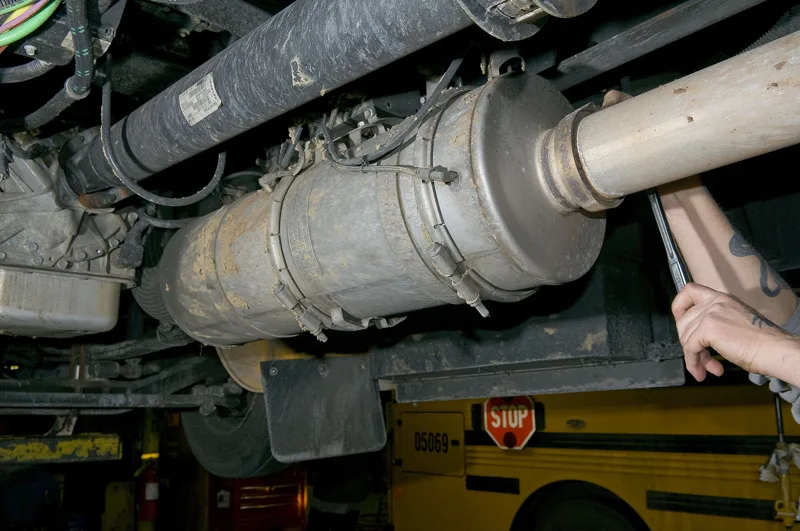
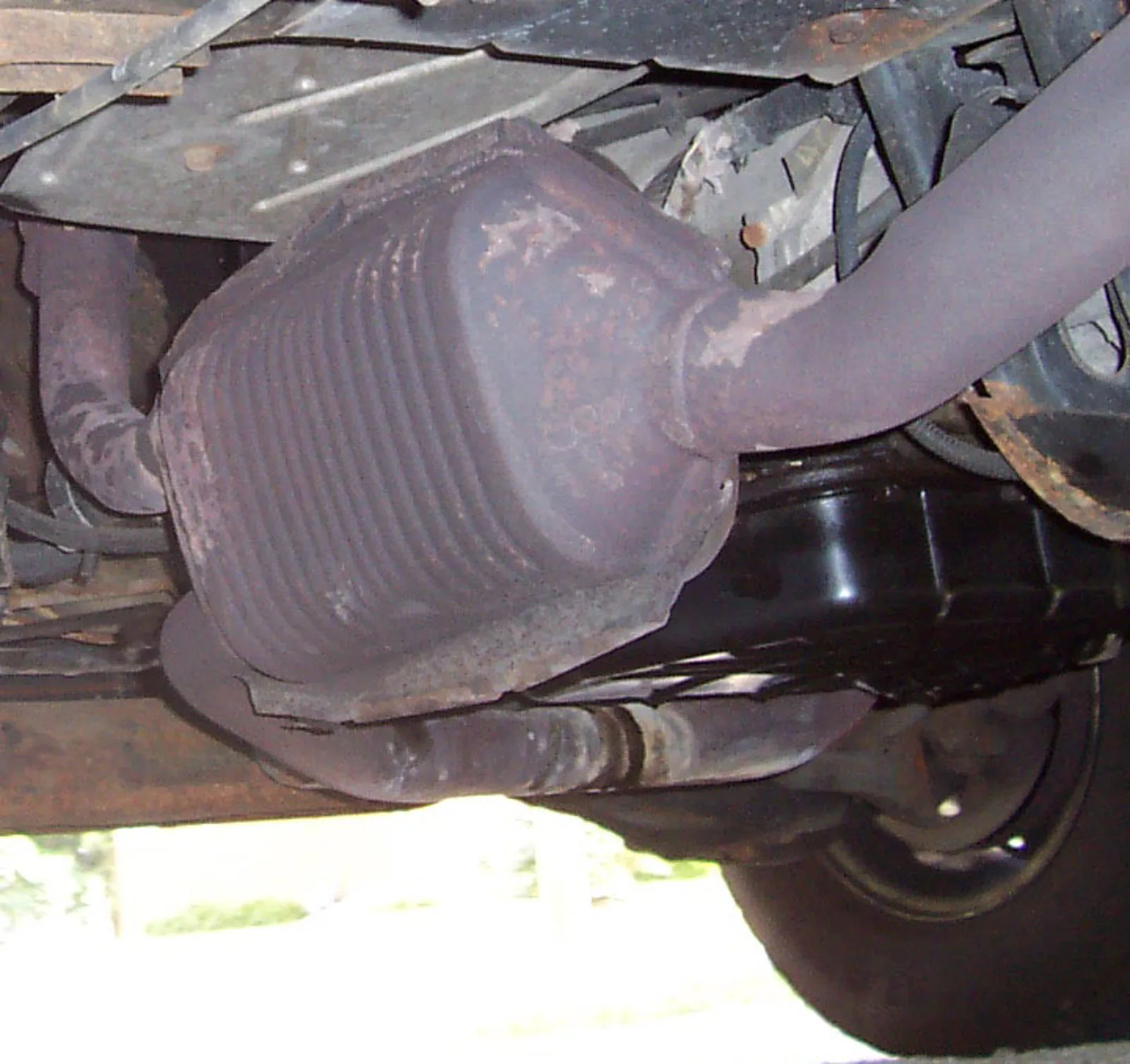
A catalytic converter sits in the exhaust of an internal combustion engine and changes toxic gases and pollutants into less harmful ones, using a catalysed redox reaction. It is usually fitted to petrol or diesel engines, including lean-burn types, and sometimes to kerosene heaters and stoves.
Cars are the best-known home, but not the only one. Converters also turn up on generators, forklifts, mining machinery, lorries, buses, locomotives, motorcycles and ships. Devices of a similar kind occasionally control emissions from appliances such as wood stoves.
The honeycomb gives the gases a huge surface to meet on, and a few grams of precious metal introduce them.
Which pollutants does a catalytic converter tackle?
The main targets are hydrocarbons, carbon monoxide and nitrogen oxides. Hydrocarbons are burned or partly burned fuel and a major contributor to smog. Carbon monoxide comes from incomplete combustion. Nitrogen oxides appear when nitrogen from the air combines with oxygen under the heat and pressure in the cylinders.
The health stakes are real. Long exposure to hydrocarbons is linked with asthma, liver and lung disease, and cancer. Inhaled carbon monoxide binds persistently to haemoglobin in red blood cells and reduces the blood's ability to carry oxygen, and overexposure may be fatal. Nitrogen oxides, a group that includes NO and the extremely reactive NO2, are precursors to smog and acid rain.
There is a built-in tension. NOx output climbs as an engine approaches its most efficient, and therefore hottest, operating point, so engineers face a natural trade-off between efficiency and NOx control. That trade-off is a large part of why the converter exists.
What chemistry happens inside the honeycomb?
Inside the honeycomb, a catalyst helps pollutants react with oxygen or with each other. In a two-way converter, carbon monoxide is oxidised to carbon dioxide, and hydrocarbons are oxidised to carbon dioxide and water. A three-way converter adds the reduction of nitrogen oxides to nitrogen, handling all three jobs at once.
Think of it as a matchmaking service on a huge scale. The honeycomb gives the gases a vast surface to meet on, the precious metals introduce them, and the products leave as harmless partners: carbon dioxide, water and nitrogen. The converter itself is not used up by the reactions, which is what makes it a catalyst.
The two-way type is called an oxidation converter, sometimes an "oxi-cat". It is widely used on diesel engines to cut hydrocarbon and carbon monoxide emissions. The three-way type has an extra advantage: it also controls nitric oxide and nitrogen dioxide, which together are written NOx and should not be confused with nitrous oxide.
In plain terms, the three reactions go like this. Nitric oxide meets carbon monoxide and becomes nitrogen and carbon dioxide. Hydrogen takes the oxygen from nitric oxide and leaves water and nitrogen. And carbon monoxide and hydrocarbons burn with oxygen into carbon dioxide and water.
The reduction and oxidation catalysts usually share one housing, although in some designs they sit separately. Whatever the layout, there is a catch. The three reactions run most efficiently when the engine holds an air-fuel ratio in a narrow band around the stoichiometric point, and total conversion efficiency falls off very rapidly outside it.
That limit explains a split between engine types. Three-way converters need fuel-rich or stoichiometric combustion to reduce NOx successfully, so lean-burn engines, including diesels which typically burn lean, still rely on oxidation-only two-way converters to deal with particulate matter and hydrocarbons.
Why does a catalytic converter contain platinum-group metals?
Because those metals are the catalyst. The active layer is usually a cocktail of precious metals, chiefly from the platinum group. Rhodium works as a reduction catalyst and palladium as an oxidation catalyst, while platinum does both. Platinum is the most active and widely used, though unwanted side reactions and historically high cost limit it in some applications.
Prices move. Palladium and rhodium are the other precious metals used, and by February 2023 platinum had become the cheapest of that family. Cerium, iron, manganese and nickel see use too, each with limitations, and copper is allowed in most countries. Nickel is not legal in the European Union, because it reacts with carbon monoxide to form toxic nickel tetracarbonyl.
The metals do not vanish when a converter reaches the end of its life. A failed unit can be recycled rather than scrapped, and the platinum, palladium and rhodium inside are extracted.
What is a catalytic converter made of?
A converter has a substrate, a washcoat and the catalyst itself. The substrate is the core: usually a ceramic monolith with a honeycomb structure, commonly square rather than hexagonal, shaped to give a very large surface area. Where particularly high heat resistance is needed, makers use metallic foil monoliths made of Kanthal, an iron-chromium-aluminium alloy.
Cordierite, the ceramic in most converters, was created at Corning Glass by Ronald Lewis, Irwin Lachman and Rodney Bagley, who entered the National Inventors Hall of Fame in 2002. Before the mid-1980s, some early General Motors applications instead spread the catalyst over a packed bed of alumina pellets.
The washcoat is a carrier that spreads the catalytic materials over a large surface. It can be aluminium oxide, titanium dioxide, silicon dioxide or a mix of silica and alumina, chosen to form a rough, irregular surface that offers more area than bare substrate would. Ceria or ceria-zirconia is also added, mainly as an oxygen storage promoter.
Why does a catalytic converter sit so close to the engine?
Because it has to be hot. Converters need a temperature of 400 degrees Celsius (750 degrees Fahrenheit) to operate effectively, so they are mounted as near the engine as the layout allows. Alternatively, one or more smaller converters, known as pre-cats, are fitted immediately after the exhaust manifold.
What can stop a catalytic converter working?
Three conditions matter: temperature, mixture and contamination. Below the working temperature of 400 degrees Celsius it does not operate effectively, outside the narrow air-fuel band the conversion efficiency drops sharply, and lead poisons it. Lead and its compounds foul the converter by coating the catalyst's surface.
Lead is the reason unleaded petrol had to arrive first. By the 1974 model year, US emission standards had tightened so far that the de-tuning used to meet them was hurting engine efficiency and raising fuel use. The 1975 standards forced the invention of the converter, but it could not work with leaded petrol, because lead residue contaminated the platinum catalyst.
General Motors, in 1972, put a proposal to the American Petroleum Institute: drop leaded fuel for 1975 and later cars. Making and distributing unleaded fuel was a serious undertaking, yet it was finished in time for 1975 cars. Dropping the antiknock additive tetraethyl lead also cut lead in the air.
How do two-way, three-way and four-way converters compare?
| Type | What it does | Where it appeared |
|---|---|---|
| Two-way (oxidation) | Oxidises carbon monoxide and hydrocarbons | US and Canadian petrol cars until 1981; diesels and lean-burn engines; lower-cost European cars until Euro 3 in 2000 |
| Twin-catalyst system | Rhodium and platinum catalyst reduces NOx ahead of the air pump; palladium and platinum two-way unit follows | 1970s; cumbersome and expensive, soon made redundant |
| Three-way | Reduces NOx and oxidises carbon monoxide and hydrocarbons together | First commercialised on the California-specification 1977 Volvo 240; widespread from the 1981 model year |
| Four-way | Also removes particulates, which are burned to carbon dioxide | Developed more recently |
Where did the catalytic converter come from?
The French prototypes of the late nineteenth century were clay-based inert materials, coated in platinum, rhodium and palladium and sealed inside a double metal cylinder. A few decades later, the French mechanical engineer Eugene Houdry patented a converter. He had invented catalytic cracking, the process on which modern oil refining is based, and moved to the United States in 1930 to be near the refineries in Philadelphia.
Houdry grew worried about air pollution once early smog studies in Los Angeles came out, and founded a company called Oxy-Catalyst. He built converters for smokestacks, then for warehouse forklifts running on unleaded petrol. In the mid-1950s he began research on car engines and was awarded United States Patent 2,742,437.
Engineers at Engelhard Corporation, Phillip Messina, Antonio Eleazar, John J. Mooney and Carl D. Keith among them, then developed the converter further and produced the first production unit in 1973. Under the US Environmental Protection Agency's tighter exhaust rules, most petrol vehicles from the 1975 model year onwards carried one. These early converters were "two-way".
NOx was the next target. A twin-catalyst system appeared in the 1970s, using a rhodium and platinum catalyst ahead of the air pump to reduce NOx, followed by a palladium and platinum two-way converter for hydrocarbons and carbon monoxide. It was cumbersome and expensive, and it was soon made redundant when engineers noticed that under some conditions the first catalyst removed hydrocarbons and carbon monoxide as well.
That led to the three-way catalyst, which electronics and engine management made possible. Volvo first commercialised it on the California-specification 1977 240. When US federal regulations began demanding tight NOx control for the 1981 model year, almost every automaker answered with three-way converters and supporting engine controls.
General Motors set up an Emissions Control Systems Project Center to design a closed-loop three-way catalyst system, together with the electronics, fuel metering, ignition timing, idle speed and exhaust gas recirculation controls it needed, planned through 1981.
How did leaded petrol disappear?
Lead was added to petrol in 1922 as an antiknock agent. Research into its health effects began in 1969, nearly five decades later, and regulation to cut lead levels did not arrive until 1983. Countries then banned it between 1986 and 2021, with Japan first in 1986, nearly all of North and South America done by 1998, and most of Africa in 2004 and 2005. Algeria was last, in 2021.
The converter was part of the push. The wider regulatory story began in the 1950s and 1960s, when US studies attributed a significant share of air pollution to the automobile. California created its Air Resources Board in 1967, and the federal Environmental Protection Agency followed in 1970. Positive crankcase ventilation was fitted by law to 1961 California cars, the first tailpipe standards came in California for 1966 and nationally for 1968, and lead in petrol was officially banned in the US in 1996.