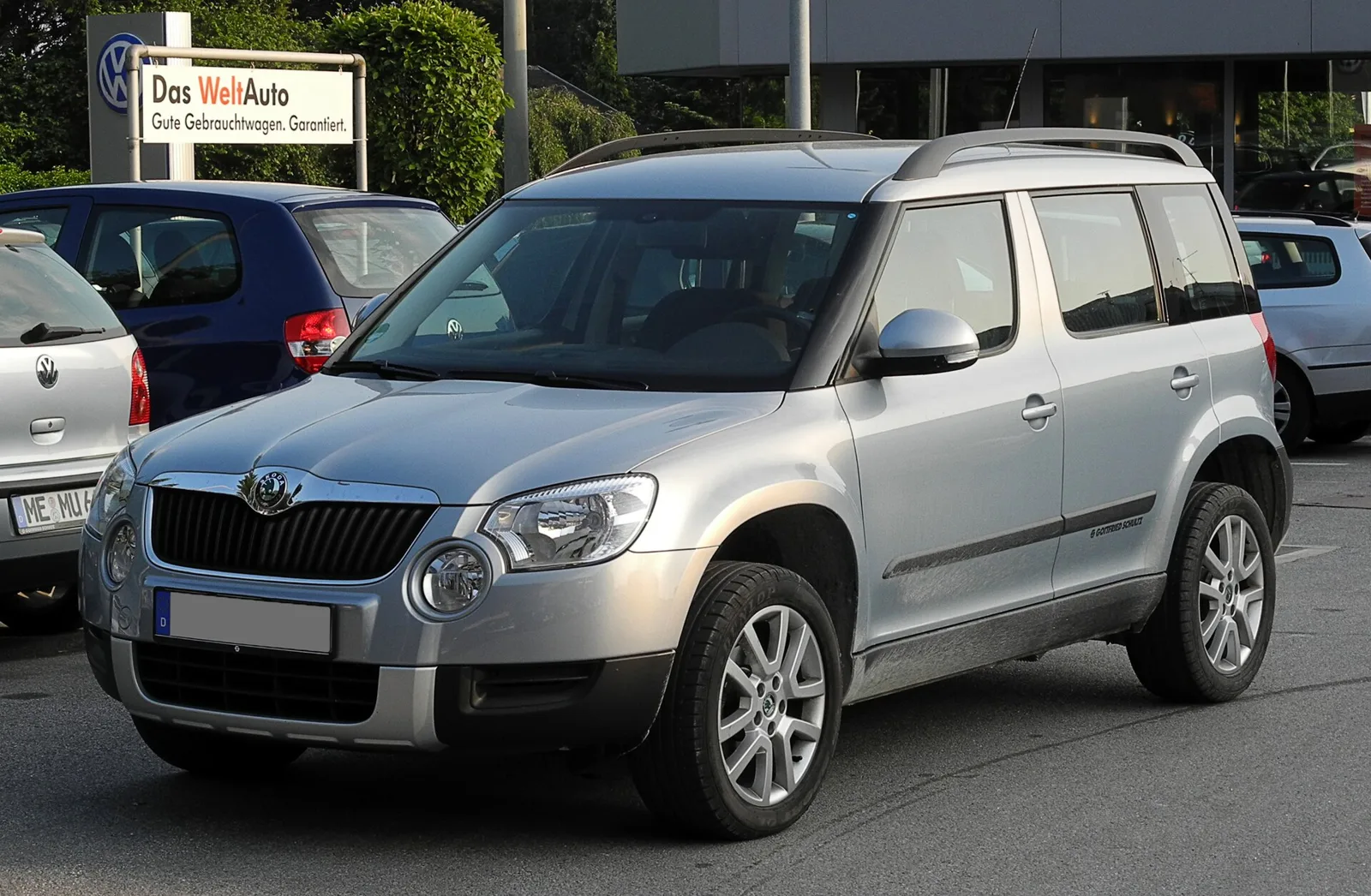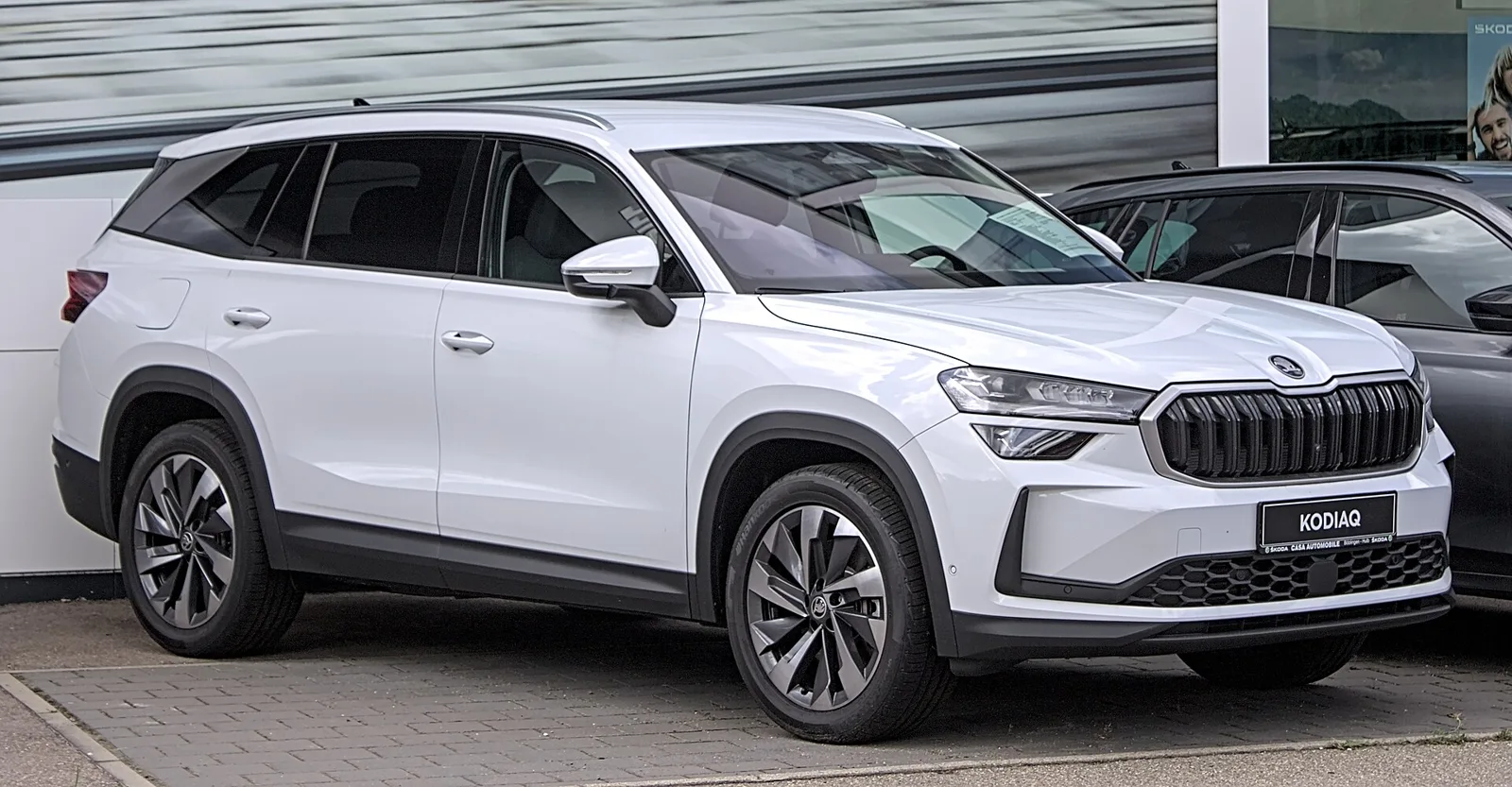
A town renamed for a day, a Yeti replacement and a Volkswagen-based electric crossover show how Skoda stretched its SUV line-up from compact to full-size.
Skoda's SUV family runs from the compact Karoq, which replaced the Yeti in 2017, to the full-size Kodiaq with optional three rows and the electric Enyaq on the MEB platform. Kodiaq and Karoq share Volkswagen Group MQB underpinnings; the Enyaq uses MEB.
In 2016 Skoda renamed a town on an Alaskan island Kodiaq for a single day to launch an SUV that it does not sell in the United States. The stunt set the tone for a model family that now runs from a Yeti replacement to a full-size seven-seater and an electric crossover.
Three cars carry that story: the Kodiaq at the top of the combustion range, the Karoq in the middle, and the battery-powered Enyaq. Each took a different route to its place in the line-up.
How do the Skoda Kodiaq, Karoq and Enyaq compare?
The Kodiaq is Skoda's full-size SUV with optional three-row seating, the Karoq is a compact C-segment SUV that replaced the Yeti, and the Enyaq is a mid-size battery electric crossover on the Volkswagen Group MEB platform. Skoda's SUV range also includes the smaller Kamiq, which sits below the Karoq.
| Model | Class | Platform | Introduced | Power | Volkswagen Group sibling |
|---|---|---|---|---|---|
| Kodiaq | Full-size SUV, optional three rows | MQB | Paris Motor Show, 29 September 2016 | Turbo petrol and diesel, 1.4 to 2.0 litres | Volkswagen Tiguan Allspace, SEAT Tarraco |
| Karoq | Compact SUV, C-segment | MQB A1 | Stockholm, 18 May 2017 | Petrol and diesel, 1.0 to 2.0 litres | SEAT Ateca |
| Enyaq | Mid-size electric crossover | MEB | Prague, September 2020 | Battery electric, 55 kWh base pack | Volkswagen ID.4 |
Skoda renamed an Alaskan town Kodiaq for a day to launch an SUV it does not sell in the United States.
Where did the Kodiaq name come from?
Skoda registered the name Kodiaq in December 2006, ten years before the car appeared. It refers to the Kodiak bear, the largest brown bear, which lives on Kodiak Island off the south coast of Alaska. For the launch campaign the town of Kodiak was renamed Kodiaq for a day.
The Karoq's name has the same roots. It is built from two Aleutian words, kaa'raq and ruq, meaning a car and an arrow, which are the elements of the Skoda logo. It was the second Skoda to take a name inspired by the Aleuts, the native inhabitants of Kodiak. The Enyaq broke the pattern: its name comes from the Irish name Enya, from the Gaelic eithne, meaning essence, spirit or principle, and it was the first of a new convention in which electric Skodas begin with an E.
Skoda Kodiaq: the full-size SUV
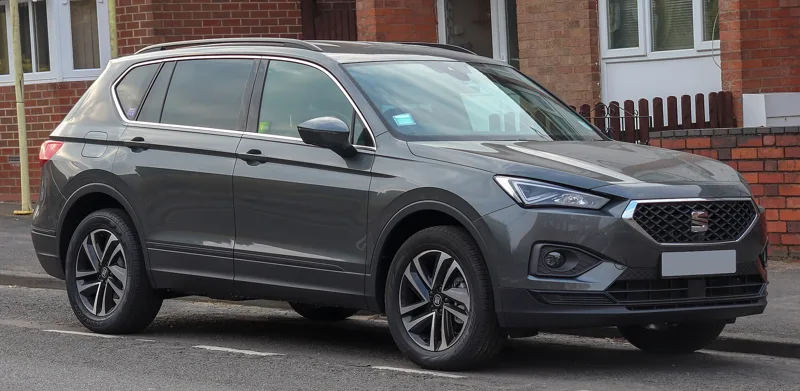
The Kodiaq was previewed as the Vision S concept at the Geneva Motor Show in March 2016, then introduced in production form at the Paris Motor Show on 29 September 2016. Customers took their first cars in February 2017. It sits in Skoda's D-SUV class above the Kamiq and Karoq and shares the Volkswagen Group MQB platform with the Tiguan Allspace and the SEAT Tarraco.
It brought several firsts to the brand: Area View, Tow Assist, Manoeuvre Assist and Predictive Pedestrian Protection were all new to Skoda, and it was the first MQB-based car with capacitive shortcut buttons in place of physical ones for its 8-inch infotainment screen.
The first-generation engine range covered turbocharged petrol and diesel units from 1.4 to 2.0 litres. Buyers could choose front-wheel drive or all-wheel drive, except that engines without the 4Motion badge were front-drive only.
The 2021 facelift
Skoda lightly reworked the Kodiaq in April 2021 with a redesigned bonnet, a more upright grille and slimmer headlights, with matrix LED units optional. Revised bumpers and a new roof-mounted spoiler made it more aerodynamic. Wheels ranged from 17 to 20 inches. In the RS the BiTDI diesel was dropped in favour of the 180 kW (245 PS) 2.0 TSI petrol also used in the Volkswagen Tiguan.
Kodiaq Scout, Sportline, RS and GT
The Kodiaq Scout and Sportline arrived at the Geneva Motor Show in March 2017. The Scout raised ground clearance from 187 to 194 mm (7.4 to 7.6 in) and added front and rear underbody protection, silver mirror caps and special badging. It comes with all-wheel drive, one TSI petrol and two TDI diesel engines. The Sportline takes a more road-focused direction, with black trim details, sports seats, a leather steering wheel, large alloys and aluminium pedals.
The Kodiaq RS, called vRS in the United Kingdom, was unveiled at the Paris Motor Show in October 2018 and became the fastest Kodiaq and the most expensive Skoda on sale. Its 2.0-litre bi-turbo diesel, Skoda's most powerful diesel at the time, produced 177 kW (240 PS) and 500 Nm (369 lbf ft). It also had Virtual Cockpit, a gloss black grille, 20-inch alloys, red brake calipers, heated sports seats and full LED headlights.
The RS holds the Nurburgring record for a seven-seat SUV, and since 2019 British police forces have used the Kodiaq vRS as a patrol car.
The Kodiaq GT is a coupe-bodied version sold only in China. It was introduced at the Guangzhou Motor Show on 16 November 2018 and comes with one of two 2.0-litre petrol engines, rated at 137 kW or 162 kW.
The second-generation Kodiaq
Skoda introduced the second-generation Kodiaq on 4 October 2023. In India it launched on 17 April 2025, assembled locally and offered in Sportline and Laurin and Klement trims, with a 2.0-litre turbo-petrol engine and a seven-speed DSG gearbox.
In July 2026 Skoda followed that with the fully imported Kodiaq RS in India, priced at 66.99 lakh rupees ex-showroom. The first allocation of 50 cars sold out within six minutes of bookings opening.
Skoda Karoq vs Yeti: the compact SUV that took over
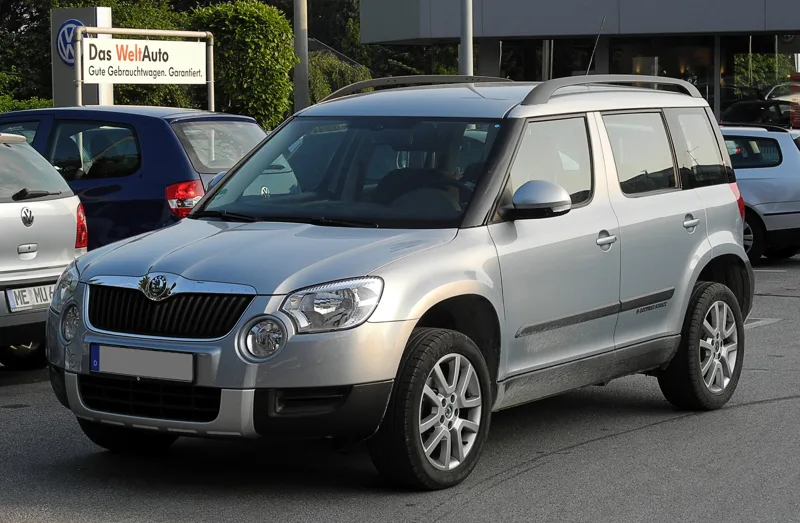
The Karoq was introduced at an event in Stockholm on 18 May 2017 and replaced the Yeti. Production began around the turn of June and July 2017 in Kvasiny, with sales starting in the autumn. As of 2019 it sits between the smaller Kamiq and the larger Kodiaq. It rides on the MQB A1 platform and is a sister model to the SEAT Ateca, with which it shares its chassis, roof stamping and side doors, though each brand applied its own design language to keep the two distinct.
The Karoq is a good deal bigger than the Yeti. It is 160 mm longer, 35 mm wider and 40 mm lower, on a wheelbase that is 60 mm longer.
Why it is not called the Yeti
Skoda did not market it as a second-generation Yeti, partly for naming consistency with the Kamiq and Kodiaq. There was also a commercial reason in China, one of the large markets for the Karoq: Skoda board member Werner Eichhorn described the yeti association there as negative and polarised.
Inside the Karoq
The Karoq comes in two- and four-wheel-drive forms with engines from 1.0 to 2.0 litres. Higher trims get a Driving Mode Select system with five modes, and four-wheel-drive models can have an Off-Road mode with traction control and an electronic differential lock. Suspension is a MacPherson front axle with triangular wishbones and a four-link rear. Cars with the 1.5-litre TSI or 2.0-litre TDI can have Dynamic Chassis Control, offering Comfort, Standard and Sport settings through electrically operated valves.
The Chinese-market Karoq is built by SAIC-Volkswagen, the sole manufacturer of Skoda cars in China. It debuted at the 2017 Guangzhou Auto Show and went on sale in January 2018, 50 mm longer than the European car with a wheelbase stretched by the same amount. It is also the basis for the Volkswagen Tharu.
In Russia, production started on 12 December 2019 at the Nizhny Novgorod plant from CKD kits, with sales from February 2020. The standard engine is an 81 kW (110 PS) 1.6-litre naturally aspirated petrol, with a 110 kW (150 PS) 1.4 TSI for higher trims.
Karoq sales, shortages and the facelift
Demand outran supply. In April 2018 Skoda chief executive Bernhard Maier said customers in several markets were waiting up to 10 months for delivery, and Volkswagen Group added production at Mlada Boleslav in the Czech Republic and Osnabruck in Germany in 2018 and 2019. Bratislava also built the car from October 2020 to December 2023.
The Karoq became Skoda's best-selling model in 2019, with deliveries above 137,700 in the first 11 months, against 115,700 in the whole of 2018. By mid-September 2019 the total built since the October 2017 launch had reached 250,000.
The facelifted Karoq was unveiled in December 2021 with restyled front and rear ends. Higher trims gained a 10.25-inch digital gauge cluster, three-zone automatic air conditioning, adaptive suspension and an electric sliding panoramic sunroof. It was offered first in the Czech Republic, Slovakia and Switzerland, with deliveries from spring 2022, in Active, Ambition and Style trims plus a sporty Sportline.
Skoda Enyaq review: the electric crossover
Skoda revealed the Enyaq iV on 1 September 2020 and introduced it in Prague that month. European production began on 25 November 2020 at Mlada Boleslav. The first deliveries went to Scandinavia in late April 2021, followed by Western and Central Europe in May. It uses the MEB platform shared with the Volkswagen ID.4 and was later renamed simply Enyaq.
The range offers rear- or all-wheel drive, three battery capacities and five performance versions. The base car has a 55 kWh pack and a 109 kW (148 PS) motor on the rear axle. The drag coefficient is 0.257, and the boot holds 585 litres, though there is no storage space under the bonnet.
Enyaq RS and the Coupe
The most powerful version is the RS, with a motor on each axle. The range overview gives the combined output as 225 kW (306 PS), while the Coupe RS is listed at 220 kW (299 PS) and 460 Nm (339 lb ft), so the two figures differ by a few kilowatts. The Coupe RS carries a 77 kWh or 82 kWh net battery, a WLTP range of 497 km (309 mi), a 0 to 100 km/h time of 6.5 seconds and a top speed of 180 km/h (110 mph).
The Enyaq Coupe was presented in Prague on 31 January 2022, with production starting in February 2022 at a target of 120 cars a day. It does not offer the entry-level 55 kWh battery, and it is 4 mm shorter and 6 mm taller than the regular Enyaq. The Enyaq RS followed in October 2022, joining the Coupe RS already on sale.
Laurin and Klement and Cargo
On 17 March 2023 Skoda announced a Laurin and Klement variant, the 85 and 85x. It uses the APP550 motor, first seen on the Volkswagen ID.7, which delivers 210 kW (286 PS) and 550 Nm (406 lb ft), compared with 150 kW for the earlier motor. That brings the 0 to 100 km/h time to around 6.6 to 6.7 seconds, close to the RS at 6.5.
In July 2025 Skoda launched the Enyaq Cargo in the UK, a conversion of the 85 and 85x that removes the rear seats for a cargo area. The conversion costs 1,815 pounds including VAT, and unlike most panel vans the Cargo keeps a rear window.
Enyaq concepts and safety
Two concepts came first. The Vision E, shown at the 2017 Auto Shanghai, had two motors with a combined 225 kW, level 3 autonomy capability and a 500 km range, with production pencilled in for the second half of 2020. The Vision iV followed in March 2019 with an 83 kWh battery and a 500 km WLTP range, and Skoda's chief executive claimed the exterior would be 92 to 95 percent identical to the production car.
The Euro NCAP assessment in 2021 noted that the Enyaq iV has a speed assistance system as standard, using a camera and digital mapping, plus a seatbelt reminder for all seating positions. Fatigue detection is optional and was not part of the assessment. Automatic emergency braking avoided or mitigated collisions in almost all scenarios.
Awards for the Kodiaq and Karoq
The Kodiaq collected trophies quickly. Top Gear magazine named it Best Family Car in the World in November 2016, and in 2017 it was Car of the Year in the Czech Republic, Poland and Bulgaria, SUV of the Year in China and France and best all-wheel-drive car in Germany. It also won Auto Test, Auto Express and What Car? contests and a Red Dot Design Award, and Carbuyer called it Best Large Family Car in 2024.
The Karoq was voted the most beautiful compact SUV in the Autonis 2017 readers' poll by Auto motor und sport readers, won the 2017 Golden Steering Wheel from Auto Bild and Bild am Sonntag, and took Czech Car of the Year in January 2018.
What this means if you are choosing between them
The three cars split along simple lines. The Karoq is the compact choice, much larger than the Yeti it replaced. The Kodiaq adds the option of three rows, with Scout, Sportline and RS versions alongside the standard car. The Enyaq is the electric option, with a 585-litre boot and coupe, RS and Cargo spin-offs.
Each one is a Volkswagen Group cousin underneath, which tells you where the engineering comes from: the Kodiaq with the Tiguan Allspace and Tarraco, the Karoq with the Ateca, the Enyaq with the ID.4.
Where this goes next
The Enyaq and Enyaq Coupe were facelifted on 8 January 2025 with the Modern Solid face that first appeared on the smaller Elroq, a better drag coefficient, new colours and a more sustainable interior. The second-generation Kodiaq is rolling out market by market, with the imported RS reaching India in July 2026.
The Karoq has been through its December 2021 facelift, and its Bratislava production run ended in December 2023.