From hand-cranked lamps on a 1935 Cord to the last pop-up Corvette in 2004, the cars, the rules and the technology behind a vanished styling trick.
Pop-up headlights conceal a car's lamps when switched off. They first appeared on the Cord 810 in 1935, reached production on the Lotus Elan in 1962, and ended on volume cars in 2004 as US rules, pedestrian-protection laws and LED lighting removed the reasons to hide them.
The first pop-up headlights were raised by hand. Owners of the Cord 810, shown at the New York Auto Show in November 1935, turned two cranks, one on each side of the dashboard, to bring the lamps out.
What are pop-up headlights?
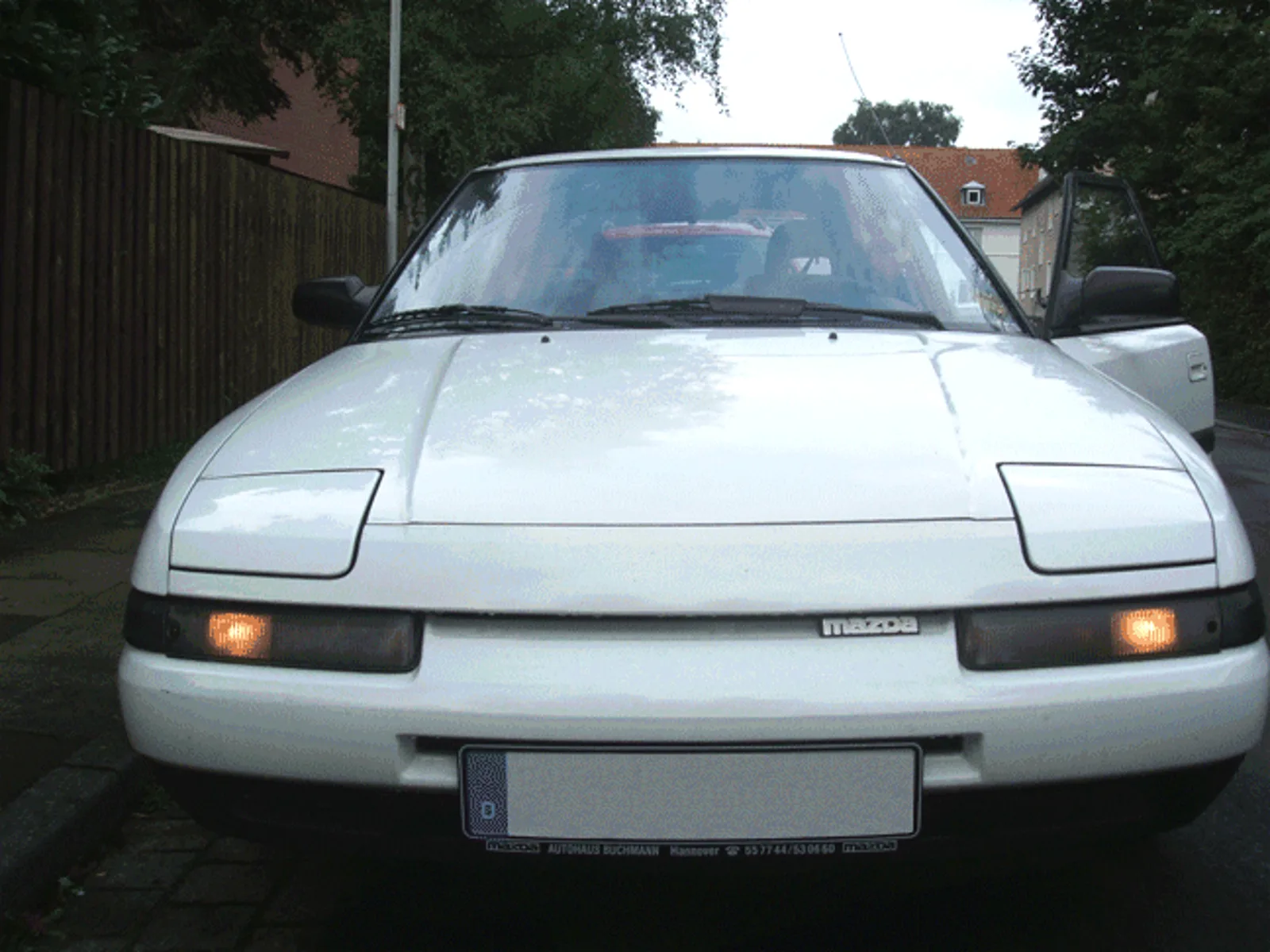
Hideaway headlights, flip-eye headlamps and hidden headlamps are all names for pop-up headlights, a styling feature that conceals a car's lamps whenever they are switched off. Several engineering solutions have been used to make the lamps vanish.
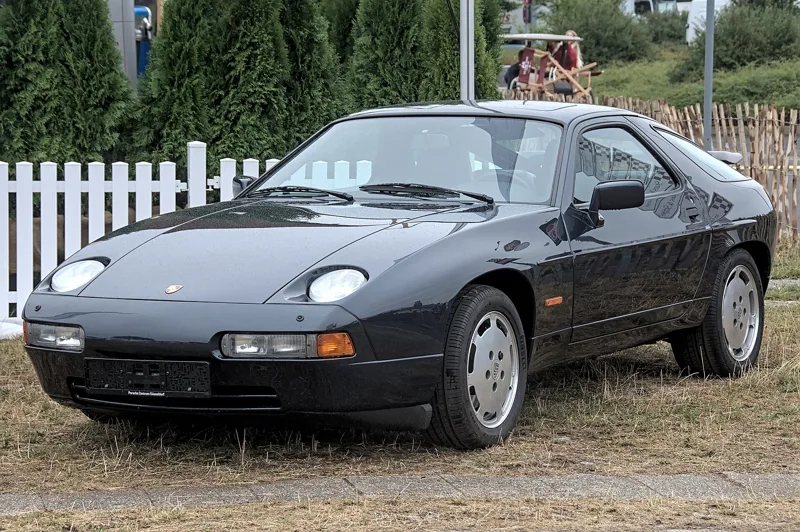
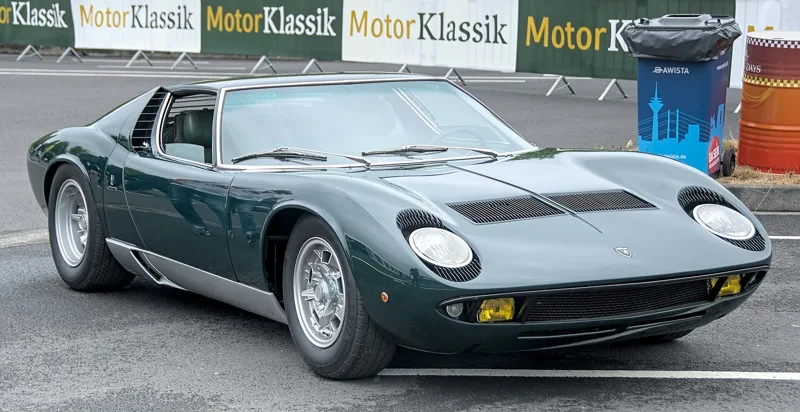
Some designs mount the lamps in a housing that rotates until it sits flush with the nose, as on the Lamborghini Miura and Porsche 928. Others retract into the bonnet or wings, which is how the Chevrolet Corvette worked from 1963 to 2004. A third kind hides the lamps behind grille panels that rotate or retract, as on the 1965 Buick Riviera, the Dodge Charger of 1966 to 1970 and the Mercury Cyclone of 1970 and 1971.
The first pop-up headlights were raised by hand, with a crank on either side of the dashboard.
Where did pop-up headlights come from?
After the Cord 810, a custom Alfa Romeo 8C picked up the idea in 1936. Powered versions came next, first on a General Motors concept car, the 1938 Buick Y-Job, and they reappeared on show cars for years afterwards, including the 1951 General Motors Le Sabre. Production cars had to wait until 1962 and the Lotus Elan.
The popularity of the feature rose and fell. From the middle of the 1960s onward it came back, first in Europe and above all in the United States, where aero-style headlamps were barred. Plenty of different cars carried hidden lamps through the 1970s, 1980s and 1990s and into the early 2000s. Later legislation made them increasingly unfashionable.
Carmakers also used them as a regulatory workaround. In 1983 Toyota exported the retractable-headlight version of the AE86, which Japan knew as the Sprinter Trueno, rather than the Corolla Levin. The Trueno sat its headlamps higher, enough to satisfy US rules, so Toyota avoided raising the body, which would have hurt the handling.
Which cars used pop-up headlights?
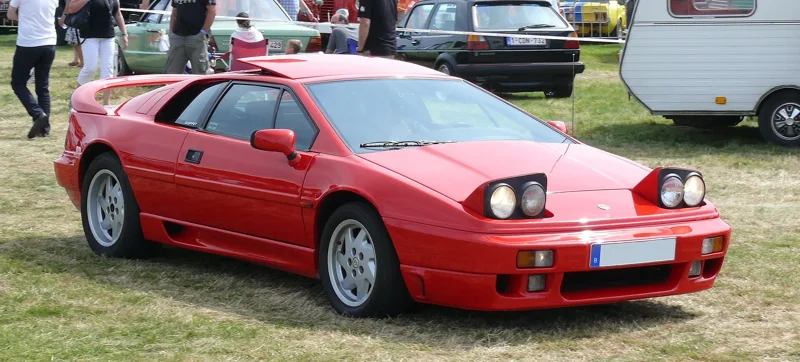
The list runs from muscle cars to supercars. Beyond the Corvette, Miura, 928, Charger, Cyclone and Riviera already mentioned, it includes the Lotus Elan, the first generation of the Mazda MX-5, the Lotus Esprit, the AE86 Sprinter Trueno and the Chevrolet Corvette C5. Hidden headlamps have also appeared on a motorcycle, the Honda Elite 150, on some coaches such as the Pegaso-Obradors, and on trains such as the Keisei AE100.
Lotus Elan
The Elan was the first production vehicle with powered hidden headlamps, and it later served Mazda as a design benchmark. The first of two Elan ranges ran from 1962 to 1975 with rear-wheel drive. It was the first Lotus road car with a steel backbone chassis and a fibreglass body, a construction style Lotus repeated for nearly three decades, and at about 680 kg (1,500 lb) it embodied Colin Chapman's minimum-weight philosophy. Independent suspension at every wheel, rack and pinion steering, disc brakes all round and a 1,558 cc DOHC engine made it technically advanced for its day.
Its steering earned the strongest praise. Gordon Murray, who designed the McLaren F1, is reported to have regretted that he could not match the Elan's steering in his own car. The first car, the Elan 1500, appeared in 1962 as a roadster, and after only 22 were built the engine was enlarged and the car became the Elan 1600. Commercially, the Elan was Lotus's first success and helped pay for its racing over the following ten years.
Lotus built the Elan from bought-in parts wherever it could. The engine began as a Ford Kent four-cylinder of 1,498 cc, topped with a twin-cam head designed by Harry Mundy; Ford later bought the rights and renamed it the Lotus-Ford Twin Cam. Gearbox and differential also came from Ford, the front suspension and steering from Triumph, the electrics from Lucas, the instruments from Smiths and the brakes, with 9.5 in (241 mm) front discs and 10.0 in (254 mm) rear discs, from Girling. Lotus supplied the Chapman Strut rear suspension. The steering took 2 2/3 turns lock to lock and had no power assistance, which is where its famous feel came from.
The range moved on steadily: the Elan 1600 of 1963 gave way to the S2 in 1964, a fixed-head coupe joined the roadster in 1965, the S4 arrived in 1968 and the Sprint in 1970, and the last Sprint left the line in 1973. In the UK Lotus also sold the Elan as a lower-cost kit for the customer to finish, as a way to avoid tax.
Lotus's record keeping was erratic, and estimates of Elan production run from 8,676 to 12,224. As of April 2018 a voluntary and therefore incomplete registry listed about 1,100 known survivors in more than 30 countries, including about 330 of the longer +2 model. A new chassis has gone under most surviving cars at some point.
Mazda MX-5
The MX-5 debuted at the Chicago Auto Show in February 1989 and treated the Elan as a design benchmark. It arrived at a time when the small roadster had nearly died out, and its idea began in 1976, when the Motor Trend journalist Bob Hall told Mazda's Kenichi Yamamoto that someone should build an inexpensive roadster. The California design team's front-engine, rear-wheel-drive proposal, the Duo 101, beat rival studies from Tokyo at a second round of judging in August 1984. The Duo 101 borrowed cues from the Elan: its door handles, tail lamps, grille opening, engine appearance and centre console layout.
Before that approval, the design had to be proved on the road. International Automotive Design in Worthing, England, built a running prototype coded V705, with a fibreglass body, a 1.4 L engine from a Mazda Familia and parts from a range of early Mazda models. Finished in August 1985, it was taken to the United States and driven around Santa Barbara, California, where the public reaction was filmed for executives back in Hiroshima. Mazda had also weighed a mid-engine layout, which looked promising on paper but was known to struggle with noise, vibration and harshness. Final approval came on 18 January 1986. The car launched at 940 kg (2,070 lb), and demand was fierce: US dealers charged as much as US$10,000 on top of a list price of $14,000 to $16,000, and waiting lists stretched to months. The first generation, the NA, sold 228,961 units between 1989 and 1997, with a 1.6 L four-cylinder engine making 116 horsepower and, from late 1993, a 1.8 L unit in most markets. The NA won Automobile Magazine's 1990 Automobile of the Year award and a place on the Car and Driver 10Best list from 1990 to 1992. Pop-up headlights were unique to the NA, and base cars had no power steering, air conditioning or sound system.
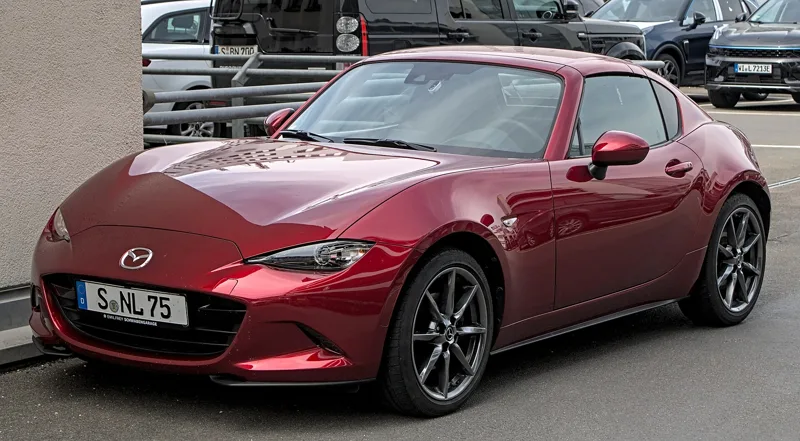
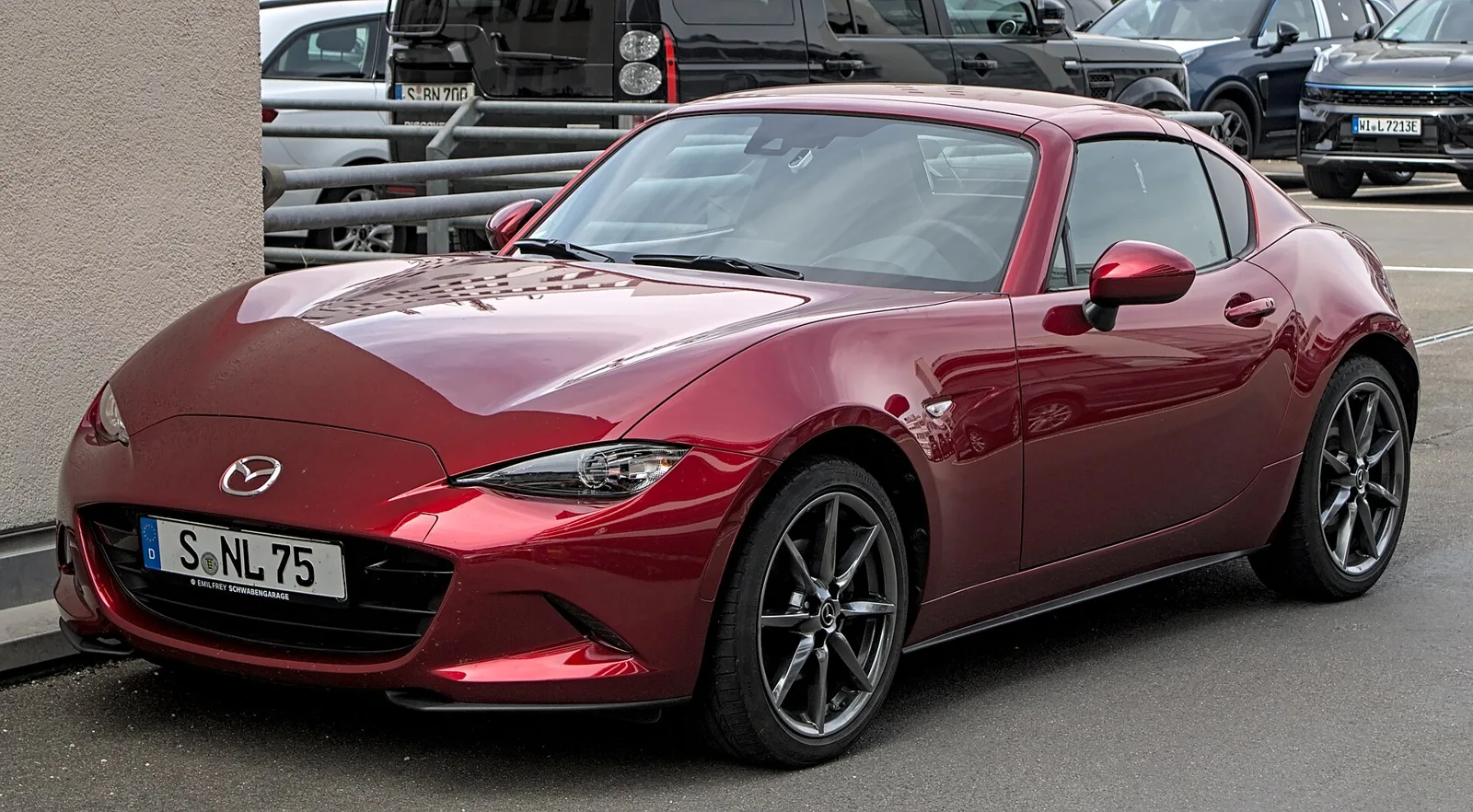
Pop-up headlights did not last, but the car did. Mazda dropped them for the second-generation NB, and the third generation, the NC, followed in 2005 with a Power Retractable Hard Top. The fourth, the ND, has been built since 2015, picked up an engine rated at 135 kW (181 hp) in 2019 and added a rigid-roof Retractable Fastback version. Mazda built its millionth MX-5 on 22 April 2016, and no two-seat convertible sports car has sold more. With light modification the MX-5 is a staple of amateur racing, forming the base of the Spec Miata class in the US, the Global MX-5 Cup and the MaX5 Racing Championship in the UK.
The two roadsters side by side
| Measure | Lotus Elan (1962 to 1975) | Mazda MX-5 NA (1989 to 1997) |
|---|---|---|
| Weight | About 680 kg (1,500 lb) | 940 kg (2,070 lb) at launch |
| Engine | 1,558 cc DOHC four-cylinder | 1.6 L four-cylinder, 116 horsepower; 1.8 L from late 1993 |
| Hidden headlamps | First powered set on a production vehicle, 1962 | Unique to the NA generation |
| Cars built | Estimates run from 8,676 to 12,224 | 228,961 sold |
Why did pop-up headlights disappear?
Three forces combined: changing law, changing technology and changing cost. In the United States the rules now allow aerodynamic headlamps, and next to those, hidden headlamps add cost, weight and complexity, with worries about reliability as cars age. Internationalised ECE safety regulations have recently added pedestrian-protection provisions that restrict protuberances from car bodies, making compliant pop-ups harder and more expensive to design.
The MX-5 shows the effect. Its second generation, unveiled in 1997 and sold from 1998, kept the proportions of the NA but dropped the retractable headlamps because of tougher pedestrian safety testing.
Technology finished the job. Projector-beam units, like those on the 1990 Nissan 300ZX (Z32), and later brighter, more efficient LEDs removed the old reasons for hiding the lamps at all. The last volume-production cars with pop-ups ended in 2004, when the Lotus Esprit and the C5 Corvette went out of production.
Are pop-up headlights banned?
Nothing in the law forbids them: they remain legal to fit to road vehicles, and the Ares Design Project1 is a current example. After 2004 they almost completely vanished from production cars. Regulation raised the cost of making them compliant, but it did not forbid them.
Could pop-up headlights return?
A trace survives. Among modern production cars, the Ferrari Daytona SP3 is a rare user of the idea, with retractable eyelids that cover part of each headlight. Some concept cars have also been shown with them, among them the Mazda Iconic SP.
For mainstream cars the reasons point the other way. The need for hidden lamps has been eliminated in practice by projector and LED lighting, and the pedestrian-protection rules make a compliant pop-up more difficult and expensive. Any return looks like a gesture at the expensive end of the market and in show cars, not a broad comeback.
What does this mean for someone who wants a car with pop-up headlights?
Age is the main consideration. Hidden headlamps raised reliability concerns as cars grew older, and the newest cars that had them date from 2004. The MX-5 NA is the best-documented way in, with 228,961 sold over its run. The Elan is rarer, with about 1,100 known survivors in 2018, and a car's chassis may well have been replaced.
Know what you are buying in practical terms. Early base MX-5s were deliberately basic, and the 1.8 L engine arrived in most markets from late 1993.