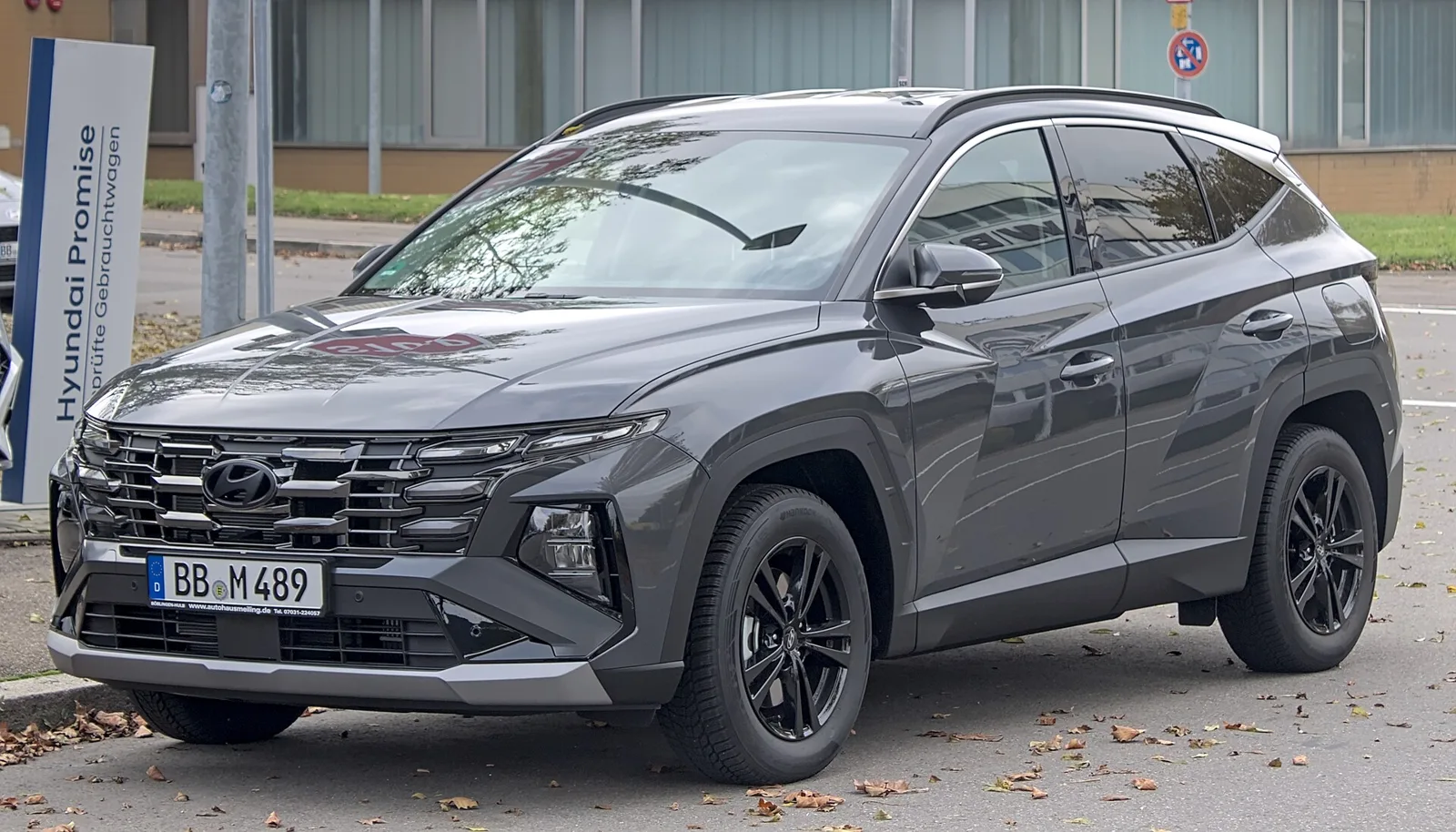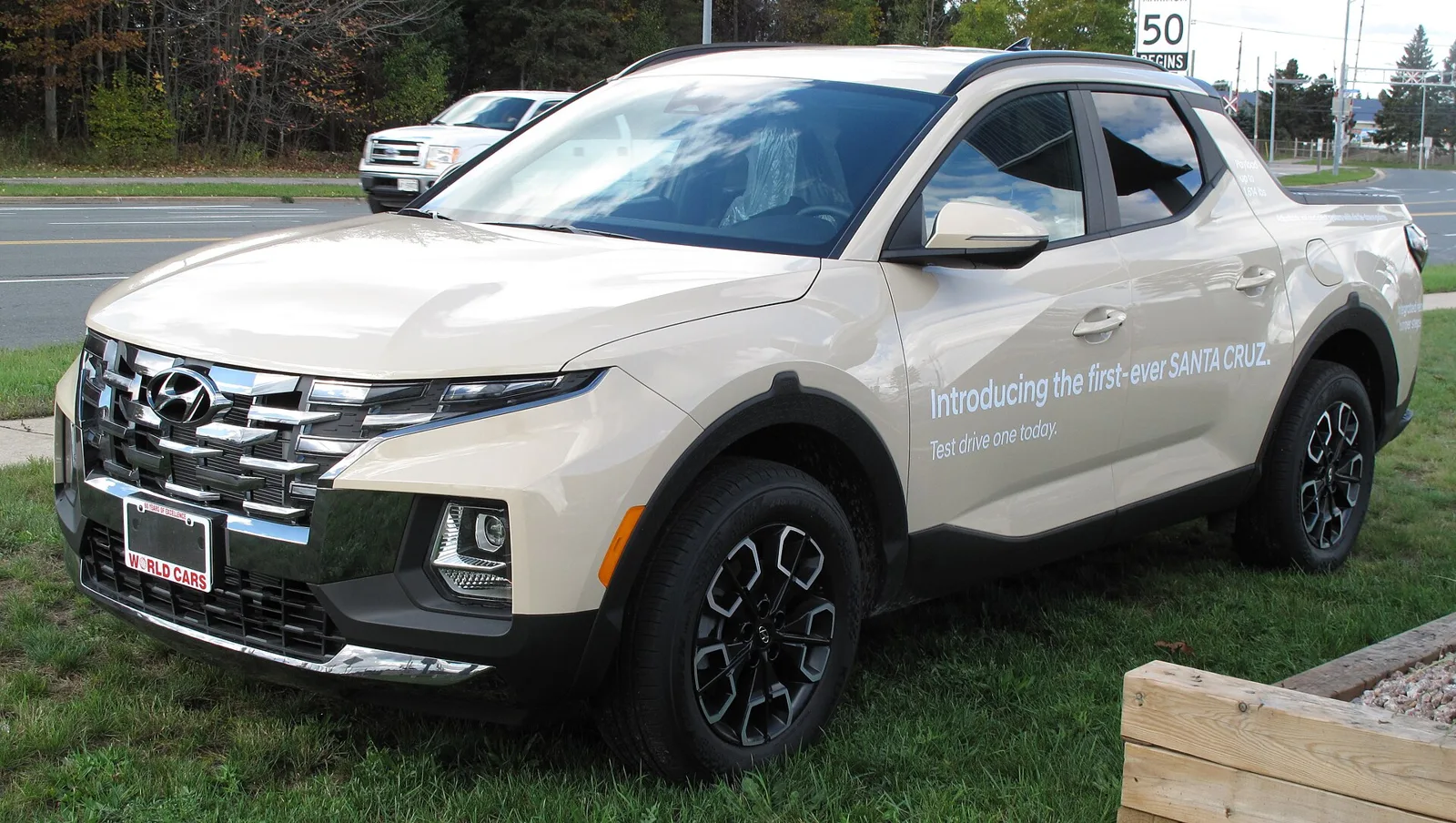
A hydrogen fuel cell crossover, a unibody pickup and the full-size SUV that took more than half of the Korean market in 1992.
The Hyundai Nexo is a hydrogen fuel cell crossover revealed in 2018 with up to 611 km of EPA range. The Santa Cruz is a Tucson-based compact pickup released in 2021. The Galloper was a full-size SUV sold from 1991 to 2004, a localised Mitsubishi Pajero.
Within a year of its 1991 launch, the best-selling SUV in South Korea was a Mitsubishi Pajero wearing a Hyundai badge. The Galloper took 52 percent of the domestic market in 1992. Beside it are two newer Hyundai oddities: the Nexo, a hydrogen fuel cell crossover, and the Santa Cruz, a compact pickup on a crossover's underpinnings.
What are the Hyundai Nexo, Santa Cruz and Galloper?
The Hyundai Nexo, revealed in 2018, is a crossover SUV powered by hydrogen fuel cells. The Hyundai Santa Cruz is a four-door compact pickup released in 2021, based on the Tucson. The Hyundai Galloper was a full-size SUV built from 1991 to 2004 as a localised first-generation Mitsubishi Pajero.
A rebadged Pajero took 52 percent of the Korean SUV market in 1992.
What is the Hyundai Nexo?
Hyundai revealed the Nexo at the 2018 Consumer Electronics Show on 8 January 2018. It replaced the Tucson FCEV and serves as the flagship of Hyundai's "eco car" portfolio. The name comes from the Danish city of Nexo.
Range figures improved a great deal on the Tucson FCEV. The Nexo Blue has an EPA-rated range of 611 km (380 mi), and the Nexo Limited has 570 km (350 mi), against 470 km (290 mi) for the older car. Three tanks together hold 6.3 kg of hydrogen, or 156 litres, compared with 5.6 kg and 140 litres before. The electric motor makes 163 PS and 400 Nm, up from 135 PS and 300 Nm.
The principle is simple. Hydrogen gas is stored in pressurised tanks and reacts with oxygen from the air inside the fuel cell, producing electricity to drive the motor and releasing only water.
How did the Hyundai Nexo sell?
The Nexo went on sale in South Korea in March 2018, with a warranty on fuel cell components of 10 years or 160,000 km (99,000 mi). By October 2020, sales there had passed 10,000: 727 in 2018, 4,194 in 2019 and 5,097 up to October 2020.
Overseas, the first US sale came in December 2018, after media saw the car in October with the plan to make it available only in California by the end of the year. The UK received it in March 2019. In March 2021 it reached Australia on special order for lease, and became the first hydrogen fuel cell vehicle sold there.
Driver assistance and a disputed claim
The Nexo got Hyundai's new assistance systems. A blind spot view monitor uses surround-view cameras to show the sides and rear of the car before a lane change, and Hyundai claims to be the first carmaker with the feature. Lane follow assist keeps the car centred by detecting lane markings or road edges and applying gentle steering. Highway driving assist watches the road with sensors and adjusts speed, and a remote parking assistant can park and retrieve the car without a driver aboard.
The car also has an air purification system that Hyundai says removes 100 percent of PM2.5 fine particles from polluted air in a three-step filtration process. The British Advertising Standards Authority judged the marketing of this feature misleading, since the car itself releases harmful particles through tyre and brake wear, and critics cited the advertising as an example of greenwashing.
In a 2018 trial, researchers at Australia's CSIRO successfully refuelled a Nexo with hydrogen separated from ammonia using a membrane. Euro NCAP awarded the Nexo 5 stars in 2018.
Second-generation Nexo
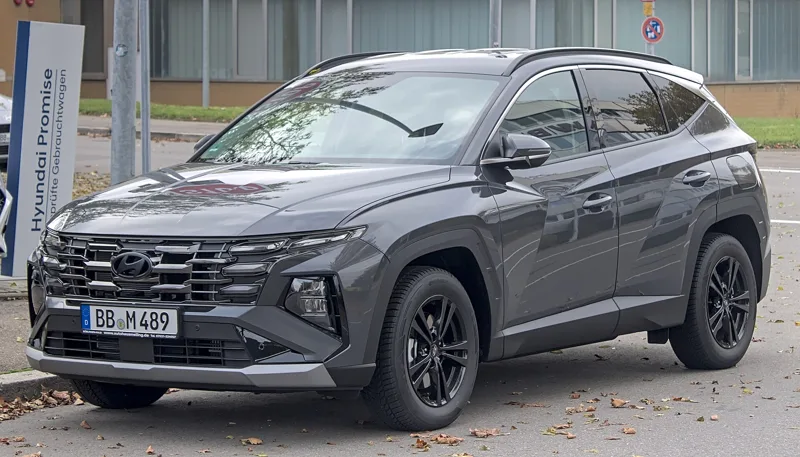
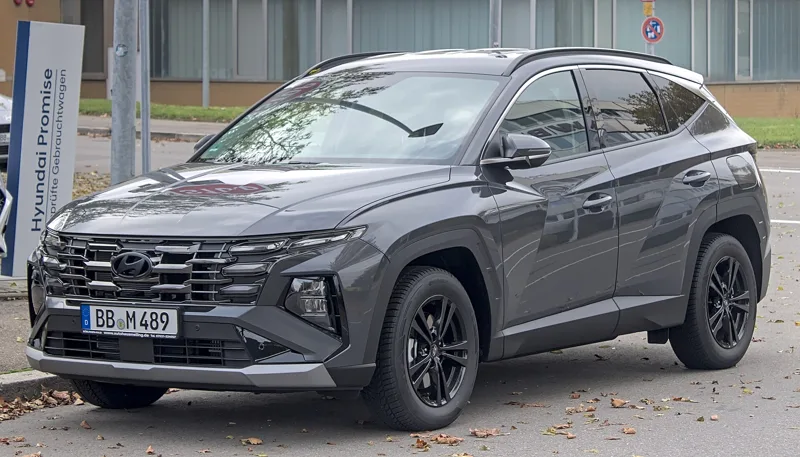
Hyundai previewed the second-generation Nexo as the Initium concept on 31 October 2024, and revealed the production version on 3 April 2025, quite close to the concept. The front daytime running lights and rear combination lamps carry the HTWO lamp, a symbol of the molecular formula for hydrogen and of Hyundai Motor Group's HTWO hydrogen business brand. The car has a panoramic curved display and digital side mirrors.
What is the Hyundai Santa Cruz pickup?
Hyundai released the Santa Cruz, a compact pickup truck with four doors, in 2021 for the 2022 model year. It was the first such truck the company sold in North America. The Santa Cruz is based on the Tucson crossover SUV and uses a unibody chassis, in which body and frame are one structure, unlike a traditional truck's separate ladder frame.
Industry analysts expected it to attract car or crossover SUV buyers rather than owners of larger, traditional pickups. Hyundai is reportedly set to discontinue production in 2026.
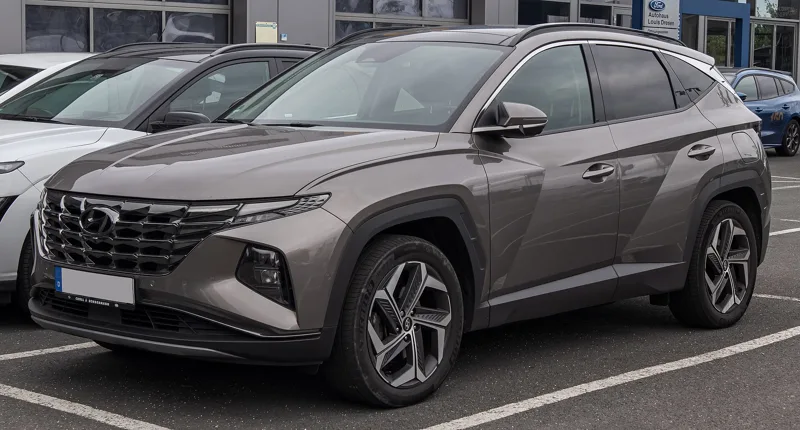
A concept pickup with the same name was shown at the 2015 North American International Auto Show, and the production model debuted in April 2021. Hyundai calls it a "Sport Adventure Vehicle". Underneath it is a close relation of the fourth-generation Tucson, with the same NX4 project code (an 'a' marks American production and 'OB' means open bed), the same plant and the same dashboard design. The front, with a grille that integrates the daytime running lights, echoes the Tucson's styling.
Drive and suspension
The base Santa Cruz is front-wheel drive, with an optional upgrade to the HTRAC all-wheel-drive system, which can send up to 50 percent of the drive to the rear wheels through a lockable clutched centre differential. The front wheels use MacPherson struts, and the rear has a multi-link independent suspension with self-levelling shock absorbers that keep the truck level when there is weight in the bed or on a trailer hitch.
What engines does the Hyundai Santa Cruz have?
The standard engine is a naturally aspirated 2.5-litre four-cylinder with port and direct injection, producing 191 hp (194 PS; 142 kW) and 181 lb ft (245 Nm). That engine is exclusive to the United States. A turbocharged 2.5-litre engine makes 281 hp (285 PS; 210 kW) and 311 lb ft (422 Nm). It is optional in the US and standard in Canada.
The base engine is paired with an eight-speed automatic. Turbo models originally used an eight-speed dual-clutch automatic with paddle shifters, but for the 2026 model year they switched to an eight-speed conventional automatic.
The facelifted truck was revealed on 27 March 2024. It has new headlights with redesigned LED daytime running lights, a new front fascia and grille, new colours and wheels, and a curved panoramic screen holding two 12.3-inch displays. Physical controls for the climate system and infotainment shortcuts return, there is a new steering wheel and new air vents, and the XRT version received some visual changes. The 2022 Santa Cruz was awarded Top Safety Pick by the IIHS.
What is the Hyundai Galloper?
The Galloper, also called the Galloper Exceed, Galloper Innovation, Mitsubishi Galloper, Asia Galloper and Hawtai Jitian, is a full-size SUV built by Hyundai from 1991 to 2004. It is a localised version of the first-generation Mitsubishi Pajero.
How the Galloper began
Chung Mong-koo drove the localisation while heading the Hyundai Precision and Industry division of the Hyundai Group. His father, group chairman Chung Ju-young, reportedly asked why he was leaving Hyundai Motor, then led by his uncle Chung Se-yong, to make a four-wheel-drive vehicle. His answer was that Hyundai Motor was a sedan-oriented company that resisted developing a utility vehicle, and that adding to the range would benefit both the group and the Korean market.
Hyundai Precision first worked with Roush Enterprises on a four-wheel-drive utility vehicle, the X-100 ECS ROUSH, but test audiences panned it and it never reached the market. The company then picked the Pajero for localisation, razed a container factory at Yeompo-dong that had been completed in 1989, and rebuilt it as a dedicated car plant.
The design is almost identical to the Pajero. Changes for Korea included steel bush guards on the higher Exceed trim, running boards and "Western"-style door-mounted mirrors. It is a five-seater with a third row for two more, making seven. A three-door short-wheelbase body was sold as the Galloper 4WD and Innovation 4WD, and a five-door long-wheelbase body as the Galloper I and II Exceed.
How successful was the Hyundai Galloper?
Hyundai launched the Galloper at the Seoul Hyatt Hotel on 25 September 1991, and within a year it was the best-selling SUV in Korea. The 5,000th car was assembled in February 1992. Hyundai sold 24,000 Gallopers in 1992, a 52 percent share of the domestic market, which knocked the Ssangyong Korando off the top spot. Ssangyong answered with the Musso in 1993, using Mercedes-Benz engines.
The advertising slogan was "Follow the Sun to the West". Three Gallopers drove 73,000 km (45,000 mi) between 28 March 1992 and 9 January 1993, starting in Mumbai and crossing 35 countries to reach Cabo da Roca in Portugal. Hyundai called it the "Travels of Marco Polo" route, and a book about the journey appeared in 2000.
Cartech's October 1991 review was generally positive, praising refinement compared with other Korean SUVs of the time, and criticising only the short gear selector, tight space between driver and door, and difficult access to the third row.
Engines and chassis
The first Gallopers had round sealed-beam headlights and a 2.5-litre naturally aspirated D4BA diesel with 73 hp (54 kW) at 4,200 rpm and 108 lb ft, driving through a five-speed manual. An automatic arrived in November 1991 and a D4BF turbodiesel with 81 hp (60 kW) in December. A G6AT V6 petrol option followed in February 1992. In 1993 an intercooler was added to the turbodiesel, which became the D4BH with 101 hp (75 kW).
Up front the Galloper has double wishbones and torsion bars, and at the rear a live axle with asymmetric leaf springs. The brakes are ventilated discs at the front and drums at the rear, with a load-sensing valve that apportions force and resists rear-wheel lock-up when the vehicle is lightly loaded.
Production began in September 1991 at the Hyundai Precision factory in the Yeompo-dong neighbourhood of Ulsan's Buk-gu district. Hyundai Motor Company made the engines, transmissions and body panels, and Hyundai Motor Service sold the finished SUVs.
Later years
A mild restyle in 1994 brought square headlights, horizontal mirrors, new body styles and a nine-seat option. That year Hyundai began exporting the Galloper to other Asian countries, starting with China, and by December it had built its 100,000th. From 1997, after around 220,000 had been built, most European markets got it as a left-hand-drive-only vehicle. Production capacity was 60,000 a year. It sold very well in Europe, particularly in Spain and Italy, which had erected trade barriers against Japanese vehicles.
The Galloper II of 1997 had composite replaceable-bulb headlights and extra side cladding, while mechanically staying close to its predecessor. Its updated styling made it resemble the second-generation Pajero. By 1999 more than 300,000 Gallopers had been built, and on 31 July 1999 the plant and line passed from Hyundai Precision to Hyundai Motor Company as Hyundai Motors Ulsan Factory #5. Hyundai discontinued the Galloper in January 2004, after thirteen years, and the Terracan succeeded it.
The Galloper today
Early Gallopers have grown in value since the early 2010s. Nostalgic owners spend more than 30 million won restoring cars bought for a twentieth of that. Mohenic Garage built restomod Gallopers as the Mohenic G for up to 85 million won (US$80,000), taking up to 12 months each. Because of the engine's obsolete pollution control, access to central Seoul in a Galloper has been restricted since 2021.
In November 2021, Hyundai said the third model in its Heritage Series of battery-electric restomods, after the Pony EV and Grandeur EV, would be based on the 1991 Galloper. As of 2025 it had not been revealed and is likely cancelled. The Galloper brand was brought back in 2026 for rebadged, Chinese-made Dongfeng Nissan products, among them the Paladin (the Nissan Terra) and the Dongfeng Rich 6.
How do the Hyundai Nexo, Santa Cruz and Galloper compare?
| Feature | Nexo | Santa Cruz | Galloper |
|---|---|---|---|
| Type | Hydrogen fuel cell crossover SUV | Four-door compact pickup | Full-size SUV |
| Built | From 2018 | 2021, reportedly ending 2026 | 1991 to 2004 |
| Power | 163 PS, 400 Nm electric motor | 2.5-litre petrol, 191 hp; turbo 281 hp | 2.5 diesel, V6 petrol |
| Basis | Replaced the Tucson FCEV | Tucson crossover, unibody | First-generation Mitsubishi Pajero |
| Headline figure | 611 km EPA range (Blue) | Up to 50 percent drive to rear wheels | 24,000 sold in 1992 |
What is the status of the Nexo, Santa Cruz and Galloper now?
The second-generation Nexo, the NH2, was revealed in April 2025. The Santa Cruz is reportedly due to end production in 2026. The Galloper EV concept has not appeared and is likely cancelled, although the Galloper name itself returned in 2026 on rebadged Chinese-made Dongfeng products.