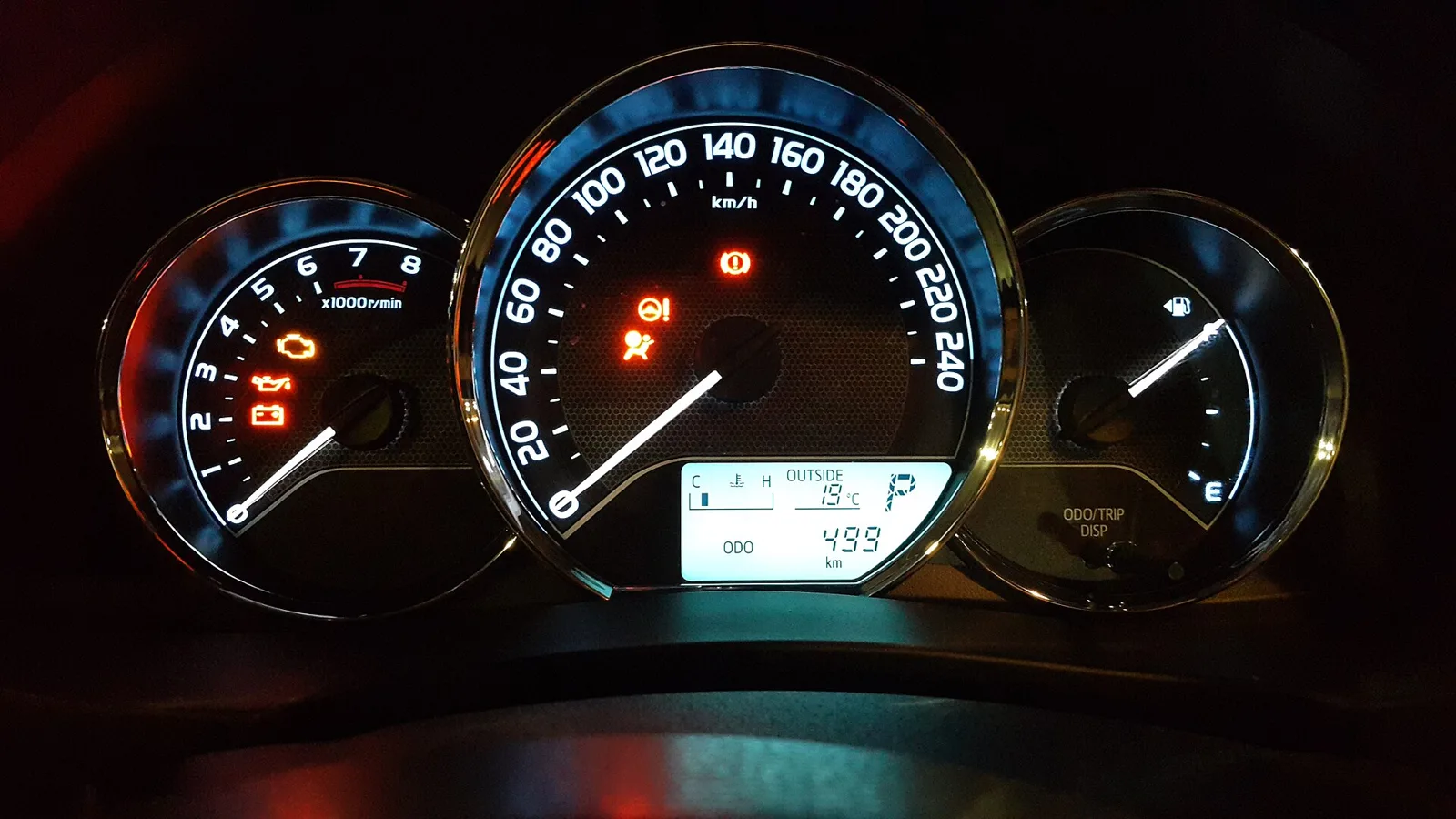
A magnet dragging an aluminium cup, a stream of electronic pulses and the legal rule that a gauge may flatter you but never understate your speed.
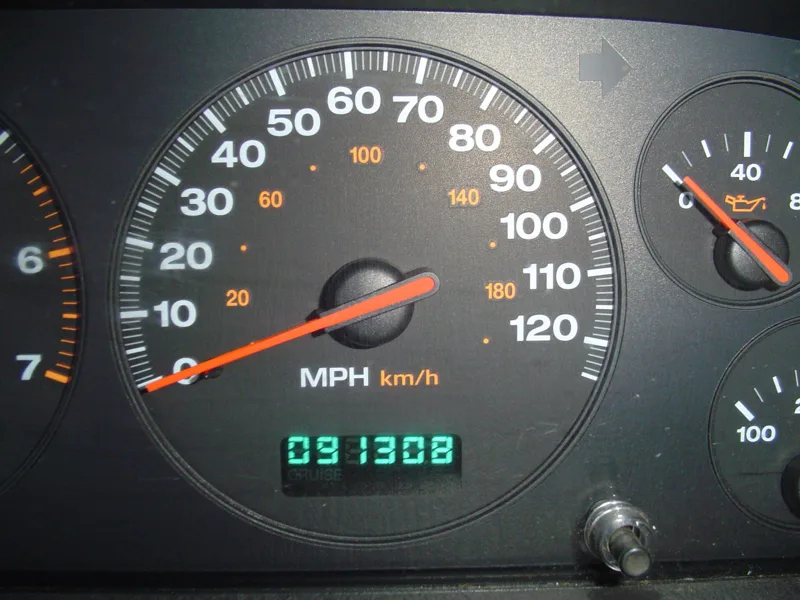
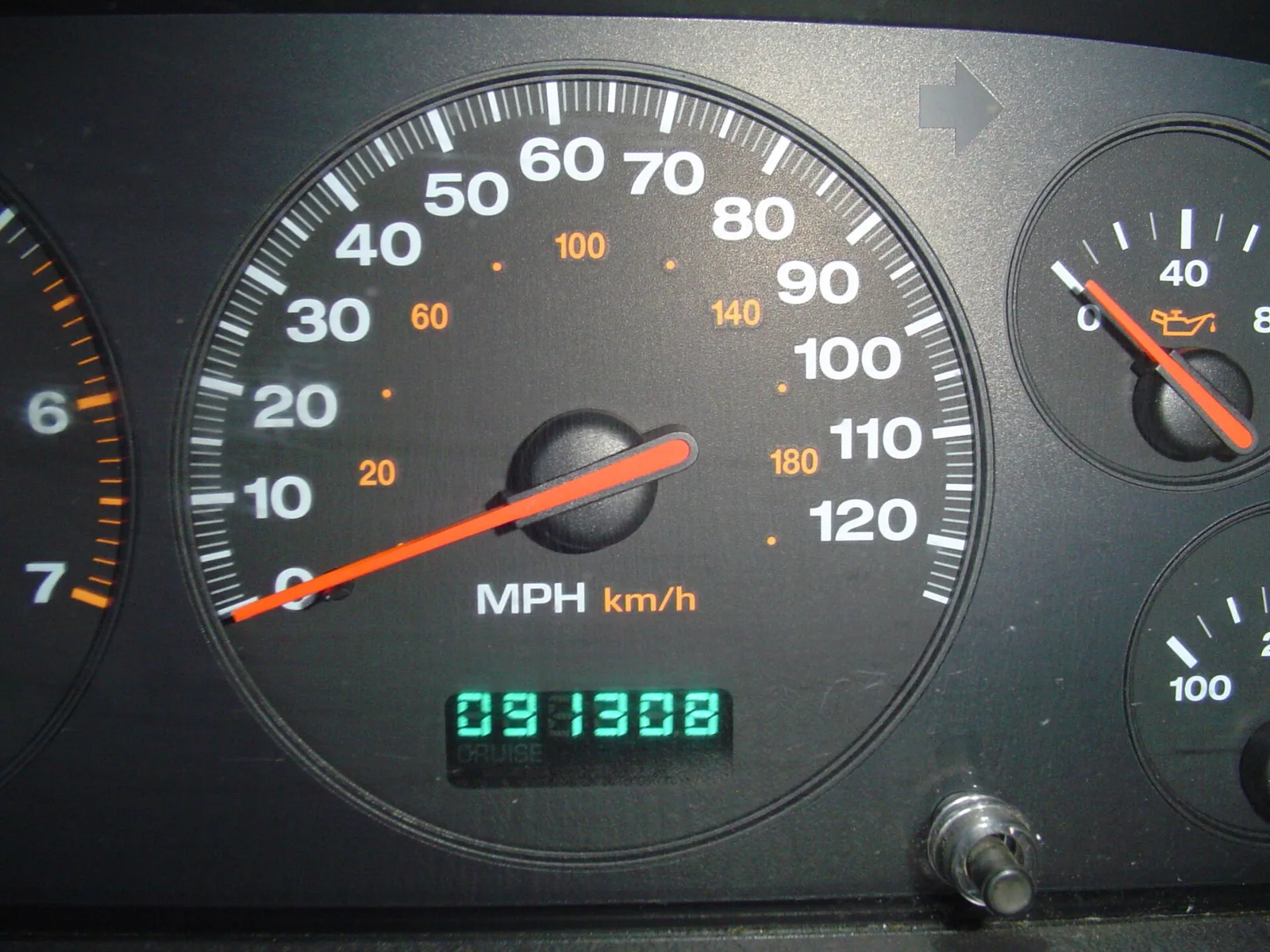
A speedometer measures how fast the wheels or driveshaft turn, using a magnet-and-cup cable design or electronic pulses, then assumes a tyre size. Makers calibrate it to read slightly high, and the rules forbid it ever reading low, allowing up to 110 percent of true speed plus 4 km/h.
Under the UNECE rules that many countries follow, a speedometer is allowed to say 92 km/h when your car is doing 80, yet it is never allowed to say 78. The law tolerates a gauge that flatters your speed and forbids one that understates it, and that single asymmetry explains why almost every car reads a little high.
How does a speedometer work?
A speedometer is a gauge that shows a vehicle's instantaneous speed. Speedometers appeared as options early in the 20th century and became standard equipment from about 1910. Charles Babbage is credited with an early type, usually fitted to locomotives, and the Croat Josip Belusic patented an electric version in 1888, calling it a velocimeter. Otto Schultze patented a similar eddy-current design in 1902.
Boats and aircraft need other means: a boat uses a pit log and an aircraft an airspeed indicator. For cars, the choice is between measuring the turning of a driven part and, more recently, measuring position over time.
A speedometer may flatter your speed, but the rules never let it understate it.
How does a mechanical speedometer work?
Most mechanical speedometers use a flexible rotating cable driven by gearing connected to the transmission. A cable from the front wheel did the job on the early Volkswagen Beetle and many motorcycles instead. Inside the instrument the cable spins a small permanent magnet beside a thimble of aluminium, called a speedcup, that is fixed to the pointer shaft.
No physical link joins the two. As the magnet rotates, its changing field creates eddy currents in the cup, and those currents create a field of their own. The result is a drag that tugs the cup, and the pointer with it, in the direction the magnet is turning. A fine torsion spring pulls the pointer back towards zero.
The pull grows with the cable's speed, so the cup turns until the drag and the spring balance, and there it stops. Drag scales with speed, and the spring's stretch scales with drag, so the pointer angle scales with speed, and that is why the markers on the dial can be evenly spaced.
The return spring is calibrated so that a given cable speed gives a given reading. That calibration has to allow for the gears driving the cable, the differential's final drive ratio and how big the driven tyres are, which is a clue to where the error comes from later. The design has one weakness: it cannot show speed in reverse, because the cup would turn the other way and the needle would be driven against its stop pin at zero.
There were other approaches. Some early mechanical units used the governor principle, a rotating weight working against a spring and swinging outward with speed, as on a steam engine. The chronometric speedometer measured the distance covered in a precise interval, three-quarters of a second in some Smiths instruments, timed by an escapement. It tolerated vibration well and stayed in motorcycles into the 1970s.
How does an electronic speedometer work?
Many modern speedometers are electronic. A rotation sensor in the transmission sends out a series of pulses, and their frequency matches the average rotation speed of the driveshaft, and so the car's speed, provided the wheels grip fully. The sensor is usually a magnet or several mounted on the output shaft, or a toothed steel disk that passes between a magnet and a field sensor. Each passing magnet or tooth disturbs the field and makes a pulse.
Some manufacturers, particularly in cars with multiplex wiring, take the pulses from the ABS wheel sensors instead and send them to the instrument panel over the CAN Bus. A computer turns the pulses into a speed and drives either an analogue-style needle or a digital display. Unlike the eddy-current type, most electronic speedometers can show speed when the car is reversing.
The same pulses do other work. The engine computer uses them for ABS and traction control, for working out average trip speed, and for counting distance on the odometer in place of a cable turning it directly. An older electronic design balanced a precision watch mechanism, which pushed the pointer towards zero, against a pulsator driven by a wheel or the transmission, which pushed it the other way. The pointer settled where the two balanced.
Is GPS speed better than the speedometer?
A virtual speedometer works from satellite navigation such as GPS. It estimates speed from distance covered over time instead of from anything spinning in the car. The approach tends to be less accurate than an analogue counterpart over short distances, and it can be affected by weather, terrain and anything that obstructs the signal.
That helps explain why a phone and a dashboard rarely match. The dashboard speed comes from a sensor that counts wheel or driveshaft turns and assumes a tyre size, with the manufacturer's deliberate bias on top. The phone works from the position fixes it manages to get. Neither is perfect, and they do not fail in the same way.
Bicycles show the trade-off clearly. A typical bicycle speedometer times each wheel revolution and updates once per turn, as seldom as once every 2 to 3 seconds at low speed on a 26-inch (660 mm) wheel. Because these devices can be programmed with the wheel size or circumference, they can beat the typical car gauge for accuracy and precision.
Why do speedometers read high?
Most speedometers have tolerances of about plus or minus 10%, largely because tyre diameter varies. Wear, temperature, pressure, load and nominal tyre size all change it. Manufacturers therefore set the instrument to over-read by the average amount of error. That way the speedometer never shows a speed lower than the vehicle's real speed, and the manufacturer cannot be held liable for a driver breaking a limit because of what the dial said.
The rules back that logic. Many countries ultimately take their legal speedometer error from Regulation 39 of the United Nations Economic Commission for Europe (UNECE), which deals with the speedometer side of type approval. Its purpose is to ease trade by letting one set of uniform standards replace separate approvals in every country. European Union standards are similar. The displayed speed can never be lower than the true one, so a wrong reading cannot lead a driver into speeding unknowingly. Nor may it exceed 110 percent of the true speed plus 4 km/h (2.5 mph) at the specified test speeds.
| Stage | Upper limit on indicated speed | Applies to |
|---|---|---|
| Type approval | 110 percent plus 4 km/h (2.5 mph) | Vehicle models being approved |
| Production audit | 110 percent plus 6 km/h (3.7 mph) | Cars, buses, trucks and similar vehicles |
| Production audit | 110 percent plus 8 km/h (5.0 mph) | Two- or three-wheelers above 50 km/h (31 mph) |
Testing is specific. For most vehicles the checks run at 40, 80 and 120 km/h (25, 50 and 75 mph), at a set air temperature on a defined road surface. Take 80 km/h (50 mph) as the example: the dial may show 92 km/h (57 mph) at most. The tests are the same in spirit across standards, although the minimum accuracy of the equipment that measures true speed differs slightly. European Union Directive 2000/7/EC covers two- and three-wheeled vehicles with similarly relaxed production limits.
How do tyre size and wear change the reading?
The speedometer counts turns and assumes a tyre size, so fitting a tyre with a different diameter changes the reading. Excessive error after manufacture most commonly comes from a non-standard tyre. The error is 100 times one minus the ratio of the new diameter to the standard diameter.
The diameter of a tyre follows from its size code. In millimetres it is twice the section width multiplied by the aspect ratio divided by 100, plus the wheel diameter in inches multiplied by 25.4. A standard 185/70R14 works out at 614.6 mm (24.20 inches). A 195/50R15 comes to 576.0 mm (22.68 inches). Swap the first for the second, on 15-inch (381 mm) wheels, and the speedometer reads 6.7% higher than the real speed. At an actual 100 km/h (62 mph), it shows approximately 106.7 km/h (66.15 mph).
Wear matters too, though far less. A new 185/70R14 of 620 mm (24.4 inches) has about 8 mm of tread. At the legal limit of 1.6 mm it is 12.8 mm smaller in diameter, 0.5 inches, which is 2% of 620 mm. A worn tyre therefore turns more often per kilometre and nudges the reading upward by that amount.
What are the speedometer rules in Australia?
No Australian Design Rule covered speedometers until July 1988, when they became necessary because speed cameras were arriving. As a result there are no legally accurate speedometers for older vehicles. Cars built from 1 July 2007 onward, and any model launched from 1 July 2006, must comply with UNECE Regulation 39.
What does the odometer do?
An odometer, or odograph, measures distance travelled. It may be electronic, mechanical or electromechanical. In places that use imperial units it is called a mileometer or milometer, especially in the UK and the Commonwealth.
It is one of the oldest instruments in motoring. Vitruvius described one in the 1st century BC, with chariot wheels 4 Roman feet (1.18 m) across turning 400 times to the Roman mile (about 1,480 m). On each turn a pin nudged a 400-tooth cogwheel, and a second gear dropped pebbles into a box, so the distance was simply the number of pebbles. Leonardo da Vinci tried to build it and failed. In 1981 the engineer Andre Sleeswyk built a replica using the pointed teeth found in the Antikythera mechanism, and it worked perfectly. In China, odometer carriages struck a drum at each li and a gong or bell at each ten li.
Blaise Pascal's pascaline of 1645 is not an odometer, but its gears of 10 teeth each, with one advancing the next after a full turn, are the same principle modern mechanical odometers use. William Clayton and Orson Pratt put a gear-based Roadometer on a settlers' wagon in 1847. In 1903 the Warner brothers of Beloit, Wisconsin, introduced the Auto-meter, which used a magnet on a rotating shaft to pull on a thin metal disk, giving both speed and distance from one instrument. By 1925 odometers and trip meters from Stewart-Warner came as standard on most American cars and motorcycles.
Mechanical odometers were phased out by the early 2000s. GM's last mechanical odometer in the US was on the 2003 Pontiac Grand Prix, and the Ford Crown Victoria and Mercury Grand Marquis, the last Fords with one, followed in 2005. Today the electronic counting uses the same pulses that feed the speedometer.
Where does the tachometer fit in?
The word tachometer and the word speedometer mean essentially the same thing: a device that measures speed. By an arbitrary convention, the automotive world uses one for engine revolutions and the other for vehicle speed. A car tachometer shows the crankshaft's rotation rate and typically marks a safe range, helping the driver pick the right throttle and gear.
Sustained high revs risk poor lubrication, overheating and exceeding the capability of parts such as valve springs. The red area on an analogue dial gave us the term redlining, and most modern cars add a rev limiter to prevent damage. Diesels with traditional mechanical injection have an integral governor, so their tachometers sometimes have no redline at all.
What does this mean for you?
A few practical readings follow. A dashboard speed a little above your true speed is normal and intended, and by design it can never lie in the other direction. A change of wheel and tyre size shifts the figure by a predictable amount, which you can calculate from the diameters. A phone's GPS reading is a useful cross-check, but it has its own error sources. And in Australia, vehicles built before the July 1988 rules have no legally accurate speedometer to rely on in the first place.