Where the law draws its lines, how pricing guides weigh mileage, and the checks that matter more than the number on the clock.
No single mileage is too many on a used car. The odometer measures only distance, while condition rests on appearance, history, mechanical state and mileage together. Legal lines differ: Queensland removes the warranty at 160,000 km or 10 years, while the EU gives 12 months.
In the Australian state of Queensland, one number on the dashboard can strip away a used car's warranty. Sell a car that has covered fewer than 160,000 km (99,000 mi), and was built under 10 years earlier, and the dealer owes three months or 5,000 km of cover. Cross either line and the cover is gone. The law treats the odometer as a hard edge. Buyers and pricing guides do not, and that gap is at the heart of the question of how many miles is too many on a used car.
How many miles is too many on a used car?
The legal answer is a patchwork. Queensland draws its lines at 160,000 km (99,000 mi) and 10 years. Across the European Union, used cars carry a statutory warranty, known as liability for defects, that lasts 12 months. Elsewhere the buyer is left to the seller's own cover: some retailers offer certified used cars, extended service plans or warranties, and certified pre-owned vehicles made up about 33% of global used-car sales by 2025.
| Place | Condition | Cover |
|---|---|---|
| Queensland, Australia | Under 160,000 km (99,000 mi) and made under 10 years before sale | Three months or 5,000 km (3,100 mi), whichever comes first |
| Queensland, Australia | 160,000 km (99,000 mi) or more, or made 10 years or more before sale | No warranty |
| European Union | Used cars generally | Statutory warranty of 12 months |
Queensland also excludes motorcycles, caravans and commercial vehicles from the warranty altogether. A commercial vehicle there means a car with nine seats or more, or one that can haul a ton of goods; utilities, which are built to carry goods, are treated differently.
The odometer measures distance and nothing else; condition is judged on appearance, history, mechanics and mileage together.
What an odometer actually measures
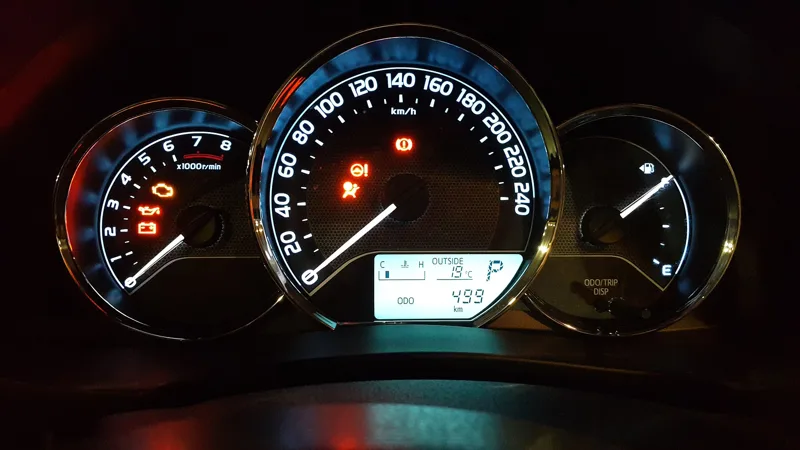
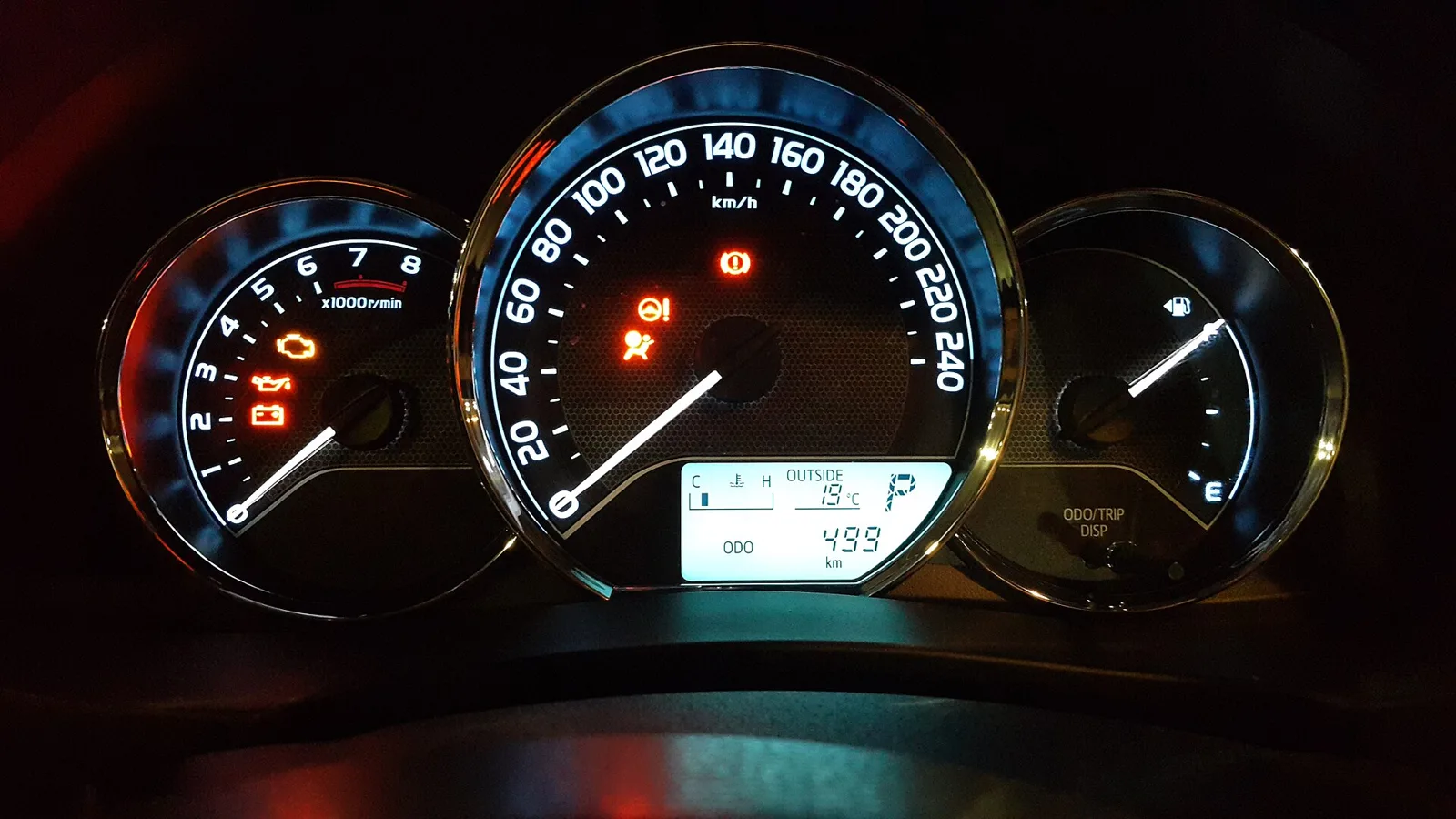
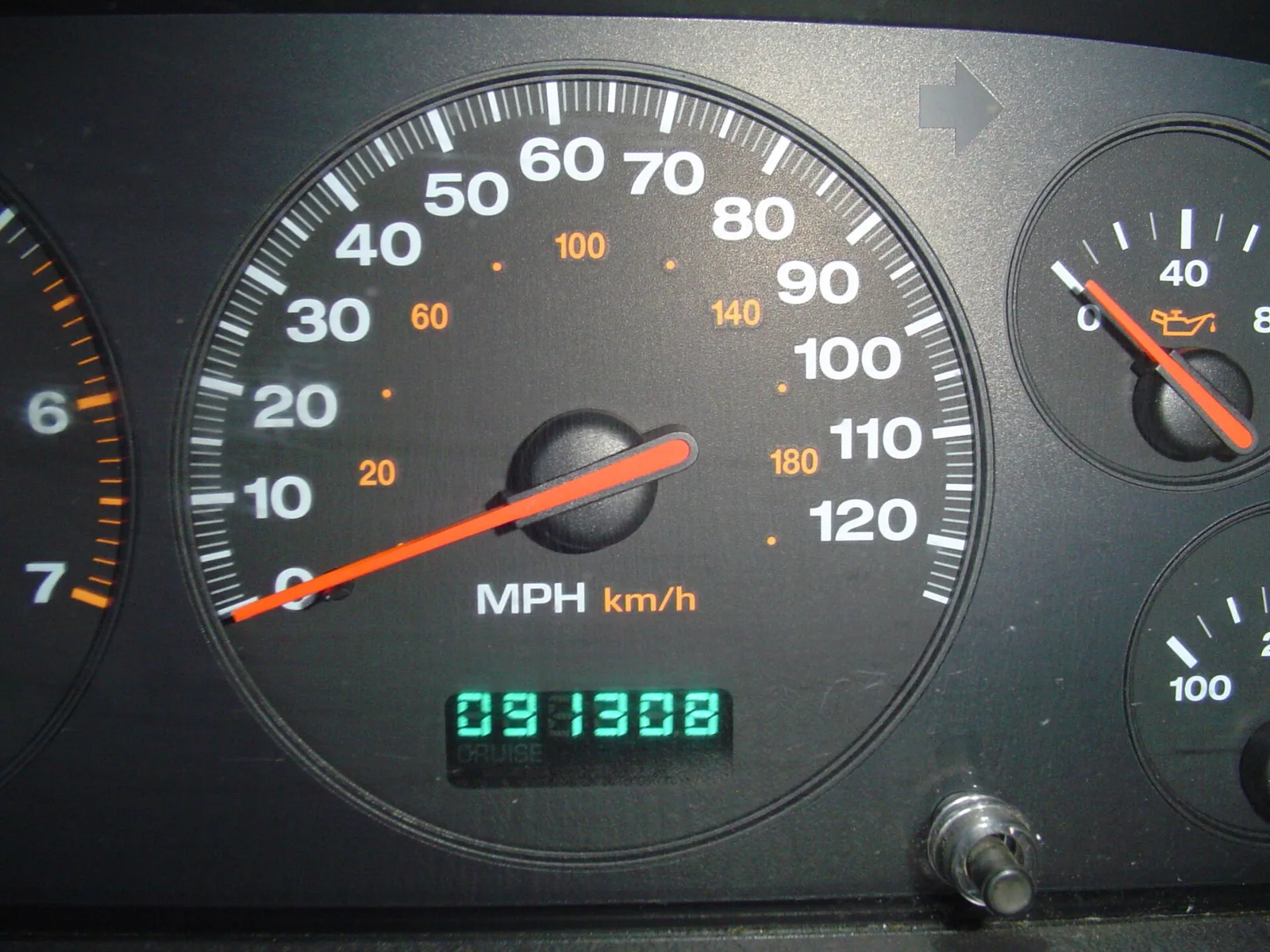
An odometer measures the distance a vehicle has travelled and nothing else. It may be electronic, mechanical or a mix of both. In Britain and the Commonwealth the instrument is often called a mileometer or milometer, and most modern cars add a trip meter as well.
The idea is old. Vitruvius described a chariot odometer in the 1st century BC, in which wheels 4 Roman feet (1.18 m) across turned 400 times per Roman mile (about 1,480 m) and dropped a pebble into a box on every mile. Ancient China had a carriage that struck a drum for every li and a gong or bell for every ten. The principle behind the modern mechanical odometer came later: in 1645 Blaise Pascal built a calculator whose gears each had 10 teeth and advanced the next gear one place per full turn.
The car instrument arrived in 1903, when the Warner brothers launched the Auto-Meter, which used a magnet on a rotating shaft to give both distance and speed. Stewart-Warner, which bought the Warners' company in 1912, made the instrument almost universal: by 1925 its odometers and trip meters came as standard on most cars and motorcycles built in the US. Mechanical units faded out in the early 2000s. GM's last US model to offer one was the 2003 Pontiac Grand Prix, and Ford's were the Canadian-built Crown Victoria and Mercury Grand Marquis in 2005.
Earlier versions did serious work. In 1847 the pioneers William Clayton and Orson Pratt fitted their Roadometer, built with two gears in the manner of Pascal's calculator, to a wagon used by settlers heading west, and it recorded the distance covered each day by the wagon trains. Benjamin Franklin had built a prototype in 1775 to measure the mileage of postal routes. A French firm, Felber, showed a carriage odometer at the 1881 Paris exhibition that sent an electrical pulse every 100 metres to a dashboard dial.
High mileage car: what matters more than the number
Pricing guides treat mileage as one input among four. A used car's condition is judged on its appearance, its vehicle history, its mechanical condition and its mileage, and there is much subjectivity in how those are weighed. The overall condition has a major impact on price.
Mechanical condition is where distance travelled turns into wear, and the suspension is a good place to see it. The suspension keeps each wheel in steady contact with the road, because every force the road exerts on the car passes through the tyre contact patches. It also protects the car and its cargo from damage and wear. Worn-out or damaged springs let a car ride lower, which cuts the compression travel left in the suspension and adds body lean. Springs of the wrong stiffness, whether too firm or too soft, also fail to isolate the car from the road.
Use matters as well as distance. Vehicles that carry heavy loads are given heavier springs, set close to the upper limit for their weight, while a luxury car, taxi or bus is described as soft-sprung for the comfort of passengers. A spring that is right for one job can feel wrong, or wear differently, in another, which is one more reason the same reading on the clock can mean different things on two cars.
That makes a test drive worth more than a glance at the dash. How a car settles over bumps, how much it leans in a corner and whether it sits level are all things the odometer cannot show you. Shock absorbers, which Mors of Paris first fitted to a car in 1901, and coil springs, which first appeared on a production car in 1906, are standard parts to examine, and most cars now have independent suspension on all four wheels. Rear-wheel-drive models often use a complex multi-link rear layout. Newer cars add air suspension with adjustable ride height, adaptive dampers and active roll control, which gives a buyer more to examine.
Odometer fraud and what a history report can show
A clock can be wrong, so buyers cross-check it. A vehicle history report, built on the car's vehicle identification number (VIN), lists who has owned the car, whether its title has been branded, whether it was bought back under lemon laws, whether the odometer has been tampered with, and any recalls. It may also show maintenance records, collision damage and whether the car once worked for a rental firm, the police or a taxi fleet. Roughly a third of American used-vehicle buyers, an estimated 34%, paid for a report in 2006.
The data comes from police records, the UK licensing authority (DVLA), lenders, a national mileage register, insurers and trade bodies, and a report can only repeat what those holders know, so a clean report is not a guarantee. Of the dozen or so providers approved under the US National Motor Vehicle Title Registration System, about half sell to consumers and none is free; the Better Business Bureau advises using an approved one. Some services sell reports to dealers, who then display them free on their websites. The UK government's own service covers a single aspect of a car's past, such as Ministry of Transport records. In India the Parivahan portal handles registration only, and private providers source service records from authorised service centres.
The US Federal Trade Commission also recommends weighing a dealer's reputation when deciding where to buy.
Questions to put to the seller
- Which side of the warranty lines does the car sit on? In Queensland that means 160,000 km (99,000 mi) and 10 years from the build date.
- Can I see a history report tied to the VIN, and does it show any rental, police or taxi use?
- Where are the maintenance records, and who produced them?
- How does the car ride and lean on a test drive, and does it sit level?
- Is the asking price a retail, a trade-in or a private-party figure?
Used car depreciation and the price you should pay
Mileage and age drive price along a steep curve. In the United States a new vehicle typically sheds 20% to 30% of its value within the first twelve months and about 60% by its fifth year. Prices fall faster where incomes are high, so a seller in a rich country can get more for the same car in a poorer market, which is the incentive to export used vehicles.
A used-car pricing report usually gives three numbers. The dealer or retail price is what you pay a licensed dealer. The trade-in or wholesale price is what a dealer will pay, whether at trade-in or at a dealer auction. The private-party price sits between them: a private seller hopes for more than a trade-in offer, and a private buyer hopes to pay less than retail. Guides rely on different data and judge it differently, so their values can differ.
Geography matters too. Convertibles are in higher demand in warm climates, and pickups sell better in rural areas than in cities. One theory about the market also explains why a used car costs less than its condition suggests: owners of problem cars, known as lemons, are more likely to sell, so a buyer carries a higher risk and prices adjust downwards.
Prices for used vehicles aged one to five years in the US averaged about US$31,624 in March 2025, up 1% on a year earlier. That was the first annual rise since late 2022, and it was mainly down to a shortage of near-new cars reaching the used market. Buyers who financed a used vehicle in the first quarter of 2025 borrowed US$28,338 on average, at an annual percentage rate of 11.3%.
Why governments count years, not kilometres
Look at how countries restrict used-car imports and the same pattern appears: the line is drawn at age. Mauritius, Seychelles, Algeria and Chad set a limit of 3 years, Gabon and Senegal 4 years, and Libya, Mozambique, Niger and Tunisia 5 years. Kenya, Mauritania and Namibia allow 8 years, and Liberia, Nigeria and Eswatini 12. Panama's limit is 10 years and Mexico's is 5. Paraguay allows 10 years and Peru 5. The United States usually admits imported used vehicles only at 25 years or older, though a Show or Display exemption caps mileage at 2,500 miles (4,023 km) a year. Transport Canada accepts a vehicle that was not built to US standards only when it is 15 years old or more.
Where used cars are sold
Used cars change hands through franchise and independent dealers, rental fleets, buy-here-pay-here lots, leasing offices, auctions and private sales, and some retailers offer no-haggle prices. The United States sold around 37.4 million used vehicles in 2024, with 19.9 million going through the retail channel. Australian used-car sales grew by about 12.1% in 2024 before cooling in early 2025, and Spain sold more than two million used units in 2024. Online platforms were estimated to handle 55% of global used-car deals by 2025.
Where this goes next
Analysts value the global used-car market at US$1.81 trillion for 2025 and project US$3.31 trillion by 2034. For the US, industry forecasts see US$40.2 billion of growth between 2025 and 2029, which they attribute to demand for value for money and the spread of AI-driven pricing tools.